Physical Address
304 North Cardinal St.
Dorchester Center, MA 02124
Physical Address
304 North Cardinal St.
Dorchester Center, MA 02124


There are some journeys where you return with photographs, and then there are journeys where you return a little quieter than you arrived. A visit to Shri Somnath Jyotirlinga Temple in Gujarat often feels like the second kind.
The Arabian Sea keeps moving beside the temple, the bells rise into the coastal air, and for a few moments the ordinary noise of life seems to stand somewhere behind you.
For devotees, Somnath Temple is not simply an old stone structure or another stop on a Gujarat itinerary. It is the sacred home of Lord Shiva, revered as the first among the 12 Jyotirlingas in the tradition followed by millions of Hindus.
The temple stands at Prabhas Patan, close to Veraval, and the official Shree Somnath Trust describes it as the First Aadi Jyotirlinga.
This Somnath Temple 2026 guide is meant for the person who is actually planning the trip, not merely saving another article in a browser tab and forgetting it. We will look at Somnath darshan timings,
Somnath Temple aarti timings, pooja and seva options, the often-searched question of Somnath VIP darshan, travel connections, accommodation, nearby sacred places, and a few practical details that can make your pilgrimage much less stressful.
The story of Somnath Jyotirlinga begins, according to ancient tradition, with Chandra, the Moon God. The story says that Chandra was cursed by Daksha Prajapati after favouring Rohini among his twenty-seven wives.
Seeking relief, Chandra came to Prabhas Teerth and worshipped Bhagvan Shiva, who blessed him and relieved him from the curse.
That is why the name Somnath, associated with the Lord of Soma or Moon, carries such a special place in Shaiva tradition.
There are also temple legends connected with different forms of construction: a golden temple attributed to Soma, a silver one to Ravi, a wooden one associated with Lord Krishna, and a stone temple associated with King Bhimadeva.
These are part of the traditional narrative, so it is better to understand them as sacred and cultural traditions rather than treating every detail as modern archaeological fact, which sometimes gets muddled online.
The later history of the shrine is equally powerful. The temple faced repeated desecrations and reconstruction over centuries.
The present temple emerged from the modern reconstruction effort associated with Sardar Vallabhbhai Patel, while Dr. Rajendra Prasad performed the Pran-Pratishtha on 11 May 1951.
The Trust says the existing temple was eventually dedicated to the nation in 1995. In a way, the story of Somnath is a story of returning, again and again, after being broken.
For visitors planning their Somnath Temple darshan, the official Shree Somnath Trust currently lists temple darshan from 6:00 AM to 10:00 PM.
This is the most useful basic timing to keep in your 2026 travel plan, though devotees should still verify any temporary changes around major festivals or special arrangements before leaving.
The long opening window means you do not necessarily need to rush into the temple the moment the sun comes up.
Early morning can feel especially peaceful, while evening has a different charm because the temple and coastal surroundings become beautifully illuminated.
A few practical things matter here:
The temple is not merely a place where you tick “darshan completed” on your travel checklist. Give yourself time to sit, observe, listen. Sometimes the best part is the few minutes when you are not trying to capture anything at all.
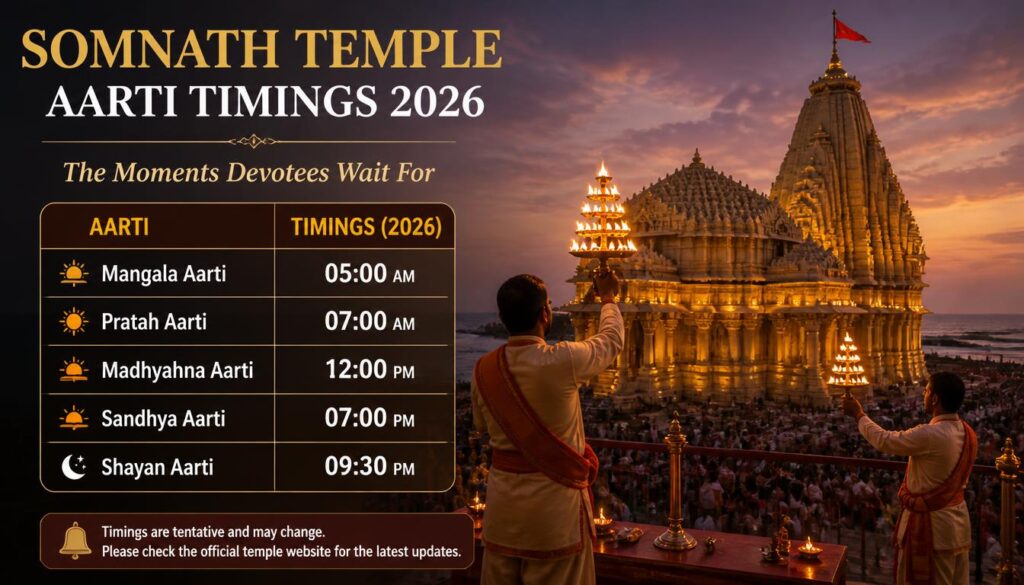
The official Trust’s pilgrim-facilities page currently lists the principal Somnath Temple aarti timings as 7:00 AM, 12:00 noon and 7:00 PM.
So, if you are arranging your day around the worship schedule, this simple outline helps:
The evening ceremony is especially attractive for visitors because the temple’s illumination, the sea and the devotional atmosphere come together in a rather unforgettable way.
Still, don’t expect every aarti to feel exactly the same. Morning has a quieter, awakening quality, while evening tends to feel more ceremonial and crowded.
One important correction for people searching online for Somnath Shayan Aarti: the currently published official pilgrim timetable lists three principal aarti times, rather than a separate Shayan Aarti time.
So it is wise to check the Trust’s official schedule before planning around a supposed fourth ceremony found on an unofficial website.
The Trust also currently lists the “Jay Somnath” Sound and Light Show at 7:45 PM on its pilgrim-facilities page, while another official Somnath page gives a broader presentation window.
Because published pages can differ with programming updates, confirm the show timing locally on the day of your visit.
This is probably the question that causes the most confusion online: How to book Somnath VIP darshan? How much is the Somnath VIP pass? Is VIP entry available online?
Here is the important bit: the current official Shree Somnath Trust pages reviewed for this guide do not publish a standard 2026 “VIP Darshan” ticket price or a clearly defined online VIP-darshan product.
The Trust does, however, maintain a VIP Guest House, which is an accommodation facility and should not be casually confused with a VIP temple-entry pass.
That distinction matters because numerous third-party pages use phrases such as “Somnath VIP ticket,” “fast darshan,” or “VIP pass price” and may quote figures without establishing that they are current, official or even applicable to ordinary devotees.
So, for Somnath VIP booking, the safest approach is:
The Trust itself warns that room booking, pooja and donation transactions should be made only through its official website, and it specifically cautions pilgrims about fraud through social media, WhatsApp, phone numbers and private payment accounts.
For official information, use Shree Somnath Trust official website rather than an agent’s “special link”. That one habit can save a traveller both money and a very unpleasant morning.
A pilgrimage does not have to end with ordinary darshan. The Trust provides online registration for several pooja vidhi and donation services, with some services requiring advance notice and others being available with shorter notice.
Among the listed services are Rudrabhishek, Gangajal Abhishek, Panchopachar Pooja, Maha Mrityunjay Jap, Bilva Pooja, Deepmala, Rajbhog Thal and various Rudra-related rituals. The official rate list is subject to change, so use the booking page rather than copying an old price from a travel blog.
For example, the currently displayed online schedule lists Rudrabhishek at ₹200, Gangajal Abhishek at ₹200, Panchopachar Pooja at ₹150, and Maha Mrityunjay Jap 500 at ₹150.
Larger ceremonies have considerably higher charges and advance-notice requirements. These are official listed figures at the time of checking, not a promise that the amount will remain unchanged throughout 2026.
The beauty of Somnath Temple seva booking is that it gives the journey a more personal character. Someone may come praying for peace, someone for a family milestone, someone carrying a grief they have not spoken about. The ritual becomes less like an item purchased and more like a quiet offering of intention.
The present Somnath Mandir is built in the Kailas Mahameru Prasad style, according to the Shree Somnath Trust. The structure includes the Garbhagriha, Sabhamandap and Nrityamandap, while its shikhara rises approximately 155 feet.
Its coastal setting makes the architecture feel even more dramatic. You can stand near the temple and see the Arabian Sea stretching away, which gives the whole pilgrimage site an unusual sense of openness.
The Tirth Stambh, or arrow pillar, points toward the unobstructed sea route in the southern direction and is one of the details visitors often stop to notice.
The temple’s appearance is also part of a wider story of Indian heritage, restoration and reconstruction. The building is not simply an untouched ancient monument; it represents a modern reconstruction shaped by historical memory, religious devotion and architectural tradition.
This is why a visit can appeal even to someone deeply interested in history and architecture but not travelling purely for religious reasons. Somnath has several layers sitting on top of one another, like old pages in a book that somebody kept adding to.
Somnath is located at Prabhas Patan in Gujarat, very close to Veraval. The Trust’s official information says the area is connected by rail, road and air routes through nearby cities.
For railway travellers, the official FAQ lists Somnath railway station at about 0.5 km from the temple and Veraval at about 7 km. That makes train travel particularly convenient for pilgrims.
For air travel, the Trust lists Diu Airport as the nearest airport at roughly 85 km, with Rajkot and Ahmedabad farther away. Exact road distance and travel time can vary by route and traffic, so don’t plan your cab pickup based on a distance figure alone.
Depending on your itinerary, you can consider:
If you’re doing a road trip, leave some breathing room. Somnath is much more enjoyable when the itinerary isn’t packed so tightly that every temple visit becomes a race against Google Maps.
A good Somnath pilgrimage can easily become a full day or two-day spiritual and heritage itinerary.
Bhalka Tirth is among the most important nearby sites associated with the tradition of Lord Krishna’s final journey.
The Trust places it around 5 km on the Prabhas-Veraval highway. Dehotsarg Tirth, located on the banks of the Hiran, is another significant sacred location.
At Triveni Sangam, the Hiran, Kapila and Saraswati are traditionally associated with the sacred confluence at the Arabian Sea. The area has long-standing ritual significance and is visited for ancestral rites and other religious observances.
Other nearby places listed by the Trust include Ahalyabai Temple, Shashi Bhushan Temple, Golokdham Tirth, Prachi Tirth and other religious sites.
For a longer Gujarat itinerary, Gir National Park, Junagadh, Diu, Porbandar and Dwarka can be considered depending on the number of days you have.
If convenience is your priority, staying close to the temple can make a noticeable difference. The Shree Somnath Trust operates multiple guest houses along with dormitory accommodation, including Sagar Darshan Atithi Gruh, Lilavati Atithi Gruh and Maheshwari Samaj Atithi Gruh.
The Trust currently lists Sagar Darshan as a sea-facing accommodation option, while budget dormitories are available for travellers who care more about a clean place to sleep than a fancy room.
Check-in and check-out times, tariffs and room availability should always be confirmed during booking because these details can change.
The official booking system is particularly worth using here. The Trust has explicitly warned pilgrims not to book rooms or make pooja donations through unofficial agents, private numbers or random payment
accounts. It is one of those boring practical details that becomes very important after a fraud has already happened, so better to be boring beforehand.
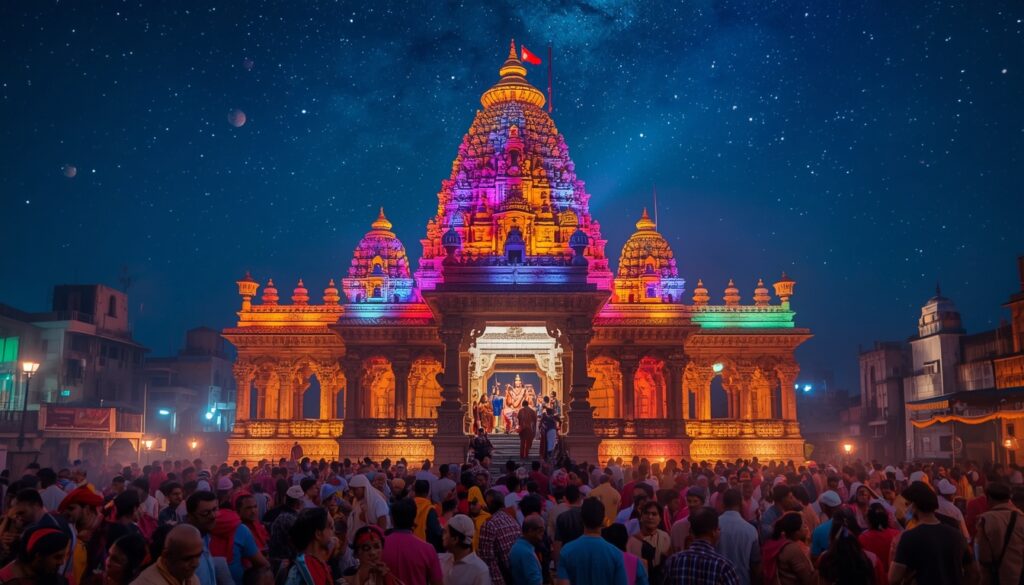
If you visit during Somnath Mahashivratri, expect the pilgrimage atmosphere to become much more intense. Devotees arrive in large numbers, and arrangements may differ from ordinary days.
The same applies to Shravan month, traditionally one of the most important periods for devotees of Lord Shiva. Special worship and Bilva offerings are closely associated with this period, and the Trust lists a Savalaksha Bilva Pooja among its services.
For families with elderly travellers or young children, festival dates need a little extra planning. Accommodation should ideally be arranged well ahead, transport should be confirmed, and everyone
should be prepared for queues and slower movement. Spiritual enthusiasm is lovely; discovering that your hotel is 30 km away at midnight is less lovely.
A pilgrimage becomes much easier when you think about practical comfort before arriving. Senior citizens may prefer an early visit, comfortable footwear and accommodation close to the temple.
Visitors should also check the latest on-site arrangements for wheelchair access, lifts, parking and other accessibility services directly with
the Trust before travelling, especially if someone in your group has mobility limitations. Facilities can change, and an official confirmation is better than an old review written three years ago.
Dress respectfully for the temple, carry only what is permitted, and follow the temple’s current security instructions. Do not assume that an item allowed at one Shiva temple will automatically be allowed at Somnath.
And please, don’t turn the darshan queue into a photography expedition. Some memories become stronger when the phone stays in the pocket.

A little planning can make your Somnath Temple travel guide practical rather than merely pretty.
The official Trust currently lists 6:00 AM to 10:00 PM for darshan.
The currently published official schedule lists 7:00 AM, 12:00 noon and 7:00 PM.
The official pages checked for this guide do not currently publish a standard 2026 VIP-darshan ticket, price or online VIP pass. Because third-party claims vary, verify directly with the Shree Somnath Trust before paying anyone.
Yes. The Trust provides an online Pooja Vidhi / Donation system with multiple services and performance dates. Some rituals require advance notice.
The official FAQ lists Somnath railway station, around 0.5 km from the temple, and Veraval around 7 km away.
The official FAQ lists Diu Airport, approximately 85 km away, as the nearest airport.
Bhalka Tirth, Dehotsarg Tirth, Triveni Sangam, Ahalyabai Temple and other sacred sites are nearby. Gir National Park and Diu are options for a longer trip.
A visit to Shri Somnath Jyotirlinga Temple is easy to describe in practical terms: reach Prabhas Patan, check the Somnath Temple timings, attend an aarti, visit the nearby tirths and return home.
But that isn’t really the whole story.
The deeper attraction of Somnath is the meeting of devotion, history, architecture and the Arabian Sea. The temple has been rebuilt through changing eras, yet the pilgrimage continues.
Bells ring, people wait, families pray, someone folds their hands for the first time in years, and someone else whispers a thank-you that nobody around them hears.
For your Somnath Temple 2026 visit, plan the essentials carefully but leave a little room for the unexpected.
Verify current timings, use official booking channels, don’t get trapped by questionable VIP-pass offers, and give yourself enough time to experience the place rather than simply photograph it.
And when the evening light falls across the temple and the sea is doing its old, endless thing beside it, you may understand why people return here.
Not because every visit gives them the answer they wanted, perhaps, but because sometimes standing quietly before Somnath Mahadev is itself a kind of answer.