Physical Address
304 North Cardinal St.
Dorchester Center, MA 02124
Physical Address
304 North Cardinal St.
Dorchester Center, MA 02124

There are some temple visits that feel less like checking a place off a travel list and more like stepping quietly into a living tradition. Arunachalam Temple, also known as Annamalaiyar Temple and Arulmigu Arunachaleswarar Temple, is one of those places.
Situated in Tiruvannamalai, Tamil Nadu, the temple is closely connected with Lord Shiva, Arunachala Hill, and the ancient traditions of Shaivism. For many devotees and pilgrims, the visit is not only about Darshan. It can include Pooja, Aarti, temple offerings, and the sacred walk around Arunachala known as Girivalam or Giri Pradakshina.
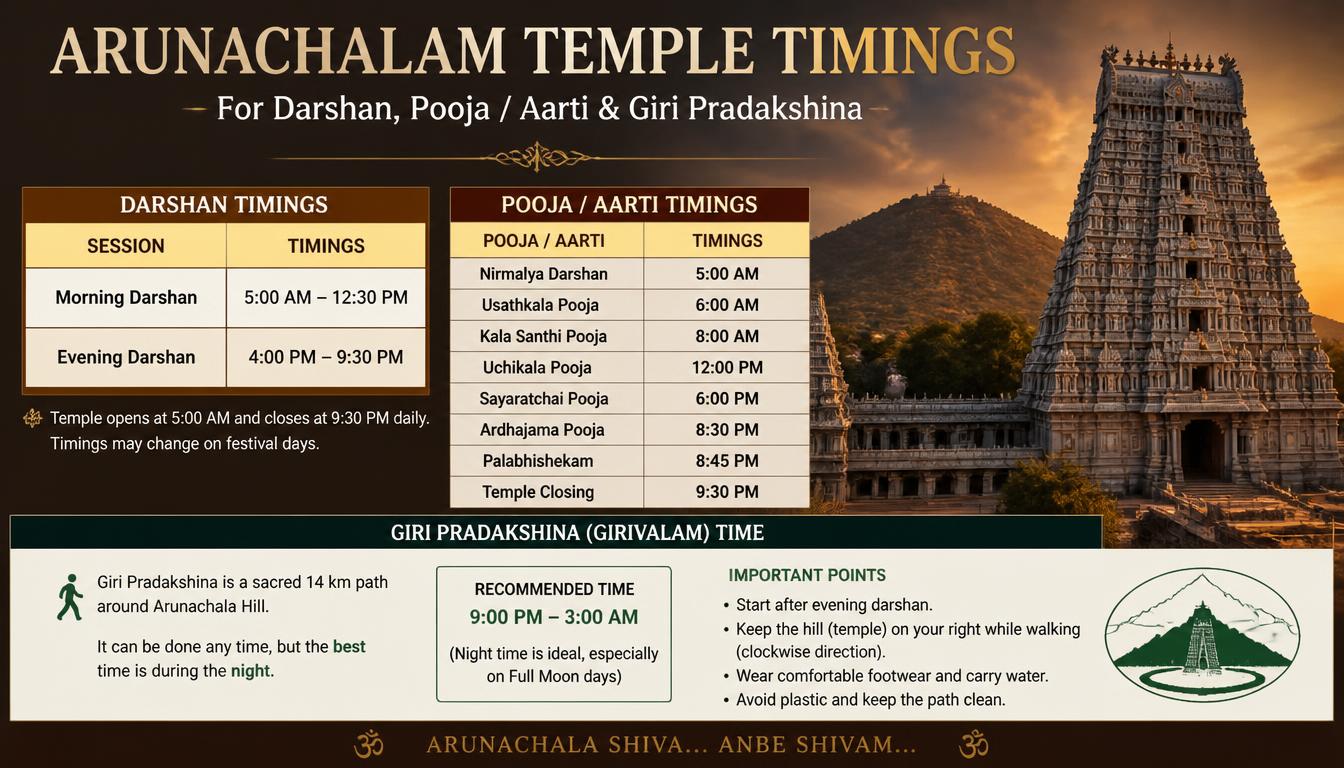
If you are planning a visit in 2026, knowing the daily opening hours, pooja schedule and full-moon Girivalam timing can make the experience much smoother. The official temple administration currently lists Darshan from 05:30 AM to 08:00 PM, while noting that on Saturdays, Sundays, Pournami, holidays and very crowded days, Darshan admission may stop around 07:30 PM.
The official Arunachalam Temple Timings 2026 are especially useful for anyone visiting for regular Morning Darshan or Evening Darshan.
According to the temple’s official HRCE Tamil Nadu page, the temple opens at 05:30 AM. The morning session continues until 03:00 PM, followed by the evening session from 03:00 PM to 08:00 PM. General Darshan is listed from 05:30 AM to 08:00 PM.
| Temple service | Timing |
|---|---|
| Temple opening | 05:30 AM |
| Morning Darshan | 05:30 AM – 03:00 PM |
| Evening Darshan | 03:00 PM – 08:00 PM |
| Regular Darshan closing | 08:00 PM |
| Crowded days admission may stop | Around 07:30 PM |
The important little detail is that the published hours are not a promise that every day will feel the same. Full Moon Day, festivals, holidays and exceptionally crowded periods can change the practical entry situation.
The official temple page also says devotees are admitted through the East Rajagopuram and North Ammani Amman Gopuram during the stated Darshan period.
For a peaceful visit, many pilgrims prefer reaching the temple early rather than arriving close to closing time. The first hours of the morning have a completely different feeling, with fewer distractions and the day still waking up around Tiruvannamalai.
The Arunachalam Temple darshan time begins at 05:30 AM according to the official schedule. Reaching a little before opening can also give you some breathing space instead of rushing directly into a queue.
Evening Darshan is another popular choice because the atmosphere becomes more devotional as the Pooja and lamp rituals approach. However, evenings can become much busier, particularly around Pournami, weekends and major festivals.
There is no single “perfect” time for every pilgrim. Someone wanting a quieter visit may choose early morning, while another devotee may specifically want to experience the temple during an evening ritual. Both are meaningful in their own way.
The daily worship at the temple follows a traditional sequence of sacred rituals. Different published sources can show slightly different spellings and exact times for the individual rituals, so visitors should confirm the day’s schedule locally, particularly when a specific Pooja is the main purpose of the visit.
Commonly published names include Ko Pooja, Ushakala Pooja, Kalasandhi Pooja, Uchikkala Pooja, Sayaraksha Pooja, Irandamkala Pooja and Ardhajama Pooja.
A commonly referenced daily pattern is:
The exact published schedules differ because some sources describe ritual windows while the official Darshan schedule describes visitor admission. For planning a visit, it is therefore better not to treat every individual pooja time as an exact public-entry time.
When people search for Arunachalam Temple Aarti timings, they are often referring to the lamp-offering portion of the temple’s daily worship.
Traditional worship at the temple includes several stages, including ritual bathing, decoration, food offerings and Deeparadhana, where lamps are offered before the deity. The timing of the associated ritual can vary with the day’s temple schedule.
The evening Sayaraksha Pooja, generally associated with the evening worship period, is commonly listed around 05:30 PM or nearby depending on the source. If your primary purpose is to attend a particular Aarti, it is sensible to arrive earlier and confirm the current day’s timing at the temple.
This small buffer can save you from the classic pilgrimage problem: reaching the gate just when the ritual has already begun. Happens more often than people admit.
The main deity is Arunachaleswarar, the form of Shiva associated with Arunachala. The temple also has the shrine of Unnamulai Amman, representing Parvati.
The official temple records identify the principal shrines as Arulmigu Annamalaiyar and Arulmigu Unnamulaiyammai.
During Darshan, devotees generally approach the sacred areas according to the temple’s current crowd-management arrangements. Depending on the time and ritual taking place, movement can be slower than expected.
For a first-time visitor, it helps to remember that Darshan is not simply about spending a long time in front of the deity. Sometimes the actual moment is brief, but the waiting, chanting, lamps, bells and quiet anticipation around it become part of the experience too.
Giri Pradakshina, also called Girivalam, is the sacred circumambulation of Arunachala Hill. Devotees walk around the hill as an act of spiritual practice and pilgrimage.
The route is commonly described as approximately 14 km, although the practical walking distance can vary slightly depending on the route taken. It is traditionally performed barefoot by many pilgrims, though individual circumstances and health should always be considered.
Unlike a temple Darshan session, Giri Pradakshina time does not have one fixed daily opening-and-closing schedule in the same way. Devotees can undertake the walk at different times, while Full Moon Day is especially significant and attracts very large crowds.
The full-moon walk is often called Full Moon Girivalam, and the town can become extremely busy. If you want to walk during Pournami, planning accommodation, transport and walking time beforehand is very important.
The exact Giri Pradakshina date follows the lunar Full Moon or Pournami calendar. The starting and ending moments of Pournami can cross two civil dates, which is why different calendars may appear to show slightly different dates or times.
For example, published 2026 temple-calendar information identifies the October Pournami period as beginning on October 25, 2026, and continuing into October 26.
A useful way to think about Giri Pradakshina time 2026 is this:
If you are travelling specifically for Girivalam, check the current lunar timing shortly before your journey rather than relying only on an old calendar.
For Shaivite devotees, Arunachala is much more than a mountain sitting beside a temple. It is deeply connected with the worship of Arunachalesvara, the manifestation of Lord Shiva as the Fire element, or Agni.
The temple is associated with the Pancha Bhuta Sthalas, the five elemental Shiva temples connected with the Five Elements. Arunachala represents Agni, making the pilgrimage particularly significant within this spiritual tradition.
Walking around the hill can therefore feel very different from an ordinary hike. People chant, pray, walk silently, light lamps and make offerings along the route. Some complete the circuit slowly, while others walk with a steady pace throughout the night.
The Arunachalam Temple architecture is a remarkable example of South Indian temple design. Its enormous gateways, Gopurams, stone structures, sculptures and sacred spaces make the temple itself part of the pilgrimage experience.
The official temple records include information on its towers, including the East Rajagopuram. The temple’s East Rajagopuram is associated with the Vijayanagara period and records specifically mention work connected with Krishnadevaraya in 1513–1514.
Inside the complex are multiple shrines, Mandapas, Praharas, sculptures and other architectural elements. The temple also preserves paintings and historical material associated with different periods. Official records, for example, identify wall paintings connected with Chola and Pandya periods.
This layered history is one reason the temple should not be rushed. A visitor who spends a little time looking at the stone pillars, sculpture and towers may notice details that disappear when the visit becomes only about reaching the sanctum.
The spiritual heart of the temple revolves around Arunachaleswarar and Unnamulai Amman.
In Shaivite tradition, Arunachalesvara is associated with Shiva’s manifestation as fire. Unnamulai, or Unnamulai Amman, is the divine feminine presence associated with Parvati.
For many Hindu devotees, visiting both shrines forms an important part of the pilgrimage. The official HRCE temple records separately list the principal Swami shrine of Annamalaiyar and the Amman shrine of Unnamulaiyammai.
The experience is therefore not just one photograph, one queue or one ritual. It is a sequence of sacred spaces, each carrying its own atmosphere.
Visitors may encounter different forms of temple offerings, including traditional archana and abhishekam services. Availability, prices and procedures can change, so visitors should use official temple counters or the official booking portal rather than relying on unofficial payment links.
The temple is administered by the Hindu Religious and Charitable Endowments Department of the Government of Tamil Nadu. Its official website provides temple information and an online Darshan-booking section.
If you want a particular seva, ask about the current availability before entering the queue. A few minutes spent confirming the procedure is much better than discovering later that a particular ritual needed separate booking.
Among the major celebrations connected with the temple, Karthika Deepam, also called Karthigai Deepam, holds a special place.
The festival is associated with the lighting of the great Maha Deepam on Arunachala Hill. The sight of a sacred flame shining from the mountain is one of the defining images of Tiruvannamalai’s religious calendar.
The festival period can bring exceptionally large numbers of pilgrims into the town. Because of this, ordinary Arunachalam Temple timings and access arrangements should not be assumed to remain unchanged during the festival.
If your journey is planned around Karthika Deepam, check the temple’s current announcements and local administration notices before travelling.
For important questions about Darshan, current timings, special arrangements or temple services, official information should take priority over old travel blogs.
The official HRCE listing gives the temple address as Sannathi Street, Tiruvannamalai, Tamil Nadu – 606601. It lists the temple phone number as 04175-252438 and the official email as jceotvm_20343.hrce@tn.gov.in.
Arulmigu Arunachaleswarar Temple official HRCE website
The temple is officially administered by the Government of Tamil Nadu’s Hindu Religious and Charitable Endowments Department, so this is the useful place to verify changes rather than depending on a random social-media post.
A little planning can make the pilgrimage considerably easier.
These things sound simple, but simple planning is often what saves a spiritual trip from becoming an exhausting logistical puzzle.
For quick reference, the official temple information currently lists Darshan from 05:30 AM to 08:00 PM. On Saturdays, Sundays, Pournami, holidays and days with heavy crowds, admission may stop around 07:30 PM.
The daily worship cycle includes morning, midday and evening rituals such as Ushakala Pooja, Kalasandhi Pooja, Uchikkala Pooja, Sayaraksha Pooja, Irandamkala Pooja and Ardhajama Pooja, but individual ritual times should be confirmed before a time-sensitive visit because published schedules vary.
Giri Pradakshina is the circumambulation of Arunachala Hill, commonly understood as a roughly 14 km pilgrimage route. It can be undertaken at different times, while Pournami is the major monthly period when huge numbers of devotees traditionally perform Girivalam.
Arunachalam Temple is generally open for darshan from 5:30 AM to 8:30 PM daily, although timings may vary during festivals and special occasions.
Devotees can visit Arunachalam Temple for regular darshan during temple hours, while special pooja or entry services may have separate booking procedures or charges.
Arunachalam Temple Giri Pradakshina, also called Girivalam, is a sacred 14-km walk around Arunachala Hill, traditionally performed barefoot by devotees.
Arunachaleswarar Temple generally welcomes devotees from 5:30 AM to 8:30 PM, with specific timings for different poojas and daily rituals.
Arunachala Giri Pradakshina is especially significant on Full Moon days, and the 14-km circumambulation usually takes around 3–5 hours to complete.
Read more: https://templetimingsdaily.com/ayodhya-ram-mandir-current-crowd/
A journey to Arunachalam Temple is difficult to describe as just a visit to an ancient building. The sound of bells, the towering Gopuram, the movement of pilgrims, the presence of Arunachaleswarar, and the immense form of Arunachala Hill outside create a setting that feels very different from ordinary sightseeing.
For a first visit, start with the practical details: remember the 05:30 AM to 08:00 PM Darshan schedule, allow extra time on crowded days, and verify any special Pooja timing before travelling.
Then, if your pilgrimage includes Giri Pradakshina, give the walk the time it deserves. Around Arunachala, the journey itself is part of the prayer.
And perhaps that is the most beautiful thing about Tiruvannamalai: sometimes the destination is the temple, sometimes it is the mountain, and sometimes it is simply the quiet feeling you carry home after walking around both.