Physical Address
304 North Cardinal St.
Dorchester Center, MA 02124
Physical Address
304 North Cardinal St.
Dorchester Center, MA 02124

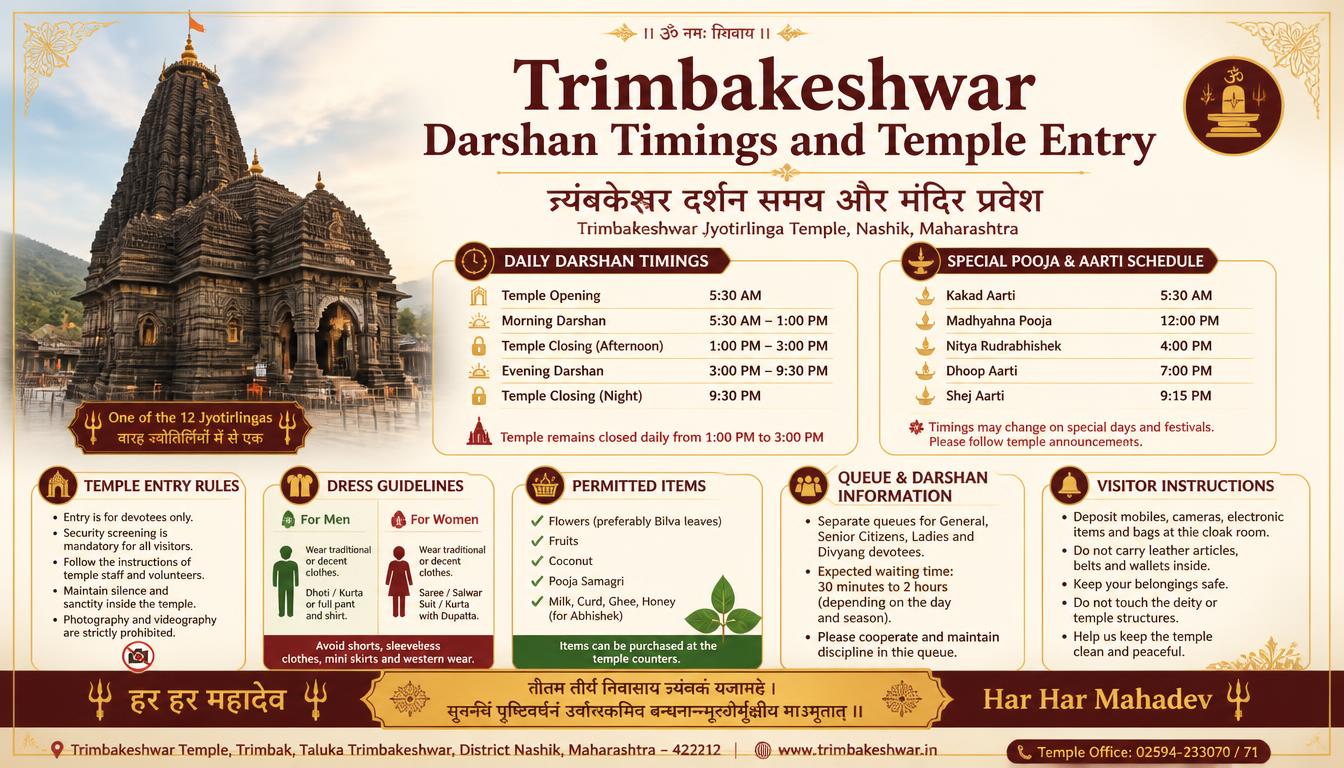
There is something quietly powerful about arriving at a temple before the day has fully begun. The roads may still feel sleepy, the morning air in Dharmasthala, Karnataka can be wonderfully fresh, and then the thought comes: today I am going to stand before Lord Manjunatha. For many pilgrims, that feeling itself becomes part of the temple visit.
If you are planning a visit to the Dharmasthala Manjunatha Temple, checking the temple timings before leaving is important because darshan is not simply one uninterrupted session. The temple follows a detailed daily routine, with worship and Mahapooja creating short periods when darshan is paused.
According to the official Shri Kshetra Dharmasthala temple routine, the shrine gates open early, while regular visitor darshan begins later in the morning. The official schedule lists darshan from 6:30 AM to 11:00 AM, again from 12:15 PM to 2:30 PM, and in the evening from 5:00 PM to 8:30 PM.
For someone searching Dharmasthala temple timings today, the most useful thing is to understand the actual darshan windows rather than assuming that the temple remains continuously available from opening until closing.
The official temple routine currently gives these main darshan timings:
So, if your question is simply, “What time does Dharmasthala temple open?” there are two timings worth separating. The shrine gates open at 4:00 AM, whereas the official visitor darshan schedule starts at 6:30 AM. That little distinction can save a pilgrim from reaching very early and wondering why general darshan has not started yet.
The official website also notes that temple timings may vary on special occasions, so festival days, special rituals, or unusual religious observances can change the normal routine.
The Dharmasthala temple opening time is often described differently on various travel pages because the shrine’s gate-opening time and public darshan time are not necessarily the same thing.
The official Shri Kshetra Dharmasthala routine says the gates open at 4:00 AM every morning. After the necessary cleansing and ritual preparations, darshan begins for pilgrims at 6:30 AM.
For practical travel planning, therefore, 6:30 AM is the more useful time to remember if your purpose is general darshan.
In the evening, regular darshan continues until 8:30 PM, when the evening Mahapooja begins. A Nithyabali follows at 8:45 PM, during which darshan is blocked.
A simple daily picture looks like this:
| Temple activity | Timing |
|---|---|
| Shrine gates open | 4:00 AM |
| Morning darshan | 6:30 AM – 11:00 AM |
| Shatharudra Abhisheka & Pooja | 8:30 AM – 10:30 AM |
| Shiva Sahasranamavali | 11:00 AM |
| Maha Naivedya | 11:30 AM |
| Mahapooja | 12:00 PM |
| Nithyabali | 12:10 PM |
| Darshan resumes | 12:15 PM – 2:30 PM |
| Evening darshan | 5:00 PM – 8:30 PM |
| Evening Mahapooja | 8:30 PM |
| Nithyabali | 8:45 PM |
This is why saying that the temple simply “opens at 6:30 AM and closes at 8:30 PM” can be a little too simple. The day has several sacred pauses tucked inside it.
The Dharmasthala darshan timings are arranged around the temple’s daily rituals. Darshan is available during several periods, but it is temporarily interrupted when important worship takes place.
The first major visitor period runs from 6:30 AM to 11:00 AM. This is a useful window for devotees who prefer a morning temple visit and want to complete darshan before the main midday rituals begin.
After the Maha Naivedya Samarpana at 11:30 AM, the temple conducts the midday Mahapooja at 12:00 PM. Darshan is closed around this ritual so that the religious ceremony can take place without the usual movement of visitors.
Darshan resumes at 12:15 PM and continues until 2:30 PM, after which the next major visitor period begins at 5:00 PM.
The evening session continues until 8:30 PM. If you are travelling a long distance, it is sensible to allow some extra time rather than arriving at the final minute. Temple queues have their own personality, you could say, and they don’t always care about our carefully prepared travel plans.
For many pilgrims, Dharmasthala morning darshan has a special appeal. The first regular darshan session begins at 6:30 AM, after the temple’s early cleansing and ritual preparations.
The official temple routine says that the shrine is opened to devotees after the Vedic cleansing of the temple premises and the idol. This makes the morning period more than just an early opening; it is part of a carefully maintained daily religious routine.
The morning schedule also includes Shatharudra Abhisheka & Pooja from 8:30 AM to 10:30 AM. Darshan continues alongside this ritual according to the official schedule.
If you want a quieter beginning to your Dharmasthala temple visit, reaching around the start of the morning darshan window may be worth considering. Still, crowd levels can change from one day to another, especially around weekends, holidays and important religious occasions.
The Dharmasthala evening darshan begins at 5:00 PM and continues until 8:30 PM under the regular schedule.
There is a different atmosphere in the evening. The heat of the day begins to soften, families and pilgrims move through the temple complex, and the approaching night rituals give the visit a distinct rhythm.
If you cannot arrive in the morning, the evening session gives you another substantial opportunity for darshan. Just remember that 8:30 PM is not merely another ordinary closing time; the evening Mahapooja begins then.
The temple’s official places-to-visit page also lists the Shri Manjunatha Swamy Temple visitor periods as 6:30 AM–2:30 PM and 5:00 PM–8:30 PM, which broadly reflects the detailed routine while accounting for the midday ritual interruption.
A visit to the Manjunatha Temple is not only about entering, seeing the deity and leaving. The daily routine is shaped by several forms of worship.
The morning includes Shatharudra Abhisheka & Pooja, followed by Shiva Sahasranamavali at 11:00 AM. At 11:30 AM, Maha Naivedya Samarpana takes place, when food is offered to Lord Manjunatheshwara as part of the worship.
At noon, the Mahapooja is performed. The official description explains that the idol is decorated with natural Vedic elements, accompanied by chanting and Vedic instruments. During this important ritual, regular darshan is paused.
The same pattern returns in the evening. The 8:30 PM Mahapooja marks another important point in the daily schedule, followed by Nithyabali at 8:45 PM.
This is also why checking only the broad Manjunatha temple opening time is not enough. Knowing the ritual schedule helps you plan your visit around the sacred pauses rather than discovering them after reaching the temple.
People also search for Dharmasthala aarti timings, especially when they want their visit to include worship rather than only general darshan.
A third-party visitor guide currently lists aarti at 10:00 AM and 7:00 PM, but the official temple routine is the better source for the broader daily ritual schedule. Because religious schedules can change for special observances, visitors should confirm any specific aarti or seva timing directly with the temple before travelling.
The same principle applies to pooja, Archana, Abhishekam, and other seva offerings. A timing found on an old travel page should not automatically be treated as today’s confirmed schedule.
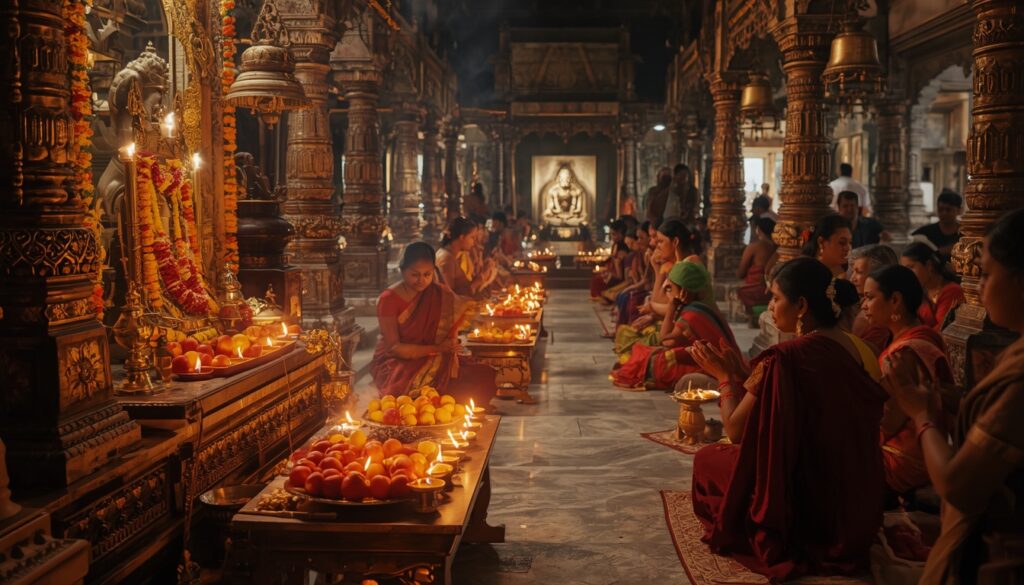
The temple’s spiritual life includes various sevas and forms of worship. Devotees may encounter services associated with Archana, Abhishekam, Tulabhara seva, and other traditional offerings.
The official Darshana page notes that Tulabhara seva is conducted on all days of the week, while receipt issuing can be fixed differently on special days.
This is one reason it helps to distinguish between general darshan timings and timings connected with a particular seva. If you are travelling specifically for a seva, don’t plan the whole journey using only the general temple opening time.
One of the most recognised aspects of Dharmasthala Annadana is its emphasis on feeding pilgrims. The official routine states that Annadana begins after the Maha Naivedya is offered at 11:30 AM.
The idea is beautifully simple: food offered in worship becomes part of a wider tradition of service. Around a major pilgrimage centre, this matters because visitors may arrive from faraway places, carrying tired feet, long journeys and sometimes very little besides faith.
The temple complex is also associated with Prasadam, sacred offerings, and the broader tradition of serving visitors. The official temple information describes Dharmasthala as a place where religious devotion and social service have long been closely connected.
Normal Dharmasthala temple timings should not automatically be assumed for every festival day.
The temple celebrates several important occasions, and Lakshadeepotsava is among the most distinctive. The festival is associated with the lighting of a very large number of lamps and takes place during the month of Kartika, generally around November–December according to festival calendars.
The temple also observes Annual Brahmotsavam and other religious celebrations. During major occasions, visitor numbers can rise significantly and the daily routine may be adjusted to accommodate special rituals.
For a festival-day temple visit, it is therefore wise to check the latest announcement from the temple administration rather than relying on a normal-day timetable.
A little preparation can make the visit much smoother. The official Dharmasthala darshan guidelines include specific practices for devotees entering the sanctum area.
The temple states that men should remove their shirt and banian or vest while entering the Sanctum Sanctorum. Men wearing half pants and women wearing nighties are not permitted inside the temple for darshan. Children below two years of age are also not allowed inside the sanctum sanctorum.
Bags are not allowed inside the temple, and visitors may need to cooperate with security checks. The official guidance also asks devotees to take care of valuables such as purses, ornaments and mobile phones.
These are practical details, but they matter. A peaceful pilgrimage can become unnecessarily stressful if you arrive without knowing the entry requirements.
The Dharmasthala Manjunatha Temple is located in Dharmasthala, Dakshina Kannada District, Karnataka, India, in the temple town traditionally known as Shri Kshetra Dharmasthala.
The official temple website describes Dharmasthala as a religious centre with a history extending back around 800 years. The chief deity, Manjunatheshwara, is worshipped in the form of a Shivalinga.
The temple is also notable for its unusual religious and administrative heritage. The official site describes the shrine as a Shaiva temple served by Vaishnava priests and administered through the Heggade tradition associated with Jain heritage.
That combination gives Dharmasthala Karnataka temple a character that goes beyond a conventional description of a Shiva Temple.
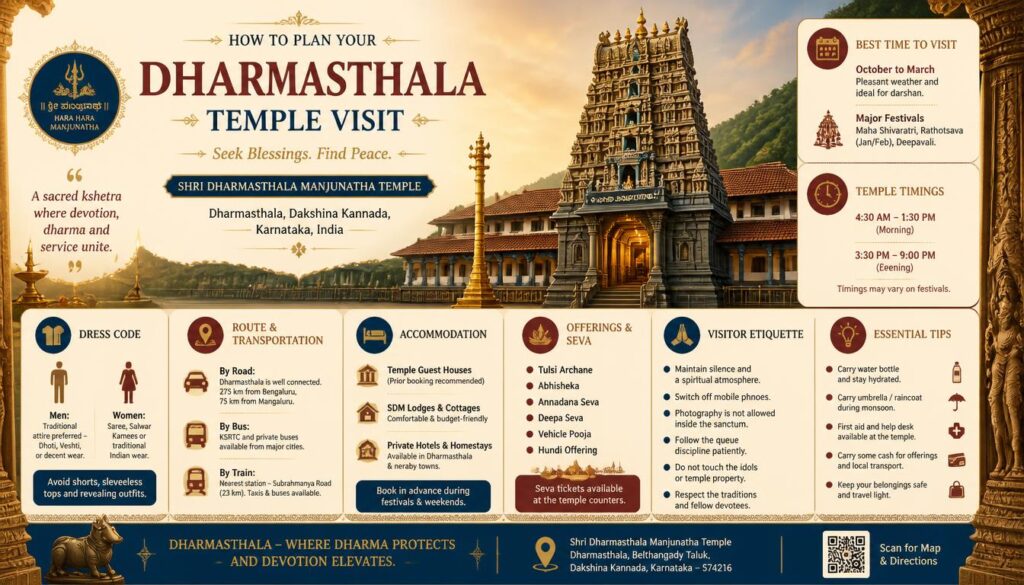
If you are travelling specifically for Dharmasthala temple timings today, first identify which darshan period fits your journey.
For morning visitors, remember 6:30 AM–11:00 AM. If you miss the morning period, darshan resumes after the midday rituals at 12:15 PM–2:30 PM. The evening session is 5:00 PM–8:30 PM.
Keep some flexibility in your travel plan. A pilgrim arriving at 11:55 AM may technically have reached the temple during the broader daytime opening period, but the Mahapooja means general darshan is temporarily closed.
Also check the schedule if your visit date falls during a festival, eclipse, major annual celebration or another special occasion. The temple has previously announced altered darshan hours for special astronomical and religious events, showing why a normal daily schedule should not be treated as permanent.
The temple follows a daily worship routine, and the official visitor information lists regular darshan sessions throughout the week.
However, “open every day” does not mean that devotees can expect uninterrupted darshan every minute. Mahapooja, Nithyabali, cleansing rituals and other sacred activities create temporary closures within the day.
This distinction is especially useful for visitors travelling from another city. Sometimes the difference between a smooth temple visit and a frustrating one is simply knowing about a 15-minute or 30-minute ritual pause beforehand.
The official temple routine says the shrine gates open at 4:00 AM, while regular public darshan begins at 6:30 AM.
Regular evening darshan ends at 8:30 PM, when the evening Mahapooja begins. A Nithyabali follows at 8:45 PM.
The official schedule lists darshan from 6:30 AM–11:00 AM, 12:15 PM–2:30 PM, and 5:00 PM–8:30 PM.
Yes, but plan around the midday rituals. Darshan resumes at 12:15 PM and continues until 2:30 PM.
The temple follows its regular daily routine on Sundays, although special events can alter timings. Checking the latest official notice before travelling is still advisable.
Regular morning darshan starts at 6:30 AM according to the official temple routine. The gates themselves open earlier at 4:00 AM.
Read more: https://templetimingsdaily.com/trimbakeshwar-jyotirlinga-timings-today/
The temple conducts important rituals including Mahapooja and Nithyabali around noon. General darshan is temporarily blocked during these activities and resumes at 12:15 PM.
They can be. The official temple specifically notes that timings may vary on special occasions, so festival visitors should check current announcements before travelling.
Yes. The official daily routine states that Annadana begins after the Maha Naivedya is offered at 11:30 AM.
Yes. The official darshan guidelines specify clothing and entry requirements, including rules concerning shirts, vests, half pants and nightwear.
A temple timetable can look like nothing more than a collection of numbers until you understand what those numbers are protecting. At Dharmasthala, the gaps in the schedule are not empty spaces; they belong to pooja, Mahapooja, Nithyabali, offerings and other sacred rituals.
For a normal visit, keep the main darshan periods in mind: 6:30 AM–11:00 AM, 12:15 PM–2:30 PM, and 5:00 PM–8:30 PM.
If your journey is planned around a festival, special seva or an important ritual, verify the latest schedule with the temple administration before setting out. The official temple contact information lists the temple office in D.K., Karnataka – 574216, with the helpline 08256-266666.
And perhaps that is the nicest way to approach a place like Dharmasthala Manjunatha Temple: not rushing to defeat the clock, but allowing the clock to become part of the pilgrimage. A little patience, suitable preparation and respect for the temple routine can make the visit feel much more peaceful.