Physical Address
304 North Cardinal St.
Dorchester Center, MA 02124
Physical Address
304 North Cardinal St.
Dorchester Center, MA 02124

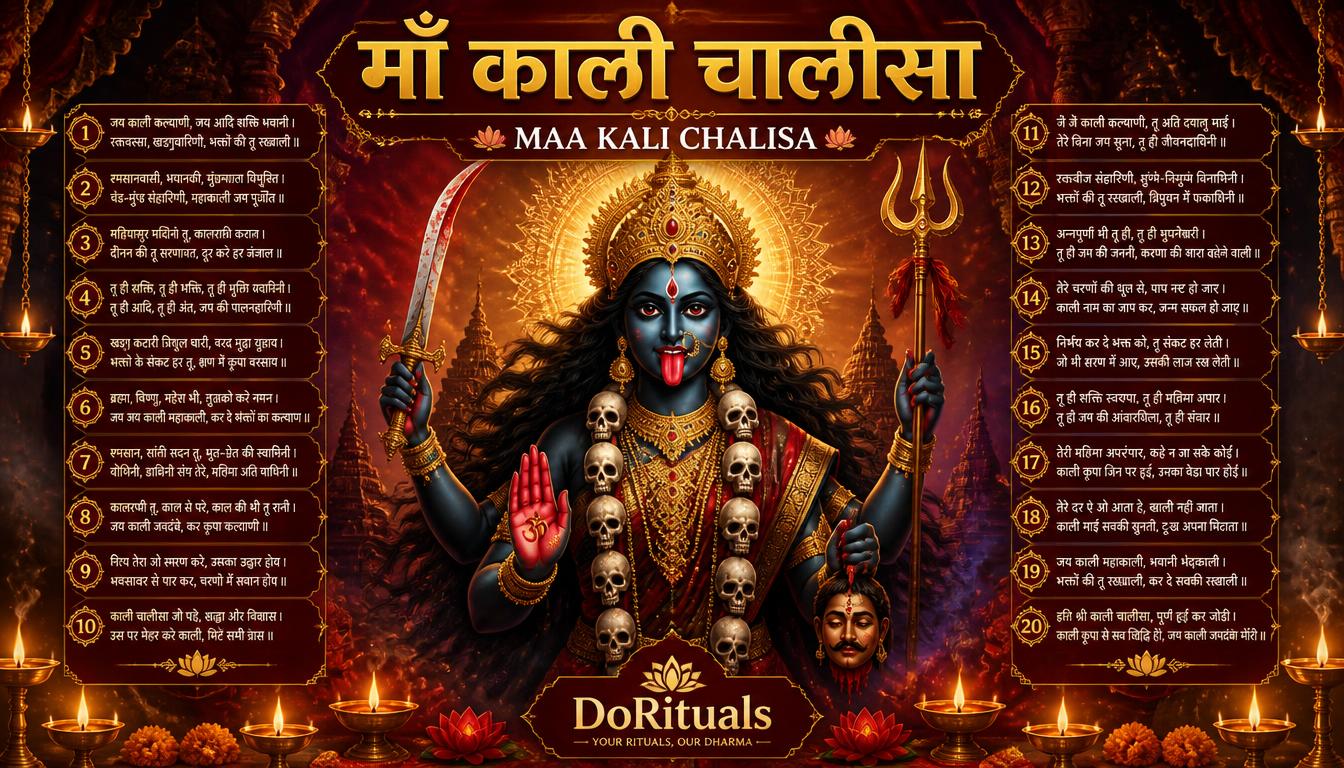
There are prayers that are read with the lips, and then there are prayers that seem to come from somewhere much deeper. Maa Kali Chalisa belongs to that second kind of devotion. When a devotee sits quietly before the image of Maa Kali, the atmosphere can suddenly feel different, almost as if the noise of the outside world has stepped a little farther away.
Kali Mata is worshipped as a powerful manifestation of Shakti, the Divine Mother who represents strength, transformation, protection, and the destruction of forces that disturb dharma. Her appearance may seem fierce, but devotees often understand that fierceness as the compassion of a mother who refuses to let darkness have the final word.
The माँ काली चालीसा gives devotees a devotional way to remember her greatness. Through its verses, names, imagery, and praise, the devotee turns attention toward Mahakali, Kalika, Jagadamba, and the limitless power of the Divine Mother. It is not merely about reading words quickly; the feeling behind the Kali Chalisa path is what makes the practice meaningful.
Maa Kali Chalisa is a devotional hymn dedicated to Goddess Kali, traditionally recited as an expression of Bhakti, surrender, and prayer. Like other Chalisa traditions, it praises the deity through devotional verses and remembers different aspects of divine power.
For many devotees, the Kali Mata Chalisa is associated with courage during difficult periods. A person may read it in the morning, during evening prayer, or whenever the heart feels unsettled. There is no need to make the practice unnecessarily complicated; sincere devotion matters greatly.
The imagery associated with Kali is intense, featuring her fierce form, weapons, dark complexion, flowing hair, and Mundamala. Yet these symbols are understood within Hindu devotional traditions as representations of the destruction of ego, ignorance, fear, and destructive forces.
In that sense, Kali Chalisa Hindi is not simply a description of a frightening divine form. It is a prayer to the Mother who stands beyond fear itself.
The fierce appearance of Maa Kali has fascinated devotees for centuries. Her Shyamvarn or dark appearance is often interpreted symbolically, suggesting the vastness that absorbs everything, much like the limitless night sky.
Her protruding tongue, disheveled hair, weapons, and skull garland can appear startling to someone encountering the iconography for the first time. But Hindu symbolism often carries several layers at once. The skulls, for example, can remind devotees of mortality and the temporary nature of worldly identity.
Her Trishul, sword, Khappar, and other weapons represent divine power against destructive forces. The message is not that violence is something to celebrate. Rather, these symbols portray the triumph of divine strength over adharma and inner darkness.
That is why Kali Mata worship can feel both powerful and deeply personal. A devotee may approach her not because life is perfect, but precisely because it isn’t.
The purpose of Kali Chalisa path is primarily devotional. A person may recite the verses while keeping the mind focused on Maa Kali and asking for her grace, courage, and guidance.
Some devotees approach the prayer with a particular manokamna, while others simply pray without asking for anything. Both approaches can become meaningful when accompanied by sincerity.
During Kali Chalisa recitation, the repeated remembrance of the Divine Mother can help create a devotional rhythm. Thoughts may still wander, of course. The mind is not a machine that suddenly becomes silent because a prayer book has been opened. But gradually, attention can return to the prayer.
For this reason, Kali Chalisa may become part of a wider spiritual practice involving dhyan, meditation, seva, puja, and devotional chanting.
One of the fascinating aspects of Shakti worship is the enormous range of names and manifestations connected with the Divine Feminine.
Kali, Kalika, and Mahakali are among the most recognizable names. Devotional traditions also connect her worship with forms such as Durga, Chandi, Chandika, Parvati, Bhavani, and Jagadamba.
Other manifestations associated with Shakti include Tara, Bhuvaneshwari, Chhinnamasta, Dhumavati, Baglamukhi, Matangi, Bhairavi, and Kamala. These forms have their own theological and devotional contexts, so they should not simply be treated as interchangeable names.
The broader idea is the presence of Mahashakti in many expressions. The Divine Mother may be remembered as nurturing, protective, wise, fierce, transformative, or victorious. It is this enormous spiritual landscape that makes Goddess Kali such a powerful figure within Shakti traditions.
One of the most common devotional intentions behind Maa Kali Chalisa is the prayer for protection.
Devotees may pray to Maa Kali for spiritual protection, courage, and freedom from fear. The tradition portrays Kali as a powerful force capable of confronting destructive energies and overcoming forces represented by demons and enemies.
However, it is useful to understand protection spiritually rather than treating the Chalisa as a guaranteed formula for controlling events. Prayer can become a source of courage and inner steadiness, while practical action remains important in everyday life.
A person facing uncertainty may therefore read Kali Chalisa for protection while also taking sensible steps to address the actual problem. Faith and responsible action do not need to fight each other.
Devotees associate several spiritual intentions with the Kali Chalisa benefits. These beliefs vary between traditions and individuals, so they are best understood as devotional beliefs rather than guaranteed worldly results.
Commonly associated purposes include:
The most meaningful benefit may sometimes be the simplest one: sitting quietly for a few minutes and remembering that fear does not have to dictate every decision.
Fear is one of the strongest themes associated with Maa Kali. Her fierce form itself appears to challenge the devotee: if the Divine Mother can stand in the middle of darkness without retreating, perhaps the devotee can learn to face darkness too.
For this reason, some people turn to Kali Chalisa for removing fear. The recitation can become a reminder of courage, surrender, and spiritual strength.
This does not mean that a person should ignore genuine danger or practical problems. Instead, prayer may help create emotional steadiness while the person takes appropriate real-world action.
The image of Mahakali becomes especially meaningful here. She is not portrayed as running away from destructive forces. She confronts them.
Another common intention is Kali Chalisa for wish fulfillment. Devotees may approach Maa Kali with a heartfelt manokamna and express it through prayer.
Yet devotional traditions also emphasize surrender. A prayer can contain a request without becoming a demand. The devotee asks for what is desired while accepting that divine wisdom may lead life in an unexpected direction.
This makes the practice more than simply saying, “I want this.” It becomes an opportunity to ask for strength, wisdom, and the ability to accept the outcome.
Whether the wish concerns family, work, personal progress, or relief from a difficult situation, the devotional attitude remains important.
The mythology surrounding Kali includes dramatic battles against destructive forces. Stories involving Shumbha, Nishumbha, Raktabija, Chanda, Munda, and other Asura figures describe the confrontation between divine power and forces of disorder.
The story of Raktabija is particularly memorable in Shakta traditions because his ability to multiply from drops of blood creates an almost impossible challenge. Kali’s appearance in this narrative represents a divine response to a force that seems to grow every time it is attacked.
Such stories can be read at different levels. On one level, they are powerful mythological narratives. On another, devotees may see them as symbolic reflections of inner struggles, where one negative tendency can seem to create several others if it is not confronted wisely.
The presence of Shiva and Mahakal in Kali-related traditions further deepens the symbolism surrounding time, transformation, death, and cosmic power.
It is common to encounter Maa Kali alongside discussions of Durga, Chandi, and other forms of the Divine Mother. This relationship becomes easier to understand when viewed through the broader concept of Shakti.
Durga is widely remembered as a protective and victorious form of the Goddess. Chandi is associated with fierce divine power. Parvati, Gauri, Bhavani, and other names highlight different devotional dimensions of the feminine divine.
The traditions surrounding the Navadurga also present forms such as Brahmacharini, Chandraghanta, Kushmanda, Katyayani, and Kalratri. Meanwhile, Shakta traditions describe numerous other manifestations.
This does not mean every name has exactly the same theological meaning. Rather, Hindu Goddess traditions contain a rich network of forms through which devotees understand the many dimensions of divine feminine power.
When people search for Kali Chalisa doha, Kali Chalisa chaupai, or Kali Chalisa lyrics, they are often looking for the traditional devotional text and a convenient way to recite it.
A respectful approach is to read the verses carefully rather than racing through them simply to finish. Pronunciation can be improved gradually, especially when reading Hindi devotional poetry.
If possible, keep a consistent place and time for your prayer. Some devotees prefer the quiet of early morning, while others find evening more peaceful. The best time is often the time when you can actually give the prayer your attention.
During the Maa Kali Chalisa path, one may sit comfortably, maintain cleanliness, light a traditional lamp if appropriate, and begin with a calm mind. Elaborate arrangements are not the only measure of devotion.
A simple devotional routine can make the practice easier to maintain.
There is something beautifully ordinary about this routine. No dramatic moment is required. Sometimes devotion is simply returning to the same prayer again and again, even on an ordinary Tuesday when nothing special seems to be happening.
Kali Mata worship can take different forms depending on family traditions, regional practices, and personal devotion. Some people visit temples, some perform Kali Puja, while others maintain a small devotional space at home.
In Shakta traditions, worship may include offerings, lamps, flowers, mantras, meditation, and devotional songs. Practices can vary considerably, so people following a specific family or temple tradition should respect its guidance.
The central thread is remembrance of the Goddess.
A short Kali Mata prayer spoken sincerely may feel more meaningful than a long ritual performed mechanically. Devotion does not become valuable merely because it takes more time.
Read more: https://templetimingsdaily.com/birth-horoscope/
The appearance of Goddess Kali is filled with symbols. Her dark complexion can represent the boundless and all-encompassing nature of the Divine. Her long tongue and fierce expression communicate an intensity far removed from conventional ideas of softness.
The skull garland, sword, Trishul, and other weapons are equally symbolic. They can represent mortality, destruction of ego, removal of ignorance, and the power to cut through attachments.
Her association with the Smashan or cremation ground is especially significant in certain traditions. The cremation ground is a place where worldly distinctions eventually disappear. Wealth, status, beauty, and pride cannot remain permanent there.
Seen this way, Kali’s frightening imagery carries a strangely liberating message: everything temporary must eventually change, so do not build your entire identity around what cannot last.
The deeper significance of Maa Kali Chalisa lies in remembrance.
The prayer invites the devotee to remember Shakti, courage, transformation, and divine protection. It can also encourage reflection on fear, attachment, ego, and the temporary nature of worldly circumstances.
For a devotee, Kali devotional prayer may become a personal conversation with the Divine Mother. The words may be traditional, but the emotions brought into them are individual.
One person may recite while seeking courage. Another may recite after a difficult period and simply want peace. Someone else may read it as part of regular Kali Mata worship. The same devotional text can therefore hold different meanings for different people.
Those searching for Maa Kali Chalisa in Hindi or Maa Kali Chalisa lyrics in Hindi are often looking for accessibility as much as devotion. Reading in a familiar language can make it easier to connect with the words and their emotional meaning.
If a particular verse is difficult to understand, take time to learn its basic meaning rather than worrying about finishing quickly. Understanding can turn recitation from repetition into reflection.
The goal is not to perform a perfect recital for an imaginary scoreboard. There isn’t one. The devotional value comes from sincerity, attention, and respect.
Kali Chalisa is a devotional prayer dedicated to Maa Kali, praising her divine power, protection, and compassionate nature.
Kali Chalisa lyrics contain devotional verses describing the different forms, powers, and divine qualities of Maa Kali.
Maa Kali Chalisa is recited by devotees to seek the blessings, protection, courage, and divine grace of Goddess Kali.
The full Kali Chalisa includes the complete doha and chaupai verses that praise Maa Kali and her many divine manifestations.
Kali Chalisa in Hindi provides the traditional devotional verses in Hindi, making it easier for devotees to read and recite the prayer.
Maa Kali Chalisa is a devotional expression of faith in the powerful and transformative presence of the Divine Mother. Through Kali, Mahakali, Kalika, and the broader tradition of Shakti, devotees encounter an image of divine strength that does not hide from darkness.
Whether someone reads the काली चालीसा पाठ for peace, courage, protection, spiritual strength, or a heartfelt manokamna, the practice can become a quiet moment of connection.
The fierce face of Maa Kali ultimately carries a surprisingly comforting message. Darkness does not have to be the end of the story. Fear can be faced, difficulties can be endured, and transformation can begin from places that once seemed frightening.
Read the Maa Kali Chalisa with attention, approach Kali Mata with humility, and let the prayer become more than words on a page. Sometimes the strongest prayer is simply the one that helps the heart stand a little straighter afterward.