Physical Address
304 North Cardinal St.
Dorchester Center, MA 02124
Physical Address
304 North Cardinal St.
Dorchester Center, MA 02124

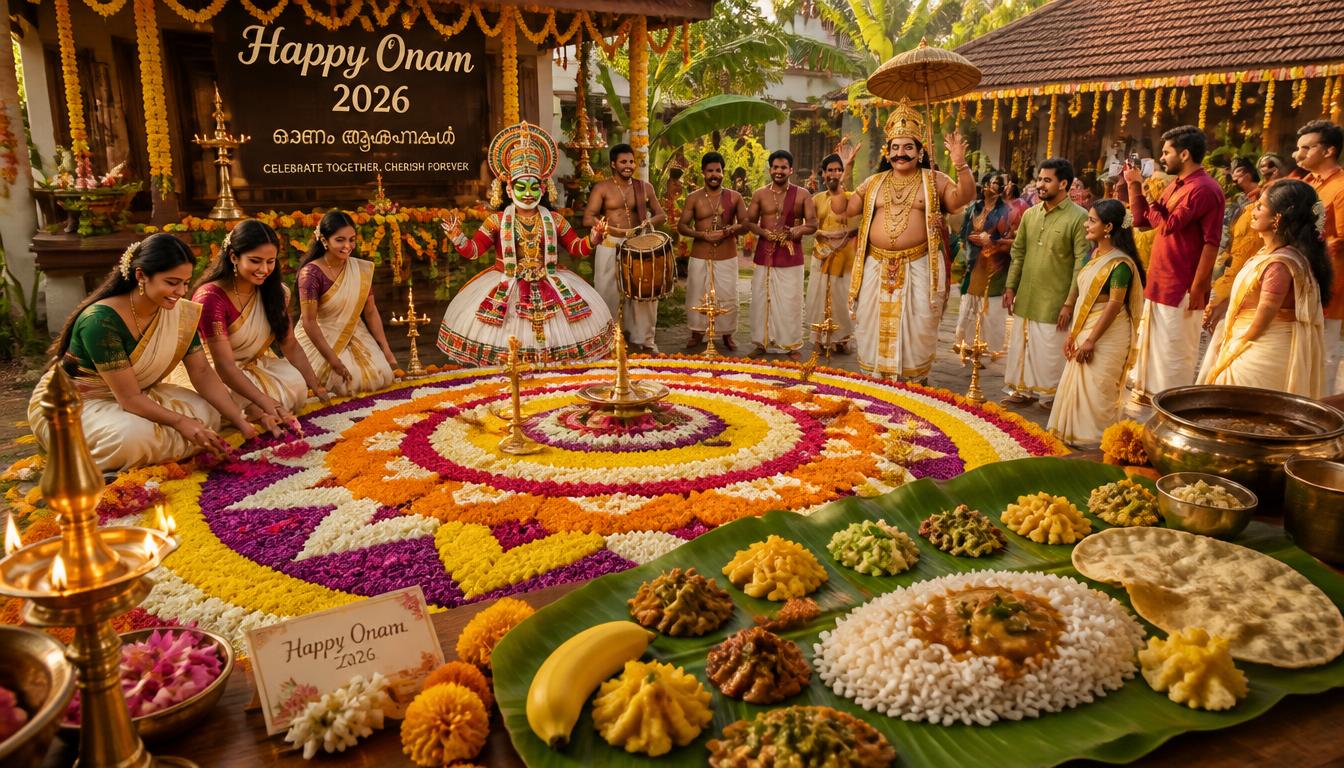
There are festivals that arrive with noise, and then there are festivals that seem to enter the home quietly, carrying flowers, memories, food, and a feeling that everyone belongs at the same table.
Onam 2026 is one of those beautiful occasions. Across Kerala, streets, homes, temples, and family courtyards take on a festive character as people prepare to welcome the spirit of King Mahabali.
The heart of the celebration is not only decoration or a grand meal. It is the idea of returning, remembering, sharing, and sitting together without asking who belongs where. For Malayalis around the world, Onam remains deeply connected with family, community, prosperity, gratitude, and Kerala culture.
In 2026, Thiruvonam falls on Wednesday, August 26. Kerala Tourism also lists August 26 as Thiruvonam in its official festival calendar.
Onam 2026 reaches its main celebration on Wednesday, August 26, 2026, with the day of Thiruvonam marking the high point of the traditional ten-day festivities. The festival follows the Malayalam solar calendar, and Thiruvonam is associated with the Thiruvonam Nakshatra during the month of Chingam.
For people searching for the Onam 2026 date, Onam date 2026, or wondering when is Onam 2026, the key date to remember is August 26.
The Thiruvonam Nakshatra begins at around 10:51 PM on August 25 and ends around 12:48 AM on August 27 for Thiruvananthapuram, although exact timings can vary by location.
| Festival detail | Onam 2026 |
|---|---|
| Main festival | Onam |
| Main day | Thiruvonam |
| Date | August 26, 2026 |
| Day | Wednesday |
| State most closely associated | Kerala |
| Festival period | Ten-day celebration |
| Important star | Thiruvonam Nakshatra |
So, if you are making a family calendar, planning a traditional feast, or simply wondering when is Thiruvonam 2026, August 26 is the central date.
The traditional Onam 10 days begin with Atham and culminate in Thiruvonam. Each day has its own place within the festival rhythm, and the celebrations gradually become more elaborate as Thiruvonam approaches.
The ten traditional days are:
The exact customs associated with individual days can differ between families and communities, so the ten-day sequence should not be treated as one identical program followed everywhere.
The Onam significance comes from several layers of tradition. At its center is the story of King Mahabali, a legendary ruler whose reign is remembered in Kerala tradition as a period associated with prosperity, equality, and well-being.
According to the traditional story, Mahabali was a powerful ruler whose generosity and popularity became significant in the religious narrative surrounding Vamana, an incarnation of Vishnu. The story eventually connects Mahabali with an annual return to visit his people.
That idea of Mahabali’s homecoming gives Onam its emotional character. Families prepare their homes, create floral decorations, wear new clothes, share food, and gather together as part of the welcoming spirit.
Kerala Tourism describes Thiruvonam as the symbolic return of Mahabali and connects the celebration with prosperity, equality, unity, gratitude, and togetherness.
There is something rather lovely in that symbolism. A festival does not merely ask people to remember a king; it asks them to remember what kind of society they want to celebrate one associated in tradition with abundance, harmony, and shared happiness.
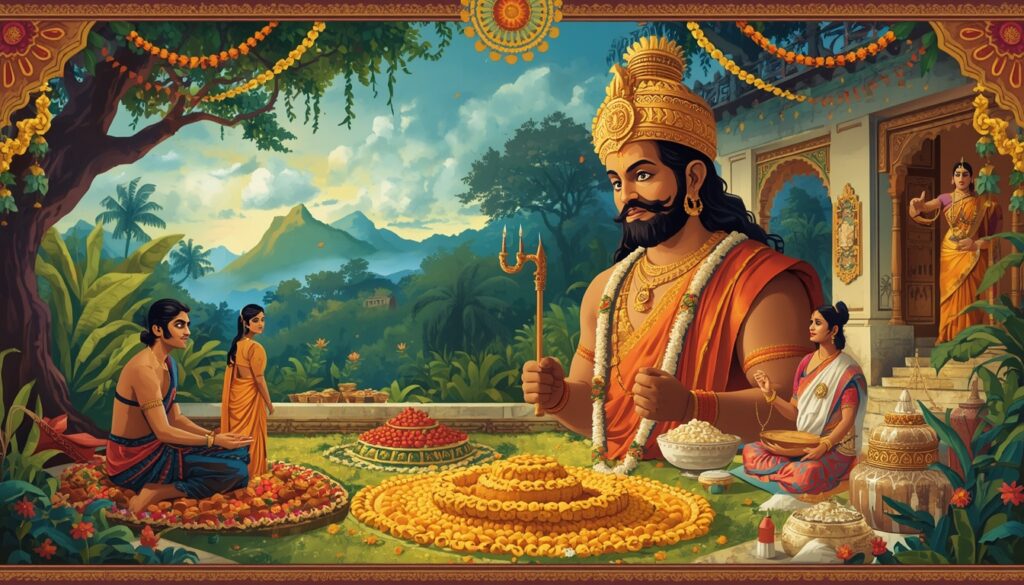
The King Mahabali story is one of the most important narratives associated with Onam.
Mahabali is traditionally described as a generous and respected ruler. His kingdom became prosperous, and his reputation as a ruler beloved by his people forms the emotional background of the festival.
The religious narrative introduces Vamana, the dwarf form of Vishnu. Vamana approaches Mahabali and asks for three paces of land. Mahabali agrees to the request.
The story then takes a dramatic turn as Vamana assumes a cosmic form and covers the earth and heavens in two steps. Mahabali offers his own head for the third step.
Different retellings emphasize different theological and cultural details, so the story is best understood as part of a long religious tradition rather than as a single modern historical account.
The Onam tradition focuses especially on Mahabali’s annual return to his people. That homecoming is why many customs feel welcoming rather than solemn. The flowers are arranged, food is prepared, clothes are worn, and families gather.
The Onam rituals are wonderfully visual. You can almost recognize the festival before anyone says its name.
A doorway covered with flowers, people dressed in traditional clothing, the smell of coconut and spices coming from the kitchen, and a large banana leaf waiting for a meal together, these details create the unmistakable atmosphere of Onam traditions in Kerala.
Not every household performs every custom in exactly the same way, but several traditions have become strongly associated with the festival.
One of the most recognizable Onam rituals is Pookalam, a decorative arrangement of flowers traditionally created on the ground near the entrance of a home.
Fresh flowers are arranged into colorful patterns, often using circular forms and increasingly elaborate designs as the festival progresses.
A Pookalam is not simply something pretty placed outside the house. It becomes a small daily project for family members, especially children, who may collect flowers, discuss patterns, and proudly defend their particular corner of the design sometimes very seriously, of course.
The floral decoration is traditionally associated with welcoming King Mahabali. Today, Pookalam has also become an important part of community competitions, schools, workplaces, and public celebrations.
In other words, the flower arrangement has grown from a household tradition into a shared expression of Onam celebration.
If Pookalam gives Onam its visual identity, Onam Sadhya gives it an unforgettable taste.
A traditional Sadhya is a vegetarian feast served on a banana leaf. Depending on the household and occasion, it may include rice, vegetables, curries, pickles, papad, coconut-based preparations, and several other dishes.
Then comes Payasam, which for many people feels less like the end of the meal and more like the moment everyone suddenly finds room for one more spoon.
The exact number and combination of dishes vary. There is no single universal Sadhya menu that every Malayali family must follow.
What matters most is the shared meal. People sit together, serve one another, talk, laugh, and sometimes discover that the person who claimed they were full five minutes ago has somehow found space for another serving.
Wearing Onakkodi, or new clothes associated with the Onam celebration, is another familiar tradition.
Families may purchase new clothing for themselves and loved ones before the festival. Traditional Kerala clothing can be especially visible during celebrations, although modern clothing is equally common.
The practice carries a simple festive meaning: a special occasion deserves something fresh.
For children, the new clothes can be the most exciting part. For grandparents, however, the real joy may come from watching the whole family dress up and gather under one roof again.
Family gatherings are central to the emotional side of Onam.
People who live in different cities or countries may try to return home during the festival. When that is not possible, families increasingly use phone and video calls to share greetings and see one another.
Some devotees also visit temples during the festival period. Religious observances vary according to family and regional traditions, while Onam itself has a broader cultural presence that reaches beyond one particular form of worship.
This combination of religious tradition and community celebration is one reason Onam festival in Kerala feels so layered.
Another spectacular part of the festive season is Vallamkali, the traditional snake boat race associated with Kerala.
Long boats carrying teams of rowers move through the waterways while rhythmic songs and synchronized rowing create an extraordinary atmosphere.
The Kerala backwaters provide a memorable setting for these events. Alappuzha is especially associated with major boat-race traditions, while the Aranmula boat race is another important cultural event connected with Kerala’s traditional boat-racing heritage.
Kerala Tourism lists the Aranmula Boat Race for August 30, 2026, shortly after Thiruvonam.
Vallamkali is more than a race watched from the riverbank. It brings together teamwork, music, local identity, competition, and a strong sense of community.

Pulikali, literally associated with the imagery of the tiger, is one of the most visually striking Onam cultural events.
Performers use elaborate tiger costumes and body painting before taking part in energetic folk performances and processions.
Thrissur Pulikali is particularly well known. Kerala Tourism lists Pulikali in Thrissur for August 29, 2026, following Thiruvonam.
The painted performers, lively movements, music, and crowds give the streets a completely different personality. It is festive, theatrical, and wonderfully loud in the way only a proper street celebration can be.
The Onam festival also provides a stage for Kerala’s artistic traditions.
Depending on the location, celebrations may feature traditional songs, folk performances, classical dance, Kathakali, Mohiniyattam, Thiruvathira, music programs, and other cultural activities.
Kerala Tourism’s 2026 Onam Tourism Week included traditional, folk, classical, and contemporary performances, along with food experiences, exhibitions, and community programs.
These performances matter because festivals do not survive only through dates on calendars. They survive through people actually performing, teaching, watching, remembering, and passing traditions to another generation.
The phrase Onam 2026 Kerala can describe many different experiences because there is no single way that every part of the state celebrates.
In one home, the morning might begin with a Pookalam and a family breakfast. Somewhere else, relatives may be preparing a large Sadhya. In a town, people might gather for cultural programs, while visitors watch a boat race or a traditional performance.
Kochi, Thiruvananthapuram, Thrissur, Alappuzha, Aranmula, and other parts of Kerala can offer very different festival experiences.
Kerala Tourism scheduled its 2026 Onam Tourism Week from August 24 to August 30, with cultural programs and activities across the state.
That variety is part of the charm. Onam can be intensely local while still feeling unmistakably shared.
The importance of Onam is not limited to one feast or one religious story.
It is closely connected with ideas of gratitude, prosperity, harvest, family, community, and togetherness. The festival arrives during a season traditionally associated with the agricultural cycle, which helps explain its strong relationship with abundance and the harvest festival tradition.
For Malayalis living far from Kerala, Onam can also become a bridge to home.
A small Pookalam made in an apartment, a Sadhya prepared outside Kerala, or a video call with grandparents may seem simple. Yet these small acts can keep a cultural memory alive.
That is perhaps one of the quiet strengths of a festival: it can travel without losing its emotional address.
Onam is strongly associated with Kerala and Malayali identity, but its celebration is not restricted geographically to the state.
Malayali communities across India and in other countries also organize Onam gatherings, cultural programs, floral decorations, meals, and celebrations.
The form may change depending on the location. A community abroad may have limited access to traditional flowers or ingredients, while a Kerala household may have an entire courtyard available for celebrations.
Still, the central feeling remains recognizable — gathering, sharing, remembering, and celebrating.
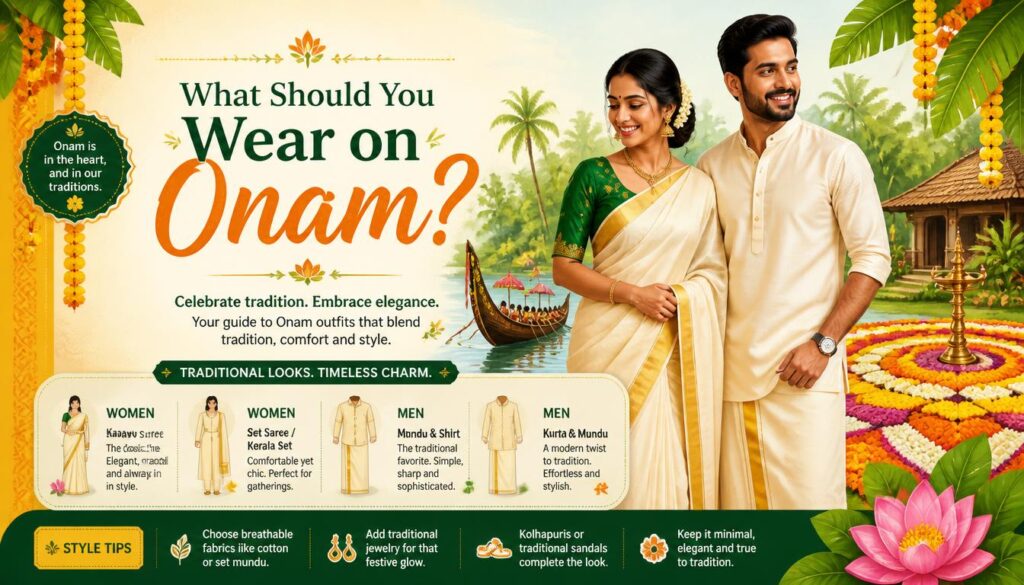
There is no single compulsory outfit for Onam.
Many people choose traditional Kerala clothing because it complements the cultural atmosphere of the festival. Women may wear traditional sarees or Kerala-style outfits, while men may choose a mundu with a traditional shirt or kurta.
The most important thing is comfort and respect for the occasion. Modern festive clothing is also perfectly common, particularly among younger people.
Onam fashion, like Onam itself, has changed with time while retaining recognizable cultural touches.
Onam is not generally defined by a universal fasting rule followed by everyone.
Religious practices can differ according to family traditions, temples, and individual beliefs. For many people, the festival is more closely associated with celebration, prayer, family gatherings, and the Onam Sadhya than with fasting.
Anyone following a specific religious observance should follow the guidance of their family tradition or local religious authority.
Read moore: https://templetimingsdaily.com/hariyali-teej-2026/
People celebrate Onam for a combination of cultural, religious, seasonal, and social reasons.
The traditional Mahabali story gives the festival a powerful narrative about a beloved ruler and his annual return. The festival also connects with the harvest season and ideas of prosperity and abundance.
At the same time, Onam has become an important expression of Kerala culture and Malayali community identity.
Perhaps that is why the celebration can mean slightly different things to different people. For one person, it is about Mahabali. For another, it is about family. Someone else may remember the Sadhya, the Pookalam, a boat race, or childhood mornings spent helping arrange flowers.
All of those memories can sit comfortably inside the same festival.
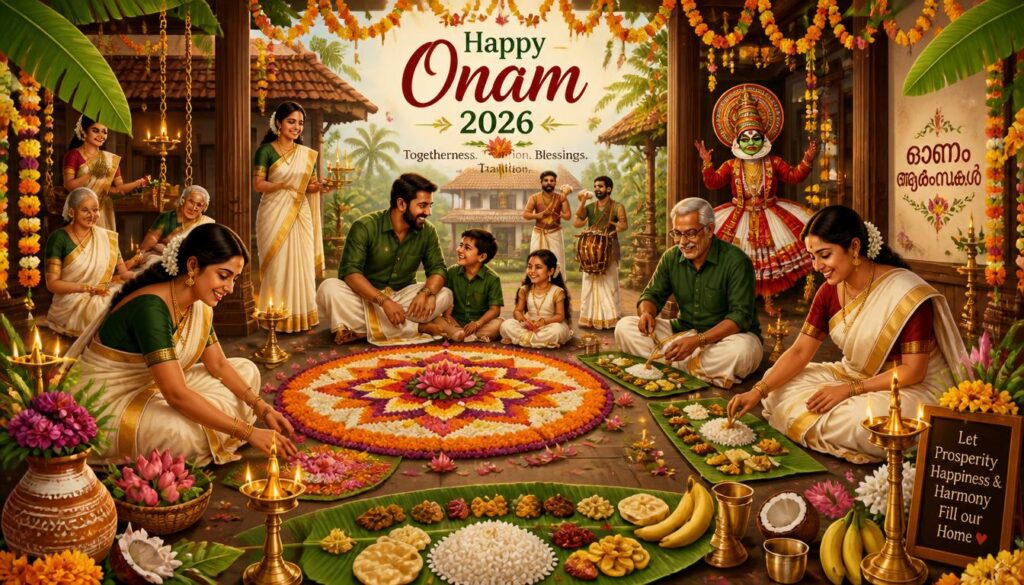
You do not need a huge event to experience the spirit of Onam celebration 2026.
A family can begin by creating a small Pookalam with locally available flowers. Even a simple circular design can make the doorway feel festive.
Prepare a few traditional dishes instead of attempting an enormous Sadhya if time is limited. The purpose is not to compete with a restaurant menu; it is to share food.
Wear festive clothes, call relatives, play traditional music, learn about the story of Mahabali, or watch recordings of Kerala’s cultural performances.
Children can also be included in the preparations. Give them flowers to arrange, explain why the Pookalam is made, or tell them the Mahabali story in simple language.
Sometimes culture survives in exactly these little moments, not in grand speeches.
A calendar can tell us that Onam 2026 falls on August 26. It cannot, by itself, explain why that date can make an entire household feel different.
The flowers do some of that work. The food does some more. A grandmother remembering an old Onam, a child carefully placing the next flower in a Pookalam, relatives arriving at the door, and everyone eventually sitting together these are the pieces that turn a date into a memory.
The festival’s enduring story of King Mahabali adds another layer. His return is remembered not simply as an event from a traditional story, but as a symbolic reminder of prosperity, fairness, belonging, and affection for one’s community.
That is why Onam traditions remain meaningful even when the way people celebrate them changes.
Onam 2026 reaches its main celebration on Wednesday, August 26, 2026, which is Thiruvonam. Kerala Tourism also lists Thiruvonam on August 26.
Thiruvonam 2026 falls on August 26, 2026. The associated Thiruvonam Nakshatra spans late August 25 into early August 27 according to the location-specific timings for Thiruvananthapuram.
Onam celebrates the traditional annual homecoming of King Mahabali and is also associated with harvest, prosperity, gratitude, community, and Kerala’s cultural identity.
The Onam significance lies in its combination of religious tradition, the Mahabali story, seasonal harvest associations, family gatherings, cultural performances, and community celebration.
Pookalam is a decorative floral arrangement traditionally created near the entrance of a home during Onam. Fresh flowers are arranged into colorful patterns, often with circular designs.
Onam Sadhya is a traditional vegetarian feast served on a banana leaf. It commonly includes rice, vegetables, curries, pickles, papad, coconut-based dishes, and Payasam, although menus vary.
Vallamkali refers to traditional boat races in Kerala, particularly those involving long snake boats and teams of synchronized rowers.
Pulikali is a lively folk performance associated with Onam in which performers use tiger-inspired body painting and costumes. Thrissur Pulikali is particularly famous.
No. While Kerala is the heartland of Onam, Malayali communities in other parts of India and around the world also celebrate the festival.
Onakkodi refers to new clothes traditionally worn or gifted during Onam. It represents the freshness and festive spirit associated with the occasion.
Onam 2026 is a 10-day festival celebrated in Kerala, marking the homecoming of King Mahabali and celebrating prosperity, harvest, and togetherness.
Onam 2026 will be celebrated from August 16 to August 26, with Thiruvonam, the main day, falling on August 26, 2026.
Onam 2026 begins on Sunday, August 16, and the main celebration, Thiruvonam, will be observed on Wednesday, August 26, 2026.
This year, Onam is celebrated in August 2026, with families observing traditional rituals, preparing Pookalam and Sadhya, and celebrating together.
Onam 2026 brings together much more than a festival date. It brings the colors of Pookalam, the warmth of family gatherings, the abundance of Onam Sadhya, the excitement of Vallamkali, the energy of Pulikali, and the enduring story of Mahabali’s homecoming.
On August 26, 2026, Thiruvonam will once again become the central day of the celebration, carrying traditions that have been passed from one generation to another.
Whether you celebrate in a Kerala village, a busy city, or far away from home, the essence can remain surprisingly simple: make space for others, share what you have, remember where you came from, and enjoy the people sitting beside you.
That is the quiet beauty of Onam. The flowers eventually fade, the banana leaves are cleared away, and the music grows quiet — but the feeling of togetherness can stay long after the festival has ended.