Physical Address
304 North Cardinal St.
Dorchester Center, MA 02124
Physical Address
304 North Cardinal St.
Dorchester Center, MA 02124

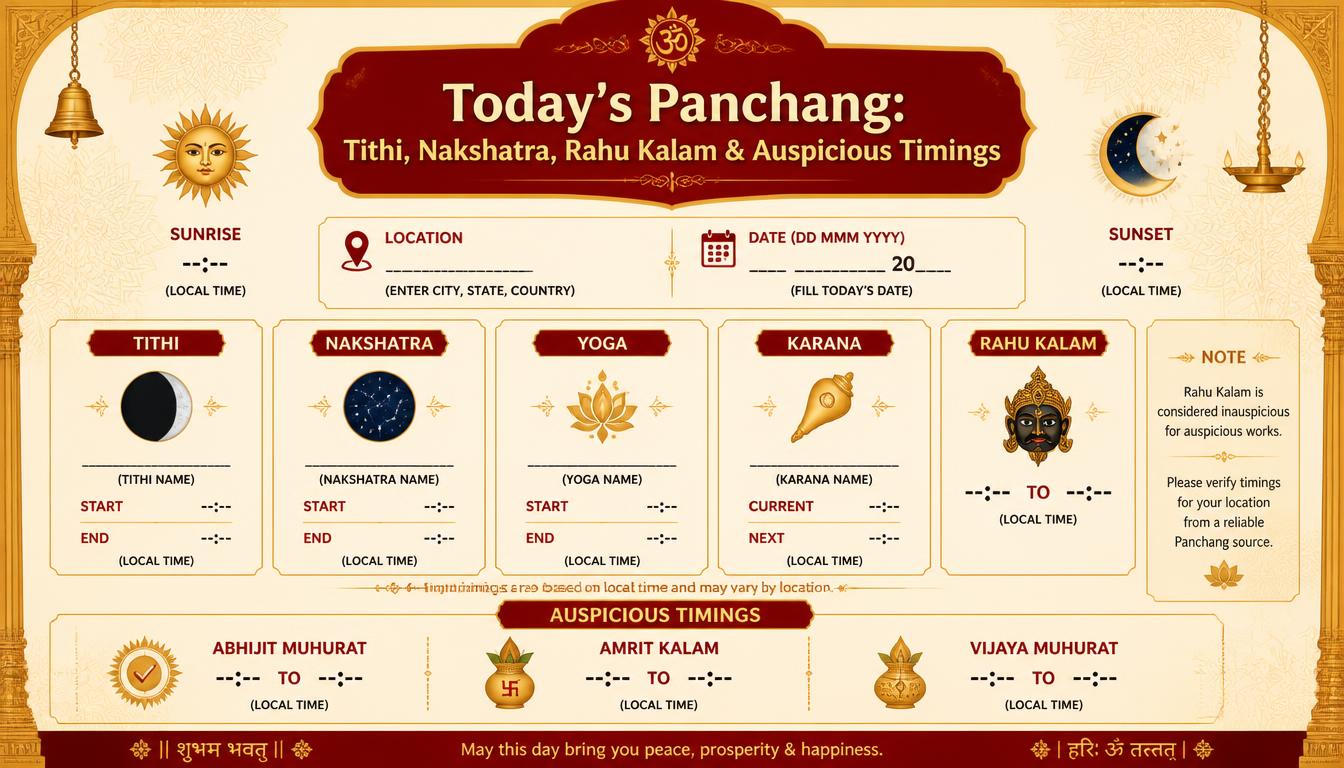
Every morning begins with a little question that has been asked for generations: What does today look like according to the Panchang? The answer is not simply a date on a calendar. Today’s Panchang brings together the movement of the Sun and Moon, the lunar day, Nakshatra, Yoga, Karana and traditional time periods that help people understand the character of the day.
For October 5, 2026, the Panchang provides a useful picture of the day through its Tithi, Nakshatra, Yoga, Karana, sunrise and sunset. For people who follow Hindu astrology, Vedic astrology, or traditional Jyotish practices, these details can help in planning worship, religious activities, travel, meetings and other important work.
A small but important thing is often missed: Panchang timings are location-sensitive. The same Tithi or Nakshatra may appear with slightly different timings when calculated for another city because sunrise, sunset, latitude, longitude and time zone affect the calculation. So a local Panchang is generally more useful than copying timings from another location.
According to the supplied Panchang details, October 5, 2026, falls on a Monday. In the traditional weekday system, Monday is known as Induvasara, a day associated with the Moon.
For the Karachi calculation, the location is Asia/Karachi, and the listed sunrise is 6:29 AM, while sunset is 6:11 PM. These solar timings are important because several traditional Panchang calculations are connected with the period between sunrise and sunset.
The day’s major Panchang elements include Krishna Dashami, Pushya Nakshatra, Shiva Yoga, and the relevant Karana divisions of Garija Karana and Vanija Karana. Depending on the exact transition time, the following Tithi or Nakshatra may begin during the day, which is why precise timing matters when observing religious events.
In other words, a Panchang is less like a simple wall calendar and more like a traditional time map. It tells you not only which date it is, but also what celestial and calendrical combinations are associated with that date.
Tithi is one of the five fundamental elements of a traditional Hindu Panchang. It represents a lunar day and is calculated from the angular relationship between the Sun and Moon.
For October 5, 2026, the supplied details identify Krishna Dashami as the principal Tithi. Krishna Paksha refers to the waning half of the lunar month, when the Moon gradually moves toward Amavasya.
Dashami is the tenth Tithi of a Paksha. After the Moon has passed through the earlier stages of the waning fortnight, Dashami marks another step toward the darker lunar phase.
People checking today’s Tithi may use it to understand religious observances, fasting traditions and the timing of certain rituals. However, the exact beginning and ending of a Tithi should always be checked according to the local Panchang rather than assuming that it lasts from midnight to midnight.
That detail is surprisingly important. The traditional Panchang day does not work exactly like the ordinary civil calendar day we use for appointments and office schedules.
The Nakshatra represents the lunar constellation or star segment through which the Moon is traditionally considered to be passing.
For the supplied October 5 Panchang, Pushya Nakshatra is one of the important Nakshatra details. Pushya has a respected place in Indian astrology and traditional religious timing, and it is often associated with nourishment, growth and auspicious beginnings.
The Moon’s movement through the Nakshatras is used in Jyotish for evaluating different activities and Muhurat considerations. People may therefore search for today’s Nakshatra when planning worship, ceremonies or other culturally significant activities.
The Nakshatra is not simply a decorative astrology label. It is part of the mathematical structure of Panchang calculation, alongside Tithi, Yoga, Karana and Vara.
Another part of Panchang details is Yoga. In this context, Yoga is a combination calculated using the positions of the Sun and Moon.
The supplied Panchang information includes Shiva Yoga and Siddha Yoga among the relevant daily combinations. Traditional Panchang users may consider these Yogas while evaluating the character of a particular period.
Karana, meanwhile, is half of a Tithi. Since one Tithi contains two Karanas, Karana changes more frequently than Tithi and therefore gives another layer of detail to the daily Panchang.
For this date, the supplied information includes Garija Karana and Vanija Karana. Their exact periods can differ according to the local calculation and transition times.
This is why simply writing “today is Dashami” does not describe the whole Panchang. The real picture comes from putting all the pieces together.
Sunrise and sunset are among the most useful practical details in a daily Panchang.
For the supplied Karachi calculation on October 5, 2026:
These timings help establish the daytime period used for many traditional calculations.
The sunrise today is particularly important because several Panchang traditions calculate daily periods beginning from local sunrise rather than from 12:00 AM. This explains why a Panchang can sometimes appear to disagree with a normal calendar even though both are referring to the same civil date.
Sunrise-based calculation also helps determine periods such as Rahu Kalam, Yamaganda, Gulika Kalam, and other divisions of daytime.
Rahu Kalam or Rahu Kaal is traditionally regarded as an inauspicious period for beginning certain important activities.
People commonly check today’s Rahu Kalam before starting a new venture, signing an important agreement, beginning a journey or undertaking a significant religious or ceremonial activity.
Rahu Kalam is calculated from the daytime period and therefore depends on the local sunrise and sunset. Its duration and clock time are not identical every day.
It is also worth remembering that traditional practices vary between families, regions and communities. Some people strictly avoid starting important activities during Rahu Kalam, while others consider it only one factor among many.
So, if you are searching for Rahu Kalam today, use the Panchang calculated for your own city instead of relying on a generic timing copied from another location.
Rahu Kalam is not the only traditional time period people check.
Yamaganda is another period traditionally considered unfavorable for beginning certain important activities. Like Rahu Kalam, its timing is connected with the local daytime division.
Gulika Kalam is another traditional planetary time period included in many Panchang calculations. Its interpretation and practical use can vary depending on the tradition being followed.
Then there is Varjyam, which is treated as an unfavorable period in certain Panchang systems, particularly in relation to the Nakshatra-based calculation.
Durmuhurta or Durmuhurtam is also traditionally considered an inauspicious period. People who carefully select a Muhurat may check all these periods before finalizing an important activity.
This gives the daily Panchang a rather interesting character: it does not simply say that a day is “good” or “bad.” Instead, it divides the day into different windows, each interpreted according to a traditional system.
One of the most searched parts of any Panchang is today’s auspicious time.
The term Shubh Muhurat refers to a favorable period selected for an activity. Depending on the purpose, people may look for a suitable time for starting work, buying a vehicle, purchasing business goods, entering a house or beginning a journey.
Abhijit Muhurat is traditionally associated with a favorable midday period, while Brahma Muhurta refers to a spiritually significant early-morning period.
However, these periods should not automatically be treated as universally suitable for every activity. A detailed Muhurat may also consider Tithi, Nakshatra, Vara, Lagna, Tara Bala and Chandra Bala.
For major ceremonies such as marriage, Griha Pravesh, Upanayan or other religious rituals, a specialized Muhurat calculation is generally more appropriate than relying only on one general “good time.”
People who follow traditional daily time divisions may also check today’s Choghadiya and Hora.
Choghadiya divides the daytime and nighttime into traditional time periods and is commonly consulted for selecting favorable or unfavorable windows for activities.
Hora represents planetary hours. Each period is traditionally associated with a planetary influence, and people following this system may choose a Hora according to the nature of the activity.
Together, Choghadiya and Hora offer another way of looking at the day. Instead of treating the entire Monday as having one fixed quality, these systems divide it into smaller periods.
This is one reason Panchang remains interesting even for people who already know their ordinary calendar date. There are several layers sitting quietly underneath that one date.
The supplied Panchang information identifies Karka Rashi, or Cancer zodiac sign, in connection with the Moon.
In Vedic astrology, the Moon’s position is an important part of interpreting a person’s emotional tendencies and daily astrological environment. The Moon sign is therefore commonly searched alongside today’s Rashi and Nakshatra today.
Rashi information is different from Tithi. Tithi describes the lunar day based on the angular relationship between the Sun and Moon, while Rashi refers to the zodiac sign associated with the Moon’s position.
That difference can sound technical at first, but it becomes easier when you think of the Panchang as several clocks running together: one tracks lunar days, another tracks the Moon’s Nakshatra, and another describes its zodiac position.
A common question is: Why does the Panchang for Karachi show different timings from one for another city?
The answer is location.
Panchang calculations can depend on latitude, longitude, local sunrise, sunset, time zone and the astronomical position of the Sun and Moon. This is why Panchang by location, Panchang according to city, and location-based Panchang are useful searches.
For example, a person checking Panchang for Karachi should ideally use Karachi’s local sunrise and sunset rather than taking timings from an Indian city and assuming they are identical.
Even a relatively small geographical difference can affect the exact moment at which Tithi, Nakshatra or other elements change.
This is also why two Panchangs can occasionally show different timings without one necessarily being “wrong.” They may be using different locations, calculation settings, Ayanamsa conventions or astronomical parameters.
Traditional Panchang calculation combines several astronomical and calendrical elements.
The Sun and Moon’s positions are important for determining Tithi, while the Moon’s position is used in determining Nakshatra and Rashi. Yoga is calculated from the combined positions of the Sun and Moon, while Karana comes from the division of a Tithi.
More detailed systems may use geocentric calculation, astronomical longitude, local coordinates, time zone information and other parameters.
The Panchang therefore sits at an interesting meeting point between an ancient calendrical tradition and astronomical calculation. Different regional Panchangs can also follow different conventions, which is why users should check the methodology behind the particular calendar they follow.
The practical value of a daily Panchang is often seen in religious and household routines.
Someone may check today’s Hindu calendar before beginning a puja, observing a fast, planning a religious ceremony or identifying a festival date.
Others may look for today’s auspicious Muhurat before starting work, buying a vehicle, entering a new house or arranging an important meeting.
For major ceremonies, however, the calculation can become much more detailed. Marriage Muhurat, Griha Pravesh and Upanayan may involve several factors rather than a single favorable clock time.
Traditional astrology may consider Lagna, Tara Bala, Chandra Bala, Nakshatra, Tithi and other factors before selecting a final Muhurat.
So the best way to use Panchang is not to treat every timing as an absolute command. It is better understood as a traditional planning framework.
Read more: https://templetimingsdaily.com/free-telugu-horoscop/
For readers who want the essential information at a glance, the supplied details for October 5, 2026 can be summarized as follows:
The exact transition times for Tithi, Nakshatra, Yoga and Karana should be checked against the local Panchang calculation when a precise Muhurat is required.
The simplest approach is to begin with the date and location. Check the local Panchang today, confirm sunrise and sunset, and then look at Tithi, Nakshatra, Yoga and Karana.
After that, check the relevant time periods such as Rahu Kalam, Yamaganda, Gulika Kalam, Varjyam and Durmuhurta if your tradition observes them.
For an ordinary day, you may simply want to know the Tithi and Nakshatra. For an important religious ceremony, however, you may need a more complete Muhurat calculation.
And don’t forget the most basic rule: do not copy a Panchang time from a different city without checking the location. The Sun does not rise everywhere at the same minute, so the calculations built around sunrise naturally move too.
There is something quietly fascinating about the Panchang. A modern calendar tells us that October 5 is Monday. A Daily Panchang asks a much more detailed question: What is happening in the traditional lunar and solar calendar around that date?
It connects the ordinary day with Tithi, Nakshatra, Yoga, Karana, Rashi and traditional Muhurat calculations.
For some people, this is part of daily religious practice. For others, it is a cultural tradition passed from grandparents to parents and then to the next generation. And for many, it is simply a useful way to remain connected with the Hindu calendar and its rich system of timekeeping.
The usefulness of Panchang does not depend on rushing through every term. Start with the basics—Tithi, Nakshatra, Rahu Kalam, sunrise, sunset and auspicious timings—and gradually explore the deeper calculations if they matter to you.
Today’s Tithi is the lunar date according to the Hindu Panchang, determined by the relative positions of the Sun and Moon.
Today is Monday, October 5, 2026, according to the date and local time given in the Panchang.
Today’s Tithi is Krishna Dashami, which continues until 1:38 AM and is followed by Krishna Ekadashi.
Today’s Panchang includes Tithi, Nakshatra, Yoga, Karana, sunrise, sunset, Rahu Kalam, auspicious timings, and other daily Hindu calendar details.
Today’s Hindi Panchang provides the daily Tithi, Nakshatra, Rahu Kalam, auspicious timings, sunrise, sunset, and other important Panchang details.
Today’s Panchang for October 5, 2026 offers much more than a simple date. With Krishna Dashami, Pushya Nakshatra, Monday, the listed Yogas and Karanas, Karka Rashi, and the local sunrise and sunset details, the day can be viewed through several traditional layers at once.
Whether you are checking today’s Tithi, today’s Nakshatra, today’s Rahu Kalam, today’s auspicious timings, or simply looking at the Hindu Panchang today, the most important thing is to use information calculated for the correct location.
Panchang is ultimately about understanding time in a traditional way. Some days feel ordinary, some feel spiritually significant, and some become memorable because of the work or ceremony we choose to begin on them.
So before the day runs away into meetings, errands and notifications, taking a quiet minute to look at the Panchang can be a small way of slowing down and understanding the rhythm of the day. Sometimes, that little pause is useful in itself.