Physical Address
304 North Cardinal St.
Dorchester Center, MA 02124
Physical Address
304 North Cardinal St.
Dorchester Center, MA 02124

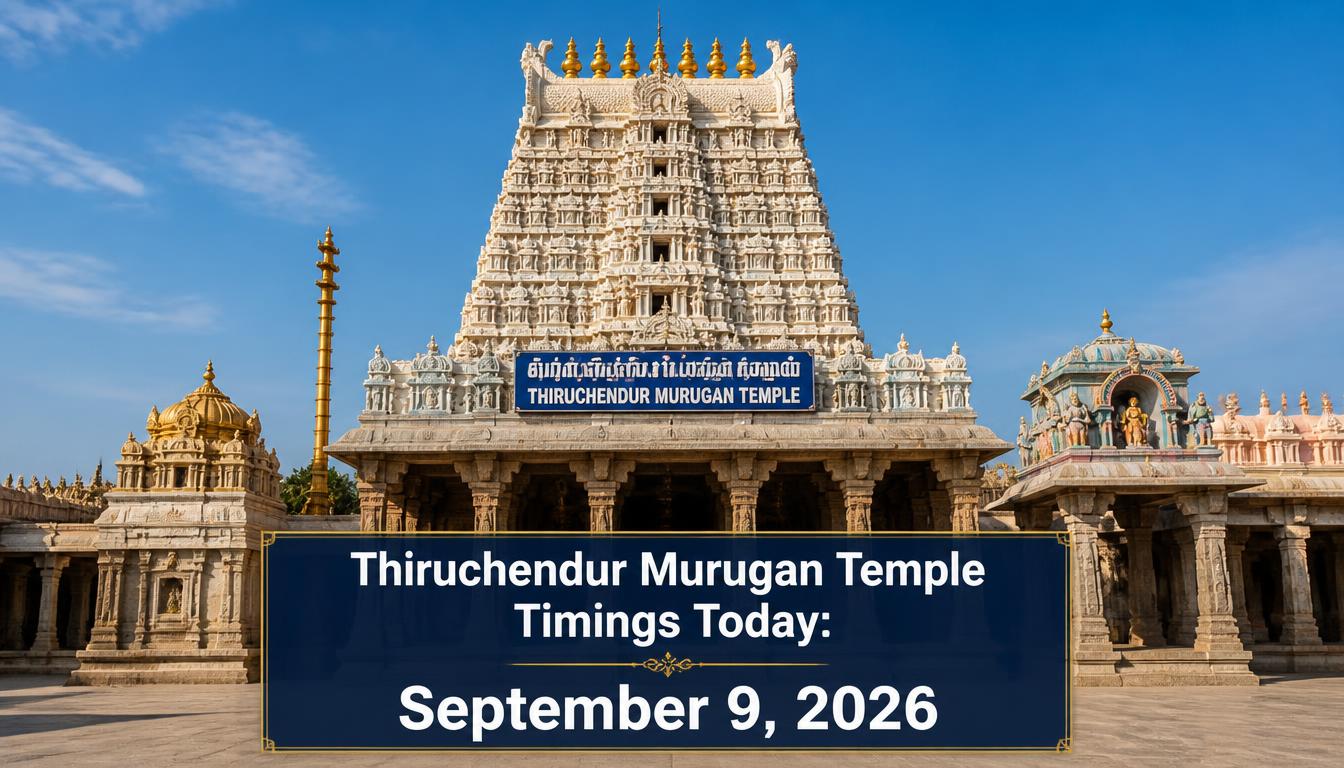
There are some temple visits that begin long before the first darshan, almost in the mind itself. You leave home with a small prayer, perhaps a name on your lips, and somehow the road to the shrine feels different from an ordinary journey.
A visit to the Thiruchendur Murugan Temple is very much like that. The sea is nearby, the temple rises in the coastal air, and the presence of Lord Murugan gives the whole place a devotional character that is difficult to describe in plain words.
If you are searching for Thiruchendur Murugan Temple timings today, there is one especially important point for Wednesday, September 9, 2026: today is the 10th day of the Aavani festival, and the famous temple-car procession, or Therottam, is scheduled for 7:00 AM.
So the normal daily timetable should not be treated as the whole story today. Festival-day arrangements can alter the usual rhythm, and crowds are expected to be considerably larger. Dinamani+1
On usual days, the Thiruchendur Murugan Temple, also known as the Arulmigu Subramanya Swamy Temple, is generally open from 5:00 AM to 9:00 PM. The regular schedule includes several important daily pooja and darshan periods throughout the day. Tiruchendur.org+1
However, Thiruchendur Temple timings today need a special note because September 9 falls during the 12-day Aavani festival.
The official temple-related schedule available through the temple’s public archive states that the temple normally remains open from 5:00 AM until 9:00 PM. It also lists the regular pooja sequence, from the early morning Subrapadam through the final night rituals. Tiruchendur.org
So, if someone asks, “Thiruchendur Murugan Temple opens at what time?” the safest answer for an ordinary day is 5:00 AM, while festival days can have substantially earlier opening times. That distinction matters today.
The regular Thiruchendur temple opening time is 5:00 AM, while the usual Thiruchendur temple closing time is 9:00 PM. The regular schedule is not simply one continuous darshan window, though. Several rituals take place during those hours, and the experience of visiting at 5 AM is quite different from arriving at 7 PM.
The temple’s published puja schedule says the first listed morning observance is Subrapadam – Thirupalli Eluchi at 5:10 AM, followed by Viswaroopam Darshan at 5:30 AM and Dwajasthamba Namaskaram at 5:45 AM. Tiruchendur.org
The morning continues with Udaya Marthanda Abishegam at 6:15 AM and Udaya Marthanda Deeparadhanai at 7:00 AM. The Kalasandhi Pooja is listed from 8:00 to 8:30 AM, followed by Kalasha Pooja and the midday rituals. Tiruchendur.org
The regular evening schedule begins with Sayaratchai Pooja at 5:00 PM. Later come the night rituals, including Arthasama Abhishegam, Arthasama Pooja, Ekanda Seva, and the final Ragasia Deeparadhanai, Palliarai Pooja. At 9:00 PM, Nadai Thirukappiduthal marks the closing of the temple for the day. Tiruchendur.org
That final closing is why reaching the temple at 8:55 PM and expecting a leisurely darshan is, well, not a great plan.
For devotees trying to understand the Thiruchendur Murugan Temple darshan timings, it helps to think in terms of the temple’s ritual cycle rather than just “open” and “closed.”
The early morning period is especially meaningful for devotees who like quieter worship. The sequence begins with dawn prayers and proceeds into Viswaroopam Darshan, abhishekam and deeparadhanai. There is a certain stillness to a coastal temple at this hour, before the heat and larger crowds arrive.
The principal regular timings published by the temple archive are:
These timings are a useful guide for a normal devotional visit, but they should not be assumed to override special festival arrangements. The published schedule itself notes that pooja timings can change on certain special days and during solar or lunar eclipses. Tiruchendur.org
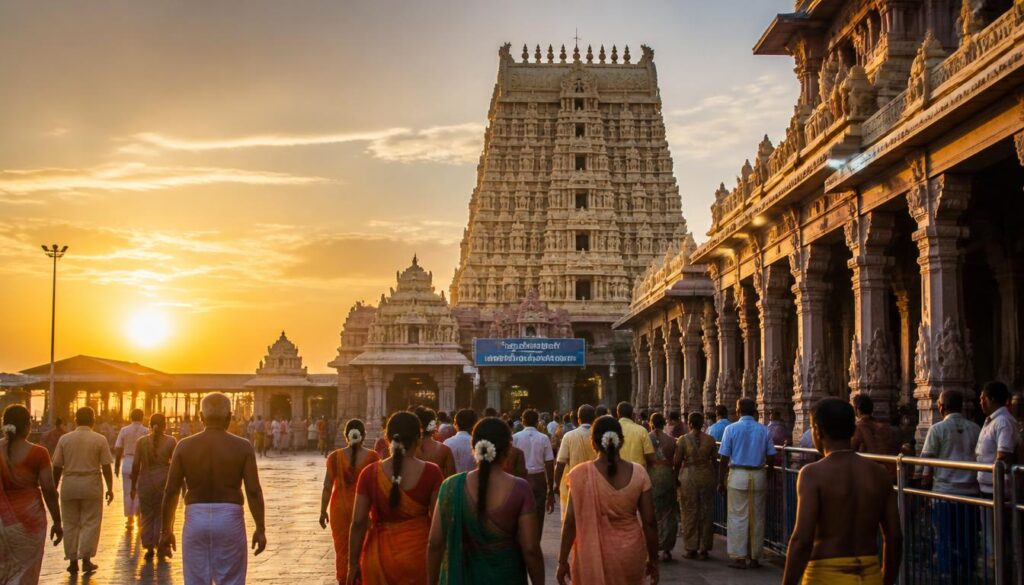
For those specifically looking for Thiruchendur temple morning darshan time, the early morning is often the most attractive part of the day. The temple’s regular schedule starts at 5:00 AM, with the first ritual shortly afterwards.
The 5:30 AM Viswaroopam Darshan is particularly significant in the morning sequence. After that, the temple moves through abhishekam and deeparadhanai, eventually reaching Kalasandhi Pooja around 8:00–8:30 AM. Tiruchendur.org
Today, however, September 9 is not an ordinary morning. The Aavani festival’s Therottam is scheduled for 7:00 AM, making the early hours exceptionally busy. Daily Thanthi+1
If your intention is to witness the chariot procession, arriving well before 7:00 AM is sensible. If your intention is a calm, uncomplicated personal prayer, today may not be the ideal day to expect that sort of quietness. Festivals have their own heartbeat.
The regular Thiruchendur temple evening darshan period continues through the evening until the temple closes at 9:00 PM. Sayaratchai Pooja at 5:00 PM is an important part of the evening ritual cycle. Tiruchendur.org
The later hours become increasingly connected with the temple’s night worship. Arthasama Abhishegam is listed at 7:15 PM, followed by Arthasama Pooja at 8:15 PM and further night rituals before the 9:00 PM closing. Tiruchendur.org
For visitors interested in the evening ritual atmosphere rather than simply ticking off a darshan from the travel itinerary, staying into the later part of the evening can be rewarding. But on festival days, crowd movement and procession arrangements may make the experience very different.
Today deserves its own section because the normal Thiruchendur temple daily timings are not enough to describe what is happening.
The temple is currently observing the Aavani Festival, a 12-day celebration that began with flag hoisting on August 31 and is scheduled to conclude on September 11. The major Therottam is taking place today, September 9, at around 7:00 AM. Dinamani+1
The event is the 10th day of the festival. Reports from the festival schedule indicate that the day’s programme includes the temple-car procession in the morning, followed by an evening Periya Thirupallakku procession and the conclusion of the festival flag-related rituals later in the day. Skanda News
That means Thiruchendur Murugan Temple today is not simply a regular Wednesday visit. It is a major festival day.
Large numbers of devotees are expected, and local arrangements are naturally focused on managing the movement of pilgrims around the procession. A traveller coming today should therefore allow substantially more time for parking, walking, queueing and finding a comfortable place from which to observe the festivities.
The ritual life of the Arulmigu Subramanya Swamy Temple follows a traditional sequence rather than treating worship as a single event.
Nine daily pooja kalams are observed, according to the temple’s published schedule. These include morning worship, midday offerings, evening deeparadhanai and the final night rituals. Tiruchendur.org+1
Among the names visitors will commonly encounter are Thiruvanandal, Kalasanthi, Uchikala Pooja, Sayaratchai, and Ardhajama. Different sources and local descriptions may use slightly different transliterations, so spellings such as Sayaraksha, Sayaratchai or Ardhajama can appear.
The morning Abhishekam is another important part of worship at the shrine. The broader temple tradition includes sacred offerings and ritual bathing of the deity, while devotees may also make an Archana, offer a personal prayer, or participate in available sevas.
The exact ritual details are more important to many pilgrims than the clock itself. You are not merely waiting for the doors to open; you are stepping into a sequence that has been repeated through generations.
Located in Thiruchendur, Tamil Nadu, in Thoothukudi District, the shrine is one of the celebrated Arupadai Veedu, the six principal pilgrimage abodes associated with Lord Murugan.
Its setting is extraordinary in a very literal sense: this is a seashore temple, standing close to the sea in coastal Tamil Nadu. Among the six sacred Murugan shrines, Thiruchendur is especially distinctive because of this relationship with the seashore.
The temple is devoted principally to Lord Subramanya, also called Subramanya Swamy and Murugan. For devotees, the journey is not merely geographical. It is a Hindu pilgrimage shaped by prayer, ritual, family tradition and the long memory of Tamil devotional culture.
You can feel that especially on festival days, when the streets around the temple complex become part of the religious experience rather than simply being roads outside a building.
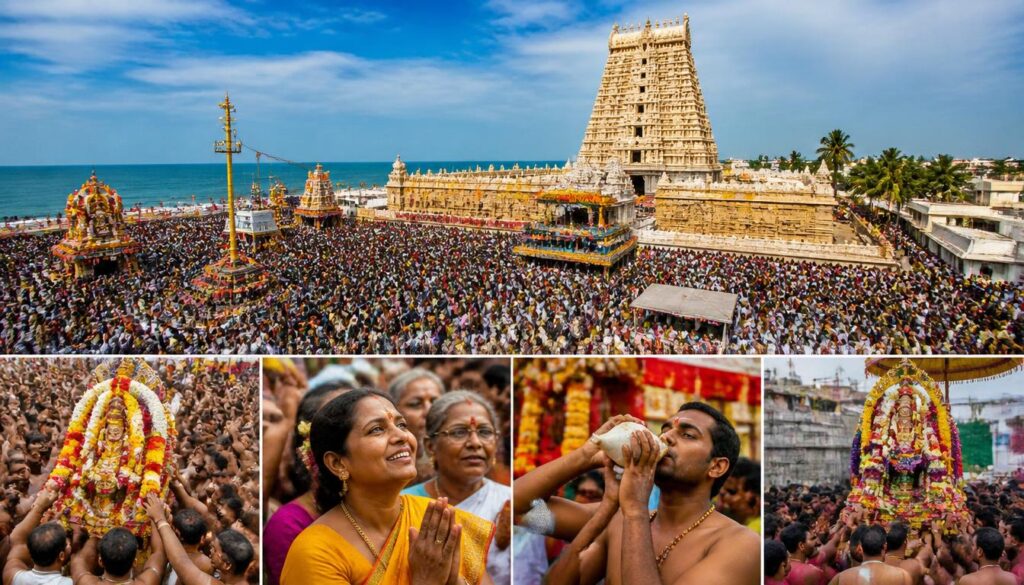
Festival days require a different kind of visit planning. The ordinary timetable is useful as a baseline, but special events can move the centre of attention outside the normal sanctum routine.
The current Aavani Festival provides a good example. On September 9, the Therottam begins at 7:00 AM, while the broader festival programme includes additional processions and evening events. Skanda News+1
Other major celebrations at Thiruchendur include Skanda Sashti, Thai Pusam, and Panguni Uthiram. Skanda Sashti is especially associated with Lord Murugan’s victory over the demon Soorapadman, and its multi-day observances can bring very large crowds.
Thai Pusam is strongly connected with kavadi traditions and Murugan worship, while Panguni Uthiram is associated with important ceremonial observances and processions. Festival dates change according to the Hindu calendar, so checking the particular year’s schedule is much better than relying on a remembered date.
The lesson is simple, but people forget it every year: festival timing and ordinary timing are cousins, not twins.
A visit to a Murugan Temple often feels incomplete without receiving Temple Prasadam. At Thiruchendur, devotees traditionally receive sacred offerings associated with the shrine, including Vibhuti, or sacred ash.
The temple tradition also has a distinctive association with sacred ash being given in leaves, described in the temple’s historical material as ilai vibhuti. Tiruchendur.org
Depending on the day and availability, devotees may encounter Panchamrit, blessed food, temple sweets or a Prasad Packet. Offerings and prasadam availability can vary, so visitors should not assume that every listed item will be available at every hour.
If you have participated in an Abhishekam or another seva, the associated prasadam may have its own distribution arrangements. It is always best to follow instructions given at the temple counters rather than relying on old travel information.
There is an important difference between knowing the temple opening time and knowing when you will actually see the deity.
On an ordinary day, queue conditions may be manageable, but weekends, holidays and major festivals can dramatically increase the wait. Today, because of the Aavani Therottam, visitors should expect a much busier environment than a normal Wednesday.
Terms such as General Darshan, Special Darshan, priority entry, free darshan, and darshan tickets are commonly used in visitor information, but arrangements and fees can change. I would not recommend relying on an old website claiming a fixed “₹50–₹100 special darshan ticket” unless the current temple administration confirms it.
The same caution applies to claims about 20–60 minute general darshan waits, 10–20 minute special darshan waits, or particular online booking prices. Queue times are not fixed facts; they depend heavily on the day, crowd, festival programme and temple administration decisions.
For online darshan booking, seva booking, or any advance reservation, use the current Tamil Nadu HR&CE portal and current temple-issued information rather than an old third-party page. The temple’s own published material identifies tnhrce.gov.in and the temple’s HR&CE address as official information channels. HRCE
Tamil Nadu HR&CE official portal
For ordinary walk-in darshan, visitors should not assume that every identification document listed for online registration is required at the temple entrance.
For online registration or a specific seva, however, the booking system may request information such as pilgrim names and identity details. Depending on the service and current rules, documents can include Aadhaar, PAN Card or Voter ID.
Because booking requirements can change, the safest practice is to check the current Tamil Nadu HR&CE portal when making an advance booking. Do not depend on an old screenshot telling you that a particular document, mobile OTP, or booking slot is compulsory unless the current booking page says so.
That little bit of checking before leaving home can save a surprisingly large amount of irritation later.
Read more: https://templetimingsdaily.com/udupi-sri-krishna-temple-timings-today/
If you are already travelling to Thiruchendur, Tamil Nadu today, plan around the festival rather than around the ordinary timetable.
Arriving before the 7:00 AM Therottam is advisable if the purpose of your visit is to witness the chariot procession. Since today is one of the major Aavani festival days, expect crowds to build well before the headline event.
If you are coming primarily for personal prayer, consider whether you genuinely need to visit during the busiest procession period. A quieter time on a non-festival day may provide a more relaxed devotional experience.
Wear comfortable, respectful clothing, carry water for the journey, keep valuables secure and allow extra walking time. The combination of Tamil Nadu heat, crowds and prolonged standing can be tiring, particularly for elderly pilgrims and young children.
The temple’s coastal location also means visitors sometimes combine the pilgrimage with sea bathing. Take care near the sea and follow any current local safety instructions; devotional enthusiasm should never outrun basic caution.
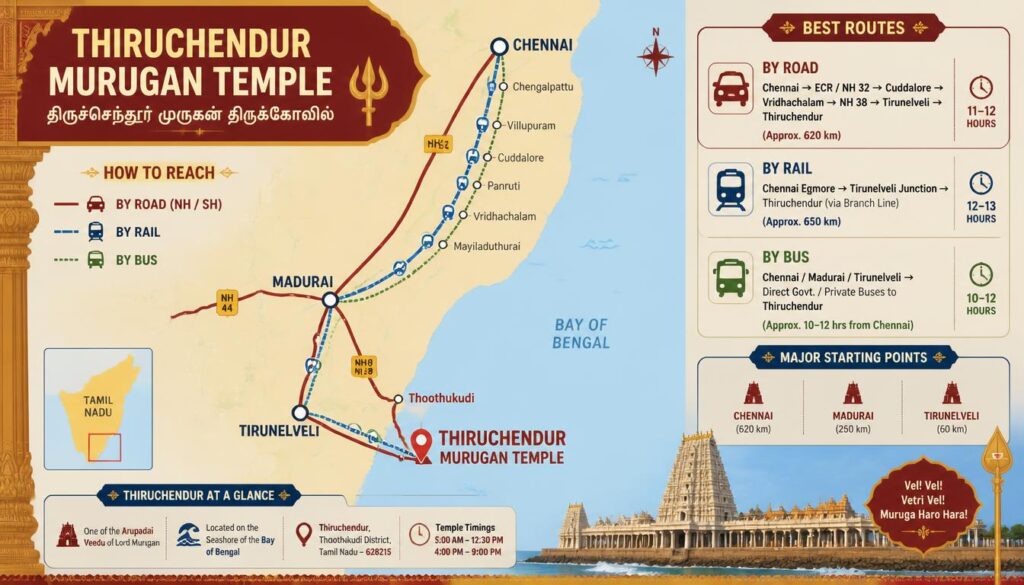
Thiruchendur is in Thoothukudi district of Tamil Nadu, and it is a well-established pilgrimage destination with road and rail connections serving the town.
Visitors commonly reach the town by bus, road transport or rail, while those travelling from farther parts of India may use an airport serving the wider region and continue by road.
For a festival-day visit, transportation can take longer than the map suggests. Temporary traffic arrangements, pedestrian diversions, parking restrictions and crowds can all affect the final part of the journey.
If you are searching for Thiruchendur temple directions, parking, accommodation near temple, maps or hotel/stay options, check current local information close to your travel date. Festival conditions are exactly the kind of thing that make a beautifully accurate old travel article suddenly become not-so-accurate.
You can check Tiruchendur Temple timings and book eligible darshan or seva services online through the Tamil Nadu HR&CE portal. Advance booking is especially useful during weekends and festivals.
Tiruchendur Murugan Temple generally opens at 4:00 AM and closes at 9:00 PM. Darshan is usually available from 4:00 AM to 12:30 PM and 4:00 PM to 9:00 PM.
Today, Tiruchendur Temple is generally open from 4:00 AM to 9:00 PM, with a break between the morning and evening darshan sessions. Timings can change during festivals or special rituals.
The usual temple timings are 4:00 AM to 9:00 PM, while morning darshan runs until 12:30 PM and evening darshan starts at 4:00 PM. Visitors should verify timings before traveling.
Tiruchendur Murugan Temple opens at 4:00 AM and closes at 9:00 PM on regular days. The main darshan sessions are 4:00 AM–12:30 PM and 4:00 PM–9:00 PM.
For an ordinary day, the core answer is refreshingly straightforward: the Thiruchendur Murugan Temple is generally open from 5:00 AM to 9:00 PM. Its regular schedule includes morning darshan, midday worship, evening rituals and night ceremonies. Tiruchendur.org
But for Thiruchendur Murugan Temple timings today, September 9, 2026, the important information is that the temple is in the middle of the Aavani Festival, and the major Therottam is scheduled for 7:00 AM. Dinamani+1
So, if today’s visit is about witnessing the festival, arrive early and prepare for heavy crowds. If it is about a peaceful personal prayer, understand that today will have a very different atmosphere from an ordinary day.
And perhaps that is part of what makes Thiruchendur Murugan Temple memorable. The clock tells you when the doors open.
The rituals tell you when worship moves from one moment to another. But the feeling of standing before Lord Murugan, with the sound of devotees around you and the sea close by, is not something a timetable can quite capture.
May your journey to this sacred Arupadai Veedu be safe, meaningful and filled with the quiet kind of blessing that stays with you even after you have left the temple entrance and started the road home.