Physical Address
304 North Cardinal St.
Dorchester Center, MA 02124
Physical Address
304 North Cardinal St.
Dorchester Center, MA 02124

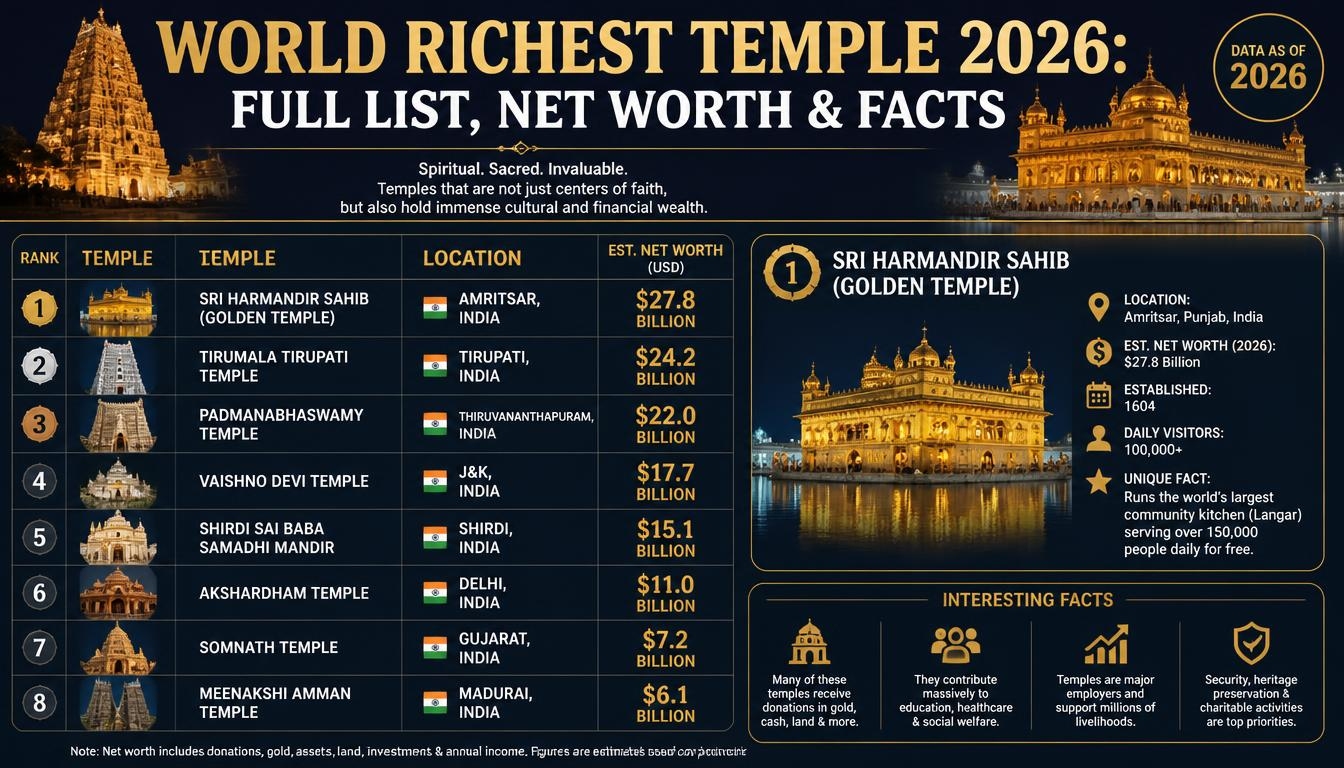
The world’s richest temples are fascinating for reasons that go far beyond money. Behind their enormous wealth are centuries of devotion, royal offerings, ancient gold ornaments, precious gemstones, valuable properties, and millions of pilgrims who visit with faith in their hearts.
India, in particular, is home to some of the wealthiest religious institutions on Earth. Some temples hold extraordinary historical treasures hidden in underground vaults, while others receive billions of rupees through daily donations and manage extensive financial investments.
But an interesting question often creates confusion: Which is the world’s richest temple in 2026? Is it the mysterious Sree Padmanabhaswamy Temple in Kerala, or the famous Tirupati Balaji Temple in Andhra Pradesh?
The answer depends on how temple wealth is measured. Padmanabhaswamy is famous for its extraordinary historical treasure, whereas Tirumala Tirupati Devasthanams (TTD) manages an enormous modern asset portfolio and generates substantial annual revenue.
In this guide, we explore the world richest temple 2026, the top 10 wealthiest religious sites in India, their estimated net worth, historical treasures, gold reserves, donations, and some remarkable facts that make each place special.
The Sree Padmanabhaswamy Temple in Thiruvananthapuram, Kerala, is widely recognized as the richest Hindu temple in the world because of its extraordinary underground treasure.
The temple became internationally famous in 2011 when a major inventory of its underground vaults revealed enormous quantities of gold, silver, diamonds, precious stones, antique coins, and royal ornaments.
According to Guinness World Records, the treasure discovered in the temple was estimated at approximately £12 billion at the time of its discovery, equivalent to around $18 billion in 2011. Guinness World Records+1
However, there is an important distinction. The Tirumala Tirupati Devasthanams is often considered India’s wealthiest operational temple trust because of its extensive deposits, properties, investments, and annual income.
Therefore, there isn’t one universally accepted financial ranking for every religious institution. Historical treasure, current financial assets, annual donations, and property holdings are different measurements.
Here is an overview of some of India’s wealthiest and most famous religious institutions. The figures are reported estimates, not a single audited international ranking.
| Temple | Location | Reported wealth or financial position |
|---|---|---|
| Sree Padmanabhaswamy Temple | Kerala | Historical treasure estimated above ₹1.2 lakh crore |
| Tirupati Balaji Temple | Andhra Pradesh | TTD assets estimated around ₹2.26 lakh crore |
| Shirdi Sai Baba Temple | Maharashtra | Estimated assets around ₹2,500–3,000 crore |
| Guruvayur Temple | Kerala | Estimated assets around ₹1,700–2,500 crore |
| Vaishno Devi Shrine | Jammu and Kashmir | More than ₹2,000 crore in reported estimates |
| Siddhivinayak Temple | Maharashtra | Estimated assets above ₹500 crore |
| Kashi Vishwanath Temple | Uttar Pradesh | Reported estimates above ₹500 crore |
| Somnath Temple | Gujarat | Significant donations, gold and property |
| Jagannath Temple | Odisha | Valuable jewellery, land and donations |
| Golden Temple | Punjab | Substantial donations and gold; no comparable official net-worth figure |
Note: The estimates for several temples come from media reports and are not directly comparable. Some describe historical treasure, while others refer to trust assets. BusinessToday+2
Sree Padmanabhaswamy Temple, Kerala – Timings, Tips & Things To Do
Sri Padmanabhaswamy Treasure Photos | Rare Indian Facts
India inicia el inventario de un tesoro valorado en 16.000 millones hallado en un templo
Famous for historical treasure
The Sree Padmanabhaswamy Temple is one of India’s most extraordinary religious landmarks. Located in Thiruvananthapuram, Kerala, this ancient Hindu temple is dedicated to Lord Vishnu, who is worshipped here in the unique Anantha Shayana posture.
Its history is closely connected with the Travancore kingdom and the Travancore royal family, which supported and protected the temple for generations.
Estimated wealth: More than ₹1.2 lakh crore in widely reported estimates of historical treasure.
The temple’s extraordinary wealth comes from centuries of royal donations and offerings made by devotees. Its underground chambers contained gold ornaments, precious stones, antique coins, golden idols, and valuable ceremonial objects.
In 2011, the discovery of the hidden treasure attracted international attention. The inventory revealed an extraordinary collection that had remained protected inside the temple for generations.
The temple is particularly famous for its six underground chambers, commonly identified as Vault A, B, C, D, E, and F.
The contents and status of the chambers should not be confused with a complete, publicly verified valuation. Vault B, in particular, has attracted considerable speculation, but claims about its contents are not established facts.
The Supreme Court of India addressed the temple’s administration and protection in its July 2020 judgment, recognizing the role of the Travancore royal family in the temple’s management arrangements. Sci API
Храм Тирумалы Венкатешвары Индия – фото, описание, адрес с картой, отзывы, достопримечательноcти Индии
July 2025 – TTD News
Pilgrimage Travel Blog | Tirupati, Shirdi & More | Balaji Tour Package
The Tirupati Balaji Temple is among the most visited and financially powerful religious institutions in the world. Situated on the Tirumala hills in Andhra Pradesh, it is dedicated to Lord Venkateswara, an incarnation of Lord Vishnu.
Millions of devotees travel here every year, offering prayers, gold, jewellery, cash, and other valuable items. Its enormous popularity makes the temple a major part of India’s religious tourism economy.
Estimated wealth: Approximately ₹2.26 lakh crore in reported TTD asset estimates.
The temple receives wealth from several different sources. Its famous hundi collections are particularly important because devotees regularly deposit cash, gold, and other offerings.
Other major income sources include:
According to its official 2026–27 budget announcement, the Tirumala Tirupati Devasthanams approved a budget of ₹5,456.26 crore. The projected hundi income alone was ₹1,880 crore, while interest from bank deposits was estimated at ₹1,205 crore. TTD News+1
One important point is that the estimated ₹2.26 lakh crore asset figure is not the temple’s annual income. It represents the reported value of the wider TTD asset portfolio.
The organization manages financial deposits, gold reserves, properties, and other investments. Its annual budget covers religious activities, pilgrim facilities, education, healthcare, employee expenses, and charitable initiatives.
Shree Saibaba Sansthan Trust, Shirdi.Official Website
sai.org.in
The Shirdi Sai Baba Temple is one of India’s most respected pilgrimage destinations. Located in Shirdi, Maharashtra, the shrine attracts devotees from different religions, communities, and backgrounds.
Sai Baba’s teachings emphasized faith, patience, kindness, and helping people in need. This message continues to attract millions of visitors.
Estimated wealth: Approximately ₹2,500–3,000 crore in reported estimates.
The Shri Saibaba Sansthan Trust manages donations, precious ornaments, financial deposits, and other institutional resources.
Its income comes from:
The trust also publishes annual financial reports, providing information about its financial activities. Shri Sai Baba Sansthan Trust+1
An interesting aspect of Shirdi’s financial management is its charitable work. The trust supports hospitals, educational institutions, medical assistance, free meals, and other welfare programmes.
During the 2025–26 Christmas and New Year festival period, the trust reported approximately ₹23.29 crore in donations from more than eight lakh visitors. It also reported substantial food distribution and gold and silver offerings. Sai Sansthan Trust
Guruvayur Sri Krishna Temple – Tourist Attraction in Kerala
cholantours.com
The Guruvayur Temple is a famous Hindu pilgrimage destination dedicated to Lord Krishna. Located in Kerala, it is sometimes described as the Dwarka of the South because of its spiritual importance.
Estimated wealth: Approximately ₹1,700–2,500 crore in reported estimates.
The temple’s wealth comes from devotee donations, gold ornaments, financial investments, land, and religious offerings. Its centuries-old traditions also contribute to its cultural importance.
Devotees visit throughout the year to participate in religious ceremonies and seek blessings. Weddings, traditional offerings, and special poojas are important parts of its religious activities.
The temple is also famous for its elephant traditions and the nearby Punnathur Kotta elephant sanctuary.
Its wealth is not simply a financial achievement. The institution also preserves religious customs and supports activities connected with its community.
Vaishno Devi Temple, Jammu & Kashmir – Temples of India Blog
blog.templesofindia.org
The Vaishno Devi Shrine is one of India’s most visited religious destinations. Situated in the Trikuta Mountains, the shrine is dedicated to Mata Vaishno Devi.
Estimated wealth: More than ₹2,000 crore in some reported estimates.
Unlike temples that are famous for ancient treasure, Vaishno Devi has a financial structure supported by pilgrimage services, devotee donations, accommodation facilities, and other activities.
Its main sources of income include:
The Shri Mata Vaishno Devi Shrine Board manages the institution and its resources. The board also supports healthcare, education, sanitation, and facilities for pilgrims.
For many devotees, reaching the shrine after a difficult mountain journey is a deeply personal experience, making this religious destination important beyond its financial position.
Top 10 Historical Sites in Mumbai to Explore by Self-Drive Car
indusgo.in
The Siddhivinayak Temple is dedicated to Lord Ganesha and is among the most famous temples in Maharashtra.
Located in Prabhadevi, Mumbai, the temple attracts businesspeople, celebrities, families, and ordinary devotees seeking blessings before important life events.
Estimated wealth: More than ₹500 crore in reported estimates.
Its financial resources come from cash donations, gold ornaments, jewellery, property, investments, and other contributions.
The temple’s location in Mumbai, India’s major commercial centre, also makes it an important destination for visitors throughout the year.
The trust supports social welfare programmes, healthcare, education, and other charitable activities.
Kashi Vishwanath Corridor Marks 3 Years with 19.13 Crore Devotees Visiting the Temple
thehawk.in
The Kashi Vishwanath Temple is one of the most sacred Hindu pilgrimage sites. Dedicated to Lord Shiva, it is situated in the historic city of Varanasi.
Estimated wealth: Some reports place its assets above ₹500 crore, although a universally accepted official net-worth figure is not available.
The temple receives donations from devotees, religious organizations, and supporters. Its gold-covered structures, religious ornaments, and extensive pilgrimage facilities add to its importance.
The temple is one of the twelve traditional Jyotirlingas of Lord Shiva. Its location near the River Ganga makes it a major destination for religious tourism.
The Kashi Vishwanath Corridor has also improved access and facilities for pilgrims, bringing renewed attention to the temple and its surrounding heritage area.
Saurashtra Darshan Tours
saurashtradarshantour.com
The Somnath Temple is one of the most historically significant Hindu temples in India.
Dedicated to Lord Shiva, it is situated near the Arabian Sea in Gujarat and is traditionally counted among the twelve Jyotirlingas.
Estimated wealth: No universally accepted net-worth figure is publicly established.
Somnath has a long history of royal patronage, donations, destruction, and reconstruction. Its religious importance has remained strong across generations.
The temple receives contributions from pilgrims, donations, gold offerings, and supporters. Its trust also manages religious facilities and activities.
Rather than focusing on an unverified billion-dollar valuation, it is more accurate to recognize Somnath for its historical importance, cultural heritage, and continued devotional support.
Enchanting land of sacred souls
incredibleindia.gov.in
The Jagannath Temple is one of India’s most important pilgrimage destinations. Dedicated to Lord Jagannath, the temple has a deep connection with Odisha’s religious and cultural traditions.
Estimated wealth: No reliable consolidated net-worth figure is publicly established.
The temple holds valuable jewellery, gold ornaments, traditional treasures, and land-related assets. Its historical collection is particularly significant to devotees and cultural historians.
The famous Rath Yatra festival attracts enormous crowds every year. During this celebration, the deities are carried in magnificent wooden chariots through the streets of Puri.
The temple’s Mahaprasad tradition is another important attraction. Its religious customs and historical treasures make it one of India’s most remarkable spiritual institutions.
Golden Temple
Golden Temple views at night: in photos | Condé Nast Traveller India
In the langar at Golden Temple – The Tribune
The Golden Temple, officially known as Harmandir Sahib, is the holiest shrine of Sikhism.
Situated in Amritsar, Punjab, the shrine is recognized worldwide for its beautiful golden architecture, peaceful atmosphere, and tradition of serving free meals to visitors.
Estimated wealth: No comparable, independently verified total net-worth figure is publicly established.
The Golden Temple is famous for its gold-covered exterior and historical jewellery. Its financial resources come from voluntary donations, offerings, and contributions made by Sikh devotees and supporters.
However, the value of its gold-covered structure should not automatically be treated as the total wealth of the religious institution.
One of the most beautiful features of Harmandir Sahib is its langar, a community kitchen that serves free meals to visitors regardless of their background, religion, or financial position.
Volunteers participate in preparing food, cleaning utensils, and serving visitors. This tradition demonstrates that religious wealth can also be measured through generosity and public service.
When discussing the world richest temple net worth, it is important to understand that every temple does not calculate its wealth in the same way.
A temple may have billions of rupees in historical gold, while another institution may hold substantial bank deposits and generate thousands of crores in annual revenue.
Here are the main categories that explain temple wealth.
Historical treasure includes gold coins, royal jewellery, precious gemstones, antique ornaments, silver utensils, and other valuable objects accumulated over centuries.
Padmanabhaswamy Temple is the most famous example of this type of wealth.
Donations are contributions made by devotees through hundi boxes, online payments, donation counters, and special religious offerings.
Tirupati and Shirdi receive enormous contributions through these channels.
Many Indian temples maintain gold reserves collected through generations of religious offerings. Some gold is used for ornaments and religious ceremonies, while other holdings may be deposited or managed according to institutional policies.
Temple trusts may own agricultural land, buildings, accommodation facilities, fixed deposits, and other financial assets.
These holdings can contribute significantly to the overall financial strength of a religious institution.
This is one of the most frequently discussed comparisons among people researching India’s wealthiest religious institutions.
Both temples are extraordinarily wealthy, but their financial strengths come from different sources.
| Comparison | Padmanabhaswamy Temple | Tirupati Temple |
|---|---|---|
| Location | Kerala | Andhra Pradesh |
| Main deity | Lord Vishnu | Lord Venkateswara |
| Famous for | Historical underground treasure | Donations and financial assets |
| Wealth type | Ancient gold and gemstones | Deposits, gold, land and investments |
| Major discovery | 2011 treasure inventory | Extensive institutional asset portfolio |
| Public financial picture | Treasure estimates | Published budgets and asset estimates |
The important difference is that Padmanabhaswamy’s estimated treasure value is not the same thing as an institution’s current financial assets.
Similarly, the ₹2.26 lakh crore estimate associated with TTD should not be described as its annual income.
So, which temple wins? Padmanabhaswamy is widely recognized for its extraordinary historical treasure, while TTD has a particularly strong claim to being India’s wealthiest operational temple trust.
People searching for the world richest temple near Punjab or the richest temple near Bathinda may be interested in visiting a famous religious destination closer to their region.
The Golden Temple in Amritsar is the most prominent wealthy Sikh shrine in Punjab.
Best Places to Visit in Amritsar | Incredible India
incredibleindia.gov.in
Harmandir Sahib is located in Amritsar and is famous for its golden architecture, historical significance, and community kitchen.
It receives voluntary donations from devotees and visitors throughout the year. Its exact total net worth is not publicly established through a comparable audited valuation.
The Golden Temple is a Sikh shrine, not a Hindu temple. Therefore, it is important to distinguish religious traditions when comparing wealthy religious places.
For people looking specifically for Hindu temples in Punjab, there are several important regional pilgrimage destinations, but no reliable official ranking establishes one as the richest.
Bathinda has several local religious destinations, but the Golden Temple in Amritsar is among Punjab’s best-known major shrines.
For someone interested in the largest historical temple treasures, Padmanabhaswamy Temple in Kerala is a much more distant destination.
Kerala has several famous temples, but Sree Padmanabhaswamy Temple is particularly well known for its extraordinary treasure.
Its location in Thiruvananthapuram makes it an important destination for religious tourism and historical exploration.
Another important religious destination is Guruvayur Temple, dedicated to Lord Krishna.
Both temples have valuable religious collections, long-standing traditions, and strong connections with Kerala’s cultural heritage.
The wealth of Indian temples is not created through a single source. It develops over many generations through donations, religious activities, property, investments, and historical contributions.
Here are some of the major ways religious institutions build and maintain their financial resources.
These sources help temples maintain their buildings, organize festivals, support pilgrims, and fund charitable programmes.
There are several interesting facts about wealthy temples that are worth understanding before comparing their financial positions.
Sree Padmanabhaswamy Temple in Kerala is widely recognized as the world’s richest Hindu temple because of its extraordinary historical treasure of gold, diamonds, antique coins, and precious ornaments.
The answer depends on the measurement. Padmanabhaswamy is famous for historical treasure, while Tirumala Tirupati Devasthanams manages an exceptionally large institutional asset portfolio.
The historical treasure of Padmanabhaswamy Temple has been reported at more than ₹1.2 lakh crore. However, this is an estimated valuation rather than a recently audited total net worth.
Tirupati is considered one of India’s wealthiest operational temple institutions. TTD manages gold deposits, bank investments, land, and other financial assets, with reported asset estimates around ₹2.26 lakh crore.
Its wealth accumulated through centuries of royal patronage, offerings from devotees, gold jewellery, precious stones, ancient coins, and other valuable objects.
The temple’s 2011 inventory revealed substantial quantities of gold ornaments, coins, jewellery, and precious objects. However, there is no simple, fully verified public figure for all its gold holdings.
Vault B has remained the subject of religious, historical, and legal discussions. Claims about supernatural dangers or enormous hidden treasures should be treated as speculation rather than verified information.
The six commonly identified underground chambers are Vault A, Vault B, Vault C, Vault D, Vault E, and Vault F. Their contents and inspection histories are not identical.
There is no universally accepted international ranking that establishes a definitive second-place temple. Tirupati is frequently discussed as a leading contender because of its enormous assets and income.
Read ARticul: https://templetimingsdaily.com/tadbund-hanuman-temple-timings-2026/
The Golden Temple in Amritsar is Punjab’s most famous wealthy religious shrine. It is a Sikh religious institution, and its exact overall net worth is not publicly established through a comparable valuation.
The Golden Temple in Amritsar is among the most prominent major religious destinations in Punjab for visitors from Bathinda. However, it should not be confused with a verified ranking of nearby temples by wealth.
Sree Padmanabhaswamy Temple in Thiruvananthapuram is widely recognized as Kerala’s richest temple because of its extraordinary historical treasure.
Padmanabhaswamy Temple is particularly famous for its historical gold and jewellery collection. However, a definitive comparison of the total gold holdings of every Indian temple is not publicly available.
Temple donations support religious ceremonies, building maintenance, pilgrim facilities, charitable hospitals, education, free meals, and community welfare programmes, depending on the institution’s rules and responsibilities.
The top five wealthiest temples commonly include Padmanabhaswamy Temple, Tirupati Temple, Shirdi Sai Baba Temple, Siddhivinayak Temple, and the Golden Temple, based on reported wealth estimates.
Duniya ka sabse amir mandir is Sree Padmanabhaswamy Temple in Kerala, India, famous for its enormous collection of gold, diamonds, jewelry, and ancient treasures.
Tirupati Temple is considered one of the wealthiest temples globally and is often ranked second after Padmanabhaswamy Temple due to its massive donations and valuable assets.
Sree Padmanabhaswamy Temple is widely regarded as the richest temple in the world, with its historic underground vaults reportedly containing treasures worth billions of dollars.
Sree Padmanabhaswamy Temple in Thiruvananthapuram, Kerala, is widely recognized as the world’s richest temple because of its extraordinary gold, precious stones, and historic royal treasures.
If you are researching the top 10 richest temples in India, always check what a reported financial figure actually represents.
A few simple checks can help you avoid misleading information:
This approach gives readers a much clearer understanding of temple wealth instead of relying on sensational headlines.
The search for the world richest temple 2026 reveals an extraordinary part of India’s cultural and religious history. From the mysterious underground treasures of Sree Padmanabhaswamy Temple to the enormous financial assets of Tirupati Balaji, each institution has its own story of devotion, tradition, and generosity.
Shirdi Sai Baba Temple, Golden Temple, Vaishno Devi Shrine, Guruvayur Temple, and other famous religious destinations also demonstrate how faith has supported remarkable institutions over generations.
Ultimately, wealth is not the only thing that makes these places special. Their charitable activities, free food services, preservation of heritage, and support for millions of devotees give them a value that cannot be measured in rupees or dollars.
The Padmanabhaswamy Temple may hold one of the world’s most extraordinary historical treasures, but the generosity and devotion behind every offering are equally remarkable.
Which temple do you think deserves the title of the world’s richest temple? Share your thoughts and favourite temple in the comments!