Physical Address
304 North Cardinal St.
Dorchester Center, MA 02124
Physical Address
304 North Cardinal St.
Dorchester Center, MA 02124

There are some places in Bengaluru where the city seems to lower its voice for a little while. ISKCON Temple Bangalore is one of those places. You may arrive after travelling through traffic, horns, shops and the usual impatient rhythm of the city, and
then, almost strangely, find yourself walking toward a hill where bells, kirtans and the fragrance of flowers create a different sort of morning. It is not only a temple visit, really; for many people it becomes a small pause in a very busy life.
The temple officially known as the ISKCON Sri Radha Krishna Temple stands on Hare Krishna Hill in Rajajinagar, Bengaluru, Karnataka.
It is associated with the International Society for Krishna Consciousness (ISKCON) and is centred on devotional practices connected with Krishna Consciousness, Bhagavad Gita teachings and Srimad Bhagavatam.
The complex has also grown into a place for cultural activities, food distribution, spiritual education and community service. ISKCON Bangalore+1
One important thing before you plan your visit: people sometimes use “ISKCON Bangalore” for two different temple complexes.
The principal Sri Radha Krishna Temple at Hare Krishna Hill, Rajajinagar, and ISKCON Vaikuntha Hill at Vasanthapura on Kanakapura Road are separate places.
Their deities, schedules and locations are not identical, so mixing the two can turn an otherwise peaceful temple trip into a rather confusing auto ride across Bengaluru. The details below keep these two locations separate wherever it matters. ISKCON Bangalore+1
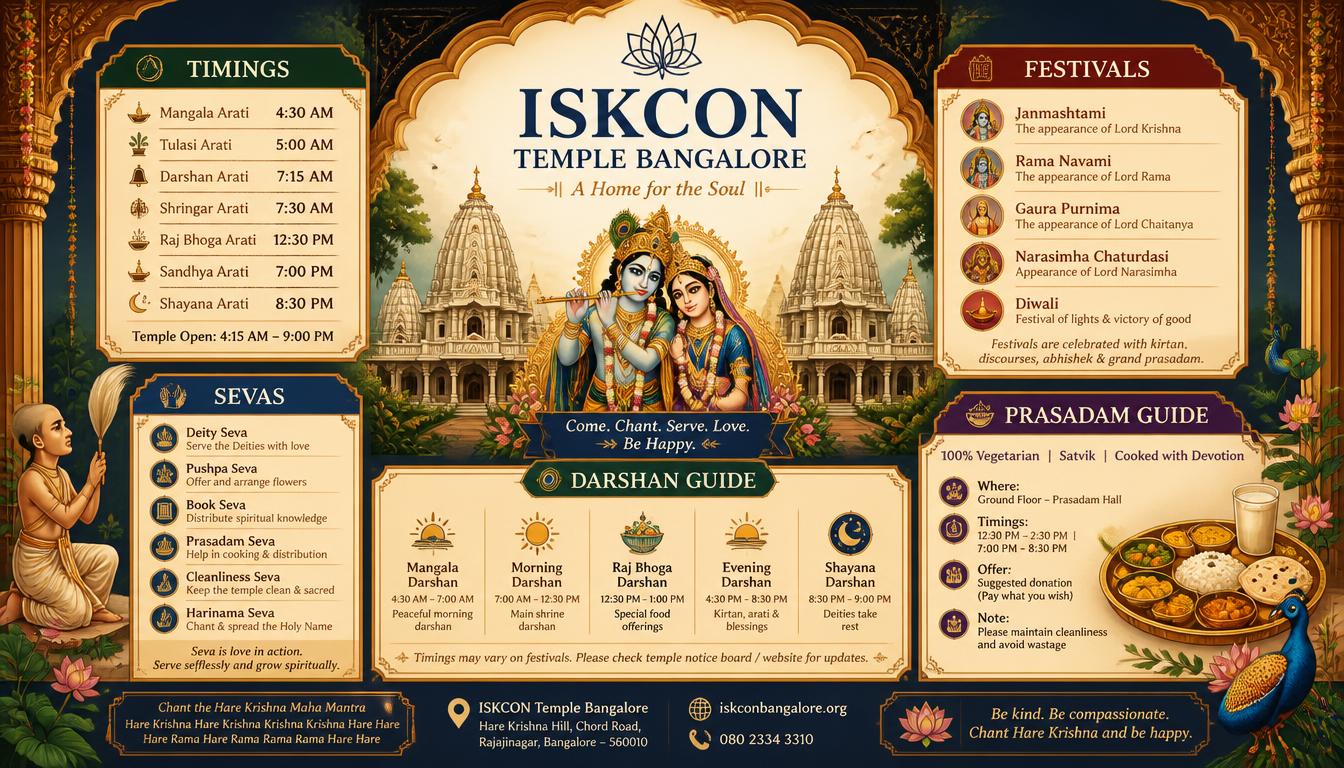
For most visitors, the first question is simple: what are the ISKCON Temple Bangalore timings? At the Hare Krishna Hill, Rajajinagar temple, the official published darshan timings are 4:30 am to 5:20 am and 7:15 am to 1:15 pm in the morning, followed by 4:15 pm to 8:20 pm in the evening.
On Saturdays, Sundays and public holidays, the morning darshan extends from 7:15 am through 8:20 pm, apart from the early 4:30 am–5:20 am session. The temple lists entry as free, although parking and footwear-stand charges may apply. ISKCON Bangalore
That schedule makes the temple interesting for very different kinds of visitors. An early riser might come for Mangala Arati, while a family may prefer the more comfortable 7:15 am Shringara Darshana Arati. Someone working in the city could instead arrive after 4:15 pm for the evening darshan.
There is no one “correct” time, thankfully, because spirituality would be a funny thing if it came with office-hour rules.
The detailed daily schedule begins with the morning program. Mangala Arati is at 4:30 am, followed by Tulasi Puja at 4:45 am and Narasimha Arati at 5:00 am.
At 5:10 am, devotees participate in the Suprabhata Seva for Sri Srinivasa Govinda, while 5:30 am includes Nitya Shodasha Upachara Puja and Japa Meditation. The principal morning darshan opens again at 7:15 am for Shringara Darshana Arati and Guru Puja. ISKCON Bangalore
At 8:30 am, a Srimad Bhagavatam lecture is held, which can be especially worthwhile if your interest extends beyond simply seeing the temple.
The midday Rajbhog Arati is scheduled for 12:30 pm, while the evening sequence begins with Dhupa Arati at 4:15 pm, followed by Tulasi Puja at 6:45 pm, Sandhya Arati at 7:00 pm, and Shayana Arati at 8:15 pm. Darshan closes after the concluding evening rituals. ISKCON Bangalore
If your aim is a peaceful darshan rather than a very crowded experience, a weekday morning outside the major festival rush can be a sensible choice.
Festival days are beautiful, yes, but they can also be extremely busy. The temple itself advises visitors to allow roughly one to two hours for darshan at the Rajajinagar complex. ISKCON Bangalore
The ISKCON Bangalore darshan timings make it possible to choose your visit according to the experience you want.
The official schedule notes that the morning program is deeply connected with the Vaishnava devotional routine, including japa meditation, Deity worship, kirtan and scriptural hearing.
So, if you have time, don’t rush in, take one photograph and rush out again. Sitting quietly for ten minutes can sometimes be the part you remember later.
The word seva means devotional service, and at ISKCON it is much broader than a single ritual. Visitors can encounter different forms of worship, offerings, meditation and festival-related service.
Mangala Arati is the first major public worship of the day. The official temple schedule describes the ceremony as involving offerings such as incense, lamps, water, cloth and flowers, accompanied by devotional singing.
It has that unmistakable early-morning quality where even the city outside seems, for a moment, to be somewhere very far away. I ISKCON Bangalore
Tulasi Puja takes place twice daily, at 4:45 am and 6:45 pm. Tulasi is deeply revered within the Vaishnava tradition, and the worship includes prayers, arati and circumambulation.
Narasimha Arati follows the early morning Tulasi worship, honouring Lord Narasimha and recalling the protection of devotee Prahlada. ISKCON Bangalore
Visitors can also encounter Suprabhata Seva, Japa Meditation, Shringara Darshana Arati, Guru Puja, Rajbhog Arati, Dhupa Arati, Sandhya Arati and Shayana Arati in the daily schedule.
Special sevas and abhishekams may have separate arrangements, particularly during festivals, so it is wise to check the official temple information before planning around a particular seva. ISKCON Bangalore
The principal deities at the Hare Krishna Hill complex include Sri Radha Krishnachandra, Sri Krishna Balarama, Sri Nitai Gauranga, Sri Srinivasa Govinda and Sri Prahlada Narasimha.
The presence of these different Deity forms is part of what makes the complex more than a single sanctum visit. ISKCON Bangalore
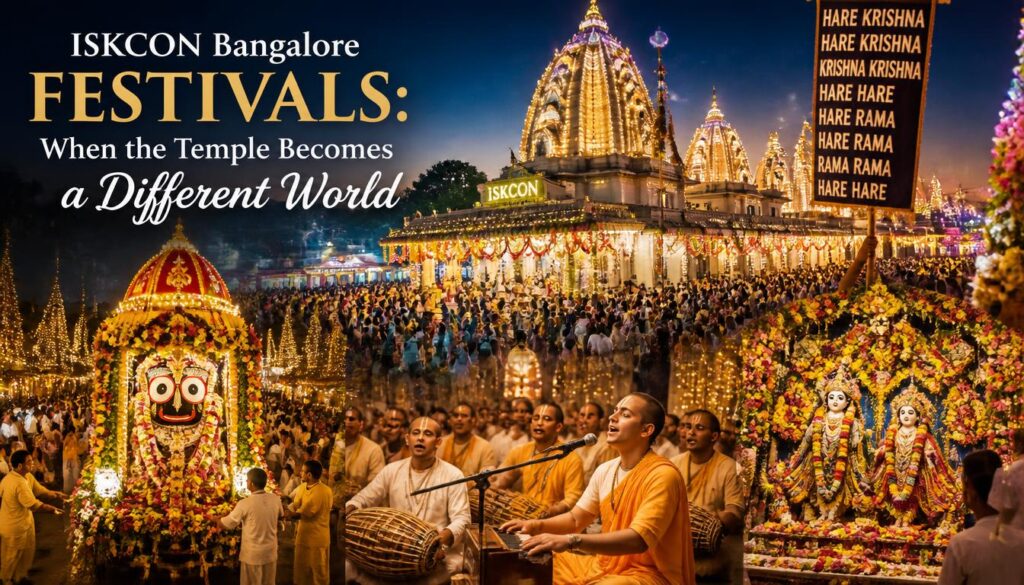
If the everyday temple is peaceful, festival days can feel almost like Bengaluru has temporarily become another city.
The annual calendar includes major celebrations such as Sri Gaura Purnima, Sri Rama Navami, Brahmotsava, Narasimha Jayanti, Jhulan Utsava, Balarama Purnima, Sri Krishna Janmashtami, Vyasa Puja, Radhashtami, Vamana Jayanti, Deepotsava, Govardhana Puja, Gita Jayanti and Vaikuntha Ekadashi.
The official festival calendar is the safest place to confirm dates because festival dates follow the Vaishnava calendar and therefore move from year to year. ISKCON Bangalore
As of the current 2026 calendar, Jhulan Utsava is listed for August 23–28, Balarama Purnima for August 28, Sri Krishna Janmashtami for September 3–4, and Vyasa Puja for September 5. Gita Jayanti is listed for December 20, while Sri Gaura Purnima is scheduled for March 22, 2027. ISKCON Bangalore
Among all the celebrations, Janmashtami at ISKCON Bangalore is perhaps the one most people immediately associate with the temple.
The official account describes extensive preparations, temple decoration, devotional singing, darshan and prasadam as central elements of the celebration. ISKCON Bangalore
If you plan to attend Sri Krishna Janmashtami, don’t assume that ordinary weekday timings will apply. Festival arrangements can involve extended hours, crowd-management measures, special queues and changed access arrangements.
Check the official festival announcement close to your visit rather than trusting an old blog post from somebody’s 2019 trip, which is a very Bengaluru way to accidentally create a three-hour queue.
The temple also celebrates Krishna Balarama Ratha Yatra, a chariot festival connected with the wider Vaishnava tradition and the famous Ratha Yatra heritage of Jagannath Puri.
The temple’s festival calendar explains that the event brings devotional music, processions and public participation into the celebration. ISKCON Bangalore
Other festivals bring their own flavours flower decorations, special abhishekam, cultural performances, spiritual talks, kirtans and elaborate offerings.
The result is not simply a religious ceremony but a community gathering where children, families, long-time devotees and curious first-time visitors may all find something meaningful.
There is a reason people often remember the food almost as vividly as the architecture.
ISKCON Bangalore prasadam refers to vegetarian food offered to Lord Krishna and then distributed as sanctified food. The tradition is not treated merely as a cafeteria service.
Food distribution has been part of ISKCON’s wider mission from its early years, and the Bangalore temple connects its present programs with Srila Prabhupada’s emphasis on ensuring that people receive prasadam. I ISKCON Bangalore+1
The temple’s Nitya Annadanam program provides free lunch prasadam to temple visitors every day from 11:30 am to 2:00 pm. The official site describes it as a service for hundreds of pilgrims, and the program has been running since 2015. ISKCON Bangalore+1
For visitors, this creates a rather nice rhythm: darshan in the morning, some quiet time around the temple, and then a simple vegetarian meal.
If you’re travelling with elders or children, remember that free food service does not mean unlimited leisurely restaurant seating; on busy days the flow can be substantial, so follow the volunteers and temple instructions.
The larger food-service philosophy also connects with the Akshaya Patra Foundation, an initiative associated with ISKCON Bangalore that provides mid-day meals to children in schools, particularly
supporting children from disadvantaged communities. This is one reason the temple’s identity extends beyond worship into education and social service. ISKCON Bangalore+1
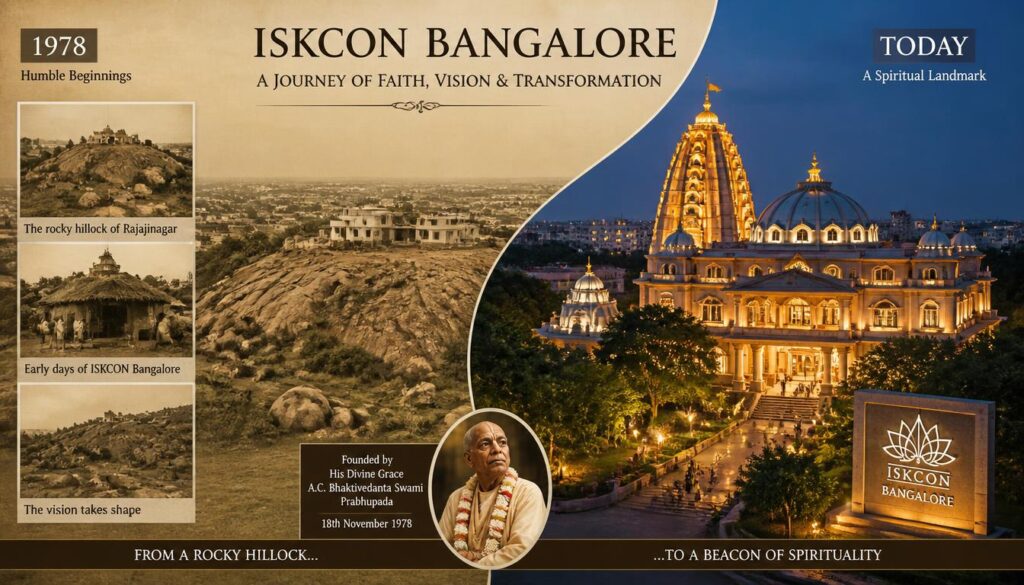
The ISKCON Bangalore history is surprisingly dramatic when you look at what stood on Hare Krishna Hill before the temple was built.
The Bangalore society was registered on May 8, 1978, under the Karnataka Societies Registration Act. In the late 1980s, the society sought land for a major temple and cultural complex.
In 1988, the Bangalore Development Authority allotted a seven-acre hillock that was essentially a huge rocky monolith and had been described as “karaab land,” or wasteland.
A temporary temple was then established, and the Deities of Sri Krishna Balarama were moved there in September 1988. ISKCON Bangalore
The eventual temple design emerged under the guidance of Sri Madhu Pandit Dasa, a civil engineer educated at IIT-Bombay, with architectural and engineering assistance from Sri Jagat Chandra Dasa.
Construction began in 1990, and the completed complex was inauguated by the then President of India, Dr. Shankar Dayal Sharma, on May 31, 1997. IISKCON Bangalore
The architecture itself reflects an unusual marriage of old and new. The temple combines elements of traditional Dravidian architecture and gopuram-inspired forms with modern construction and glass.
According to the temple’s history, hundreds of skilled craftsmen contributed millions of man-hours to the project. Looking at the finished structure now, it is easy to forget that the hill began as an awkward piece of rock that nobody quite knew what to do with.
The temple’s physical setting matters. It rises above the surrounding city on Hare Krishna Hill, creating a sense of separation without actually taking you far away from Bengaluru’s urban core.
Inside, the devotional focus naturally turns toward the Deities. Sri Radha Krishnachandra and Sri Krishna Balarama occupy an especially prominent place, while Sri Nitai Gauranga, Sri Srinivasa Govinda and
Sri Prahlada Narasimha enrich the wider devotional landscape. The temple describes these Deities as having been central to its life since 1997. I ISKCON Bangalore
The complex is also known for its architectural scale, gardens and visitor-oriented spaces. Yet the most memorable detail for many people is not necessarily the stone, glass or towering forms.
It may be the sound of a Hare Krishna kirtan travelling across the hall while people stand silently for darshan. Architecture gives a temple its shape; atmosphere gives it its memory.
Here is the distinction worth putting in bold because it prevents a surprisingly common mistake: ISKCON Vaikuntha Hill is not the same temple as the Rajajinagar Hare Krishna Hill complex.
ISKCON Vaikuntha Hill is in Vasanthapura on Kanakapura Road, Bengaluru, and is associated with the Sri Rajadhiraja Govinda Temple. Its published schedule includes darshan from 4:30 am to 5:00 am
and 7:15 am to 12:40 pm in the morning, followed by 4:15 pm to 8:10 pm in the evening. Weekend and public-holiday timings are longer. ISKCON Bangalore
The Vaikuntha Hill temple has its own daily schedule, including Mangala Arati, Tulasi worship, japa meditation, aratis at several shrines, Guru Puja and scriptural classes. Its evening darshan begins at 4:15 pm, with Sandhya Arati at 7:00 pm and Shayana Arati around 8:00 pm. ISKCON Bangalore
So if someone tells you, “Go to ISKCON Bangalore, it’s near Rajajinagar,” they are talking about Hare Krishna Hill. If your destination says Vasanthapura or Kanakapura Road, you’re heading to Vaikuntha Hill. Similar name, different temple, different side of the city. Bengaluru traffic will appreciate you getting this right.
For the Rajajinagar temple, visitors generally use city buses, taxis, app-based cabs and auto-rickshaws, depending on where they begin their journey. Chord Road is an important reference point when navigating toward Hare Krishna Hill, and the temple is relatively accessible from the central Bengaluru area.
If you are arriving by train, Bengaluru City Railway Station at Majestic is a useful major transport reference. From there, a cab, auto or public transport connection can be used depending on traffic and the time of day.
From Kempegowda International Airport, the journey is considerably longer, so allow generous travel time rather than trusting a wonderfully optimistic navigation estimate at 5 pm.
For the Vaikuntha Hill complex, use Vasanthapura and Kanakapura Road as your main location references. Do not simply enter “ISKCON Bangalore” into a cab app and jump in without checking the displayed destination.
This tiny precaution can save you from discovering halfway through the ride that you are visiting the correct organisation but the wrong hill.
The temple’s visitor guidance recommends formal or traditional clothing and asks visitors to avoid shorts and overly casual attire. Entry itself is free, while nominal charges may apply for facilities such as parking or the footwear stand. ISKCON Bangalore
During darshan, modesty and patience matter more than knowing every ritual beforehand. You do not need to arrive as a religious scholar. Observe the queues, listen to volunteers, avoid blocking pathways for photographs and keep your voice low in worship areas.
Photography rules and access arrangements can vary by area or special event, so visitors should follow the signs and current instructions rather than assuming that because someone else took a photograph, every corner is automatically open for cameras.
If you are travelling with small children, don’t make the entire outing a test of their spiritual discipline. Let them look at the architecture, hear the music and ask questions.
A child who remembers “the place where everyone sang together” may have received more from the visit than a child who was forced to stand perfectly still for an hour.
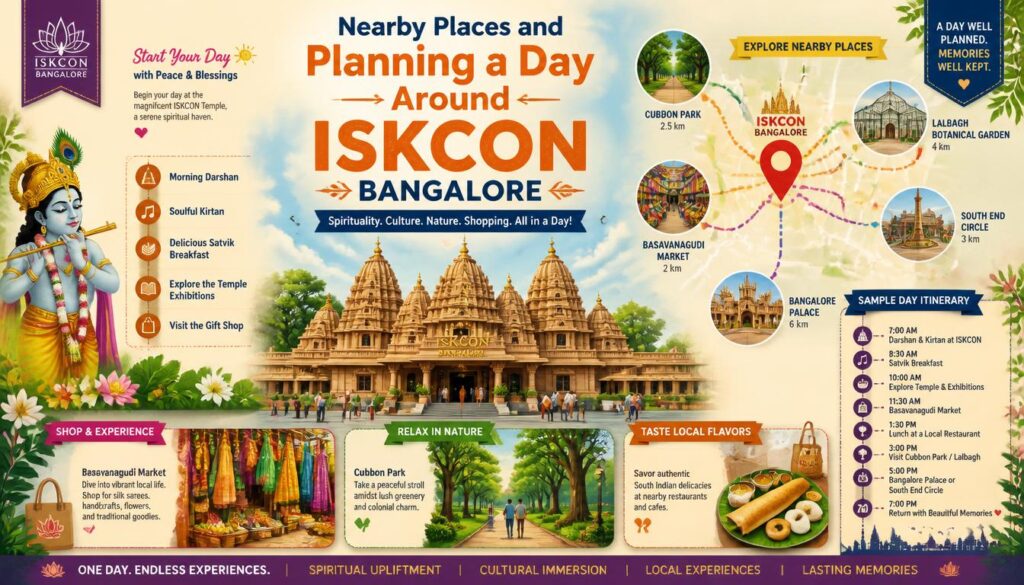
A visit to ISKCON Temple Bangalore can easily become part of a broader Bengaluru itinerary. Depending on your interests, you might combine the temple with parks, cultural attractions, historical sites or family-oriented destinations elsewhere in the city.
Places commonly considered for a wider Bengaluru sightseeing plan include JP Park, Jawaharlal Nehru Planetarium, Bangalore Fort, St. Mary’s Basilica, Fun World, Turahalli Forest, Pyramid Valley and Bannerghatta Zoo.
They are not all immediately next door, so treat “nearby places” as a city itinerary rather than assuming everything can be covered in a ten-minute walk.
For accommodation, travellers can look at hotels around Rajajinagar, central Bengaluru and other well-connected neighbourhoods instead of limiting themselves strictly to a hotel beside the temple.
Your best choice depends heavily on whether the temple is your main purpose or just one stop in a larger Bengaluru trip.
The best time to visit ISKCON Bangalore depends on what you actually want from the visit.
For a quieter experience, a regular weekday morning is generally more sensible than a major festival evening. For devotional participation, choose one of the scheduled aarti periods.
For food service, plan around the Nitya Annadanam lunch period. For the full festival atmosphere, accept that crowds are part of the experience and plan accordingly.
Personally, there is something special about arriving around the morning darshan rather than treating the temple like another tourist attraction to tick off. The city is waking up, the temple is already alive, and the contrast is rather beautiful. You don’t have to be a lifelong devotee to appreciate it.
If this is your first ISKCON temple visit, keep the day uncomplicated.
Arrive with enough time to park or get dropped off, dress respectfully and enter without trying to photograph everything immediately. Spend time at the main temple, observe the Sri Radha Krishnachandra, Krishna Balarama and other Deities, and listen to the kirtan if one is taking place.
If your schedule permits, attend the 7:15 am Shringara Darshana Arati, explore the complex afterward and consider the 8:30 am Srimad Bhagavatam lecture. Later, you may have the Nitya Annadanam lunch between 11:30 am and 2:00 pm. ISKCON Bangalore+1
Or come in the evening and experience Sandhya Arati at 7:00 pm, followed by the atmosphere leading toward Shayana Arati. Either way, leave some unplanned time. Temples are not museums where every minute needs to be accounted for, and a little wandering is sometimes the nicest part.
A useful guide can tell you that ISKCON Bangalore timings begin as early as 4:30 am, that darshan resumes at 7:15 am, that evening worship begins at 4:15 pm, and that Nitya Annadanam is served from 11:30 am to 2:00 pm. Those details are important, certainly. But they don’t really explain why people return.
The deeper attraction is the combination of worship, music, architecture, food, learning and service. The teachings of Srila Prabhupada, the chanting of the holy names,
the study of Bhagavad Gita and Srimad Bhagavatam, and the temple’s charitable initiatives all form part of the broader Krishna Consciousness tradition represented here. ISKCON Bangalore+1
And perhaps that is the nicest way to approach the temple: not as a place where you must already know what everything means, but as a place where you can slow down enough to notice something.
Check the official schedule before travelling, especially on festivals and public holidays, because timings and visitor arrangements can change. The official ISKCON Bangalore website is the best source for current darshan, festival and temple information. ISKCON Bangalore+1
Most of all, remember the Hare Krishna Hill and Vaikuntha Hill distinction before you leave home. It sounds like a small detail, but in Bengaluru, small geographical details have a habit of becoming large stories.
Official ISKCON Bangalore website