Physical Address
304 North Cardinal St.
Dorchester Center, MA 02124
Physical Address
304 North Cardinal St.
Dorchester Center, MA 02124

There are some places in Bengaluru where the city seems to lower its voice for a while, and ISKCON Temple Bangalore is one of them.
Perched on Hare Krishna Hill in Rajajinagar, the temple feels like a meeting point of devotion, music, architecture, food, learning, and everyday service.
You may arrive as a curious traveller, a Krishna devotee, a family looking for a peaceful morning, or simply someone who wants a few quiet minutes away from the traffic and somehow the visit can become more memorable than expected.
The temple, officially known as the Sri Radha Krishna Temple, attracts lakhs of devotees and tourists every year. The sound of bhajans, the sight of beautifully decorated deities, the rhythm of aarti and the atmosphere around the hill create an experience that is difficult to describe with only the word “temple”.
It is, in many ways, a living spiritual centre. The information in this guide covers ISKCON Temple Bangalore timings, darshan, daily sevas, festivals, prasadam, history, travel details and practical suggestions, so you can plan your visit without running around at the last minute.
The ISKCON Temple Bangalore, also called the Sri Radha Krishna Temple, is one of the prominent spiritual centres in Karnataka.
It operates under the guidance of Sri Madhu Pandit Dasa, who has played an important role in the development of ISKCON Bangalore and its various spiritual and social initiatives.
The temple officially opened on 31 May 1997, with the inauguration performed by former President of India Dr. Shankar Dayal Sharma.
Its philosophy is rooted in Krishna Consciousness, with the Bhagavad Gita and Srimad Bhagavatam forming important foundations of its teachings.
But the place doesn’t stop at worship. Spiritual talks, devotional singing, public kirtans, youth programmes, cultural activities and food-distribution initiatives are also part of the temple’s wider mission. That combination of prayer and practical service is what gives the complex its rather distinctive character.
Knowing the ISKCON Temple Bangalore timings before leaving home is a small thing, but it can save you from arriving just when one darshan session is ending.
The source schedule describes a daily routine beginning very early in the morning and continuing through the evening, with a break in the afternoon.
The general daily darshan schedule given is 4:15 AM to 5:00 AM, 7:15 AM to 1:00 PM, and 4:15 PM to 8:20 PM from Monday to Sunday.
The early morning period is especially suited to people who enjoy quieter temple visits. There is something quite different about seeing the temple before Bengaluru has properly woken up;
the atmosphere feels slower, almost as if the day has not yet started making demands. Weekends and festival days can become substantially busier, so reaching early is a sensible little trick.
The source also notes that festival schedules may differ because major celebrations, special poojas and Krishna-related occasions can involve extended opening hours.
So, if you’re travelling specifically for Janmashtami, Ratha Yatra, Deepotsava or another major celebration, checking the day’s schedule with the temple is wise rather than assuming the ordinary timetable will apply.
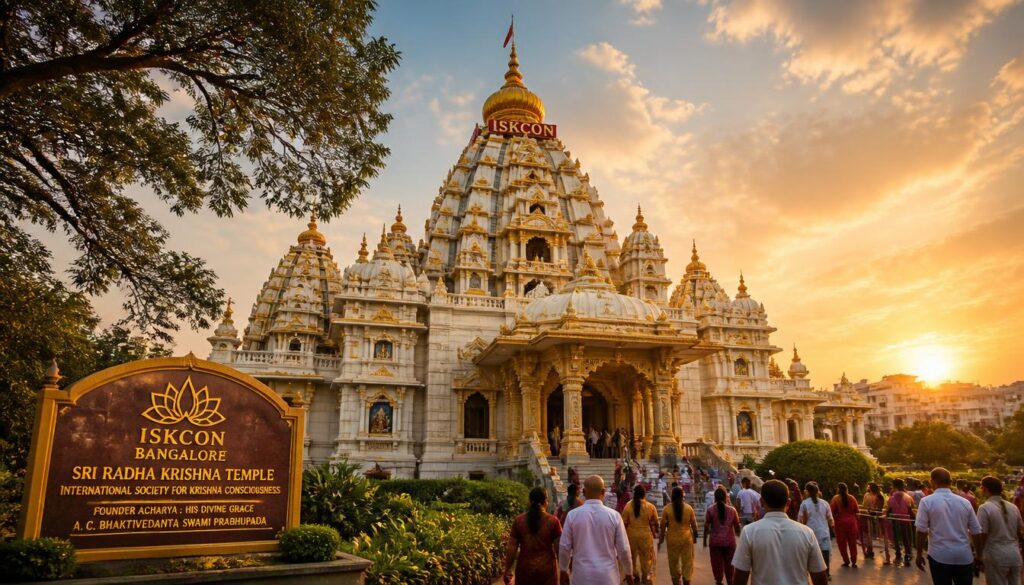
For devotees primarily interested in darshan, the Rajajinagar temple has separate sessions that make planning a little easier.
The source gives weekday timings of 4:30 AM to 5:20 AM for the early morning session, 7:15 AM to 1:15 PM for the morning-to-afternoon session, and 4:15 PM to 8:00 PM in the evening.
On Saturdays, Sundays and public holidays, the source lists the early morning darshan as 4:30 AM to 5:20 AM, followed by 7:15 AM to 8:20 PM for the longer morning-to-evening period. The extended schedule makes sense because weekends generally bring a heavier flow of devotees.
There is an important detail here: the source presents both a general daily schedule and a more specific Rajajinagar darshan schedule, with slightly different morning opening figures.
For practical planning, visitors should treat these as schedule references rather than assuming every ritual begins at exactly the same minute every day.
Festival arrangements and temple activities can change the flow too, so a quick confirmation before travelling is still the safest choice.
Bengaluru has another significant ISKCON centre at Vaikuntha Hill in Vasanthapura, on Kanakapura Road. This temple is dedicated to Sri Rajadhiraja Govinda, a form of Lord Venkateswara, and has a traditional stone-carved Dravidian architectural character. The source lists its daily opening hours as 4:15 AM to 1:00 PM and 4:15 PM to 8:30 PM.
For Vaikuntha Hill, weekday darshan is listed as 4:30 AM to 5:00 AM, 7:15 AM to 12:40 PM, and 4:15 PM to 8:10 PM. On weekends and public holidays,
the listed sessions are 4:30 AM to 5:00 AM, 7:15 AM to 1:10 PM, and 4:15 PM to 8:25 PM. If your destination is Vaikuntha Hill rather than the Rajajinagar temple, don’t mix the two schedules up Bengaluru has two distinct ISKCON experiences here.
A visit becomes more meaningful when you understand what is happening rather than simply walking through the temple at a convenient hour. The daily routine at ISKCON Bangalore includes a sequence of sevas, aartis, meditation, worship and spiritual discourse, beginning in the early morning and continuing until night.
The listed daily schedule begins with Mangala Arati at 4:15 AM, followed by Tulasi Puja at 4:45 AM, Narasimha Arati at 5:00 AM, Suprabhata Seva at 5:10 AM, and Japa Meditation and Puja at 5:20 AM. The morning then moves towards Shringara Darshana Arati at 7:15 AM and a Bhagavatam Discourse at 8:30 AM.
Later in the day, Rajbhog Arati is listed at 12:30 PM, followed by Dhupa Arati at 4:15 PM, Evening Tulasi Puja at 6:45 PM, Sandhya Arati at 7:00 PM, and Shayana Arati at 8:15 PM.
The rhythm is quite lovely when experienced in person not just one grand moment, but a chain of small devotional moments spread across the day.
Some special sevas may require advance booking or registration, particularly around crowded occasions such as Janmashtami, Ratha Yatra and Gaura Purnima.
If participating in a specific seva is the main purpose of your visit, it is better to ask the temple office about availability instead of arriving with an assumption.
If ordinary temple days feel peaceful, festival days feel like the volume of devotion has been turned up. ISKCON Bangalore festivals are celebrated with decorations, devotional music, kirtans, special abhishekas, grand aartis, spiritual talks and cultural programmes.
Some celebrations also include prasadam distribution, bringing the devotional gathering into something more communal and warm.
The annual calendar includes Sri Gaura Purnima, commemorating the appearance of Lord Chaitanya Mahaprabhu; Sri Rama Navami, associated with Lord Rama; Brahmotsava, a major annual celebration; Narasimha Jayanti; Jhulan Utsava; Balarama Purnima; and Sri Krishna Janmashtami.
Other important occasions include Vyasa Puja, Radhashtami, Vamana Jayanti, Deepotsava, Govardhana Puja, Gita Jayanti Mahotsava, Vaikuntha Ekadashi and Ratha Yatra.
Among these, Janmashtami is naturally one of the most anticipated occasions for Krishna devotees. Ratha Yatra, Deepotsava and Vaikuntha Ekadashi also draw significant crowds and can involve extended temple hours.
The source specifically notes that major festival days may have longer opening schedules to accommodate the heavy devotee flow.
A useful way to experience a festival is to avoid treating it like a tourist attraction that must be “completed”. Choose one or two rituals, spend time listening to the kirtan, observe the decorations, and let the atmosphere unfold a bit. You don’t have to chase every event, really.
Food at a Krishna temple carries a meaning beyond simply filling the stomach. At ISKCON Bangalore, prasadam services are closely connected with the temple’s culture of devotion and service.
The source describes Nitya Annadanam as an important daily initiative through which nutritious vegetarian meals are served.
The listed timing for Nitya Annadanam lunch is 11:30 AM to 2:00 PM. The temple also provides Krishnamrita prasadam services, offering sanctified food to devotees.
For someone visiting for the first time, this part of the experience can be surprisingly memorable a spiritual visit sometimes ends not with a grand sight, but with a simple meal shared with others.
ISKCON Bangalore is also associated with the Akshaya Patra Foundation, which provides mid-day meals to underprivileged schoolchildren across India.
This connection reflects the larger idea behind the institution: devotion is not meant to remain confined inside a shrine, but can move outward through food, education and service.
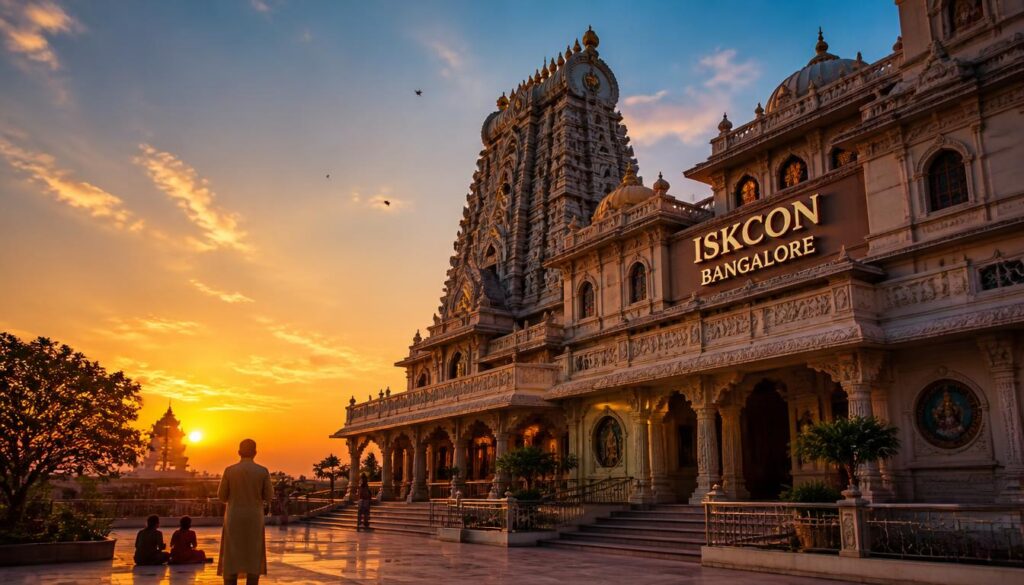
The best time to visit ISKCON Bangalore depends on what sort of experience you want. If you enjoy quiet surroundings, early mornings are a strong choice. Weekday evenings can also be relatively peaceful and suitable for people who want to sit quietly, pray or meditate without dealing with the intensity of festival crowds.
If energy and celebration are what you’re after, festival seasons offer an entirely different experience. Janmashtami, Ratha Yatra, Gaura Purnima, Ram Navami and Deepotsava bring decorations, kirtans and large gatherings, making the temple feel especially vibrant. It can be crowded, yes, but thats also part of the character of these occasions.
For a balanced first visit, a morning or late-evening trip during a festival season can work beautifully. Just leave extra time for crowds, queues and movement around the premises. A temple visit is rarely improved by arriving breathless and checking the clock every two minutes.
The temple houses several important deities within the Vaishnava tradition. The principal forms listed in the source include Sri Radha Krishnachandra, representing love, devotion and divine grace;
Sri Krishna Balarama, associated with brotherhood, strength and support; and Sri Nitai Gauranga, the forms of Lord Chaitanya and Lord Nityananda.
Devotees can also offer prayers to Sri Srinivasa Govinda, a revered form of Lord Vishnu, and Sri Prahlada Narasimha, associated with protection and the destruction of fear.
Even for visitors unfamiliar with Vaishnava traditions, learning the names and significance of these deities adds another layer to the visit.
The story behind the temple is almost as interesting as the building itself. The source traces ISKCON in Bangalore to 1987, while noting that the organisation had been officially registered in Karnataka in 1978.
In the early period, devotees faced difficulties finding an appropriate location for a permanent temple. Eventually, Hare Krishna Hill in Rajajinagar was selected.
Construction of the main temple began in 1990 and continued for nearly seven years. Sri Madhu Pandit Dasa, a trained civil engineer, worked on the design with Sri Jagat Chandra Dasa, the chief designer.
More than 600 skilled workers and artisans contributed to the construction, which ultimately blended modern building techniques with traditional temple design.
That history helps explain why the temple can feel simultaneously traditional and modern. It isn’t simply an old structure preserved from another era;
it represents a comparatively recent attempt to create a major devotional and cultural centre using contemporary construction while retaining a recognisable temple aesthetic.
Getting to the Rajajinagar temple is relatively straightforward because the area is well connected by road. Visitors can use city buses, auto-rickshaws and taxis from different parts of Bengaluru.
Bengaluru City Railway Station is listed as the nearest major railway station, making the temple reasonably convenient for travellers arriving by train.
For visitors arriving by air, Kempegowda International Airport, Bengaluru is the nearest airport. Taxis and cabs are available for the journey into the city. The temple’s listed address is Hare Krishna Hill, Chord Road, Rajajinagar, Bengaluru, Karnataka – 560010.
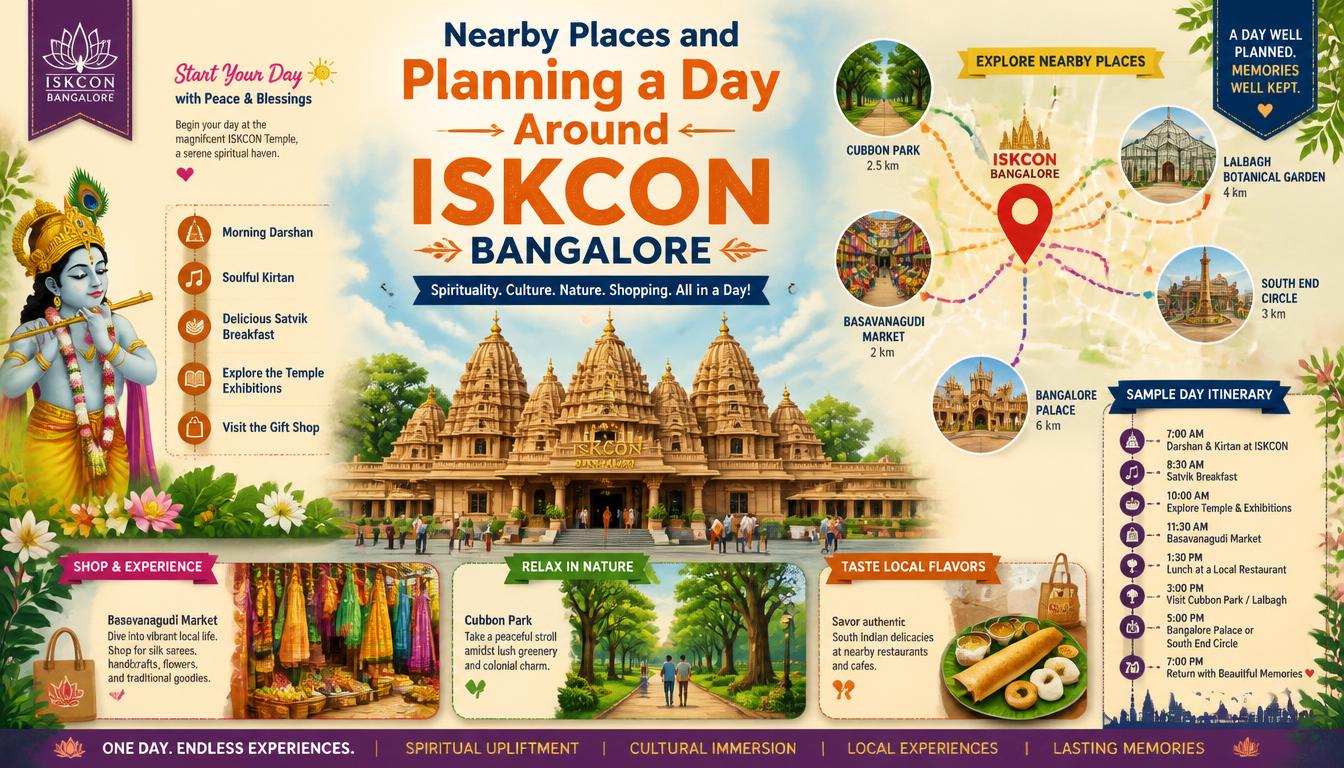
A temple visit can easily become part of a larger Bengaluru day out. Nearby attractions mentioned in the source include JP Park, Jawaharlal Nehru Planetarium, Fun World Amusement Park, Bangalore Fort and St. Mary’s Basilica.
Some are close by, while others require a short drive, so the actual order depends on your schedule and traffic Bengaluru traffic, naturally, gets a vote too.
For visitors staying overnight, the source also lists accommodation options such as Hotel Chetan International, Hotel Abhimaani Inn, Hotel Bangalore Gate, Hotel City Meridian, Hotel Grand Bee and The Chancery Pavilion.
These provide options across different accommodation styles, though visitors should confirm current availability and rates before booking.

Plan your arrival around the specific experience you want. Someone coming for Mangala Arati will need a completely different morning plan from someone arriving for lunch prasadam. Looking at the ritual schedule first makes the visit feel intentional rather than improvised.
Wear comfortable, respectful clothing and keep some patience in reserve if visiting on a weekend or major festival. Crowds can become substantial, and the source advises visitors to arrive early during busy periods. Also remember that photography is not permitted inside the temple premises, according to the supplied guide.
Entry is listed as completely free, so you do not need to budget for a standard admission ticket. If you are interested in a particular seva, however, check whether advance registration is required, especially during major celebrations.
The general daily schedule supplied for ISKCON Bangalore lists 4:15 AM–5:00 AM, 7:15 AM–1:00 PM, and 4:15 PM–8:20 PM.
More specific Rajajinagar darshan schedules give slightly different session boundaries, so checking the day’s programme is advisable before a time-sensitive visit.
No. The supplied guide states that entry is completely free for visitors.
The principal deities listed include Sri Radha Krishnachandra, Sri Krishna Balarama, Sri Nitai Gauranga, Sri Srinivasa Govinda and Sri Prahlada Narasimha.
Yes. Visitors can participate in activities such as Mangala Arati, Tulasi Puja, Narasimha Arati, meditation and kirtans, although some special sevas may require prior registration.
Major celebrations include Janmashtami, Gaura Purnima, Ratha Yatra, Radhashtami, Deepotsava and Govardhana Puja, along with many other Vaishnava festivals throughout the year.
Yes. The temple’s services include Nitya Annadanam and Krishnamrita prasadam, while the wider ISKCON Bangalore initiative is also associated with the Akshaya Patra Foundation’s school meal programme.
According to the supplied guide, photography is not permitted inside the temple premises.
For a first-time visitor, don’t try to squeeze everything into one rushed itinerary. Arrive in the morning, spend time at darshan, listen to the devotional atmosphere, learn about the deities, and if your timing allows, experience the prasadam service. If you have more time, explore one of the nearby attractions afterward.
For devotees, a more ritual-focused plan may be better: arrive for Mangala Arati, continue with morning worship and discourse, and then stay for the midday programme.
Festival visitors should instead build their day around the major celebration and allow plenty of extra time for crowds.
The most important thing is to leave a little empty space in the schedule. Temples are not airports, thankfully. Sometimes the unplanned ten minutes sitting quietly can become the part you remember longest.
ISKCON Temple Bangalore is best understood not merely as a destination to tick off a Bengaluru itinerary, but as a place where worship, learning, culture and service overlap.
From the first early-morning aarti to the evening prayers, from the decorated deities to the simple act of receiving prasadam, the experience has many layers.
The temple’s history, its connection with Krishna Consciousness, its daily sevas, major ISKCON Bangalore festivals, food-distribution initiatives and active cultural programmes all contribute to its identity.
Whether you visit during the extraordinary energy of Janmashtami or on an ordinary weekday when the hill is quieter, there is something worthwhile in slowing down and simply being present.
Before you leave, check the relevant day’s timings if your visit depends on a particular ritual, especially during festivals.
Then come with comfortable expectations, a little patience and an open mind. Sometimes a good temple visit doesn’t announce itself dramatically; it just leaves you walking back into the noisy city feeling slightly more peaceful than when you arrived.