Physical Address
304 North Cardinal St.
Dorchester Center, MA 02124
Physical Address
304 North Cardinal St.
Dorchester Center, MA 02124

There are places you visit to see something, and then there are places you visit to feel something. Nidhivan in Vrindavan belongs to the second kind. Its narrow paths, unusual Tulsi trees, quiet corners, and deeply respected traditions create an atmosphere that feels very different from an ordinary sightseeing stop.
For devotees, this sacred grove is closely connected with Radha and Krishna, and the local tradition surrounding the place is treated with remarkable seriousness.
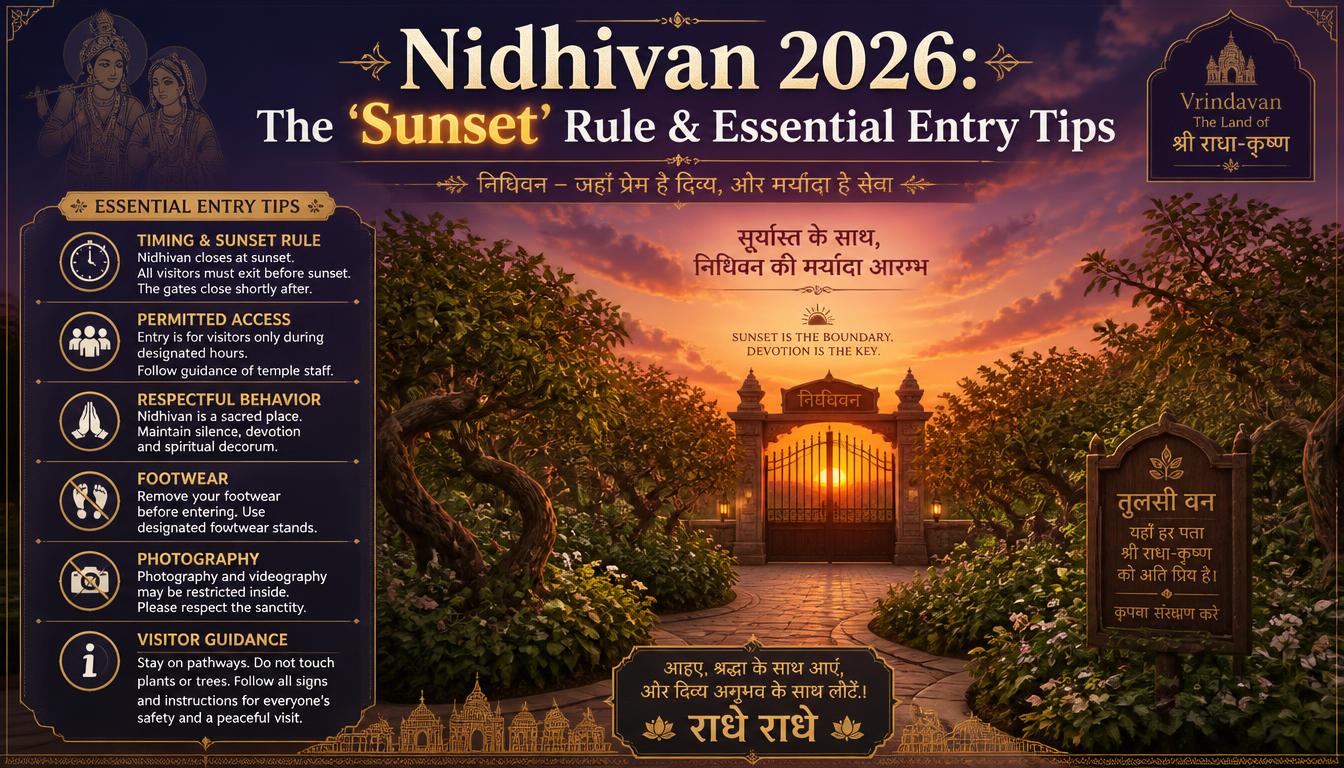
One of the most important things for a first-time visitor to understand is the famous Nidhivan sunset rule: visitors must leave before the site closes in the evening, and nobody is permitted to remain inside overnight.
That rule is not simply a tourist instruction. It is connected with the religious beliefs and daily rituals associated with Nidhivan, particularly the Rang Mahal, where devotees believe Radha and Krishna rest after their nightly divine pastimes.
So, if you are planning a 2026 visit, don’t treat Nidhivan like a normal park where you can arrive whenever you wish. A little planning makes the visit much smoother.
The most important visitor rule at Nidhivan Temple is simple: you must leave before the evening closure and sunset-related restrictions begin.
Local devotional tradition holds that Radha Krishna perform their nightly Raas Leela inside the grove after human visitors have departed. Because of this belief, the area is cleared and locked each evening. The tradition is religious rather than something scientifically established, and it should be understood respectfully as a deeply held belief of Braj devotees.
This is why searching only for a general “Nidhivan closing time” can sometimes be confusing. Different travel and temple guides publish slightly different schedules, while the actual closing arrangement can shift with the season.
The practical lesson is easy: don’t plan to arrive close to sunset.
Give yourself enough time to walk through the grove, visit its shrines, follow the permitted paths, and leave without rushing. A visitor who reaches the temple entrance five minutes before closure may have a very different experience from someone who arrives earlier in the afternoon.
The published schedules for Nidhivan Timings 2026 are not completely consistent across travel sources. Some current guides describe a summer pattern around 5:00 AM to 1:00 PM, followed by an afternoon break and reopening in the later afternoon, while other sources list different closing times.
One current guide gives a summer schedule of approximately 5:00 AM–1:00 PM and 3:30 PM–8:00 PM, while a separate guide lists different daily hours. This variation is exactly why visitors should verify the day’s schedule locally rather than relying blindly on an old timetable.
For planning purposes, you may encounter references to:
These figures should be treated as planning references, not as a guarantee for every day in 2026.
During Summer 2026, visiting early can be much more comfortable than arriving during the hottest part of the day.
Several visitor guides describe a split schedule, with a morning period followed by an afternoon closure and another visiting period later in the day. One published schedule, for example, lists approximately 5:00 AM–1:00 PM and 3:30 PM–8:00 PM for summer.
However, another source lists an afternoon closure and different evening hours, showing why the exact Nidhivan summer timings should be confirmed before setting out.
If you’re visiting in May or another hot month, early morning is especially practical. The stone paths and narrow Vrindavan lanes can become tiring when the sun is strong, and an early visit lets you explore with less heat on your shoulders.
The phrase Nidhivan sunset timing can be slightly misleading because the important thing isn’t simply a particular clock time.
The real issue is the evening closure of the sacred grove. The site is cleared before night, and visitors cannot remain inside after the permitted period. Some sources describe this as closure by dusk, while published daily schedules differ by season.
So don’t calculate your visit like this: “Sunset is at X, therefore I can enter at X minus ten minutes.”
That is risky.
Instead, aim to finish your visit comfortably before the expected closure. If you’re unfamiliar with the narrow gullies around Nidhivan, remember that getting out can take longer than expected when several groups are leaving together.
At first glance, Nidhivan may appear more like a dense grove than a conventional temple complex. The area is known for its distinctive intertwined Tulsi trees, small shrines, devotional spaces, and the famous Rang Mahal.
The grove is strongly associated with the devotional traditions of Radha, Krishna, and the Gopis. The trees themselves are surrounded by many local beliefs and stories, including the traditional idea that they are connected with the gopis. These are religious traditions rather than scientifically verified botanical claims.
Inside the wider complex, visitors may also encounter places associated with Swami Haridas and the traditional history of Banke Bihari.
This connection gives Nidhivan a larger place in the spiritual story of Vrindavan, rather than making it merely another stop on a tourist itinerary.
The Rang Mahal is perhaps the most discussed feature of Nidhivan.
According to local religious tradition, the room is prepared in the evening as a resting place for Radha and Krishna. Accounts describe a bed, water, paan, sweets, and other devotional arrangements being placed inside before the area is closed.
The doors are then locked, and people do not remain inside overnight.
Devotees connect this ritual with the belief that the divine couple returns to the grove at night. The stories surrounding the room are part of Braj’s living religious culture, so visitors should avoid treating them like a theatrical mystery created simply for tourists.
That distinction matters.
You can be curious without being disrespectful, and you can appreciate the tradition without presenting belief as scientific proof.
The reason behind the Nidhivan night entry restriction is closely connected with the local religious belief about the nightly Raas Leela.
Devotees believe that Krishna and Radha, accompanied by the gopis in the devotional tradition, continue their divine pastimes in the grove at night. Consequently, the grove is emptied and locked after the evening ritual.
This is also why searching for Nidhivan overnight stay information can lead to confusion.
Nidhivan is not a place where visitors can book a room, camp, hide inside, or arrange a special night tour. The whole point of the evening closure is that people leave.
If someone tells you that you can secretly stay inside after closing just to “see what happens,” don’t treat that as an exciting travel opportunity. It goes directly against the site’s established visitor practice.
The basic Nidhivan entry rules are more about respect and timing than complicated paperwork.
Keep these practical points in mind:
The best visitor is often the least troublesome one. You enter quietly, observe carefully, pray if you wish, and leave without disturbing the place.
Many current visitor guides describe Nidhivan entry fee as free.
That doesn’t mean every activity around the site is automatically free. Transport, guides, donations, offerings, and other services can have separate arrangements.
If somebody approaches you claiming that a large mandatory fee is required just to enter, ask for clarification from an official temple representative or caretaker before paying.
And one more useful point: don’t confuse a voluntary seva or devotional offering with a compulsory entrance charge.
Read more; https://templetimingsdaily.com/arunachalam-temple-timings-for-darshan/
There is no reason to dress like you’re preparing for a fashion shoot. Simple, clean and modest clothing is the sensible approach.
Avoid overly revealing outfits, and visitors should generally be comfortable wearing traditional or conservative clothing. Some visitor sources specifically recommend traditional or formal clothing.
Depending on the area and instructions that day, you may need to remove your footwear. A shoe stand or designated footwear area may be available nearby.
If you plan a barefoot visit, remember that the paths can be uneven or warm, particularly during summer. Carrying a small cloth or choosing appropriate footwear for the journey outside the sacred area can make things easier.
Shorts and sleeveless tops may not be appropriate for a place where devotees come specifically for worship, even if you see tourists dressed casually elsewhere in Vrindavan.
This is another area where visitors should be careful.
Photography policies can vary by location within the complex, and sources differ on how broadly photography is permitted. Some guides say photography is restricted or prohibited, particularly around Rang Mahal, while others describe photography as tolerated in certain walkways.
The safest rule is simple:
Ask before taking photographs in sensitive religious areas.
Don’t assume that because another visitor is holding a phone, you can photograph the same place.
The same applies to video recording. Avoid filming rituals, priests, devotees, or restricted chambers without permission.
A beautiful photograph isn’t worth creating an uncomfortable moment for somebody who came to pray.
Nidhivan monkeys are another practical consideration for visitors.
Monkeys are common in parts of Vrindavan, and visitors sometimes carry drinks, snacks, glasses, or shiny objects that attract attention. Local travel advice frequently warns visitors to be cautious with belongings.
Keep your spectacles, sunglasses, phone, food packets, and drinks secure.
A monkey doesn’t understand that your sunglasses cost more than your entire afternoon travel budget. It just sees something interesting.
Avoid deliberately feeding monkeys, waving food around, or trying to photograph them from extremely close range. The same advice applies around crowded lanes where animals and pedestrians are moving together.
You may see Frooti, a juice box, water bottles, and snacks in the hands of visitors, particularly around the surrounding Vrindavan streets.
Don’t carry food openly inside a sacred area unless it is permitted.
If you have children with you, explain this before entering: hold your drink, don’t tease monkeys, don’t wave packets around, and don’t run through the narrow paths.
It sounds like a small thing, but these little preparations prevent a surprising number of travel headaches.
Nidhivan sits within the older part of Vrindavan, where narrow lanes can make driving directly to the entrance inconvenient.
Many visitors combine walking with an e-rickshaw, depending on where they are staying. The exact route and vehicle access can change because of crowd controls, local traffic and temporary restrictions.
If you are coming from Banke Bihari, Nidhivan is nearby within the old Vrindavan area, and several guides describe it as a short walk from the temple.
Don’t rely too heavily on road-distance estimates here. In the old town, a route that looks short on a map can feel very different when the narrow gullies are crowded.
A visit to Nidhivan can naturally fit into a broader Vrindavan pilgrimage.
Banke Bihari is one of the major nearby religious destinations and has a strong historical connection with the devotional traditions of Vrindavan. Nidhivan itself is traditionally associated with Swami Haridas and the manifestation of Banke Bihari.
Other places that visitors may consider around the same broader area include Seva Kunj and Prem Mandir, although they are different religious sites with their own visiting arrangements.
Don’t try to squeeze every famous location into one rushed afternoon. Vrindavan is better experienced slowly, especially when your purpose is devotional rather than simply collecting photographs.
A Nidhivan morning visit can be particularly comfortable because temperatures are generally lower, especially during hot months.
Morning also gives you more breathing room before the afternoon closure found in some published schedules.
An Nidhivan evening visit has a different atmosphere. The devotional environment changes as the day moves toward dusk, but this is precisely when you need to become more conscious of the closing rule.
If you choose the evening, arrive early enough to complete your visit without watching the clock every thirty seconds.
Before leaving for the site, keep these practical points in mind:
These tips sound ordinary, but they can turn a stressful visit into a peaceful one.
This question comes up almost immediately after hearing about the place.
The answer needs some care.
The nightly Radha-Krishna tradition is a deeply held religious belief in Braj. Devotees believe that the divine Raas continues in Nidhivan after visitors leave, and the preparations inside Rang Mahal are part of this tradition.
At the same time, claims about supernatural events should not be presented as scientifically proven facts.
You don’t need to settle that question to understand why the tradition matters. For many devotees, Nidhivan is not an entertainment mystery. It is a sacred place connected with living faith, and that explains why the evening closure is observed so seriously.
That is probably the most respectful way to approach it.
Nidhivan is one of those places where the visitor experience begins before the entrance and continues after you leave. The tangled Tulsi trees, quiet pathways, Rang Mahal, devotional stories and strict evening closure all contribute to its distinctive character.
The single most important thing to remember for Nidhivan 2026 is the sunset rule: do not plan to stay after the permitted closing period. The exact timetable can vary, so verify the day’s schedule locally and leave plenty of time before dusk.
Come with modest clothing, secure your belongings, respect photography restrictions, listen to the caretakers, and treat the grove as a living religious site rather than simply another tourist attraction.
And perhaps that’s the nicest way to experience Nidhivan: arrive without trying to force a mystery to reveal itself. Walk quietly, look carefully, and let the old stories remain what they have been for generations — part of the spiritual life of Vrindavan.