Physical Address
304 North Cardinal St.
Dorchester Center, MA 02124
Physical Address
304 North Cardinal St.
Dorchester Center, MA 02124

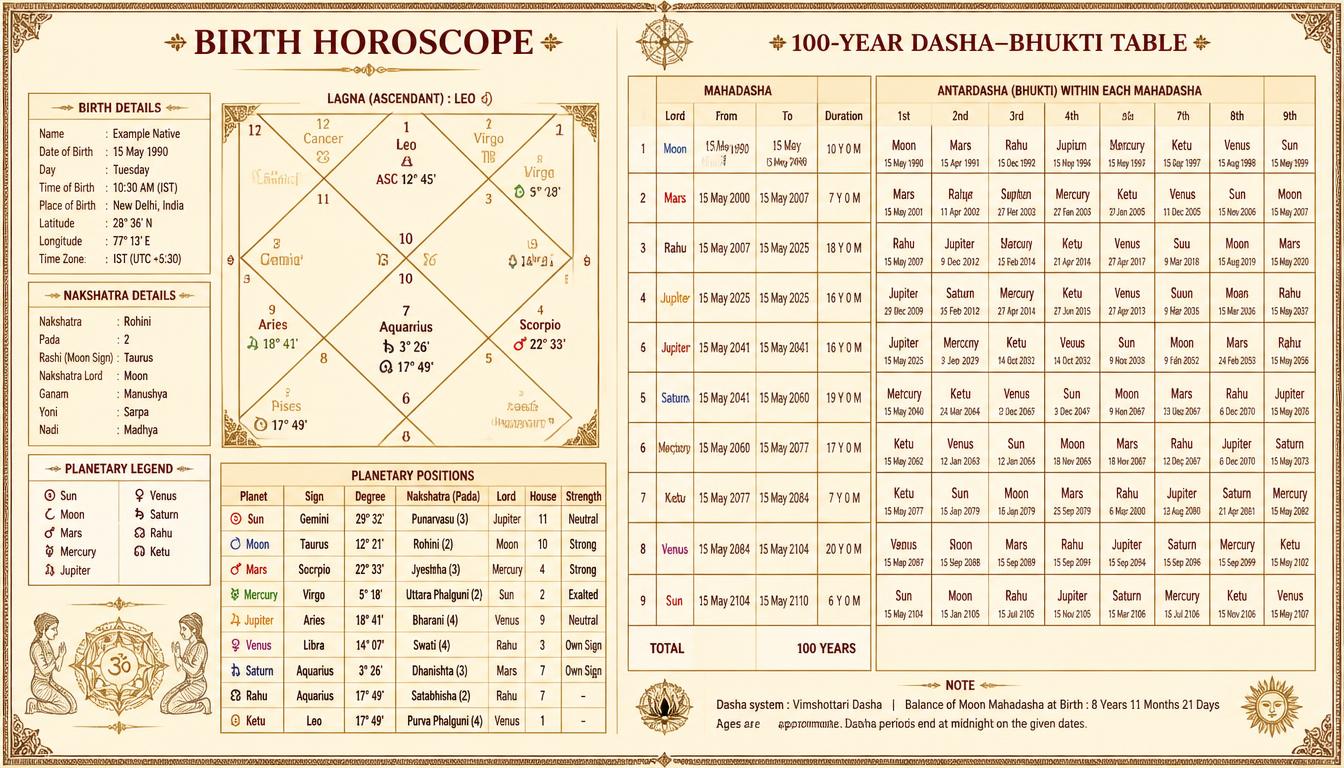
A birth chart is, in a way, a snapshot of the sky at one very particular moment. The planets were somewhere, the Moon was moving through a Nakshatra, and a particular zodiac sign was rising in the east. In Vedic astrology, that little cosmic photograph becomes the starting point for understanding a person’s life, tendencies, relationships, career and many other areas.
If you have ever wondered why two people born on the same day can have very different personalities or life experiences, the answer often begins with the exact date of birth, time of birth, and birthplace. Even a small difference in the recorded birth time can sometimes change important parts of a horoscope, especially the Ascendant and house positions.
A Birth Horoscope and 100-Year Dasha–Bhukti Table brings these details together in one place. Instead of looking only at a Sun sign, the traditional Vedic approach examines planetary positions, Moon sign, Nakshatra, Lagna, Bhavas, divisional charts and planetary periods. It is a much wider picture, not just one zodiac label doing all the talking.
A birth horoscope, also called a birth chart or Janma Kundali, is a chart prepared from the astronomical positions of the planets at the moment of birth. In Vedic astrology, this chart is traditionally interpreted to understand personality, education, relationships, career, health, family and other life themes.
The three details needed are simple: date of birth, exact time of birth and place of birth. But simple does not always mean unimportant. The birth time is particularly significant because the Ascendant can change as the eastern horizon moves through the zodiac.
The chart generally includes the Sun, Moon, Mars, Mercury, Jupiter, Venus, Saturn and the lunar nodes Rahu and Ketu. Their zodiac positions and relationships with the houses are then examined according to the chosen astrological system.
For someone using an online birth horoscope, the process can be surprisingly quick. Enter the requested birth information, verify the location and time zone, and the software can generate a detailed chart. Still, the result should be treated as a traditional astrological interpretation rather than a scientific prediction of what must happen in life.
To calculate your birth horoscope using your date of birth, time of birth, and birthplace, start with the information written in your official or family birth records.
The date identifies the calendar day, while the time helps establish the Ascendant and house positions. The birthplace supplies geographical coordinates and the relevant time-zone information. All three work together; removing one can make the calculation less precise.
Enter the local time recorded in your birth details; do not convert it to UTC. Select your birthplace from the list and verify the country and time zone. Even a small difference in birth time can change the Ascendant (Lagna), houses (Bhavas), and divisional charts.
This is especially worth remembering when a family member says, “It was around nine in the morning.” Around nine and exactly 9:00 are not always treated as the same thing in detailed horoscope calculations. A few minutes may or may not matter depending on the circumstances, but accurate information is always preferable.
A typical birth horoscope calculator may ask for your full name, gender, date, time, country and city. Some advanced calculators also display longitude, latitude and time-zone details behind the scenes.
The Birth Horoscope and 100-Year Dasha–Bhukti Table is useful for readers who want to examine not only their basic chart but also the sequence of planetary periods traditionally used in Vedic astrology.
Dasha means a planetary period, while Bhukti, often called Antardasha, refers to a sub-period within a larger planetary period. Together, these periods create a timeline that astrologers traditionally use when discussing different phases of life.
A 100-year table does not mean that a person is guaranteed to live for exactly 100 years. Rather, it provides a long-range chronological framework of planetary periods, allowing readers to see how the Dasha–Bhukti sequence is arranged across many years.
The interpretation depends on the planetary positions in the individual’s birth chart. The same planetary period can be interpreted differently for different people because their Ascendant, houses, Nakshatra and planetary placements are not identical.
For this reason, simply seeing “Jupiter Dasha” or “Saturn Bhukti” is not enough to make a complete interpretation. The wider chart matters, quite a lot actually.
A horoscope begins with birth information, so this is one area where rushing can create unnecessary confusion.
Check the date first. Then check the recorded local birth time. Finally, select the correct city and country. If the calculator provides a time zone, confirm that it corresponds to the birthplace.
For example, a sample horoscope entry might contain:
These values are simply an example of the information a horoscope form may display. The actual chart should always be generated using the person’s genuine birth details, not copied sample information.
A detailed Vedic horoscope report can contain much more than a basic zodiac sign.
The birth horoscope presents the planetary positions, zodiac signs, Nakshatra, Ascendant and houses at the time of birth. These form the foundation of traditional chart interpretation.
The planetary placements are generally examined in relation to one another and to the different houses. The first house, for instance, is traditionally associated with personality and physical identity, while other houses represent areas such as family, education, career, relationships, finances and spirituality.
The Moon sign, or Chandra Rashi, has an important place in Vedic astrology. It is determined from the Moon’s position rather than simply using the birth date as Western Sun-sign astrology commonly does.
The Nakshatra, sometimes called the birth star, identifies the lunar constellation associated with the Moon’s position at birth. There are 27 commonly used Nakshatras in the traditional system, each divided into four padas.
Nakshatra information is also important in discussions of Dasha because the starting planetary period is traditionally connected with the Moon’s Nakshatra.
The Ascendant (Lagna) is the zodiac sign rising on the eastern horizon at the time of birth.
In traditional Vedic astrology, Lagna is closely associated with personality, physical identity, approach to life and the overall structure of the horoscope. Because the Ascendant depends strongly on birth time and location, inaccurate information can affect the resulting houses.
A Lagna calculator therefore requires more than just the date of birth. Time and birthplace are essential ingredients.
Many Vedic astrology systems use Lahiri Ayanamsa, also known as Chitrapaksha Ayanamsa, when calculating sidereal planetary positions.
Ayanamsa is connected with the difference between the tropical and sidereal zodiac systems. Because different calculation approaches can produce different positions, it is useful to know which method a horoscope calculator uses.
The supplied calculation method may therefore mention Lahiri Ayanamsa, Chitrapaksha Ayanamsa, or another established convention.
The important point is consistency. If two websites use different settings, their charts may not look exactly the same. This does not automatically mean that one website has calculated everything incorrectly; the underlying calculation settings may simply differ.
One of the most common sources of confusion is the difference between a Sun sign and Moon sign.
Western astrology commonly identifies a person’s Sun sign from the position of the Sun at birth. Vedic astrology generally uses a sidereal zodiac and gives considerable importance to the Moon sign and Nakshatra.
Therefore, a person might know themselves by one Sun sign while seeing another Rashi in a Vedic horoscope. This can look strange at first, but it comes from differences in astrological systems and calculation methods.
A useful approach is to understand what each term means instead of trying to decide which label is the “real” personality. Astrology has several traditions, and they do not all calculate charts in exactly the same way.
A detailed Vedic horoscope may include 16 divisional charts, traditionally known as Shodasha Varga.
These charts divide the zodiac in different ways and are traditionally used to examine particular areas of life. The Navamsha, for example, is one of the best-known divisional charts and is frequently discussed in Vedic astrology.
Depending on the software or service, a report may also show charts such as:
These additional charts can make a report look enormous, but more charts do not automatically mean a more accurate prediction. Their value depends on how they are calculated and interpreted.
The Dasha Bhukti table provides a timeline of major and sub-periods in traditional Vedic astrology.
A Mahadasha represents a larger planetary period. Within it, Antardasha or Bhukti periods divide the timeline into smaller sections. Astrologers traditionally interpret these periods alongside the birth chart.
For example, a particular Dasha may be discussed in relation to career, education, relationships or financial circumstances depending on the planet involved and its position in the horoscope.
The 100-year Dasha Bhukti predictions are therefore better understood as a structured astrological timeline rather than a promise that every event listed will definitely happen.
Life remains complicated, wonderfully messy sometimes. A table cannot know every decision a person will make, every opportunity that will appear or every unexpected change that may happen.
Another section commonly found in a detailed horoscope is the discussion of Doshas.
Some traditional Vedic astrology reports may examine Mangal Dosha, Sade Sati Shani, and Kala Sarpa Dosha. The terminology can sound intimidating when someone encounters it for the first time, especially if the report presents a long paragraph full of Sanskrit names.
It is worth reading such sections calmly.
Traditional Vedic remedies can include mantras, worship, charitable donations and other religious or cultural practices. These are part of traditional belief systems and should not be presented as guaranteed methods for changing future events.
For example, a horoscope may recommend a particular mantra or charitable practice as a traditional remedy. A person can consider such practices according to their own beliefs and family traditions.
Some advanced astrology services mention geocentric birth charts and topocentric horoscopes.
A geocentric calculation considers the positions of celestial bodies from the perspective of Earth. A topocentric approach uses a more localized viewpoint connected with the observer’s location.
For an ordinary user, these terms can feel more technical than necessary. The main thing is to know that different calculation models can exist, and the chosen method should be clearly stated by the horoscope service.
The same principle applies to Panchang calculations. If you are comparing results from two different websites, check their calculation settings before assuming that a difference automatically means an error.
A birth horoscope is often used traditionally to discuss major life areas such as career horoscope, education, finances, health and relationships.
Career interpretations may examine the tenth house and relevant planetary placements. Education can be discussed through houses and planets associated with learning and intelligence. Relationships are traditionally considered through relevant houses, Venus, Jupiter and other chart factors.
These interpretations are best treated as reflective guidance rather than fixed instructions.
For example, a person reading that their chart suggests an interest in communication may use the idea as a prompt for self-reflection. It should not replace practical education, career research, professional advice or personal decision-making.
Many online services offer a free birth chart or free horoscope report.
A useful report should clearly show the birth details used for calculation, the selected location, the calculation method and the resulting charts. This makes it easier to spot an incorrect birth time or location before saving the final report.
Some services also provide horoscope PDF download options. A PDF can be useful when you want to keep the chart for personal reference or share it with a family member or astrologer.
Before downloading, check the details one more time. It is much easier to correct a typo before saving the report than after spending an afternoon wondering why the Lagna suddenly looks completely different.
For Tamil-speaking readers, an online Tamil horoscope can make traditional astrological information easier to access.
A service may provide the interface, explanations and report in Tamil while using familiar Vedic astrology terms such as Rashi, Nakshatra, Lagna, Dasha, Bhukti and Navamsha.
OnlineJyotish, for example, is presented in the supplied material as a free horoscope service with more than 26 years of trust among Tamil users. Claims about longevity, user numbers or accuracy should always be evaluated according to the information provided by the service itself.
The larger benefit of an online service is convenience. Instead of manually preparing every calculation, the user can enter the birth information and receive a structured report within a short time.
Some detailed Vedic astrology reports include the Avakahada Chakra as part of their broader set of traditional charts. Whether it appears depends on the particular horoscope service and its calculation system.
The Ghata Chakra is a traditional astrological concept that may appear in some detailed Vedic horoscope reports. Its interpretation depends on the specific astrological tradition and calculation method being followed.
Traditional astrology may recommend mantras, worship, donations and other remedial practices for certain Doshas. These should be understood as traditional or religious practices, not guaranteed solutions to future problems.
A 100-Year Dasha–Bhukti Table can present a long chronological sequence of planetary periods. The exact dates depend on the person’s birth information and the Dasha calculation used by the service.
A detailed Vedic report may include the Navamsha chart, which is one of the important divisional charts in the Shodasha Varga system. Check the report contents because not every basic horoscope calculator provides every divisional chart.
The best practical step is simple: protect the quality of the information you enter.
Use the actual recorded birth date whenever possible. Enter the local birth time exactly as recorded, rather than manually converting it to UTC. Choose the correct birthplace and confirm the country and time zone.
If the birth time is uncertain, do not quietly invent an exact minute and then treat the resulting chart as unquestionably precise. Tell the astrologer or service that the time is approximate.
Also, save the original birth details along with the generated report. Months later, you may remember the chart but completely forget which time, location or calculation method you used.
The real attraction of a long Dasha–Bhukti table is perspective.
Instead of reading only today’s horoscope, a person can see how traditional astrology organizes planetary periods across decades. Someone interested in astrology may use it to study patterns, compare Mahadasha and Bhukti periods, or simply understand how a Vedic horoscope is structured.
It also gives beginners a reason to look beyond generic daily predictions. A birth chart is highly individual because it starts with individual birth data.
Still, a long table should not create fear or certainty. “This period looks difficult” does not mean life is destined to become terrible. Likewise, a traditionally favorable period does not guarantee success without effort, choices and circumstances working together.
A Tamil jathagam provides details about your Rasi, Nakshatra, Lagna, planetary positions, and Dasha–Bhukti based on your birth details.
Jathagam is a traditional birth chart prepared using your date, time, and place of birth to understand different aspects of life.
Tamil astrology uses traditional Vedic astrology principles to provide insights into personality, career, relationships, finances, and other areas of life.
Tamil astrology interprets Rasi, Nakshatra, Lagna, planetary positions, and Dasha periods to provide traditional guidance about life and future trends.
Astrology by date of birth in Tamil uses your birth date, time, and place to calculate the horoscope, Rasi, Nakshatra, Lagna, and other astrological details.
Read more: https://templetimingsdaily.com/todays-telugu-horoscope/
A Birth Horoscope and 100-Year Dasha–Bhukti Table can be an interesting doorway into Vedic astrology. It brings together the birth chart, planetary positions, Moon sign, Nakshatra, Lagna, Bhavas, Dasha periods and divisional charts in a single traditional framework.
The most important thing is to begin with accurate birth information. Date of birth, time of birth and birthplace are the foundation. From there, the calculation method, Lahiri Ayanamsa, planetary positions and Dasha–Bhukti sequence help shape the resulting report.
Astrology can be used as a cultural, spiritual or reflective practice, but it is wise to keep both feet on the ground while looking at the stars. A chart may offer a traditional way of thinking about possibilities; it cannot replace your own judgment, effort and real-world decisions.
If you are creating your own horoscope, take a quiet moment before pressing “calculate.” Check the time. Check the city. Check the time zone. Then explore the chart slowly, one piece at a time.
Sometimes the most interesting part of a birth horoscope isn’t finding a prediction about tomorrow. It’s seeing how an ancient system turns one ordinary moment of birth into a remarkably detailed map of the sky.