Physical Address
304 North Cardinal St.
Dorchester Center, MA 02124
Physical Address
304 North Cardinal St.
Dorchester Center, MA 02124

Visiting a famous pilgrimage destination is not simply about reaching a temple, standing in a queue, and offering prayers. Sometimes, the journey itself becomes a beautiful part of the experience. Rameshwaram is one such sacred destination where spirituality, ancient traditions, fascinating architecture, and the peaceful atmosphere of the sea come together.
Located on Pamban Island in Tamil Nadu, Ramanathaswamy Temple is among the most respected Hindu pilgrimage sites in India. Dedicated to Lord Shiva, it is one of the 12 Jyotirlingas and holds a special place in Hindu religious traditions. According to the Ramayana, Lord Rama worshipped Lord Shiva here before travelling towards Lanka, making the temple particularly meaningful for devotees.
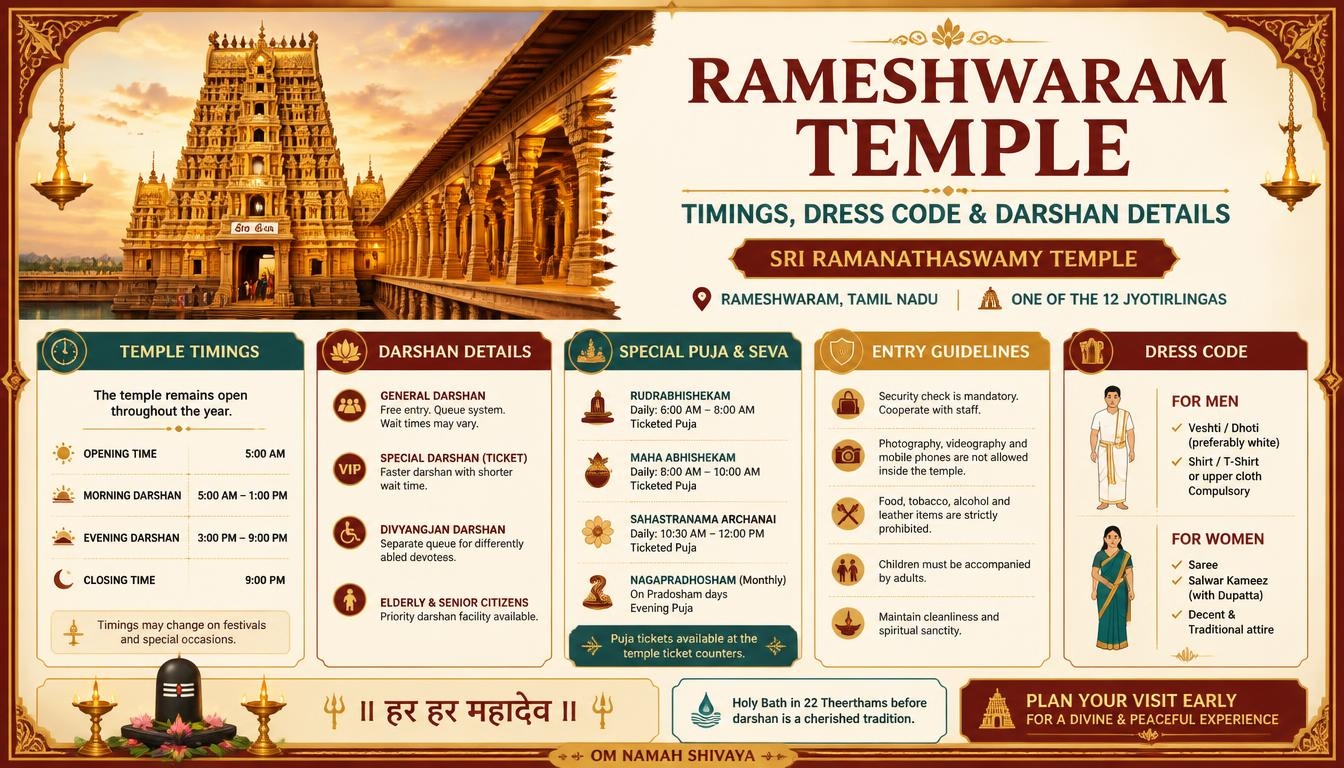
If you are planning a visit, knowing the Rameshwaram Temple Timings, Dress Code & Darshan Details beforehand can make your trip considerably easier. From morning and evening darshan schedules to special entry tickets, traditional clothing, and the famous 22 Theerthams, there are several things worth understanding before arriving.
Let’s explore everything visitors should know to plan a comfortable and spiritually meaningful temple visit.
The first thing most devotees want to know is when they can enter the temple for darshan. The Ramanathaswamy Temple Timings follow two main daily sessions, with a break in the afternoon.
According to the Tamil Nadu Hindu Religious and Charitable Endowments (HR&CE) Department, the temple opens at 4:00 AM, while devotees are generally allowed for darshan from 5:00 AM.
Here is the published daily schedule:
| Temple Activity | Timings |
|---|---|
| Temple opening time | 4:00 AM |
| Spatika Linga Darshan | 5:00 AM – 6:00 AM |
| Morning Darshan | 5:00 AM – 1:00 PM |
| Afternoon temple closure | 1:00 PM – 3:00 PM |
| Evening temple reopening | 3:00 PM |
| Evening Darshan | 3:15 PM – 8:00 PM |
| Night temple closure | Around 9:00 PM |
The actual public darshan hours are different from the temple’s opening hours, so arriving at 4:00 AM does not mean you can immediately enter the main sanctum for darshan.
The schedule may also change during festivals, special religious occasions, and other temple arrangements. It is sensible to confirm the timings before travelling.
Morning is a popular time for visiting Ramanathaswamy Temple, particularly among devotees who want to experience the early rituals and complete their prayers before the afternoon closure.
The temple opens at 4:00 AM, and the first public darshan session begins at 5:00 AM. During the first hour, devotees can attend the special Spatika Linga Darshan, which is associated with the sacred crystal lingam.
Regular Moolasthana Darshan begins at approximately 6:10 AM and continues until 1:00 PM.
If you prefer a relatively organised visit, reaching the temple before 5:00 AM is a practical idea. However, weekends and religious occasions can still attract large crowds.
The morning session is particularly useful for visitors who also want to participate in the 22 Theerthams bath before completing their darshan.
If waking up very early isn’t part of your travel plan, the evening session offers another opportunity to visit the temple.
The temple reopens at 3:00 PM, while public darshan generally starts at 3:15 PM and continues until 8:00 PM.
Evening worship has its own atmosphere. The sound of temple bells, traditional prayers, and the presence of devotees create a memorable religious experience.
The evening session also works well for travellers who have spent the morning exploring Rameshwaram or visiting nearby attractions.
Keep in mind that the 22 Theerthams bathing facility has a separate schedule and generally closes at 7:00 PM during the evening session.
Daily poojas are an important part of the religious traditions at Ramanathaswamy Temple. These rituals take place at different times throughout the day, allowing devotees to experience various forms of worship.
The temple administration publishes six main daily pooja timings.
| Pooja Name | Timings |
|---|---|
| Thiruvanandal Pooja | 6:00 AM – 6:15 AM |
| Vila Pooja | 7:00 AM – 7:15 AM |
| Kalasandhi Pooja | 10:00 AM – 10:15 AM |
| Uchikkala Pooja | 12:00 PM – 12:15 PM |
| Sayaraksha Pooja | 6:00 PM – 6:15 PM |
| Ardhajama Pooja | 8:30 PM – 8:45 PM |
Each ritual has its own religious significance, and the exact arrangements may depend on the temple’s daily schedule.
Devotees interested in attending a particular pooja should plan their arrival accordingly. Also, remember that the pooja schedule and public darshan timings are not necessarily identical.
Understanding the Rameshwaram Temple Dress Code is another important part of planning your pilgrimage.
Although the temple’s published visitor information does not provide a complete, detailed list of mandatory clothing for every visitor, wearing modest and respectful traditional clothing is strongly advisable.
Ramanathaswamy Temple is a sacred religious destination, and visitors are expected to maintain the dignity of the surroundings.
Men visiting the temple can choose comfortable and modest clothing suitable for a religious place.
Traditional clothing is a popular choice, especially among devotees participating in religious rituals.
Recommended clothing includes:
Avoid wearing extremely short clothing, revealing outfits, or clothes that may be considered inappropriate for a religious environment.
Women can choose comfortable traditional clothing that allows them to participate in temple activities without difficulty.
Some suitable options include:
A saree or salwar kameez is a common choice among female devotees.
It is also helpful to carry an additional dupatta or shawl if needed. Before travelling, check any current instructions displayed at the temple entrance, as local entry arrangements can change.
While choosing your outfit, consider the religious atmosphere and general visitor expectations.
It is better to avoid:
Choosing traditional clothing is not just about following expectations; it can also make the entire pilgrimage feel more connected to local customs.
The Rameshwaram Temple Darshan experience is one of the main reasons pilgrims travel to this island town.
The main deity is Lord Ramanathaswamy, a form of Lord Shiva worshipped in the sacred Jyotirlinga shrine.
Visitors can generally choose between regular darshan and available paid special-entry arrangements.
General darshan is the regular arrangement through which devotees can enter the temple and offer prayers.
It is generally available without purchasing a special entrance ticket.
Visitors enter through the designated queue and proceed towards the main shrine according to the temple’s arrangements.
Waiting times can vary considerably. On quieter weekdays, the experience may be more manageable, while weekends, public holidays, and major religious occasions can bring larger crowds.
The temple administration also publishes paid special entrance darshan services.
These arrangements can provide access through designated entry facilities, depending on the ticket purchased and the availability of the service.
The published service fees include:
| Darshan Service | Published Fee |
|---|---|
| Swamy Sannathi Special Entrance Darshan | ₹100 |
| Ambal Sannathi Special Entrance Darshan | ₹50 |
| Spadigalinga Darshan | ₹50 |
These are published temple service charges and should be checked again before visiting.
A special entrance ticket does not necessarily guarantee a particular waiting time, especially during busy pilgrimage periods.
Many travellers search for a Rameshwaram SPL Darshan Ticket because they want to avoid spending too much time in the regular queue.
The temple’s published service information uses terms such as special entrance darshan and Spadigalinga Darshan. Visitors should check the exact ticket category available rather than assuming every online service described as SPL Darshan is an official temple facility.
For genuine booking information, use the official temple administration website:
Check the available services, charges, and booking conditions before making any payment.
Avoid paying unknown agents who promise guaranteed VIP access or unusually fast darshan without an official receipt.
Booking information is particularly useful for visitors travelling from distant cities who want to organise their pilgrimage in advance.
The official Tamil Nadu HR&CE portal provides temple information and online service facilities for Ramanathaswamy Temple.
Here is a simple way to approach the booking process:
Not every darshan category necessarily requires advance online booking. Some services may have arrangements at the temple counters, depending on availability.
If you cannot find the required service online, contact the temple administration instead of purchasing a ticket from an unofficial website.
One of the most distinctive religious traditions associated with Rameshwaram is bathing at the sacred theerthams.
Many pilgrims begin their spiritual journey with a dip in Agni Theertham, the sacred sea area situated near Ramanathaswamy Temple.
After this, devotees traditionally proceed to the 22 sacred water wells located within the temple complex.
Each theertham has its own religious significance, and participating in the ritual is considered an important part of the pilgrimage.
Agni Theertham is located close to the eastern side of Ramanathaswamy Temple.
Devotees traditionally take a holy dip in the sea before entering the temple for the internal theertham bathing ritual.
Many families arrive early in the morning to complete this activity before the regular temple crowds increase.
Since it is a coastal location, visitors should be careful about sea conditions and follow local safety instructions.
The 22 Theerthams are sacred water sources located inside the Ramanathaswamy Temple complex.
According to religious tradition, bathing in these wells is associated with spiritual purification and blessings.
Temple attendants generally assist devotees by drawing water from the different wells and pouring it over them.
The official bathing timings are:
| Session | Timings |
|---|---|
| Morning Theertham Bath | 5:30 AM – 12:30 PM |
| Evening Theertham Bath | 3:00 PM – 7:00 PM |
Visitors planning to participate should carry an extra set of dry clothes.
It is important to remember that the bathing facility closes earlier than the regular evening darshan session. Therefore, don’t leave this activity until the last minute.
The time required for a complete temple visit depends on the number of activities you want to experience.
A simple darshan visit may take considerably less time than a pilgrimage that includes Agni Theertham, all 22 internal theerthams, special poojas, and exploration of the temple corridors.
For planning purposes, consider the following approximate time allocation:
| Temple Activity | Estimated Time |
|---|---|
| General darshan | 1–2 hours |
| Agni Theertham visit | 20–40 minutes |
| 22 Theerthams bathing | 45–90 minutes |
| Walking around temple corridors | 20–40 minutes |
| Complete pilgrimage visit | 2–4 hours or more |
These are planning estimates, not guaranteed waiting times. Festival crowds and special religious events may extend the visit.
If you are travelling with elderly family members or small children, keeping additional time available is a sensible decision.
Before entering a major religious destination, visitors should understand the rules concerning personal belongings and photography.
Ramanathaswamy Temple maintains restrictions intended to protect the sanctity of the religious environment.
Here are some useful points to remember:
Mobile phones: Tamil Nadu revised its mobile phone restrictions in October 2026. According to the reported updated arrangement, mobile phones can be carried inside designated temples, including Rameswaram, provided they are switched off. However, visitors should follow the latest instructions displayed at the temple.
Photography: Photography, videography, and selfies remain prohibited under the reported restrictions. Do not attempt to photograph the deities or religious ceremonies.
Footwear: Shoes and slippers should be removed before entering the temple’s designated areas. Footwear facilities are available near the temple.
Cleanliness: Maintain cleanliness throughout the premises and avoid littering.
Personal belongings: Avoid carrying unnecessary bags, valuable items, or other belongings that may create difficulties during security checks.
Temple instructions: Follow the instructions given by security personnel and temple staff.
A little preparation can prevent unnecessary delays at the entrance.
Rameshwaram can be visited throughout the year, but the weather and crowd conditions may affect your experience.
For many travellers, October to March is a comfortable period because temperatures are generally more pleasant than during the hotter months.
This period is commonly preferred for pilgrimage travel because the weather is relatively comfortable.
Walking around the temple, exploring its corridors, and visiting nearby attractions can feel easier during these months.
However, festival dates and school holidays may attract larger numbers of visitors.
Summer can be quite hot in Rameshwaram.
Visitors travelling during these months should plan early morning darshan, carry drinking water for outdoor travel, and avoid unnecessary exposure to the midday sun.
The monsoon season can bring changes in weather conditions.
Although Rameshwaram does not experience the same rainfall patterns as some other parts of India, occasional rain and coastal weather can affect outdoor sightseeing.
If your schedule is flexible, consider visiting on an ordinary weekday instead of a major festival or public holiday.
Maha Shivaratri, Amavasya days, and other important Hindu occasions can attract substantial crowds.
Early morning visits are often a practical choice, but no particular day or time guarantees a crowd-free experience.
Festivals are an important part of the temple’s religious identity.
During these occasions, the atmosphere becomes particularly vibrant, with special worship, traditional ceremonies, and large numbers of devotees.
Maha Shivaratri is among the most significant celebrations associated with Lord Shiva. Devotees observe fasting, offer prayers, and participate in special religious activities.
Amavasya is another important occasion when pilgrims visit Rameshwaram to perform religious rituals and offer prayers for their ancestors.
Other Hindu festivals and temple celebrations also attract visitors throughout the year.
If you are planning to visit specifically for a festival, check the temple’s latest announcements because ordinary darshan timings and arrangements may change.
Yes, Rameshwaram is a popular pilgrimage destination for families, older devotees, and people travelling with children.
However, a complete pilgrimage involving sea bathing, 22 Theerthams, and extended walking can require considerable physical effort.
Senior citizens should consider the following suggestions:
The temple administration lists wheelchair facilities, but visitors with specific mobility requirements should confirm the latest arrangements before arriving.
For families, planning the order of activities beforehand can make the visit much more comfortable.
After completing darshan, visitors can explore several attractions around Rameshwaram.
These places offer a combination of history, coastal scenery, religious traditions, and local culture.
Dhanushkodi is one of the most fascinating destinations near Rameshwaram.
Known for its coastal landscape and the remains of the old town damaged during the 1964 cyclone, it attracts travellers interested in history and natural beauty.
Pamban Bridge connects Rameshwaram Island with mainland India.
The surrounding sea views make this location a memorable stop for visitors arriving by road or train.
The memorial honours Dr. APJ Abdul Kalam, India’s former President and a respected scientist who was born in Rameswaram.
It is an important destination for visitors interested in his life and achievements.
This temple is associated with Lord Hanuman and local religious traditions.
It is another popular stop for devotees exploring the spiritual attractions of Rameshwaram.
Ariyaman Beach is a pleasant coastal destination where visitors can spend some time enjoying the seaside atmosphere.
Families often include it in their Rameshwaram sightseeing plans.
Combining temple darshan with these attractions can turn a short religious visit into a more complete travel experience.
Ramanathaswamy Temple opens at 4:00 AM. However, general public darshan begins at 5:00 AM.
The general morning darshan session is from 5:00 AM to 1:00 PM, while evening darshan is available from 3:15 PM to 8:00 PM.
Read Articul: https://templetimingsdaily.com/how-to-book-srisailam-sparsha-darshan-ticket/
Yes, the temple generally operates daily. However, specific rituals, festival arrangements, and special occasions may affect visitor access.
Visitors are advised to wear modest and respectful clothing. Traditional options such as dhoti, veshti, saree, salwar kameez, and chudidar are popular choices.
General darshan is generally available without a special entrance ticket. Certain special entrance services and religious offerings have separate charges.
The temple’s published service information lists ₹100 for Swamy Sannathi special entrance darshan and ₹50 for Ambal Sannathi special entrance darshan. Charges should be reconfirmed before visiting.
Spatika Linga Darshan is available from 5:00 AM to 6:00 AM according to the published daily schedule. A separate service charge is listed for this darshan.
The 22 internal theerthams are generally open for bathing from 5:30 AM to 12:30 PM and 3:00 PM to 7:00 PM.
Yes. Taking a holy dip at Agni Theertham before participating in the internal theertham bathing ritual is a traditional pilgrimage practice.
The mobile phone restrictions were revised in October 2026, allowing phones to be carried inside under the reported switched-off condition. Photography, videography, and selfies remain prohibited. Follow the latest instructions at the entrance.
A basic darshan may take around one to two hours, while a visit including Agni Theertham, the 22 Theerthams, and sightseeing inside the temple may require three to four hours or more.
Early morning is a practical choice for devotees who want to experience the beginning of the temple’s daily schedule and participate in the theertham bathing ritual.
Rameshwaram
A successful pilgrimage is often the result of small preparations rather than complicated arrangements.
Before leaving your accommodation, check the current darshan schedule and confirm whether your preferred special-entry service is available.
Keep an extra set of clothes if you intend to participate in the 22 Theerthams bathing ritual. Carry only essential belongings, and remember that the temple has specific rules regarding photography and personal items.
If travelling with family, decide whether everyone wants to participate in the bathing rituals or simply attend darshan. This small decision can save considerable time.
You can also contact the temple administration for specific information:
For online service information, always use the official HR&CE portal rather than relying on unofficial booking agents.
Rameshwaram is much more than a famous religious destination. It is a place where ancient traditions, the spiritual importance of Lord Shiva, the story of Lord Rama, and the beauty of South India’s coastal landscape come together.
Knowing the Rameshwaram Temple Timings, Dress Code & Darshan Details before travelling helps you organise your visit without unnecessary confusion. Whether you choose general darshan, a special entrance service, or the traditional journey through Agni Theertham and the 22 Theerthams, each part of the pilgrimage offers a meaningful experience.
Plan your visit according to the official timings, wear respectful clothing, follow temple instructions, and allow enough time for your prayers.
May your journey to Ramanathaswamy Temple be peaceful, memorable, and filled with spiritual blessings. If you have already visited Rameshwaram, share your experience and favourite part of the pilgrimage in the comments. Your travel tips may help another devotee plan a better journey.
SEO note: I used the official temple’s published timings of 4:00 AM–1:00 PM and 3:00 PM–8:00 PM for opening sessions, with public darshan beginning at 5:00 AM and 3:15 PM respectively. The dress-code section is intentionally cautious because the official portal does not publish a comprehensive clothing restriction list.