Physical Address
304 North Cardinal St.
Dorchester Center, MA 02124
Physical Address
304 North Cardinal St.
Dorchester Center, MA 02124

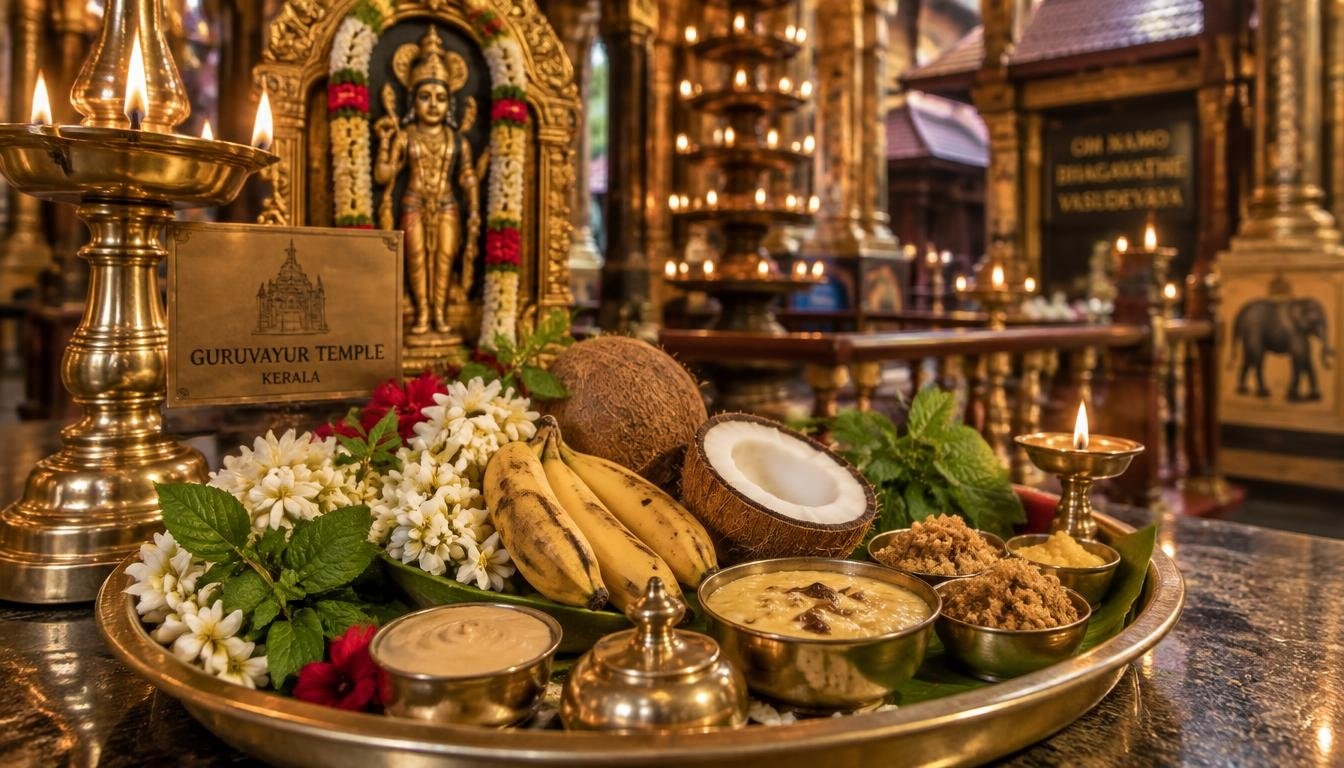
Visiting a temple is often about more than simply standing before a deity and offering a prayer. It is about carrying a little hope in the heart, remembering the people we love, expressing gratitude for life’s blessings and finding a moment of peace amid our busy routines. At Guruvayur Temple, these feelings become especially meaningful through the beautiful tradition of religious offerings, known as Vazhipadu in Malayalam.
Situated in Guruvayur, Kerala, the famous Guruvayur Sri Krishna Temple is dedicated to Lord Guruvayurappan, a form of Lord Krishna. Thousands of devotees visit this sacred place to seek blessings, celebrate important occasions and fulfil their religious vows. Some offer a simple flower prayer, while others arrange elaborate poojas, traditional food offerings or special ceremonies for their families.
The range of Guruvayur Temple Offerings reflects the temple’s rich devotional traditions. From Pal Payasam and Nei Payasam to Tulabharam, Choroonu, Udayasthamana Pooja and Krishnanaattam, each offering has its own religious significance and purpose.
If you are planning a visit or arranging a pooja from a distance, understanding the available offerings, approximate charges and booking procedures can make the experience much easier. This guide explores the Guruvayur Vazhipadu List, popular prasadam offerings, special rituals, donation options and online booking facilities, helping devotees make informed choices.
The word Vazhipadu refers to a religious offering made to a deity as an expression of devotion, gratitude or a personal prayer. At Guruvayur, devotees perform different kinds of offerings according to their family traditions, spiritual beliefs and individual wishes.
Some people arrange an offering to celebrate a wedding, the birth of a child or a child’s first feeding ceremony. Others make a vow when beginning a new journey, purchasing a vehicle or praying for good health and prosperity.
The central idea is not the amount of money spent. A small offering made with sincere Bhakthi (devotion) can be just as meaningful to the person making it as an elaborate religious ceremony.
The temple’s offerings are administered through Guruvayur Devaswom, the organisation responsible for managing the temple and its associated religious services. Offerings may include:
Knowing what each category represents helps devotees select an offering that has personal meaning rather than choosing something simply because it is popular.
The Guruvayur Vazhipadu List includes numerous offerings that devotees can arrange through the temple. Some are simple and affordable, while others involve more elaborate arrangements.
Here are several commonly listed offerings and their indicative charges from the temple’s online booking catalogue.
| Offering | Indicative charge |
|---|---|
| Pushpanjali | ₹15 |
| Bhagya Sooktham Pushpanjali | ₹25 |
| Purusha Sooktham Pushpanjali | ₹25 |
| Aikyamatyam Pushpanjali | ₹25 |
| Ayur Sooktham Pushpanjali | ₹25 |
| Sahasranama Pushpanjali | ₹50 |
| Ashtothara Archana | ₹25 |
| Vidhyagopala Archana | ₹25 |
| Santhanagopala Archana | ₹25 |
| Rajagopala Archana | ₹25 |
| Dhanwanthari Archana | ₹25 |
| Swayamvara Pushpanjali | ₹25 |
These are indicative amounts displayed in the official online offering catalogue accessed for this guide. Availability and charges can change, so devotees should check the current booking page before making payment.
Pushpanjali is among the familiar forms of worship. Flowers are offered to the deity along with prayers, and different forms of Pushpanjali are associated with particular devotional traditions.
For example, Santhanagopala Archana is traditionally associated with prayers concerning progeny and family blessings. Dhanwanthari Archana is connected with prayers for health and well-being, while Vidhyagopala Archana is associated with learning and education.
The meaning behind an offering is often what makes it special. A family arranging an Archana for a child’s education may find that a simple prayer carries far more emotional value than an expensive ceremony.
Pooja and Archana are important parts of the temple’s daily religious practices. Devotees select these services to express gratitude, seek blessings or remember a particular person during worship.
Some commonly available offerings include Ashtotharam Archana, Sahasranama-related offerings, Ganapathy Archana, Sastha Archana and Lalitha Sahasra Nama Archana.
Ashtothara Archana involves the devotional recitation of a deity’s 108 names. Sahasranama worship involves the recitation of a thousand divine names. These traditional forms of worship have an important place in Hindu devotional life.
Other recitations and prayers associated with temple offerings include:
The choice of prayer often depends on family customs and personal faith. Devotees who are unfamiliar with the different offerings can ask the temple authorities for guidance before booking.
Food offerings occupy a particularly cherished place in Guruvayur’s devotional culture. A traditional Nivedyam is prepared and offered to the deity before it becomes associated with the temple’s prasadam tradition.
For many devotees, receiving Guruvayur Temple Prasadam is one of the most memorable parts of a visit. Even a small portion of prasadam can remind someone of the atmosphere of the temple long after returning home.
Some popular food-related offerings include:
| Food offering | Indicative charge |
|---|---|
| Thirumadhuram | ₹20 |
| Pazham Panchasara | ₹25 |
| Butter Nivedyam | ₹25 |
| Pal Payasam | ₹55 |
| Nei Payasam | ₹85 |
| Appam | ₹12 |
| Pal Nivedyam | ₹40 |
| Malar Nivedyam | ₹15 |
| Aval Nivedyam | ₹25 |
| Pal Payasam (500 ml) | ₹110 |
| Pal Payasam (1 litre) | ₹220 |
The charges above reflect the online catalogue’s displayed prices and should be checked again before booking.
Pal Payasam is a traditional milk-based sweet preparation and one of the familiar offerings associated with Kerala temple cuisine. Its creamy texture and gentle sweetness make it a much-loved devotional food.
Devotees often choose it when making a simple offering to Lord Guruvayurappan. Larger quantities may also be listed separately in the booking catalogue.
Nei Payasam is prepared using ghee and other traditional ingredients. It has a richer flavour and a distinctive place in South Indian religious food traditions.
The offering is often selected by devotees who prefer traditional sweet Nivedyam.
Sarkara Payasam is a jaggery-based preparation. Its sweetness comes from traditional ingredients rather than the familiar taste of ordinary white sugar.
It is worth checking the current official catalogue for its availability and rate, as not every food preparation necessarily appears in every booking category.
Appam and Ada are traditional food offerings that are familiar to many Kerala families. Their connection with temple worship makes them popular choices for devotees who prefer a modest Nivedyam.
Other associated food offerings include Avil, Kadali, Sugar Plantain, Butter Nivedyam, Malar Nivedyam and Vella Nivedyam.
The preparation, quantity and availability of individual items should always be confirmed with the temple rather than assumed from an older price list.
Apart from everyday offerings, the temple provides several special religious services. These rituals are generally selected by devotees according to particular occasions, vows and devotional preferences.
Some offerings displayed in the official catalogue include:
| Special offering | Indicative charge |
|---|---|
| Kalabham Charth | ₹650 |
| Palabhishekam | ₹75 |
| Oil Abhishekam | ₹150 |
| Navakabhishekam (Karkidakam) | ₹500 |
| Thrikala Pooja | ₹650 |
| Dravya Kalasam | ₹750 |
| Ahassu Pooja | ₹5,000 |
| Ghee Lamp | ₹30 |
| Ghee Lamp in Sreekovil | ₹2,500 |
| Chuttuvilakku | ₹1,000 |
Some special services have restrictions or require direct confirmation with the temple office. The listed prices are not a guarantee that a particular ritual will be available on every date.
Abhishekam refers to the ritual bathing of the deity using prescribed sacred substances. Depending on the particular ceremony, the materials and procedure can differ.
Milk Abhishekam and Oil Abhishekam are examples of offerings associated with this tradition. Kalabham Charth is another special service involving a traditional sandalwood-based preparation.
Lighting offerings are also deeply meaningful. A devotee may sponsor a Ghee Lamp as a prayer for peace, prosperity or the well-being of loved ones. Larger lighting arrangements, such as Chuttuvilakku, involve more extensive temple arrangements.
Tulabharam, also called Thulabharam, is among the distinctive religious offerings associated with Guruvayur Temple.
In this ceremony, a devotee is weighed against a selected material, such as fruits, sugar, butter, rice or another approved item. The quantity required corresponds to the devotee’s weight, and the offering is made as part of a religious vow.
The ritual is often associated with gratitude, thanksgiving and prayers for well-being.
For example, a family may arrange Tulabharam after the recovery of a loved one or when fulfilling a long-standing vow. Parents may also choose it as part of a child’s religious celebration.
Commonly used materials include:
The temple’s Tulabharam arrangements have their own procedures, and the availability of individual materials should be checked before the ceremony.
Unlike many regular Vazhipadu services, advance booking may not be required for ordinary Tulabharam arrangements. However, special materials that are not readily available may need advance coordination.
Devotees should confirm the current timings, counters and payment procedure directly with the temple before travelling specifically for this offering.Writing
One of the most emotional occasions for a family is watching a baby taste solid food for the first time. In Kerala, this traditional ceremony is known as Choroonu, also called Chorun or Annaprasanam.
At Guruvayur Temple, parents bring their little ones to seek the blessings of Lord Guruvayurappan before beginning an important new stage of the child’s life.
The ceremony represents the beginning of a child’s journey towards nourishment, growth and good health. Grandparents, parents and other family members often accompany the baby, making the occasion a beautiful family memory.
The online booking catalogue lists Choroonu at an indicative charge of ₹250.
Families planning this ceremony should remember a few practical things:
For many parents, the first feeding ceremony is not simply another religious function. It is a moment when prayers for the child’s future are expressed with genuine love.
Among the special offerings, Udayasthamana Pooja holds an important place in Guruvayur’s religious traditions.
The name refers to worship performed from sunrise to sunset. It is an elaborate devotional offering involving several prescribed rituals throughout the day.
Devotees may arrange this pooja to express deep gratitude, fulfil a religious vow or seek divine blessings for their families.
The official online catalogue displays an indicative charge of ₹50,000 for Udayasthamana Pooja. However, the actual booking availability and applicable conditions must be confirmed with Guruvayur Devaswom.
Since this is a major offering, devotees should not assume that a preferred date will automatically be available.
It is better to enquire well in advance, understand the payment requirements and obtain confirmation directly from the temple.
There is something deeply moving about the sight of traditional lamps glowing inside a temple. Their light creates an atmosphere of devotion that words sometimes fail to explain.
At Guruvayur, devotees can select different lighting-related offerings as part of their religious observances.
Some important offerings include:
The Deepasthambham is a traditional lamp pillar found in Kerala temples. When illuminated during religious occasions, it adds a distinctive beauty to the temple surroundings.
Charges for elaborate lighting arrangements can be considerably higher than those for individual lamps. Devotees should check the current rate list and confirm whether the desired offering is available on their chosen date.
Many devotees visit Guruvayur to mark important milestones in their lives. The temple’s religious offerings provide different ways to celebrate these occasions through prayer.
Marriage-related offerings are chosen by devotees seeking blessings for married life and family happiness.
Some families visit Guruvayur before or after their wedding, while others arrange prayers to celebrate an anniversary.
A marriage-related offering is listed in some published Vazhipadu information, but the latest procedure and applicable charges should be confirmed with the Devaswom.
Vidyarambham is the traditional ceremony marking a child’s introduction to learning and education.
In Kerala, the ceremony is especially associated with Vijayadashami, when children are symbolically introduced to writing and learning.
Parents often seek blessings for their children’s educational journey, hoping that knowledge, wisdom and confidence will accompany them throughout life.
The online offering catalogue lists Vidyarambham at an indicative charge of ₹150.
A new vehicle is a significant purchase for many families. Some devotees arrange Vahana Pooja to seek blessings before beginning to use their vehicle.
Available categories and arrangements may include:
Published offering information has historically shown different charges depending on vehicle category. These amounts should not be treated as current official rates without confirmation.
Cow worship has a special place in Hindu religious traditions. Go-Pooja and Go-Preethi are associated with devotion and reverence towards the cow.
Devotees may also contribute towards animal-related temple activities, including the maintenance of elephants.
These offerings reflect a broader tradition of religious giving, where devotees express their faith through support for sacred animals and temple responsibilities.
One of the fascinating cultural traditions associated with Guruvayur Temple is Krishnanaattam.
It is a traditional dance-drama based on the life and stories of Lord Krishna. The performance combines music, elaborate costumes, traditional movements and devotional storytelling.
Krishnanaattam is traditionally presented through eight episodes:
Devotees can enquire about sponsoring performances through the temple’s prescribed arrangements.
Krishnanaattam is not merely entertainment. It is a form of devotional expression that brings stories from Krishna’s life to the audience through traditional performing arts.
Those interested in booking a performance should check the official calendar, availability and current charges. Special dates may have different booking conditions.
One of the most common questions among visitors is how much the different offerings cost.
The answer depends on the type of Vazhipadu, the quantity of materials, the nature of the ritual and the arrangements involved.
For convenience, here is a summary of selected amounts displayed in the official online booking catalogue consulted for this article.
| Category | Offering | Displayed amount |
|---|---|---|
| Archana | Pushpanjali | ₹15 |
| Archana | Ashtothara Archana | ₹25 |
| Archana | Sahasranama Pushpanjali | ₹50 |
| Abhishekam | Palabhishekam | ₹75 |
| Abhishekam | Oil Abhishekam | ₹150 |
| Nivedyam | Pal Payasam | ₹55 |
| Nivedyam | Nei Payasam | ₹85 |
| Nivedyam | Appam | ₹12 |
| Nivedyam | Malar Nivedyam | ₹15 |
| Special Pooja | Thrikala Pooja | ₹650 |
| Special Pooja | Udayasthamana Pooja | ₹50,000 |
| Lighting | Ghee Lamp | ₹30 |
| Lighting | Chuttuvilakku | ₹1,000 |
| Ceremony | Choroonu | ₹250 |
| Ceremony | Vidyarambham | ₹150 |
Important price note: These are indicative prices shown by the official online booking catalogue, not a guarantee of rates applicable to every future date. Some offerings may have special conditions, seasonal restrictions or limited availability. Always verify the latest amount before payment.
Older third-party price lists may show substantially different charges. Therefore, it is wise to avoid relying on an outdated screenshot or an unofficial website when planning a religious offering.
Devotees who cannot visit the temple immediately can explore the official online booking facility.
The Guruvayur Temple Online Booking system allows devotees to select available offerings, enter the necessary details and make payments through the prescribed process.
The official booking portal is:
The general procedure is as follows:
Step 1: Visit the official portal
Open the Guruvayur Devaswom booking website and access the Vazhipadu booking section.
Step 2: Select the deity
Choose the relevant deity or Pratishta. For offerings to Lord Guruvayurappan, select the appropriate option.
Step 3: Choose the offering
Browse the available list and select your preferred service, such as Pushpanjali, Archana, Pal Payasam or another listed offering.
Step 4: Select the date
Choose an available date according to the booking instructions. Some offerings permit advance reservations, while others have specific restrictions.
Step 5: Enter devotee details
Provide the requested name and other information. Certain offerings may require additional details.
Step 6: Complete payment
Review the selected service, quantity and total amount before making payment through the available payment facility.
Step 7: Save the receipt
Keep the booking confirmation and payment receipt safely. These details may be needed when collecting prasadam or confirming the offering.
The official booking instructions explain that devotees can also make bookings for multiple dates using the available date-filter facilities.
For technical assistance, the official Guruvayur Devaswom website publishes its online services helpline details.
An important precaution: Use only the official Devaswom website for online payments. The administration warns devotees about unauthorised agents and advises them never to share OTPs, passwords, CVV numbers or ATM PINs with anyone.
Apart from individual Vazhipadu, devotees may wish to support the temple through donations.
Guruvayur Temple Donations can contribute towards the maintenance of temple facilities, religious activities and other approved Devaswom responsibilities.
Some associated donation and service categories include:
Certain offerings permit contributions of any amount, while others have specified charges.
Donations should always be made through recognised Devaswom channels. Devotees should obtain an official receipt and retain the payment confirmation for their records.
It is also worth remembering that a donation is different from booking a specific pooja. If you wish to sponsor a particular religious service, make sure you select the correct category rather than assuming that a general donation automatically books a ritual.
Popular offerings include Pushpanjali, Ashtothara Archana, Pal Payasam, Nei Payasam, Ghee Lamp, Choroonu, Tulabharam and special poojas. The right choice depends on the devotee’s personal beliefs and the occasion.
Yes. Devotees can use the official Guruvayur Devaswom online booking portal to explore and book available offerings.
The official booking catalogue consulted for this guide displays Pal Payasam at ₹55, with separate listings of ₹110 for 500 ml and ₹220 for one litre. Check the live catalogue for the latest applicable prices.
The official online booking catalogue displays an indicative Choroonu charge of ₹250. Confirm the ceremony’s availability and current requirements before booking.
The catalogue consulted displays ₹50,000. As this is a special offering, devotees should contact the Devaswom to confirm the availability and booking conditions.
Read Blog; https://templetimingsdaily.com/guruvayur-temple-darshan-timings/
Tulabharam has designated arrangements at the temple, but devotees should verify the latest timings and availability directly with the authorities before visiting.
Devotees living outside Kerala can explore the official online booking facility. The Devaswom website provides online service access and information for devotees residing outside India as well.
No. Charges and availability can change. Always refer to the current official booking catalogue instead of relying on old price lists.
Choosing an offering need not become a complicated exercise. Sometimes, the simplest prayer is the one that means the most to a family.
If you are visiting for the first time, start by considering the reason behind your visit.
Before finalising your selection, consider the date, availability, charges and any special arrangements required.
It is also sensible to keep a copy of the receipt, particularly when booking for elderly family members or relatives who may be visiting the temple on your behalf.
The traditions of Guruvayur Temple Offerings represent much more than a collection of religious services. They bring together devotion, family memories, gratitude and the timeless stories associated with Lord Guruvayurappan.
Whether it is a small Pushpanjali, a bowl of Pal Payasam, the first feeding ceremony of a child, a Tulabharam offering or an elaborate Udayasthamana Pooja, each ritual provides devotees with an opportunity to express their faith.
Some visitors come with a wish. Others arrive with a heart full of gratitude. And many return year after year, carrying memories that become part of their family’s spiritual history.
If you are planning a visit, take time to understand the different offerings, check the latest Guruvayur Vazhipadu rates and use the official Devaswom booking facility wherever online reservations are available.
Above all, remember that devotion is not measured by the price of an offering. What matters most is the sincerity behind the prayer.
May Lord Guruvayurappan bless every devotee with peace, happiness, good health and prosperity. May every visit bring renewed hope, and may every sincere prayer become a beautiful reminder of faith.
Guruvayurappan Saranam!