Physical Address
304 North Cardinal St.
Dorchester Center, MA 02124
Physical Address
304 North Cardinal St.
Dorchester Center, MA 02124

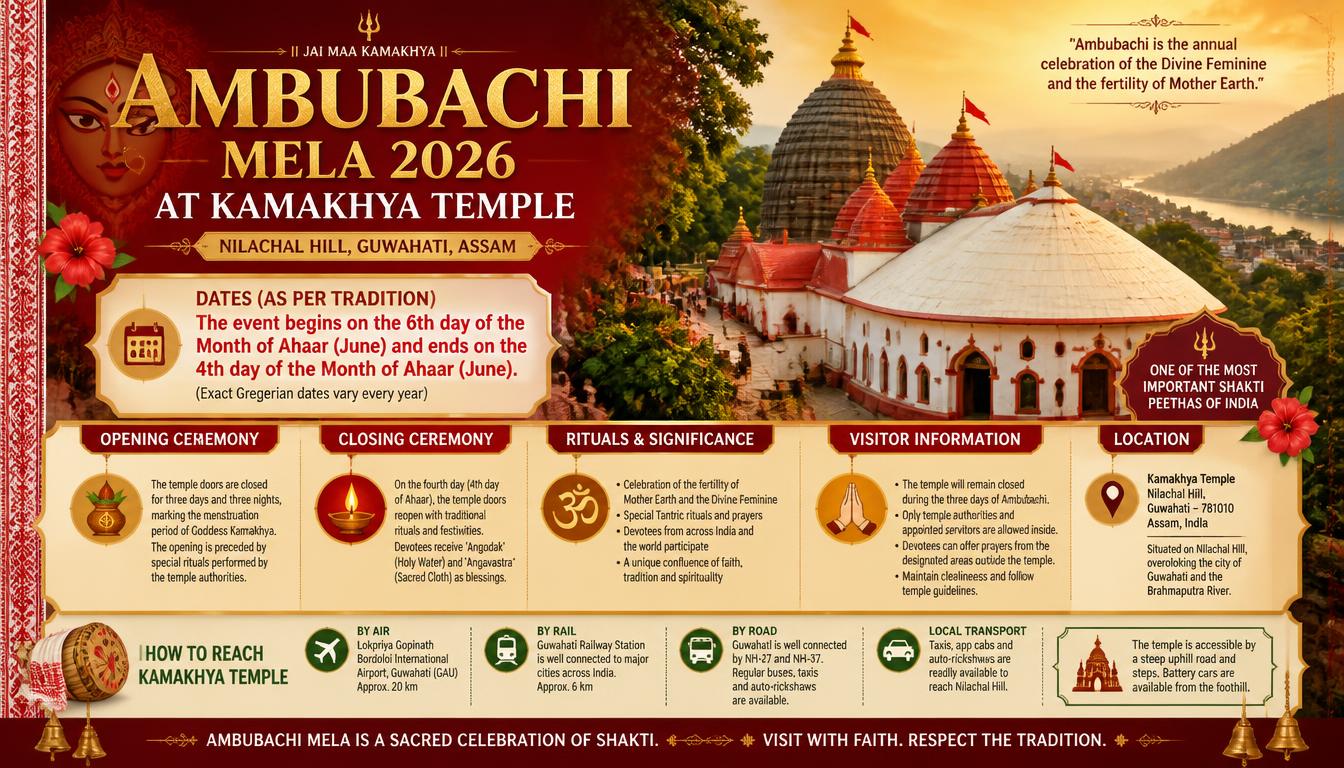
There are some pilgrimages that feel less like a journey and more like entering a living tradition. Ambubachi Mela 2026 at Kamakhya Temple in Guwahati, Assam, is one of those rare occasions. For devotees, the festival is deeply connected with the sacred feminine, fertility, creation, and the mysterious power of the Divine Mother.
The 2026 observance began with Pravritti on 22 June 2026, while the temple remained closed to devotees from 23 June to 25 June. The doors reopened on the morning of 26 June 2026 after the customary rituals, marking the return of darshan. Maa Kamakhya Devalaya
What makes this festival unusual is not simply its enormous gathering, but the belief behind it. During these days, Goddess Kamakhya is traditionally regarded as undergoing her annual menstrual cycle. The temple therefore becomes a place where fertility, womanhood, nature and divine energy are spoken about with a seriousness that feels very old, almost older than the stone around it.
If you are searching specifically for the Ambubachi Mela 2026 dates, the important dates are these:
The official Maa Kamakhya Devalaya notice gave the Pravritti time as 9:26 PM on 22 June 2026. The temple closure followed for three days, with reopening on 26 June after the required rituals. Maa Kamakhya Devalaya
So, although people commonly describe Ambubachi as a four-day festival, the actual temple closure occupies the three days following the onset, while the reopening on the fourth day is one of the most important moments for devotees.
The central idea behind Ambubachi Mela 2026 at Kamakhya Temple is the annual menstruation of the Goddess. In the Shakta tradition, this is understood as a sacred manifestation of feminine creative power rather than something impure.
The word Ambubachi is traditionally associated with water and the earth’s fertility. The festival arrives during the monsoon period, a season naturally linked with rain, agriculture, germination and renewal. The connection is quite beautiful when you stop and think about it: the earth receives rain, seeds awaken, crops begin their cycle, and the Goddess is symbolically associated with fertility and creation.
The official temple describes Ambubachi as an important monsoon observance connected with the belief that the Mother Earth enters her annual period of menstruation. Maa Kamakhya Devalaya
This is why the festival is not merely another crowded religious fair. Its meaning reaches into ideas of fertility, creation, divine feminine energy, and the mysterious cycle through which life continues.
For followers of Shakta Tantra, Kamakhya is a particularly important sacred centre. The Kamakhya Shaktipeeth is associated with the ancient Shaktipeeth tradition surrounding Goddess Sati and Lord Shiva.
According to the traditional mythology, after Devi Sati died following the events surrounding Daksh Yagna, Shiva carried her body in grief. Various parts of Sati are believed to have fallen at different locations, creating the sacred network of Shaktipeeths. At Kamakhya, tradition associates the site with Sati’s yoni, making the symbolism of fertility and creation especially powerful.
The sacred object of worship inside the temple is not an ordinary anthropomorphic statue. The shrine centres on the Yonipeeth, associated with a natural cleft or sacred stone formation and a spring of water.
That detail matters because it helps explain why Kamakhya’s religious identity is so different from many conventional temple experiences. The shrine expresses the Divine Mother through a symbol connected with nature, generation and the mysterious source of life.
The spiritual imagination surrounding Kamakhya Devi contains several layers. She is worshipped as the Divine Mother, but the tradition also connects her with forms of Shakti and with the wider tantric understanding of cosmic energy.
Names and concepts associated with the tradition include Kameshwari, Tripura Sundari, Ma Kali, and other manifestations of Shakti. These associations can become quite intricate, because Kamakhya’s religious environment contains multiple streams of worship and tantric interpretation.
At its heart, however, the message is surprisingly simple: creation is sacred.
The menstrual cycle, fertility and feminine power are not pushed away from spirituality here. Instead, they are brought into the centre of the sacred story. That is probably one reason Ambubachi continues to fascinate people even beyond Assam.
One of the most common questions about the festival is, why does Kamakhya Temple close during Ambubachi Mela?
According to religious tradition, the Goddess enters her annual Rajaswala Avastha, meaning the period associated with menstruation. The sanctum is therefore closed so that the Divine Mother may symbolically rest.
The closure is not treated as an ordinary temple holiday. It is itself part of the sacred observance.
The 2026 temple notice confirms that the doors were closed from 23 June through 25 June, following Pravritti on the night of 22 June. Maa Kamakhya Devalaya
During those days, devotees could participate in the atmosphere of the wider Ambubachi Mela, but they could not enter the sanctum for normal darshan.
The reopening, known as Nivritti, is one of the most anticipated moments of the festival.
On the morning of 26 June 2026, the temple underwent the customary ritual bath and daily puja before reopening for devotees. Maa Kamakhya Devalaya
After several days of closure, the atmosphere can become extremely intense. Pilgrims gather in large numbers, queues become lengthy, and the approach to the temple can feel more like a moving river of humanity than an ordinary pilgrimage route.
In traditional practice, devotees may receive sacred offerings associated with Kamakhya, particularly Angodak and Angavastra. Angodak refers to sacred water, while Angavastra or Raktavastra is traditionally associated with a piece of red cloth.
These are devotional objects, and their importance comes from faith and tradition rather than from ordinary material value.
Angodak is traditionally understood as sacred water associated with the Goddess’s shrine. The term is often explained in connection with water from the sacred spring within the temple.
Angavastra, sometimes called Raktavastra, refers to red cloth associated with the sacred observance. Red itself carries strong symbolic associations with Shakti, fertility, power and life.
For many devotees, receiving these items is an emotional part of the pilgrimage. A tiny piece of cloth can carry a surprisingly enormous meaning when someone has travelled hundreds of kilometres to receive it.
The Kamakhya Temple stands on Nilachal Hill in Guwahati, overlooking the surrounding landscape of Assam. Its location adds another layer to the experience because the temple is not simply an isolated shrine; the entire hill has become associated with pilgrimage and sacred geography.
Kamakhya is traditionally counted among the important Shaktipeeth sites. The mythology of Sati and Shiva gives these places a shared spiritual framework, while each individual Peeth has its own local traditions, rituals and identity.
At Kamakhya, that identity is particularly connected with Shakti, fertility and the generative principle of nature.
Another reason the festival attracts enormous attention is its connection with Tantra and tantric practitioners.
During Ambubachi, sadhaks, ascetics and practitioners associated with different spiritual traditions may gather around Kamakhya. The festival has long been regarded as an important occasion within tantric circles.
Names such as Aghoris, Naga ascetics, Kaula practitioners and other tantric practitioners are often associated with the broader festival environment, although individual practices and beliefs can vary considerably.
It is important not to turn every unusual-looking ritual into a sensational story. Tantra is a complex spiritual tradition with different schools, disciplines and philosophies. For serious practitioners, Mantra Sadhana, meditation, ritual discipline and devotion can be deeply structured practices.
The festival therefore becomes a meeting point between ordinary pilgrimage and specialised spiritual traditions.
Another fascinating part of Ambubachi mythology is the belief concerning red water.
Devotional traditions associate the reddish appearance of water during the festival with the Goddess’s menstrual cycle. This is part of the sacred symbolism surrounding Ambubachi, and devotees may understand it through faith and religious tradition.
From a scientific perspective, however, water can acquire reddish coloration from natural geological materials and mineral-rich sediment. Discussions of the phenomenon have mentioned substances such as iron-rich material and mineral deposits in the local environment.
These explanations do not need to cancel the religious interpretation. One describes a physical phenomenon, while the other describes what that phenomenon means within a sacred tradition.
That distinction is worth keeping clear, especially when writing about a festival where mythology, nature and ritual are woven together so tightly.
If you are researching Ambubachi Mela 2026 darshan, the most important point is that the sanctum was closed during the three-day period after Pravritti.
Darshan returned after the reopening rituals on 26 June. The reopening was expected to attract extremely heavy crowds, so visitors needed considerable patience.
The temple’s official 2026 notice specifically stated that special darshan costing ₹501 was unavailable on 26 and 27 June because of the heavy rush. Special entry for defence personnel was also suspended on those two days. Maa Kamakhya Devalaya
This is a useful reminder that ordinary temple rules and festival-period arrangements are not always the same.
The temple is located on Nilachal Hill in Guwahati, Assam, making Guwahati the natural base for visitors.
Travellers generally reach Guwahati by air, rail or road and then continue towards the Kamakhya area by taxi, cab, autorickshaw or other local transport.
For a major festival like Ambubachi, however, reaching Guwahati is only half the story. The final approach to the hill can become heavily controlled because of the huge number of pilgrims.
During the festival, visitors should follow the traffic, parking, shuttle and walking instructions issued by the local administration and temple authorities rather than assuming that ordinary-day access will remain available.
The safest strategy is boring but effective: leave early, keep your essentials simple, and allow much more time than Google Maps might suggest.
The festival occurs during the monsoon period, so rain, humidity and slippery surfaces can become part of the pilgrimage experience.
A visitor should think practically about:
The weather may change quickly, and a sunny morning does not promise a dry afternoon. Assam’s monsoon has its own personality, and it doesn’t always bother giving advance notice.
A huge religious gathering also creates a huge need for food and basic services.
During major pilgrimage periods, community kitchens, Bhandaras and forms of Anna Seva can become an important part of the experience. Devotees may encounter simple meals such as rice, lentils and khichdi rather than elaborate festival dining.
The spirit behind such food service is often more important than the menu. Feeding a tired traveller, giving water to someone waiting in a queue, or helping an elderly pilgrim sit down can become its own form of seva.
For visitors, it is still sensible to carry some personal snacks and water rather than depending entirely on temporary food arrangements.
Read ARticul: https://templetimingsdaily.com/vigyan-bhairav-tantra/
Accommodation in Guwahati can become difficult to secure around Ambubachi Mela 2026, particularly close to the temple and major transport points.
Depending on availability and budget, visitors may consider:
Booking early is especially sensible because the festival attracts pilgrims from many parts of India and beyond.
If your main purpose is darshan after reopening, staying somewhere with practical transport access may be more useful than choosing a property simply because it is closest on the map.
Many religious festivals celebrate a deity through elaborate worship, processions or seasonal stories. Ambubachi Mela does something quite different.
It places the biological cycle of a female body inside a sacred framework.
The annual menstrual cycle of Goddess Kamakhya is understood as an expression of divine creative energy. Menstruation, which is still uncomfortable to discuss in many societies, becomes here a subject of religious significance.
That does not mean every visitor must share the same theological interpretation. A respectful understanding simply requires recognising that for devotees, the symbolism is deeply meaningful.
The history of Ambubachi Mela is closely tied to the ancient religious identity of Kamakhya.
Traditional accounts connect the shrine with the story of Sati, Lord Shiva, and the formation of the Shaktipeeths. Textual traditions associated with the region include works such as the Kalika Purana and Yogini Tantra, which are important in understanding the religious culture surrounding Kamakhya.
Over time, the annual observance developed into a huge pilgrimage and cultural gathering.
Today, the festival combines ancient religious symbolism with very modern realities: crowds, transport systems, temporary camps, security arrangements, mobile phones, online information and thousands of travellers trying to find the same sacred hill at almost the same time.
That mixture is strange, honestly, but also part of what makes Ambubachi so alive.
Ambubachi Mela 2026 was observed from 22 June to 26 June, with Pravritti beginning on 22 June and the temple reopening on 26 June after the rituals. Maa Kamakhya Devalaya
According to tradition, Goddess Kamakhya undergoes her annual menstrual cycle during this period. The temple closes so the Divine Mother can symbolically rest.
The temple reopened on the morning of 26 June 2026, after the ritual bath and daily puja. Maa Kamakhya Devalaya
The festival is centred at Kamakhya Temple on Nilachal Hill in Guwahati, Assam.
Its central significance lies in the worship of the Divine Mother through themes of fertility, menstruation, creation, Shakti and the natural cycle of life.
Angodak is traditionally regarded as sacred water associated with the Kamakhya shrine and is distributed as a devotional blessing.
Angavastra, also referred to as Raktavastra in this context, is sacred red cloth associated with the shrine and the Ambubachi observance.
Yes. Ambubachi is a major public religious gathering, and men, women and devotees from many backgrounds participate in the wider festival. Specific temple-entry rules can vary during different stages of the observance.
Not throughout the festival. In 2026, the official temple notice stated that the ₹501 special darshan facility was unavailable on 26 and 27 June because of the heavy rush. Maa Kamakhya Devalaya
Kamakhya has a longstanding association with Shakta Tantra, and the festival attracts tantric practitioners and spiritual seekers. The period is regarded as particularly significant within some tantric traditions.
Sure, I’ll keep your H3 headings exactly as written and provide a 1–2 line English answer under each.
Ambubachi Mela 2026 will be observed from 22 June to 26 June 2026 at Kamakhya Temple in Guwahati, Assam. The main temple remains closed for three days and reopens on June 26 for devotees.
The Ambubachi Mela 2026 dates are 22 June to 26 June 2026. The festival begins with the Pravritti rituals on June 22 and concludes with Nivritti rituals on June 26.
Ambubachi Mela 2026 is scheduled for 22 June to 26 June 2026 at Kamakhya Temple, Guwahati. The temple doors remain closed during the three-day observance.
In 2026, Ambubachi Mela begins on 22 June and ends on 26 June. The temple reopens to devotees for Darshan on June 26 after the conclusion rituals.
Ambubachi Mela 2026 takes place from 22 June to 26 June. The temple remains closed from June 22 through June 25 and reopens for Darshan on June 26.
Ambubachi Mela 2026 at Kamakhya Temple brought together faith, mythology, nature, pilgrimage and the enduring symbolism of feminine creative power. The dates were important, but the deeper meaning was never really contained by a calendar.
From Pravritti on 22 June to the reopening on 26 June, the festival followed a rhythm of closing, resting, ritual purification and renewal. That rhythm mirrors something larger in nature itself: things withdraw, transform, and eventually begin again.
For anyone studying Kamakhya Temple, the Ambubachi Mela dates, the Kamakhya Shaktipeeth, or the spiritual significance of the festival, one idea stands out beautifully creation is not separate from the sacred. It is part of it.
And perhaps that is why, year after year, people continue travelling toward Nilachal Hill. They are not simply going to see a famous temple. They are going to encounter a tradition where the earth, the feminine, fertility and divine energy are allowed to speak in the same language.