Physical Address
304 North Cardinal St.
Dorchester Center, MA 02124
Physical Address
304 North Cardinal St.
Dorchester Center, MA 02124

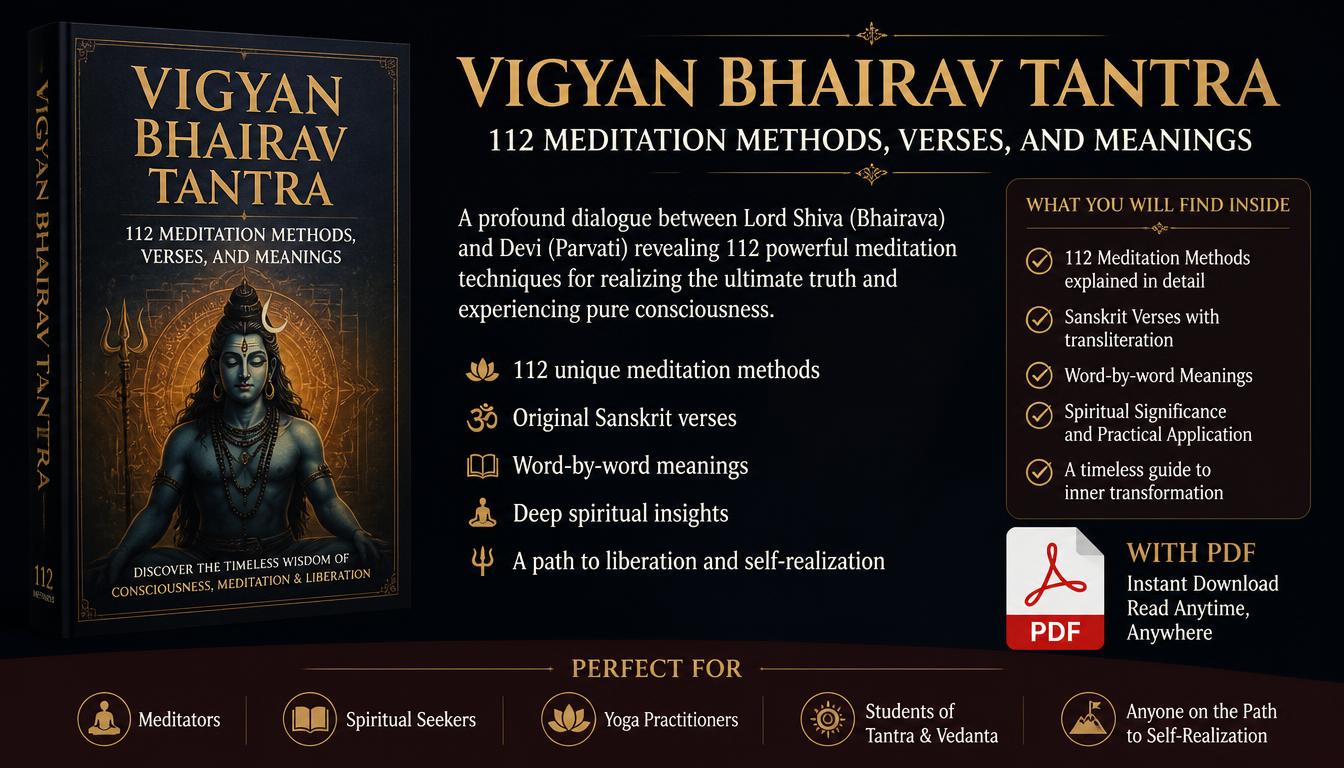
There are some spiritual texts that feel less like books and more like quiet doors waiting to be opened. Vigyan Bhairav Tantra is one of them. Instead of giving a single rigid path to meditation, it explores many ways a person can turn attention inward, sometimes through the breath, sometimes through sound, silence, sensation, or the space between thoughts.
At the heart of the text is a profound conversation between Bhairava and Bhairavi, traditionally understood as Lord Shiva and Goddess Parvati. Bhairavi asks about the ultimate nature of reality, and the response unfolds through a collection of 112 meditation methods. The unusual beauty here is that meditation is not presented as something belonging only to a quiet cave or a person sitting perfectly still.
The Vijnana Bhairava Tantra suggests that ordinary experiences can become doorways to awareness when approached with complete attention. A breath can become a meditation, a sound can become a meditation, and even a moment of stillness can reveal something deeper. That makes this ancient work feel surprisingly intimate even today.
Vigyan Bhairav Tantra is a Sanskrit spiritual text associated with the Kashmir Shaivism tradition, especially the broader Trika Shaivism philosophical environment. Its central teaching is concerned with direct experience of consciousness rather than simply collecting spiritual ideas.
The word Vigyana can be understood in relation to deeper knowledge or direct knowing, while Bhairava refers to a profound form or state associated with Shiva. Tantra here should not be reduced to the modern meanings sometimes attached to the word. In this context, it points toward a spiritual approach involving awareness, energy, consciousness, and transformation.
The text is especially famous because it presents 112 meditation techniques rather than insisting that everyone must follow one identical practice. Some methods focus on breath awareness, others on sound, inner space, concentration, sensation, emotion, visualization, or the experience of emptiness.
That variety is one reason the scripture has remained interesting to students of meditation and Tantra philosophy.
The conversation between Bhairava and Bhairavi forms the spiritual heart of the text. Bhairavi approaches the mystery of existence with questions about reality, consciousness, and the ultimate state beyond ordinary duality.
Rather than answering with a long philosophical lecture, Bhairava gives practical approaches. The teaching repeatedly turns the seeker toward direct observation, which is a pretty remarkable feature of the text.
The relationship between Shiva and Shakti is also important when understanding this dialogue. Bhairava represents the profound consciousness associated with Shiva, while Bhairavi represents Shakti, the dynamic divine energy. Their dialogue can therefore be read not only as a conversation between two divine figures but also as a symbolic exploration of consciousness and its creative power.
This idea of the union of Shiva and Shakti is deeply connected with several traditions of tantric spirituality.
The 112 meditation methods are designed around different experiences that human beings naturally encounter. Instead of saying that one particular object must always be used for meditation, the text explores many possible points of entry into awareness.
One person may find the breath easy to observe. Another may become naturally absorbed in sound. Someone else may experience a powerful moment of silence, wonder, love, fear, or stillness and discover that it can become an opening into deeper awareness.
This makes the Vigyan Bhairava Tantra meditation approach flexible. The methods are not simply a collection of tricks for relaxation. Their larger purpose is connected with self-realization, expanded awareness, and recognition of consciousness.
The important thing is not to rush through all 112 techniques. A seeker may find that one method speaks more clearly than the others, and spending time with that method can be more useful than constantly changing practices.
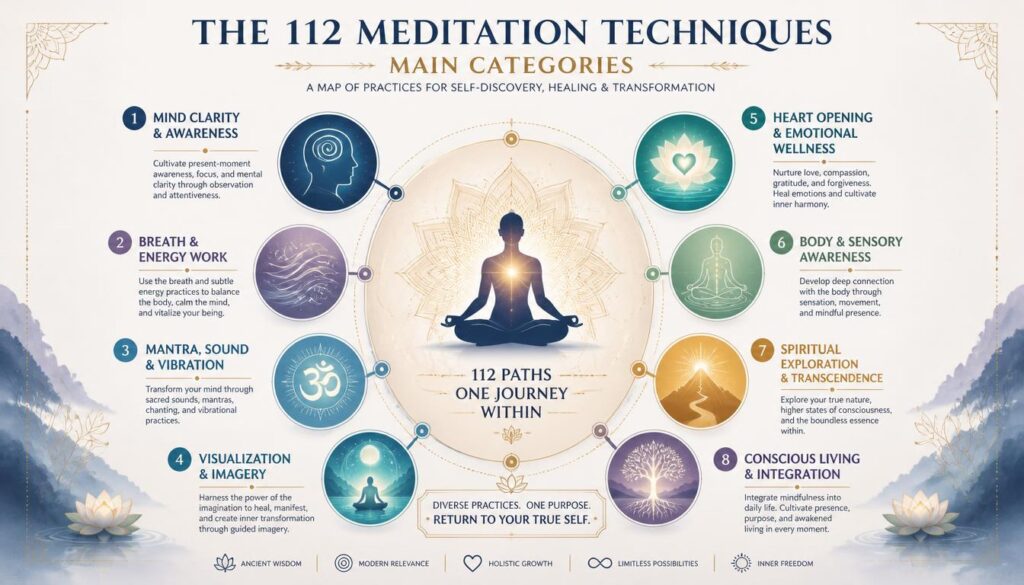
The 112 methods can be understood through broad themes, although individual techniques may overlap. This makes the huge collection easier to approach without pretending that every method belongs neatly inside one box.
Breath is one of the most accessible subjects in the text. Several practices involve noticing inhalation, exhalation, pauses, or the subtle transition between breaths.
A person can simply observe breathing without trying to force it. The attention moves toward the natural rhythm of prana, and the small spaces surrounding the breath can become especially interesting.
The idea of meditation between breaths is particularly striking because the pause can feel like a tiny doorway where ordinary mental activity becomes quieter.
Sound also becomes a doorway in the text. Mantra meditation, Om meditation, and forms of Nada meditation encourage attention toward vibration and inner sound.
The Sanskrit concept of Nada refers broadly to sound or vibration, while Anahata Nada is associated with an unstruck or subtle inner sound. Rather than treating sound merely as background noise, these practices invite the meditator to become deeply attentive to it.
This approach can eventually turn attention away from the external source of sound and toward the awareness in which sound appears.
Another fascinating group of practices concerns Shunya, often translated as emptiness, void, or open space depending on context.
Shunya meditation is not simply about imagining that nothing exists. It can involve noticing openness, gaps, stillness, or the absence of particular mental objects.
For someone constantly surrounded by thoughts, the discovery that awareness can remain present even when a thought temporarily disappears can be surprisingly powerful.
Several approaches can be understood through the simple question of awareness itself. Instead of concentrating on an external object, attention turns toward the one who is experiencing.
This is close to meditation on awareness, where the practitioner observes thoughts, sensations, and perceptions without becoming completely identified with them.
The movement from ordinary mental activity toward thoughtless awareness is sometimes described as a movement into greater inner clarity. It does not mean becoming unconscious or blank; rather, awareness remains while unnecessary mental noise may become less dominant.
The tantric tradition also includes practices connected with chakra, Nadi, and Kundalini Shakti.
Concepts such as the central channel, Prana Shakti, and subtle energy are important in tantric and yogic traditions. Some methods direct attention toward particular areas of the body, including the heart center or Ajna region, commonly associated with the third eye.
These subjects can become quite technical, so they are best approached carefully and within the context of the tradition rather than treated as instant supernatural techniques.
Silence receives an almost poetic role in many contemplative traditions. In the Vigyan Bhairava Tantra, stillness and space can become objects of contemplation rather than empty gaps that need to be filled.
A quiet room, an open sky, darkness, or the moment after a sound disappears can all provide opportunities to notice subtle changes in attention.
Sometimes nothing dramatic happens at all, and that is part of the lesson. Meditation does not always arrive with fireworks; sometimes it arrives looking almost boring, then quietly changes the way you notice yourself.
The Vigyan Bhairav Tantra verses are traditionally presented in Sanskrit and are interpreted through translations and commentarial traditions. Their meaning can vary considerably depending on how technical Sanskrit terms are understood.
For example, words such as Prana, Shakti, Shunya, Nada, Madhya, and Bhairava carry layers of philosophical and spiritual meaning that may not fit neatly into one English word.
This is why reading the Vigyan Bhairav Tantra meaning from a single short translation may not always capture the entire depth of a verse. A translation can provide an entry point, while traditional commentary can provide additional context.
The verses are most useful when treated as invitations to practice and contemplate, rather than merely inspirational quotations.
The relationship between Vigyan Bhairav Tantra and Kashmir Shaivism is important for understanding the text’s philosophical background.
Kashmir Shaivism, including the Trika Shaivism tradition, places strong emphasis on consciousness, Shakti, direct recognition, and the non-dual nature of reality. Instead of treating the divine as completely separate from the world, these traditions explore how consciousness can be recognized within experience itself.
Concepts such as Chit, Chiti Shakti, Svatantrya, and Shiva Tattva belong to this wider philosophical vocabulary.
The 112 methods can therefore be viewed not merely as relaxation exercises but as contemplative approaches connected with a larger vision of consciousness and spiritual realization.
The figure of Bhairava is central to the text. In a spiritual context, Bhairava can represent a state or dimension of consciousness beyond ordinary limitation and conceptual division.
Shakti, meanwhile, represents dynamic divine energy. The relationship between Shiva and Shakti is therefore not simply a mythological relationship; within tantric philosophy, it can symbolize the inseparability of consciousness and its power.
This is why ideas such as Shiva Shakti unity, divine energy, and supreme consciousness appear repeatedly in discussions surrounding tantric meditation.
The seeker is not necessarily being asked to escape ordinary existence. Instead, the practice can involve recognizing a deeper dimension of awareness within experience itself.
One of the strongest themes connected with the text is self-realization.
Here, self-realization does not simply mean becoming more confident or learning more facts about yourself. In a spiritual context, it points toward recognition of the deeper nature of consciousness beyond habitual identification with thoughts, emotions, roles, and personal stories.
The methods encourage observation. What happens when you watch the breath without controlling it? What remains when a sound disappears? What happens in the tiny pause between two thoughts?
These questions sound simple, but sometimes the simple questions are the ones that refuse to leave you alone.
The broader goal of these practices is connected with enlightenment, liberation, Moksha, and recognition of a deeper reality.
Different schools explain these terms in different ways, so it is better not to promise that practicing a particular technique will automatically produce enlightenment. Spiritual development is usually much more subtle than that.
The text points toward direct experience, while the practitioner brings patience, discipline, curiosity, and awareness.
In this sense, meditation for liberation is less about achieving a dramatic experience and more about seeing through habitual patterns of attachment, aversion, and identification.
Breathing happens whether we pay attention to it or not. That makes it an unusually intimate meditation object.
In breath awareness meditation, the practitioner can notice the movement of inhalation and exhalation without deliberately manipulating the breath. The changing sensations become a field of observation.
The transition between inhalation and exhalation can also attract attention. These small moments are easy to miss in normal life, yet contemplative practice asks us to notice exactly those things.
For beginners, gentle observation is generally more appropriate than aggressive breath retention or complicated Kumbhaka practices.
A mantra can provide the mind with a focused object. Repetition, or Japa, is used in many Indian spiritual traditions, while Pranava, commonly associated with Om, has a particularly important place in yogic and contemplative practice.
Sound-based practices can gradually make the practitioner more sensitive to subtle changes in attention.
The idea of inner sound meditation is especially intriguing because it moves the practitioner from ordinary listening toward a more refined awareness of sound itself.
Modern life creates a strange problem: silence is everywhere, yet many people rarely experience it internally.
A person can sit in a completely quiet room and still carry an entire noisy city inside the head. Thoughts jump around, memories arrive without invitations, and tomorrow starts worrying about itself.
Practices involving meditation on silence, stillness, and inner consciousness offer another possibility. Instead of fighting thoughts, the practitioner learns to notice them without immediately following every one.
That gentle distance can create a sense of inner peace.
The word Tantra is often misunderstood because popular culture has attached many narrow meanings to it. In its traditional spiritual setting, tantric systems can involve philosophy, ritual, mantra, visualization, meditation, subtle-body concepts, and practices aimed at recognizing consciousness.
Tantra Sadhana therefore represents a much broader field than one particular technique.
The Vigyan Bhairava Tantra is especially distinctive because it brings attention repeatedly back to immediate experience. Breath, sound, sensation, space, emotion, and awareness can all become possible entrances into contemplative realization.
A beginner does not need to attempt all 112 meditation methods in one sitting. Honestly, trying to race through them would probably miss the point.
Choose a practice that feels understandable and safe. Breath awareness is often easier to approach than advanced subtle-energy or breath-retention practices.
Practice for a modest period and observe what happens without demanding a mystical experience. If the mind wanders, notice it. If nothing seems to happen, notice that too.
The purpose is not to manufacture a special state but to become increasingly intimate with awareness itself.
People interested in meditation, Kashmir Shaivism, spiritual philosophy, self-awareness, or traditional tantric literature may find the text valuable.
It can appeal to both beginners and experienced practitioners, although the depth of its technical vocabulary means that serious study may benefit from reliable translations and traditional commentaries.
Someone interested mainly in relaxation may appreciate a few of the simple awareness practices, while a serious student may want to explore concepts such as Shunya, Nada, Prana, Shakti, Tattva, and non-duality in greater depth.
Readers searching for a Vigyan Bhairav Tantra PDF should pay attention to the quality and provenance of the edition. Different translations may use different terminology, and some modern presentations simplify complex Sanskrit concepts.
A useful English edition should ideally identify the Sanskrit text, translator, publication details, and any commentary or explanatory notes.
Searching for Vigyan Bhairava Tantra English resources can help readers compare interpretations, but the most trustworthy approach is to avoid assuming that one modern paraphrase represents the only possible meaning.
The original text is traditionally associated with Sanskrit, so translations are interpretive bridges rather than perfect word-for-word replacements.
Several Sanskrit and philosophical ideas can help readers understand discussions of the scripture.
Prana refers broadly to vital life energy and is central to many yogic practices. Apana is another important energetic concept, while Nadi refers to subtle channels within traditional yogic models.
Nada relates to sound, Bindu to a point or subtle principle, and Shunya to emptiness or open space. Madhya can refer to the middle or center, a recurring idea in contemplative practice.
Other terms, including Samadhi, Moksha, Jnana, Bhakti, and Vairagya, belong to the wider vocabulary of Indian spiritual traditions and can carry different meanings depending on the philosophical system being discussed.
Understanding these terms slowly is better than memorizing twenty of them in one evening and forgetting nineteen by breakfast.
A striking feature of the Vigyan Bhairava Tantra 112 techniques is their diversity.
They do not all require a complicated posture, a temple, special equipment, or a particular lifestyle. Some use very ordinary experiences as starting points for attention.
This makes the teaching feel practical while still remaining philosophically deep. The world around us becomes the material of meditation rather than an obstacle that must always be rejected.
The deeper message can be understood as an invitation to discover awareness inside experience itself.
The most useful way to approach ancient meditation is with both openness and discernment.
Read the verse or explanation slowly. Understand what the practice is asking. Then give yourself enough time to actually observe the experience instead of immediately searching for another technique.
A small notebook can also help. After meditation, write down what you noticed without trying to make the experience sound spiritual or impressive.
There is no prize for having the strangest meditation story. Sometimes noticing one ordinary breath clearly is already meaningful.
One misunderstanding is that the text promises instant enlightenment through a secret technique. That is not a responsible way to approach it.
Another is that Tantra should automatically be understood through modern sensational interpretations. The scripture belongs to a much richer spiritual and philosophical environment.
It is also worth remembering that terms such as Kundalini, chakra, Nadi, and Khechari Mudra come from traditional systems of practice. Advanced techniques should not be approached recklessly or through random internet instructions.
The safest attitude is patient study, gradual practice, and respect for the tradition.
If the 112 methods feel overwhelming, begin with something uncomplicated: sit comfortably, allow the breathing to remain natural, and notice the movement of inhalation and exhalation.
Do not force the breath. Do not chase visions. Do not try to stop every thought.
Simply notice.
When attention wanders, return gently. After several minutes, notice the quiet pause between activities, and then return to ordinary life without expecting yourself to become a different person overnight.
This small practice captures something important about the spirit of Vigyan Bhairav Tantra meditation: direct awareness can begin with what is already happening.
The Vigyan Bhairav Tantra PDF can help readers study its 112 meditation methods, verses, and meanings in a convenient digital format.
Vigyan Bhairav Tantra in Hindi makes the ancient teachings easier to understand for Hindi-speaking readers, especially those exploring meditation and spiritual awareness.
A Vigyan Bhairav Tantra PDF in Hindi can provide the original teachings along with Hindi explanations, making the 112 meditation techniques more accessible.
The 112 methods of Vigyan Bhairav Tantra PDF download can help readers explore different meditation approaches involving breath, sound, awareness, silence, and consciousness.
Vigyan Bhairav Tantra is an ancient tantric text associated with Shiva and Bhairavi that presents 112 meditation methods for exploring consciousness and self-realization.
Rad more: https://templetimingsdaily.com/kateel-durgaparameshwari-temple/
Vigyan Bhairav Tantra remains fascinating because it does not reduce spirituality to one narrow doorway. Through 112 meditation methods, it explores breath, sound, silence, space, sensation, awareness, energy, and consciousness as possible entrances into deeper realization.
Its dialogue between Bhairava and Bhairavi, and its connection with Shiva and Shakti, place the practices within a rich tantric vision in which consciousness and divine energy are deeply connected.
For some readers, the most valuable teaching may be breath meditation. For others, it may be Nada meditation, Shunya meditation, mantra, stillness, or the direct observation of awareness. There is no need to force one method to suit everybody.
The real invitation of the text is quieter than a promise of instant transformation. It asks us to look closely at experience, to notice what normally escapes attention, and perhaps to discover that awareness itself is much deeper than the stream of thoughts passing through it.
If you explore the Vigyan Bhairava Tantra 112 techniques, take your time. Read the verses and meanings, compare reliable translations, practice gently, and let understanding develop through experience rather than haste.
And perhaps that is the most beautiful part: the doorway does not have to be somewhere far away. It may begin with one breath, one sound, one moment of silence, or one completely ordinary second in which you finally notice that you are aware.