Physical Address
304 North Cardinal St.
Dorchester Center, MA 02124
Physical Address
304 North Cardinal St.
Dorchester Center, MA 02124

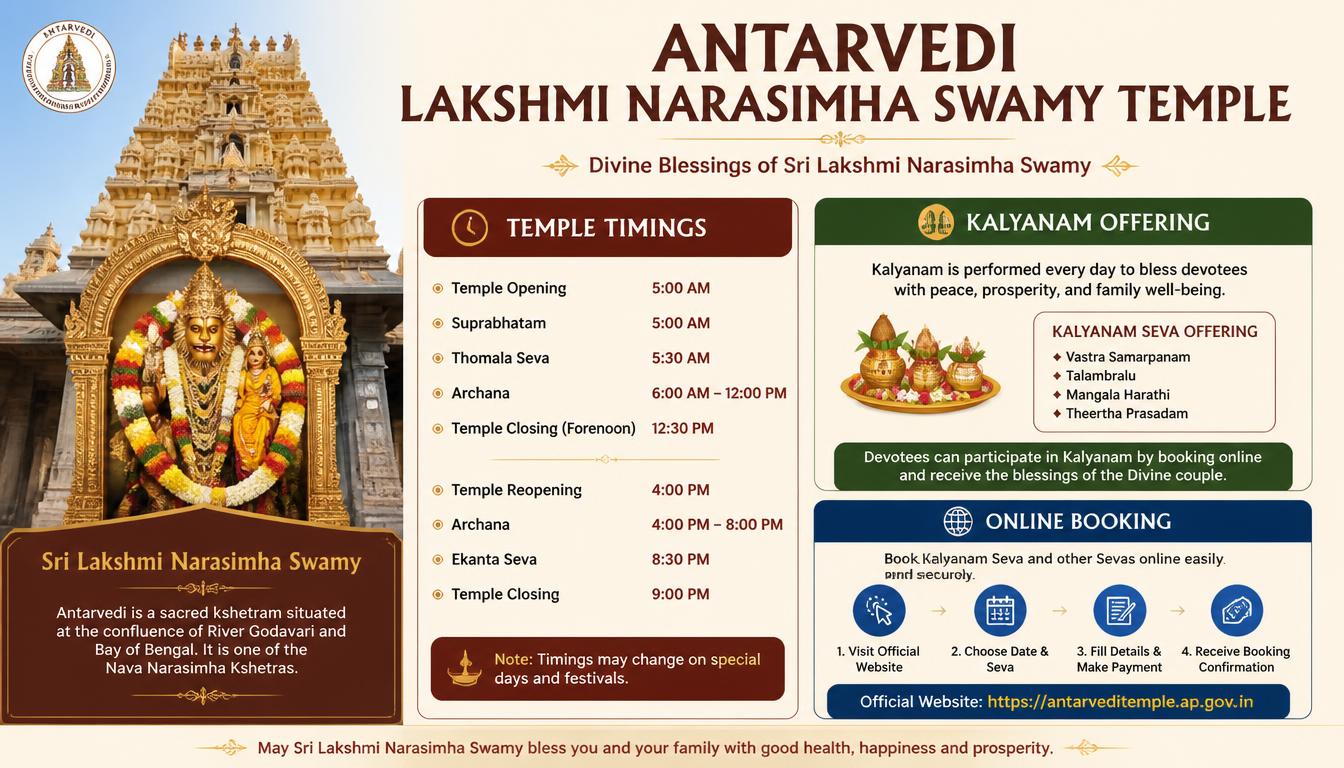
There are temples where people simply arrive, pray, and leave. Then there are places where the landscape itself seems to become part of the prayer. The Antarvedi Lakshmi Narasimha Swamy Temple is one of those rare sacred places, standing near the meeting point of the Bay of Bengal and the Vashista Godavari, a branch of the Godavari River in Andhra Pradesh.
For devotees, a visit is not only about seeing the deity. It can be about Darshan, participating in a Seva, making a Kalyanam offering, or quietly sitting for a few minutes after worship. The temple is dedicated to Lakshmi Narasimha Swamy, with Goddess Rajyalakshmi worshipped alongside the Lord.
If you are planning a pilgrimage to Antarvedi, the practical details matter too. Knowing the Antarvedi temple timings, Darshan sessions, Kalyanam arrangements, and booking process can save you from a rushed visit.
Published sources give slightly different daily schedules, so devotees should confirm the day’s timings with the temple authorities before travelling. A commonly published schedule lists Nijaroopa Darshan from 6:00 AM to 8:00 AM, Abhishekam from 8:00 AM to 9:30 AM, Sarva Darshan from 9:30 AM to 12:30 PM, and an afternoon Darshan session from around 2:30 PM to 7:30 PM.
A simple planning view is:
Because ritual schedules can change on festival days, don’t treat these hours like a railway timetable carved in stone. Special Puja, festival arrangements, or temple administration decisions can affect entry and Darshan.
The Antarvedi temple darshan timings are particularly useful for pilgrims who want to experience different forms of worship rather than just ordinary entry.
During Nijaroopa Darshan, devotees can have Darshan of the deity in a form described by temple-related sources as the early morning unadorned form. The quietness of those first hours can make the visit feel very different from a crowded festival afternoon.
The daily religious routine may include:
Older published temple information also lists free Dharma Darshan and separate paid Darshan categories, but ticket categories and charges can change, so devotees should verify current rates before making plans.
For a peaceful morning Darshan, reaching before the main morning rush is generally a sensible approach. On festival days, though, the atmosphere can become much busier.
The setting of the temple is one of its most memorable features. The Sri Lakshmi Narasimha Swamy Temple stands at Antarvedi, in the Sakhinetipalle Mandal area of Konaseema district, Andhra Pradesh.
The sacred landscape is closely associated with the meeting of the Vasishta Godavari and the Bay of Bengal. This unusual river-and-sea setting gives the pilgrimage a character that is hard to separate from the geography itself.
The principal deity is Lord Narasimha Swamy, the Narasimha Avatar of Vishnu. In Vaishnava tradition, Narasimha is understood as the fourth Avatar of Vishnu.
The Lord is worshipped with Goddess Lakshmi, who represents prosperity, fortune, beauty, abundance, and well-being. The presence of Rajyalakshmi gives the shrine an additional layer of devotional significance for worshippers.
One of the rituals that attracts devotees is the Nitya Kalyanam, or daily wedding ritual associated with the divine couple. Devotees may participate through the relevant Seva or make arrangements for a Kalyanam offering according to the temple’s current procedures.
The idea of divine wedding worship has a special place in Hindu temple traditions. It is not treated simply as a symbolic performance; for many devotees, participating in a Lakshmi Narasimha Kalyanam is a devotional act through which they offer prayers for harmony, prosperity, family well-being, and blessings.
The temple also has an annual Sri Swamy Vari Kalyanam as part of its major festival observances. The Andhra Pradesh government district page lists the Kalyanam among the important celebrations of the shrine.
If your purpose is specifically Antarvedi Kalyanam booking, check whether you are booking a daily Seva, an annual festival event, or another type of religious service. These are not necessarily the same thing.
Devotees searching for an Antarvedi Nitya Kalyanam ticket or Kalyanam Seva price should be careful with older online information.
Several websites publish historical or previously listed prices for Mokkubadi Kalyanam and other services, but those figures are not reliable enough to present as today’s official charges. For example, older online listings mention a Mokkubadi Kalyanam charge, while other sources provide different amounts.
That difference is exactly why checking the current temple office or official booking facility is important before paying anything.
When checking a Kalyanam offering, confirm:
A few minutes spent checking these details can prevent a very unnecessary headache later.
The phrase Antarvedi temple online booking can refer to different things, including Seva reservations, Darshan tickets, or other temple services.
Before entering personal details or making a payment, make sure you are using a genuine temple or government-authorized booking facility. Do not assume that every website appearing in search results is an official Temple booking portal.
A typical online reservation process, where an authorized facility is available, may involve:
The exact interface can change, so the names of buttons and fields should not be assumed in advance.
A common mistake is thinking that every temple visit requires a paid online ticket. Ordinary Darshan and special religious services can follow different rules.
For Antarvedi Darshan booking, first determine whether you simply need general entry or whether you want a Special Darshan, Seva, or Puja.
Some published sources describe free Dharma Darshan as well as paid faster-entry options. Since ticket categories and prices can change, verify them for your intended date rather than relying on an old blog post.
If you are booking a specific service, keep the confirmation on your phone and, if possible, carry a screenshot or printed copy. Internet connections have a funny habit of becoming shy exactly when you need them most.
The Antarvedi temple history combines older religious traditions with documented historical evidence.
The shrine is associated with Antarvedi, a temple town in the coastal region of Andhra Pradesh. Sources describe the temple tradition as having older roots, with references to construction activity in the 15th century and 16th century, followed by later rebuilding.
One particularly important historical reference is the Temple inscription connected with the rebuilding of the shrine.
The inscription records Shalivahana Saka 1745, corresponding to 1823 A.D., and names Kopanathi Krishnamma in connection with the construction work.
This is more useful than repeating a vague “ancient temple” description because the inscription provides a concrete historical marker.
The name Kopanathi Krishnamma appears in accounts of the temple’s history and in connection with the inscription dated 1823 A.D.
Historical descriptions associate him with the Agnikula Kshatriya community and credit him with an important role in rebuilding the temple structure. The inscription itself is the significant piece of evidence connecting the construction work with the date Shalivahana Saka 1745 / 1823 A.D.
It is worth separating documented history from temple legends here. Stories surrounding the origin of the deity belong to the devotional tradition, while the inscription provides a historical record of construction.
That little distinction makes the story more interesting, not less.
The religious traditions surrounding the shrine connect Lord Narasimha Swamy with the protection of sages and the defeat of destructive forces.
One widely circulated temple legend tells of Sage Vasishta and the demon Raktavilochana. In the story, the demon’s power becomes a threat to the sages, leading to an appeal for divine protection. Narasimha, the fierce protective form of Lord Vishnu, ultimately becomes central to the sacred tradition of Antarvedi.
These stories belong to the religious and mythological tradition of the shrine. They are best understood as devotional narratives rather than as modern historical records.
For pilgrims, that distinction doesn’t remove their meaning. A temple legend can carry spiritual significance even when it is not presented as documentary history.
The worship of Goddess Rajyalakshmi alongside Lakshmi Narasimha Swamy is an important part of the temple’s devotional identity.
Goddess Lakshmi is traditionally associated with prosperity, fortune, abundance, beauty, and auspiciousness. In the Lakshmi-Narasimha form, the protective power of Narasimha is joined with the grace and prosperity represented by Lakshmi.
For many devotees, this makes the shrine a place to pray not only for protection but also for family welfare, peace, prosperity, and spiritual strength.
The combination feels quite natural within Hindu devotional practice: protection on one side, grace on the other.
The temple calendar becomes especially lively during major Hindu festivals and temple festivals.
The Andhra Pradesh government district information identifies several important celebrations connected with the shrine, including Kalyanamohasthavams, Sri Swamy Vari Kalyanam, Rathayatra, Sri Venkateswara Swamy Kalyanam, and Sri Narasimha Jayanthi.
Other commonly mentioned festival occasions include:
The exact dates follow the Hindu calendar, so they move from year to year in the Gregorian calendar.
Festival days can also mean larger crowds, additional rituals, and altered Darshan arrangements. If you want a quiet pilgrimage visit, a normal day may feel very different from the peak festival period.
There is something visually powerful about a shrine located where freshwater and the sea come together.
Antarvedi is associated with the confluence of the Vashista Godavari and the Bay of Bengal, making the natural setting part of the pilgrimage experience. The location is also why references to Konaseema, Godavari River, and coastal Andhra appear so frequently when people describe the temple.
The surrounding region adds another dimension to the visit. Instead of being an isolated religious building in a crowded city, the temple belongs to a landscape shaped by river, coast, village life, and long-standing worship.
That is perhaps why photographs of Antarvedi often feel different from photographs of inland temples. There is water in the story.
A little planning goes a long way when visiting a pilgrimage centre.
If you want morning Darshan, consider reaching early enough to account for parking, walking, queues, and any local transport arrangements. If you are participating in a Seva, arrive according to the reporting time given by the temple rather than simply following general Darshan hours.
Before leaving for Antarvedi temple Andhra Pradesh, check:
The official district page lists the temple authorities under Sri Lakshmi Narasimha Swamy Vari Devasthanam and provides a temple contact number for enquiries.
The shrine is associated with the Sri Lakshmi Narasimha Swamy Vari Devasthanam, and government information identifies the temple authorities as the Special Officer and Assistant Commissioner.
This matters when checking information about Seva booking, accommodation, Darshan arrangements, or festival schedules.
Online articles can be useful for understanding the temple, but they are not necessarily the authority for today’s ticket price or tomorrow’s Darshan schedule. For something involving money or a fixed travel date, verify the information directly.
This is especially important because online listings for Antarvedi sometimes show different timings and different Seva prices.
If your main purpose is the Antarvedi Kalyanam, prepare before the day of travel.
First, identify the exact Seva you want. “Kalyanam” may be used online in connection with more than one type of devotional or ceremonial arrangement.
Then confirm the current:
If an online reservation is made, keep the booking confirmation until the Seva is completed.
And don’t wait until the last possible moment during a major festival. Popular religious occasions can attract large numbers of devotees, and arrangements may differ considerably from ordinary days.
If you are travelling specifically for a Kalyanam offering, build your day around the Seva rather than trying to squeeze it between random sightseeing plans.
Start by checking the Seva reporting time. Then work backwards to decide when you need to reach the temple.
If you also want Lakshmi Narasimha Darshan, ask the temple authorities whether your Seva arrangements include any particular Darshan access or whether separate entry arrangements are required.
This small detail can save you from standing in one queue, discovering you need another ticket, and then wondering why you didn’t ask five minutes earlier.
For a pilgrimage visit, simple preparation is usually enough.
Carry your booking confirmation if you have one, identification required for your reservation, your mobile phone, some cash for local needs, and water for the journey.
Dress respectfully for the Hindu temple and follow instructions given by temple staff. During special rituals such as Kalyanam, Homam, or other Seva activities, additional dress or participation rules may apply.
Most importantly, keep some patience in your pocket too. It weighs nothing and comes in handy at crowded temples.
Published sources commonly list morning Darshan from around 6:00 AM to 12:30 PM and afternoon/evening Darshan from around 2:30 PM to 7:30 PM, with some sources giving different closing or session times. Confirm the current schedule before travelling.
Several published schedules list 6:00 AM as the opening time, although online sources differ, so devotees should confirm the current opening time with the temple before their visit.
Published information describes free Dharma Darshan as well as paid faster or special Darshan categories. Current availability and charges should be checked before visiting.
Nitya Kalyanam refers to the daily divine wedding ritual associated with Lakshmi Narasimha Swamy and Goddess Lakshmi. Devotees can inquire about participation and current Seva arrangements through the temple.
Online availability can change, so check the current authorized temple or government booking facility. Do not rely on an old third-party page for current booking status or prices.
The temple is at Antarvedi, in the Sakhinetipalle Mandal area of Konaseema district, Andhra Pradesh, near the confluence of the Bay of Bengal and Vashista Godavari.
The principal deity is Sri Lakshmi Narasimha Swamy, the Narasimha form of Lord Vishnu, worshipped with Goddess Lakshmi.
Important celebrations include Kalyanamohasthavams, Sri Swamy Vari Kalyanam, Rathayatra, Sri Venkateswara Swamy Kalyanam, and Sri Narasimha Jayanthi.
Its location at the meeting of the Vashista Godavari and Bay of Bengal, its worship of Lakshmi Narasimha, its historical inscription, and its long-standing pilgrimage tradition make the shrine distinctive.
Read more: https://templetimingsdaily.com/navadurga/
Antarvedi Temple generally opens at 6:00 AM and remains open for darshan until 7:30 PM, with an afternoon break from 1:00 PM to 3:00 PM.
The official Muramalla temple website provides information about temple timings, Seva offerings, festivals, and other devotee-related services.
The beauty of the Antarvedi Lakshmi Narasimha Swamy Temple is not contained only inside the sanctum. It lives in the early morning Darshan, the sound of temple rituals, the devotion of pilgrims, and the remarkable landscape where the river moves toward the sea.
For someone planning Antarvedi online booking, the practical side is simple: verify the current timings, confirm the exact Seva, use an authorized booking facility where available, keep your confirmation safely, and allow extra time on festival days.
For someone travelling for Kalyanam Seva, the experience can be more personal still. A devotional offering is not merely another item on a travel itinerary. For many families, it becomes one of those memories that gets retold years later.
And perhaps that is the nicest way to approach this sacred place: arrive prepared, but leave a little room for the unexpected. At Antarvedi, where the river meets the sea and Lakshmi Narasimha Swamy is worshipped with deep devotion, the journey itself becomes part of the prayer.