Physical Address
304 North Cardinal St.
Dorchester Center, MA 02124
Physical Address
304 North Cardinal St.
Dorchester Center, MA 02124

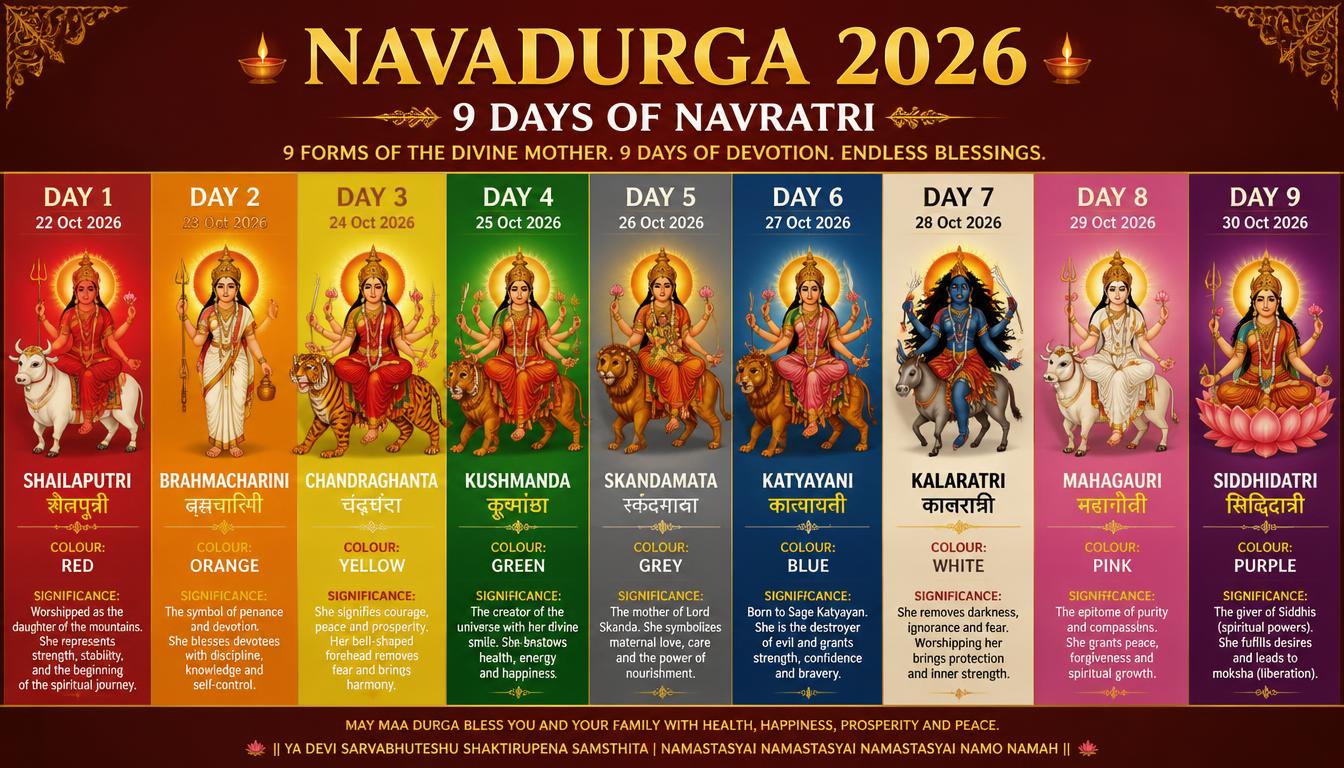
There is something deeply moving about Navratri: for nine nights, devotion takes many forms, and each day seems to open another little window into the vastness of the Divine Mother. Lamps glow, prayers become softer, homes feel different, and devotees remember that strength can be gentle too.
In Navratri 2026, the Sharad Navratri period begins on October 11 and continues through October 19, with Vijayadashami falling on October 20. The nine days are traditionally associated with the 9 forms of Maa Durga, while the colours followed by many devotees change from day to day.
The beauty of Navadurga is not only in knowing nine Goddess names. Each form represents a different quality—courage, discipline, motherhood, purity, transformation, wisdom and spiritual fulfillment. Together, they create a meaningful picture of divine feminine energy.
The Navratri 9 days in 2026 fall from Sunday, October 11, to Monday, October 19. According to the Lahore, Pakistan calendar, the day-wise forms and colours are as follows.
| Day | Date | Navratri Devi Name | Colour |
|---|---|---|---|
| Day 1 | October 11 | Shailputri | Orange |
| Day 2 | October 12 | Brahmacharini | White |
| Day 3 | October 13 | Chandraghanta | Red |
| Day 4 | October 14 | Kushmanda | Royal Blue |
| Day 5 | October 15 | Skandamata | Yellow |
| Day 6 | October 16 | Katyayani | Green |
| Day 7 | October 17 | Kalaratri | Grey |
| Day 8 | October 18 | Mahagauri | Purple |
| Day 9 | October 19 | Siddhidatri | Peacock Green |
The colour tradition can vary by region and calendar, so devotees following a particular family, temple, or local tradition may observe a different sequence. The colours above follow the 2026 calendar for Lahore.
The word Navadurga refers to the nine celebrated forms of Goddess Durga worshipped during Navratri. They are not simply nine separate names to memorize for an exam, thankfully. Each form offers a symbolic way of thinking about a particular stage of spiritual life.
The journey begins with Shailputri, associated with strength and the Earth, and gradually moves through devotion, courage, creativity, nurturing, justice, transformation, purity and finally spiritual perfection through Siddhidatri.
This is why the significance of nine forms of Durga is often understood as a journey of inner development rather than only a sequence of rituals.
The first of the Navratri Goddess forms is Shailputri, traditionally understood as the Daughter of the Mountains. Her name itself carries the feeling of something rooted, steady and powerful.
Shailputri is associated with Prithvi Tattva, or the Earth Element. Her symbolism reminds devotees that every meaningful spiritual journey needs a foundation. You cannot build a peaceful inner world on a constantly shaking ground.
The first day therefore carries themes of strength, nature, energy, enthusiasm and beginning of creation.
The Orange Navratri color associated with Day 1 represents energy and enthusiasm. Orange feels almost like sunrise—warm, active and full of the promise that something is about to begin.
During Navratri worship, devotees may use the day to establish a simple intention for the nine-day period: more patience, stronger devotion, better discipline, or simply a quieter heart.
On the second day comes Brahmacharini, often described as the Goddess of Penance. Her story and symbolism emphasize devotion, determination and disciplined spiritual pursuit.
This day feels less like rushing toward an answer and more like sitting quietly until the answer becomes clearer. Self-restraint here is not about making life joyless; it can represent learning not to be controlled by every passing desire.
The qualities connected with Brahmacharini include devotion, discipline, wisdom, inner peace and spiritual pursuit.
The White Navratri color of Day 2 beautifully complements these themes. White is commonly associated with purity, serenity and peace.
For devotees observing Navratri fasting, the day can become an opportunity to focus not merely on food restrictions but also on the discipline of thought, speech and action. Traditions differ, so fasting practices should follow one’s own family or religious custom.
The third form is Chandraghanta, recognizable through the crescent moon associated with her name. She represents a more warrior-like expression of the Goddess.
There is an interesting emotional shift here. The first two days emphasize grounding and discipline; Chandraghanta brings bravery, courage and strength into the picture.
Her symbolism is often connected with confronting fear and negativity rather than allowing them to quietly occupy the mind.
The Red Navratri color for Day 3 represents passion, vitality and strength. It is a bold colour, and perhaps that is fitting for a form of the Goddess connected with courage.
For someone reflecting on the Navratri spiritual meaning, Chandraghanta can represent the moment when inner devotion becomes active courage.
Day four introduces Kushmanda, traditionally associated with the cosmic creative force. She is described in devotional traditions as the Creator of the universe, making this day especially connected with creation and divine light.
Her symbolism can be understood as the light that makes growth possible. Life needs energy, nourishment and vitality before anything can flourish.
Kushmanda is therefore associated with health, wealth, vitality, abundance and positive energy.
The Royal Blue Navratri color assigned to Day 4 gives the celebration a rich and dignified visual character.
Royal blue is often associated with richness and elegance, making it a natural symbolic companion to themes of abundance and creative power.
The practical lesson is quite lovely: abundance isn’t only about possessing more. It can also mean having enough vitality, health, wisdom and inner resources to use what life gives you responsibly.
The fifth form, Skandamata, is known as the Mother of Skanda, also identified with Kartikeya. Her imagery emphasizes motherhood, protection and nurturing care.
Among the nine forms of Goddess Durga, Skandamata brings an especially tender dimension. Divine power is not always shown as a warrior holding weapons. Sometimes it appears as the mother who holds her child close and protects without making a speech about it.
Her associated qualities include nurturing, protection, divine motherhood, wisdom, prosperity and divine grace.
The Yellow Navratri color for Day 5 carries a cheerful, warm quality and is associated in many popular Navratri colour traditions with joy and brightness.
This day can inspire a simple reflection: strength and tenderness aren’t opposites. A person can be protective and gentle at the same time, which is a lesson humans keep relearning.
Read more: https://templetimingsdaily.com/nidhivan-2026/
Day six is dedicated to Katyayani, often described as a fierce warrior manifestation of the Goddess.
Her symbolism centers on courage, strength and justice, especially the determination to overcome obstacles. The spiritual message isn’t necessarily that life should contain no difficulties. Rather, it suggests that obstacles can be met with courage instead of surrender.
Katyayani is also associated with fulfillment of desires, growth and harmony.
The Green Navratri color of Day 6 naturally connects with ideas of growth, renewal and harmony.
Green can remind devotees that spiritual progress is rarely dramatic every single day. Sometimes growth is almost invisible—like a plant becoming taller while nobody is watching.
That quiet growth still counts.
The seventh form is Kalaratri, one of the most fierce expressions among the Navadurga names.
Her imagery can initially appear intimidating, but the deeper symbolism is closely connected with protection and the destruction of fear, ignorance, negativity and evil energies.
Kalaratri is often described as a fierce protector. Her darkness is not presented simply as something frightening; instead, it represents the power to enter darkness and destroy what threatens spiritual progress.
The Grey Navratri color on Day 7 has a subdued quality that fits the day’s themes of transformation and strength.
Kalaratri reminds devotees that spirituality isn’t always soft and comfortable. Sometimes spiritual advancement requires facing uncomfortable truths, releasing destructive habits and becoming brave enough to change.
The eighth form is Mahagauri, associated with purity, tranquility and peace.
After the fierce energy associated with Kalaratri, Mahagauri brings a noticeably calmer atmosphere. Her symbolism is often connected with forgiveness, cleansing, serenity and spiritual advancement.
The transition itself is meaningful. Transformation does not end with defeating something negative. There is also a need to create space for peace afterward.
The Purple Navratri color assigned to Day 8 is commonly associated with spirituality, dignity and a deeper inner life.
For someone following the Navratri spiritual journey, this day can be a reminder to forgive, release unnecessary resentment and return to inner peace.
Purity in this context need not mean perfection. It can mean choosing, again and again, to move toward what brings greater clarity and harmony.
The ninth and final form is Siddhidatri, traditionally described as the Granter of Siddhis.
The term Siddhi is associated in Hindu spiritual traditions with extraordinary or supernatural attainments, but the broader symbolism of the final day can also be understood through wisdom, balance, spiritual fulfillment and divine perfection.
Siddhidatri represents the culmination of the nine-day journey, bringing together qualities developed through the earlier forms.
The Peacock Green Navratri color is associated with Day 9 in the 2026 calendar.
Its distinctive appearance fits the day’s themes of balance, mystic knowledge and spiritual fulfillment.
The final lesson is perhaps the simplest: spiritual growth isn’t only about gaining something. Sometimes it means becoming balanced enough to recognize what was already present within you.
The Navratri colours are a highly visible part of the festival, especially in communities where devotees intentionally wear the assigned colour each day.
For Navratri 2026, the day-wise sequence in the Lahore calendar is:
The specific colour tradition is not universal across all regions or calendars. In fact, the colour of a particular weekday is part of how some regional traditions determine the sequence.
The spiritual significance of Navratri becomes clearer when the nine forms are viewed together.
Shailputri offers grounding. Brahmacharini develops discipline. Chandraghanta awakens courage. Kushmanda represents creative energy. Skandamata expresses divine motherhood. Katyayani brings justice and strength. Kalaratri confronts darkness. Mahagauri restores purity and peace. Siddhidatri completes the journey with wisdom and fulfillment.
That progression gives the Navratri 9 forms a remarkable symbolic rhythm.
It is almost like walking through nine rooms of the same sacred house. Each room looks different, but they all belong to one greater home—the worship of Maa Durga and the Divine Mother.
Different families observe Navratri rituals in different ways. Common practices may include setting up a sacred space, performing puja, lighting a diya, offering flowers or prasad, reciting prayers, and observing fasting according to one’s tradition.
Some devotees focus strongly on Navratri fasting, while others emphasize daily prayer and worship. There is no need to turn devotion into a competition about who follows the longest list of rituals.
The heart of Goddess Durga worship is devotion. A simple prayer spoken sincerely can carry personal meaning that a complicated ritual performed without attention may not.
Ghatasthapana marks the beginning of the Sharad Navratri observance in many traditions, and Day 1 in the 2026 calendar is associated with Shailputri Puja.
One of the most powerful ideas within Hindu spirituality is the recognition of Shakti, or divine power, through feminine forms of the sacred.
The divine feminine energy represented through the Goddess is not restricted to one personality trait. She can be a daughter, ascetic, warrior, creator, mother, protector and source of wisdom.
That range is exactly what makes Navadurga significance so rich.
The nine forms suggest that courage without wisdom can become harsh, while wisdom without courage may remain inactive. Protection needs compassion. Transformation needs discipline. Spiritual fulfillment needs balance.
In that sense, the festival becomes more than nine days of worship. It becomes a reflection on how different qualities can coexist within a person.
Readers sometimes see both Navratri 2025 and Navratri 2026 in searches because many websites retain previous-year calendars and articles.
For someone planning the current celebration, the important point is to use a calendar specifically prepared for Navratri 2026, because dates and day-wise observances depend on the lunar calendar and local sunrise calculations.
For the 2026 Sharad Navratri calendar used here, Day 1 begins October 11 and the ninth day falls October 19, followed by Vijayadashami on October 20.
You do not need to make every day enormous.
One day might be devoted to prayer. Another could be spent quietly reading about the day’s Devi. Someone observing a fast might focus on discipline, while another devotee may express devotion through charity, helping family, or simply creating a peaceful environment at home.
The useful question is not, “Did I do everything?”
It can be, “What quality does today’s Goddess inspire me to practice?”
On Shailputri day, perhaps strength. On Brahmacharini day, discipline. On Chandraghanta day, courage. By the ninth day, those little practices can begin to feel like one continuous spiritual journey.
The nine nights eventually end. The lamps are put away, colourful clothes return to the cupboard, and ordinary mornings come back.
But the ideas can stay.
The Nine forms of Goddess Durga offer a vocabulary for understanding human life: strength when things are difficult, patience when progress is slow, courage when fear appears, compassion when someone needs protection, and wisdom when choices become complicated.
That is where divine blessings become more than a phrase used during festival greetings. They can represent a sincere wish for health, prosperity, protection, wisdom and inner peace.
Nidhivan is generally open for visitors during the daytime, with entry restricted around sunset. Visitors should check the latest local timings before planning their visit.
Nidhivan Vrindavan timings usually allow devotees to visit during the morning and afternoon, while the premises are closed to visitors after evening hours.
Navadurga 2026 is not simply a calendar of nine Goddess names and nine colours. It is a nine-day reflection on strength, devotion, creativity, motherhood, courage, transformation, purity and spiritual fulfillment.
From Shailputri standing firmly with the energy of the Earth to Siddhidatri representing the culmination of spiritual wisdom, every form adds another shade to the larger image of Maa Durga.
And perhaps that is the loveliest way to approach Navratri 2026: not as nine boxes to tick, but as nine invitations to look inward.
Wear the colour if your tradition calls for it. Offer the prayer with sincerity. Observe the ritual according to your family or community practice. And let each day carry one small quality into ordinary life.
Because when the nine nights are over, the real spiritual work doesn’t have to disappear with them. Devotion, courage, wisdom, purity and divine grace can travel with us long after the festival lights have gone quiet.