Physical Address
304 North Cardinal St.
Dorchester Center, MA 02124
Physical Address
304 North Cardinal St.
Dorchester Center, MA 02124

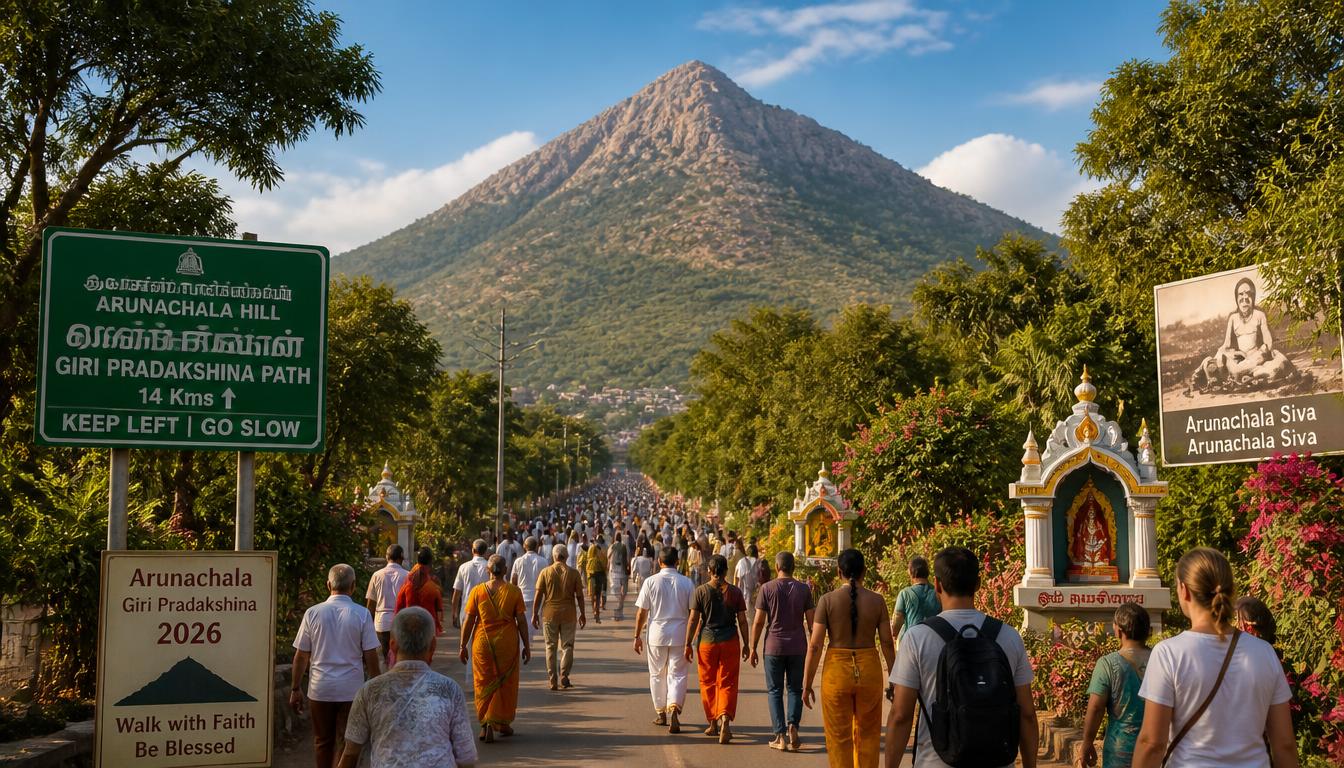
There are journeys where the destination is the whole point, and then there are journeys where your feet slowly become the destination. Arunachalam Giri Pradakshina, also called Arunachala Giri Pradakshina, belongs to the second kind.
You start walking around Arunachala Hill in Tiruvannamalai, perhaps with a small prayer in your heart, and somewhere along those kilometres the prayer becomes quieter. Sometimes, it even becomes just breathing.
For devotees of Lord Shiva, Arunachala is not simply a hill sitting behind a famous temple. It is revered as Shiva himself, the sacred Agni or fire principle, and the traditional practice of walking around it is known as Girivalam or Giri Pradakshina.
The official Tiruvannamalai district site describes the circumambulatory road as about 14 km, with especially large gatherings on Full Moon and festival days.
That is why Girivalam 2026 is not merely a date on a pilgrimage calendar. For many people, it is a pause button for ordinary life.
The mobile phone still rings, the knees still complain a little, somebody is selling tea at an impossible hour, and yet the mind can become surprisingly still.
Arunachalam Giri Pradakshina means circumambulating the sacred Arunachala Hill. In the local tradition, devotees walk with the hill kept to their right, following the established Girivalam route around the mountain.
The Tamil Nadu district administration describes the route as approximately 14 kilometres and notes the presence of eight important Lingams around the circuit.
The word pradakshina itself carries a beautiful idea: moving around what is sacred while keeping it at the centre. So the physical act is simple walk but the inner instruction is much bigger. Let Arunachala remain at the centre, while your worries, plans and old thoughts slowly move around it.
On the route are the traditional eight Dikpalaka Lingams: Indra Lingam, Agni Lingam, Yama Lingam, Niruthi Lingam, Varuna Lingam, Vayu Lingam, Kubera Lingam and Eesanya Lingam. The district’s official Girivalam description identifies these shrines and their directional associations.
For some pilgrims, every Lingam becomes a separate prayer. For others, the entire walk is one continuous prayer. Neither approach needs to compete with the other, which is perhaps one of the nicest things about pilgrimage.
Pournami Girivalam is especially popular because the circumambulation is traditionally associated with the Full Moon. The lunar dates and exact Pournami windows can differ slightly between calendars because they depend on the local lunar calculation and the way the tithi is observed.
For practical trip planning, a commonly published 2026 Girivalam schedule gives the following Pournami windows:
| Month | Pournami / Girivalam window |
|---|---|
| January | 2–3 January 2026 |
| February | 1–2 February 2026 |
| March | 2–3 March 2026 |
| April | 1–2 April 2026 |
| April–May | 30 April–1 May 2026 |
| May | 30–31 May 2026 |
| June | 29–30 June 2026 |
| July | 28–29 July 2026 |
| August | 27–28 August 2026 |
| September | 25–26 September 2026 |
| October | 25–26 October 2026 |
| November | 23–24 November 2026 |
| December | 23–24 December 2026 |
Published calendars show slightly different start and end times for several of these windows, so pilgrims should confirm the local Panchangam and current arrangements before travelling.
For example, one 2026 schedule places the August Pournami window from the morning of August 27 into August 28, while another published calendar gives a somewhat different lunar calculation.
So, if you are planning the August 2026 Girivalam, don’t treat a single website’s minute-by-minute time as though Lord Shiva himself issued a railway timetable. Check the latest local information shortly before departure.
The government district website also confirms that Full Moon days attract very large numbers of devotees, which means the spiritual atmosphere can be powerful but the physical experience may be crowded too.
Pournami means Full Moon, and in the devotional imagination surrounding Arunachala, the night has a special quality. The hill, moonlight, chanting voices and moving stream of pilgrims create an atmosphere that is difficult to explain to someone who has only seen photographs.
You may begin with a simple intention: “I will walk quietly today.” Twenty minutes later somebody is chanting Om Namah Shivaya, a bell sounds from a shrine, children are walking beside grandparents, and suddenly your carefully planned silence has become a different kind of silence.
The official district information specifically notes the huge number of devotees who perform Girivalam on Full Moon days and festival days.
For devotees, Pournami is therefore less about an astronomical event alone and more about sacred timing. Some prefer to walk through the night. Some begin before sunrise. Others choose a portion of the Pournami window when their body is comfortable.
There is no prize for suffering the most. A meaningful pilgrimage is not improved simply because your feet are blistered.
There is no single “correct” clock time that every pilgrim must follow for Giri Pradakshina. The most suitable time depends on the Pournami tithi, weather, crowd levels, personal stamina and the kind of experience you want.
Early morning is often attractive for people seeking quietness. The temperature is generally kinder, the roads can feel calmer, and the devotional mood has a soft, almost inward quality.
Evening and night are especially popular during Pournami. Moonlight, lamps, chanting and the sight of thousands of people moving in one direction can make the walk feel less like ordinary walking and more like a moving river of devotion.
Daytime can be practical on less crowded days, but the heat should not be underestimated. A 14-kilometre walk under a strong South Indian sun is not a spiritual test you need to prove to anybody.
The Tamil Nadu government describes the standard Girivalam circuit as around 14 km, so allow several hours rather than imagining it as a quick temple visit.
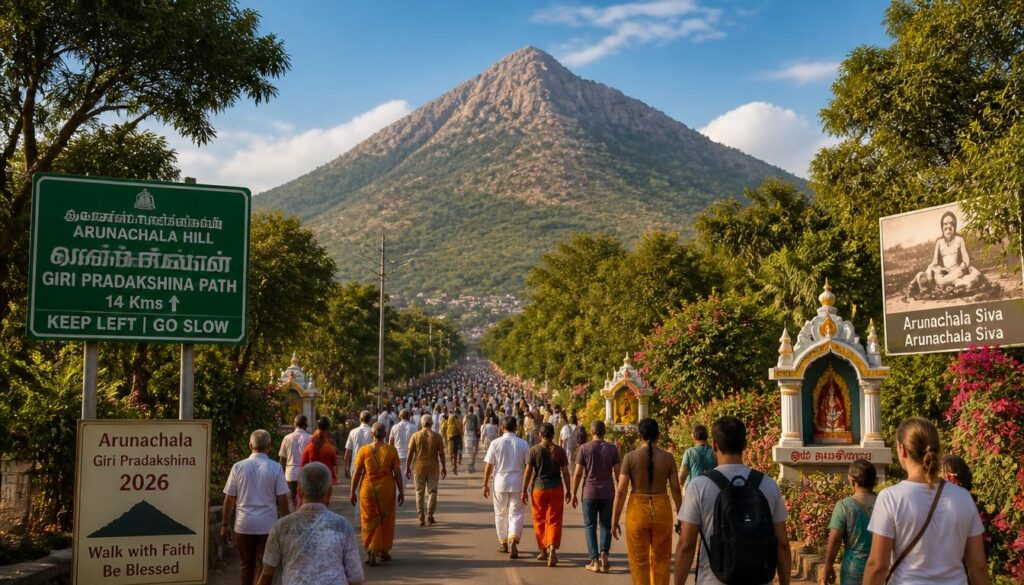
One of the most meaningful aspects of the Arunachala Giri Pradakshina route is its eight directional Lingams. They turn the walk into something more layered than simply completing a circular road.
You don’t have to rush from one shrine to another as though you are completing a checklist. Stop where you can, offer a prayer, notice your breath and continue.
That small change from finishing the route to experiencing the route can make Girivalam feel completely different.
The benefits of Giri Pradakshina are traditionally understood in spiritual rather than merely material terms. Devotees may describe the practice as a way of seeking divine blessings, inner peace, spiritual growth, purification and moksha.
These are matters of faith, and they should be understood as religious beliefs rather than scientifically established outcomes. Yet the experience of walking for several hours, chanting, praying and temporarily stepping away from normal routines can certainly create a powerful personal sense of reflection.
When you walk for hours, there are only so many things the mind can keep discussing with itself. Eventually the endless internal meeting becomes tired.
The rhythm of footsteps can support mindfulness, particularly when combined with mantra chanting or conscious breathing. A devotee may repeat “Om Namah Shivaya” and gradually notice that the repetition is no longer something being performed; it becomes part of the walking itself.
Girivalam asks for something very ordinary and very difficult: keep going gently.
You don’t need dramatic visions. You need patience when your feet hurt, humility when the crowd slows you down and enough discipline not to turn the entire pilgrimage into a sightseeing race. That itself can become a form of spiritual discipline.
People often come to Tiruvannamalai carrying private worries that nobody around them knows about. A career decision. A family problem. Grief. A wish that has been carried for years.
The walk doesn’t magically solve every problem, and it would be irresponsible to promise that. But devotional walking can create a rare space in which people sit with those concerns rather than constantly running away from them.
Perhaps the deepest spiritual experience is not asking for more and more.
At some point a pilgrim may simply think, “Let whatever needs to happen, happen.”
That feeling of surrender is central to the devotional atmosphere of Arunachala, and it can be more powerful than a long list of requests.
For Shaiva devotees, Arunachala is intimately connected with Lord Shiva and the fire principle. The government district’s description explains the traditional understanding of the hill as sacred and identifies the site with the fire form of Shiva.
Walking around the hill can therefore feel like worshipping not merely near a deity, but around a sacred presence itself. It is a subtle distinction, but devotees feel it deeply.
There is also a very practical side to Girivalam. Fourteen kilometres of walking is exercise, whether you are wearing traditional clothing or carrying a small bag full of bananas and vibhuti.
A long walk can support general physical activity, stamina and body awareness, provided it is appropriate for your health and fitness. But pilgrimage should not be confused with a fitness challenge.
If you are elderly, pregnant, recovering from an illness or injury, travelling with young children, or have any condition that makes prolonged walking difficult, consider shorter sections, rest, assistance or professional medical advice. Faith does not require ignoring the body.
The mind benefits from rhythm too. Walking without constantly changing scenery or checking the clock can become surprisingly meditative. Even when the road is busy, your own attention can become quieter.
A Girivalam pilgrimage is often combined with Sri Arunachaleswara Temple darshan, one of the central spiritual experiences in Tiruvannamalai.
The official HR&CE temple page currently lists the temple’s opening periods as 5:30 AM–3:00 PM and 3:00 PM–8:00 PM, with darshan generally available from 5:30 AM to 8:00 PM.
It also notes that on Saturdays, Sundays, Pournami days, holidays and days with heavier devotee numbers, admission may be restricted until around 7:30 PM.
This is an important practical detail: temple timings and entry arrangements can change during major crowds or festivals, so always verify the latest notice before setting your day’s schedule.
The temple is not simply a convenient “before or after Girivalam” stop. It is a major sacred complex in its own right, with Annamalaiyar and Unnamalai Amman as its principal deities.
The Tiruvannamalai civic administration describes the temple as one of the important historic and spiritual landmarks of the town.
The first kilometre can be deceptively cheerful.
You are fresh, your water bottle is full, and you are thinking, “This is easy.”
Then the kilometres begin negotiating with your ego.
You see elderly devotees continuing steadily. Someone walks barefoot. Someone is carrying a child. Someone has stopped beside a shrine with tears in their eyes. Somewhere a group begins singing, and for a few minutes dozens of strangers seem to breathe at the same pace.
That is one of the strange beauties of Tiruvannamalai Girivalam. It is deeply personal while being intensely collective.
You are alone with your prayer, yet surrounded by thousands.
The district administration notes that Full Moon and festival Girivalam can bring very large crowds, so the experience is not always silent or solitary.
Some visitors actually prefer ordinary days for contemplation, while others feel that the enormous Pournami gathering is itself part of the sacred experience.
Neither experience is “more spiritual.” They are simply different.
Read more: https://templetimingsdaily.com/ghati-subramanya-temple-2/
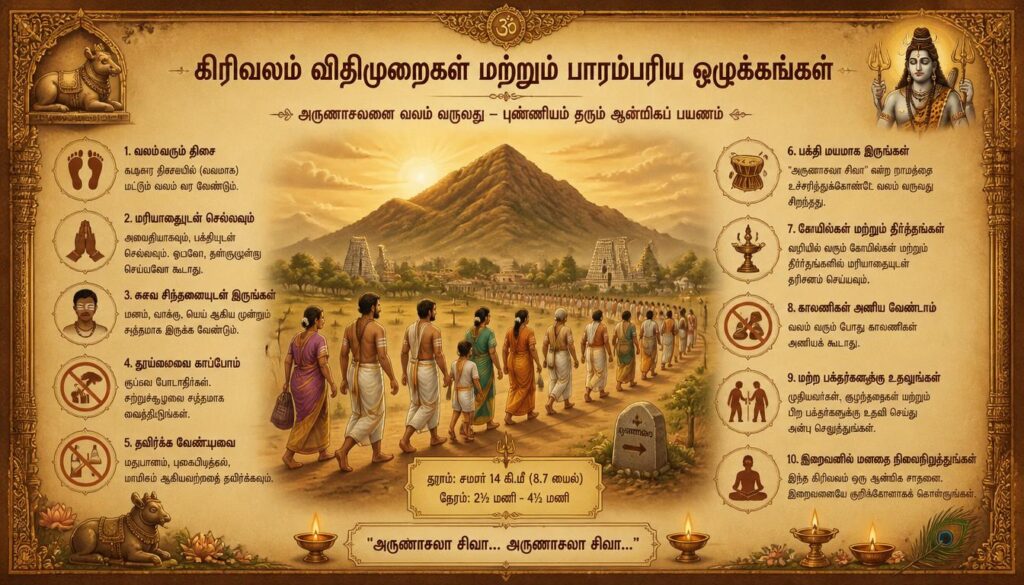
A few simple habits can make the pilgrimage kinder for everyone.
Traditional Tamil guidance also associates Girivalam with mantra recitation and mindful walking, while the official district description specifically refers to the customary practice of keeping the hill on the right side.
Preparation begins before you reach Tiruvannamalai.
For a first-time pilgrim, it is sensible to practise walking longer distances in the weeks before your trip. Don’t discover on Pournami night that your normal daily exercise is walking from the bedroom to the refrigerator.
Choose comfortable clothing and footwear, carry essential medicines if prescribed, and keep your bag light. A small cloth bag, water, phone, identification, some cash and basic personal necessities are usually more useful than ten kilograms of “just in case” items.
If you intend to walk at night, plan your accommodation and return route in advance. During major Pournami days, crowd movement can make simple transportation plans surprisingly complicated.
The district administration has also made special arrangements and basic facilities on the Girivalam path for major events; for example, official notices documented preparations for Chitra Pournami 2026 at the temple and along the Girivala Path. Still, facilities can become heavily used during peak crowds, so personal preparation remains wise.
A thoughtful visit does not have to end when the 14 kilometres are complete.
Tiruvannamalai has a broader spiritual landscape associated with Ramana Maharshi, ashrams, temples, sacred water bodies and other places of contemplation. The official municipal tourism information lists Ramanashram, the Astalingas and other locations around the Girivalam path among notable places of interest.
You might therefore keep one part of the day deliberately empty.
No sightseeing.
No shopping.
No schedule.
Just sit somewhere peaceful and let the experience settle. Sometimes the most valuable part of a pilgrimage happens after the walking has stopped, when the mind finally gets around to understanding what the feet already experienced.
This is one of those questions where the honest answer is: it depends on what you want.
If you want the traditional Full Moon atmosphere, huge devotional participation and the special energy that devotees associate with Pournami, then a Pournami Girivalam may be unforgettable.
If you want quiet contemplation, a less crowded path and more freedom to stop at shrines, an ordinary day may actually suit you better.
The government itself notes the enormous gatherings on Full Moon and festival days. So “auspicious” does not necessarily mean “peaceful.”
For a first-time visitor, that distinction matters more than people sometimes admit.
Girivalam is the traditional circumambulation of Arunachala Hill in Tiruvannamalai. It is also called Giri Pradakshina and is undertaken as a devotional practice connected with Lord Shiva and Arunachala.
The official Tiruvannamalai district website describes the circumambulatory road as approximately 14 km.
The 2026 calendars place the August Pournami/Girivalam period around 27–28 August 2026. Exact lunar start and end times vary among published Panchangam calculations, so confirm the current local timing before travelling.
For cooler conditions and a quieter experience, many pilgrims prefer early morning or late-night/early-dawn hours. Pournami evenings offer a very distinctive devotional atmosphere but can be extremely crowded.
The circumambulation of the public road around Arunachala is not the same as purchasing a temple darshan ticket. Temple rituals, special services or particular forms of darshan may have separate arrangements, so check directly with the temple for current requirements.
They can participate if their health and stamina permit, but the 14-km route should not be treated casually. Families can plan rest periods or shorter participation rather than forcing everyone to complete the entire circuit.
The eight traditional Lingams are Indra, Agni, Yama, Niruthi, Varuna, Vayu, Kubera and Eesanya Lingams. They are associated with the eight directions and form an important part of the spiritual geography of the route.
Devotees traditionally associate Girivalam with divine blessings, spiritual purification, inner peace, spiritual growth, karmic cleansing and ultimately moksha. These are religious beliefs rather than scientifically established guarantees, and the personal experience differs from pilgrim to pilgrim.
Before beginning, choose one intention.
Not twenty.
One.
Maybe it is gratitude. Maybe forgiveness. Maybe courage. Maybe simply the wish to become less restless.
Then walk with that intention without demanding an immediate answer.
At Indra Lingam, pause.
At Agni Lingam, remember the fire.
At Yama Lingam, remember that life is temporary.
At Varuna Lingam, let the mind become fluid.
At Vayu Lingam, notice your breathing.
At Kubera Lingam, think about what abundance really means.
At Eesanya Lingam, notice that the journey which seemed so long has somehow become nearly complete.
These interpretations are personal and devotional, not rigid requirements. The beauty of pilgrimage is that the same road can hold a thousand private meanings.
Arunachalam Giri Pradakshina 2026 is ultimately not about how quickly you complete a 14-kilometre circuit. It is about what happens inside while you walk it.
The official Tiruvannamalai tradition presents Arunachala as sacred, with the hill itself regarded as Shiva and the surrounding route marked by ancient devotional practices and the eight Lingams.
For one pilgrim, Girivalam may be a prayer for a family member. For another, it may be the first hopeful step after a difficult year. Someone else may come simply because an old photograph of Arunachala stayed in their mind for years.
And then there are people who arrive without knowing exactly why.
Perhaps that is part of the mystery.
If you are planning Girivalam 2026, check the Pournami tithi, current temple timings and local administration notices shortly before your journey, especially for major Full Moon days.
The official temple currently lists general darshan access from 5:30 AM to 8:00 PM, with possible earlier closure of admission on high-footfall days.
Carry water. Carry patience. Carry less luggage than you think you need.
And when you finally begin walking around Arunachala, don’t worry too much about having the “perfect” spiritual experience.
Just walk.
Let the hill remain the hill.
Let the prayer remain a prayer.
And perhaps, somewhere between the first kilometre and the last, you may notice that the person who started the walk is not quite the same person who finished it.