Physical Address
304 North Cardinal St.
Dorchester Center, MA 02124
Physical Address
304 North Cardinal St.
Dorchester Center, MA 02124

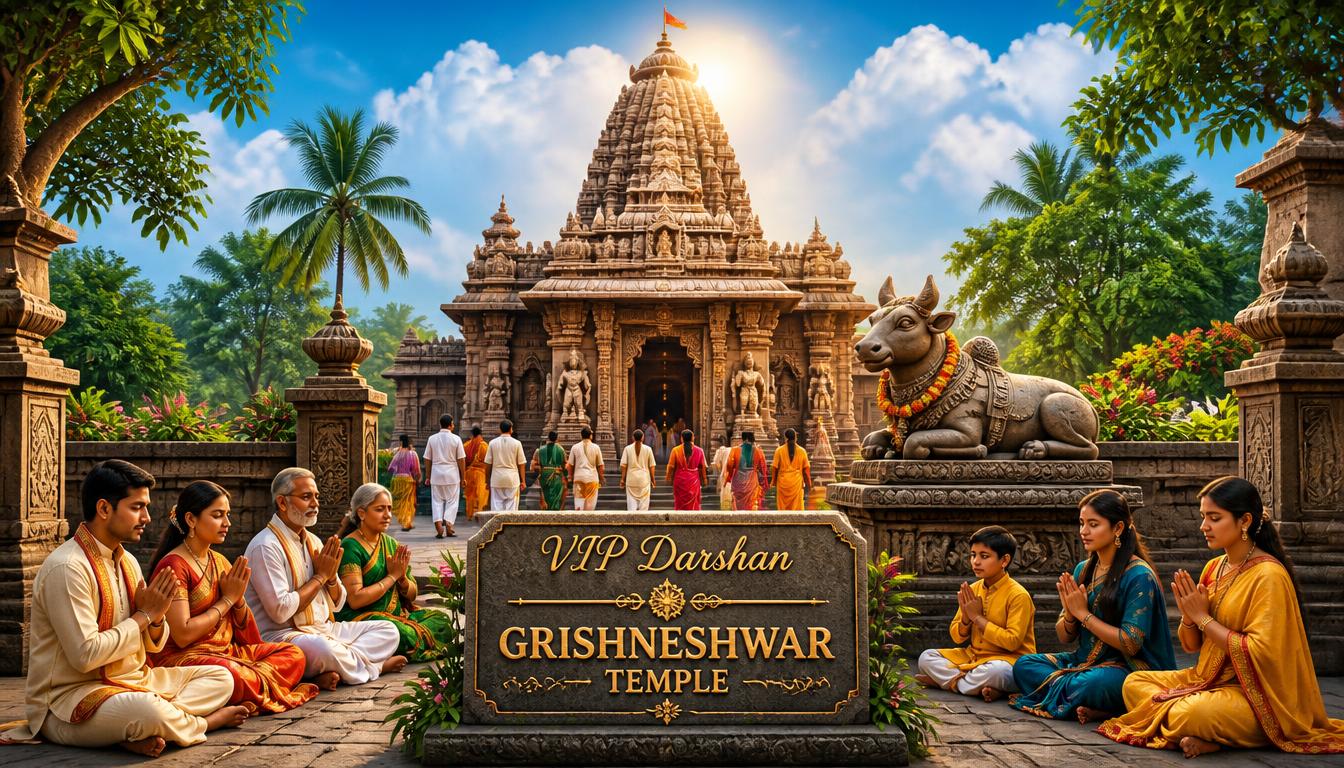
There are some journeys where the road itself feels like part of the prayer. You leave the ordinary noise behind, pass through Maharashtra’s changing landscapes, and eventually arrive at Verul, where the ancient Grishneshwar Jyotirlinga Temple seems to ask for something very simple from you: slow down.
For many devotees, a visit here is not merely another stop on a Maharashtra temple tour. It is a deeply personal meeting with Lord Shiva, with bells, stone carvings, sacred chants and that strange quietness which stays in your mind even after you have left.
The shrine is traditionally regarded as the 12th and final Jyotirlinga, and its location beside the famous Ellora Caves makes it especially convenient for travellers who want to combine spirituality with history.
Maharashtra Tourism also describes it as a major sacred destination in Verul near Chhatrapati Sambhajinagar. Maharashtra Tourism+1
If you are planning a Grishneshwar Temple visit in 2026, however, there is one thing worth remembering: temple schedules and arrangements can change on festival days or during exceptionally heavy crowds.
So, use published timings as a planning guide and verify the latest instructions before leaving home. This little bit of checking can save a surprisingly big headache later.
The phrase Grishneshwar Temple Online Booking is searched by thousands of pilgrims because nobody particularly dreams of travelling hundreds of kilometres only to discover that the particular pooja or entry arrangement they expected is different on that day. Fair enough.
The important distinction is between darshan, special-entry arrangements and pooja booking. The official temple website currently provides information about darshan timings and temple-related services,
while a separate priest-service portal associated with the Grishneshwar Brahmavrund priest community offers online and offline bookings for rituals such as Rudrabhishek, Jalabhishek and Panchamrit Abhishek. Grishneshwar Jyotirlinga Temple+1
For online pooja booking, devotees may be asked for details such as name, gotra, phone number, address and preferred date. The listed service information also says that the required pooja material is included in the applicable charges and that confirmed bookings are non-refundable. GGrishneshwar Temple+1
A sensible booking habit is to check three things before making any payment: whether the page is genuinely connected with the temple or its authorised priest community, exactly what service you are buying, and whether the confirmation specifies an actual date and ritual.
Search results are full of websites using words like “VIP,” “official” and “priority,” and not every attractive-looking booking page should be trusted blindly.
For direct temple information, begin with the Grishneshwar Jyotirlinga Temple website and cross-check general travel information with Maharashtra Tourism.
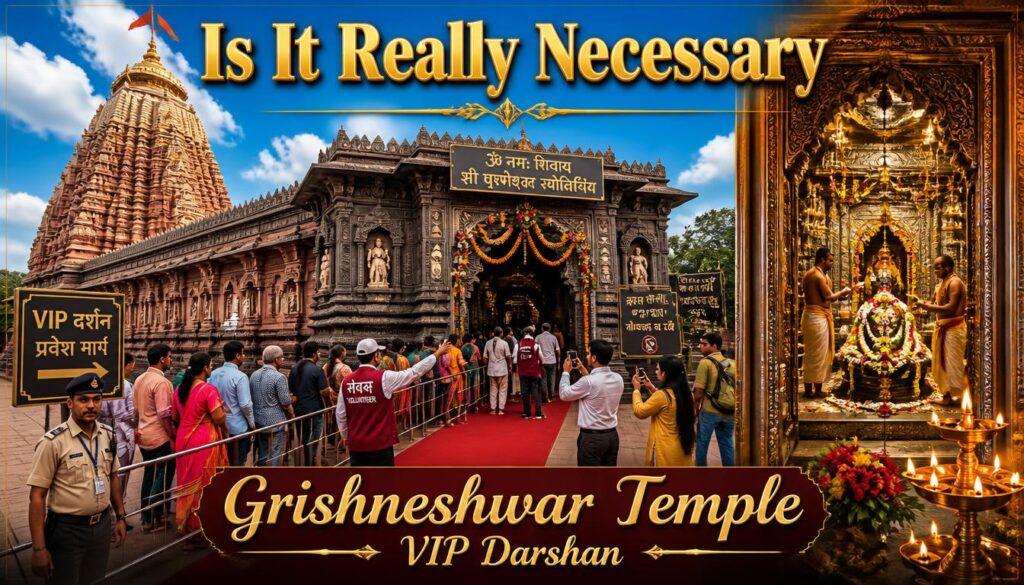
The idea of Grishneshwar Temple VIP Darshan sounds wonderfully tempting when you imagine a long queue waiting under the Maharashtra sun. But travellers should be careful with claims about a fixed VIP ticket price, guaranteed queue-free entry or a permanently available “special pass.”
As of the information available for 2026, there is no reliable basis here for presenting one universal VIP charge as though it never changes.
Temple arrangements can vary with crowd conditions, festivals and local administration. Therefore, do not treat random third-party pages quoting ₹200, ₹500, ₹551 or another amount as automatically authoritative.
What people usually mean by VIP or Special Darshan is some form of priority or organised access. The actual benefit, availability and conditions need to be confirmed through the temple or an authorised channel for your intended date.
A faster entry does not mean the entire temple suddenly becomes private, sadly; Shiva has not installed a fast-pass lane for every visitor.
If your priority is a peaceful experience rather than a particular label, arriving early can sometimes be more useful than obsessing over a VIP category. Festival mornings, Mondays and holiday periods can be extremely busy, so advance planning matters much more.
Here is where travellers need to be particularly alert because Grishneshwar Temple timings published by different credible sources are not presented in exactly the same format.
The Incredible India listing gives general visitor timings of 5:30 AM to 9:30 PM, with aarti times listed at 5:30 AM, 12:00 PM, 7:00 PM and 9:30 PM. Incredible India
Meanwhile, the Grishneshwar priest-service website currently lists daily darshan/pooja windows as 6:00 AM–10:30 AM and 1:30 PM–7:00 PM from Tuesday to Friday, and 6:00 AM–9:00 AM and 2:00 PM–7:00 PM on Saturday, Sunday and Monday.
It also warns that timings may vary during Shravan Somvar and other Hindu festivals. Grishneshwar Temple+1
So, the useful interpretation is not “one website must be wrong.” These schedules may refer to different aspects of temple operation, such as general visitor access, darshan windows or ritual activity. Check the latest temple notice for your exact date before travelling.
For a quick planning reference:
The lesson is quite boring but valuable: don’t build a 2026 pilgrimage itinerary around one old timing screenshot from social media.
The importance of Grishneshwar Jyotirlinga comes from its place among the twelve sacred Jyotirlingas associated with Lord Shiva. Maharashtra Tourism identifies it as the 12th and final Jyotirlinga and notes scriptural associations with texts including the Shiva Purana and Skanda Purana. Maharashtra Tourism
The mythology surrounding the shrine is connected with devotion, hardship and Shiva’s grace. One traditional account centres on a devoted woman named Kusuma, whose worship and faith become intertwined with the manifestation of Shiva as a Jyotirlinga.
Like much sacred mythology, the story is not simply trying to provide a historical timetable. It carries a moral universe of its own: devotion continues when circumstances become very unkind.
That is perhaps why pilgrims often speak about the place differently than tourists do. A traveller notices architecture first. A devotee may notice the sound of the bell, the Shiva Linga, the fragrance of flowers or the moment everyone suddenly becomes quiet.
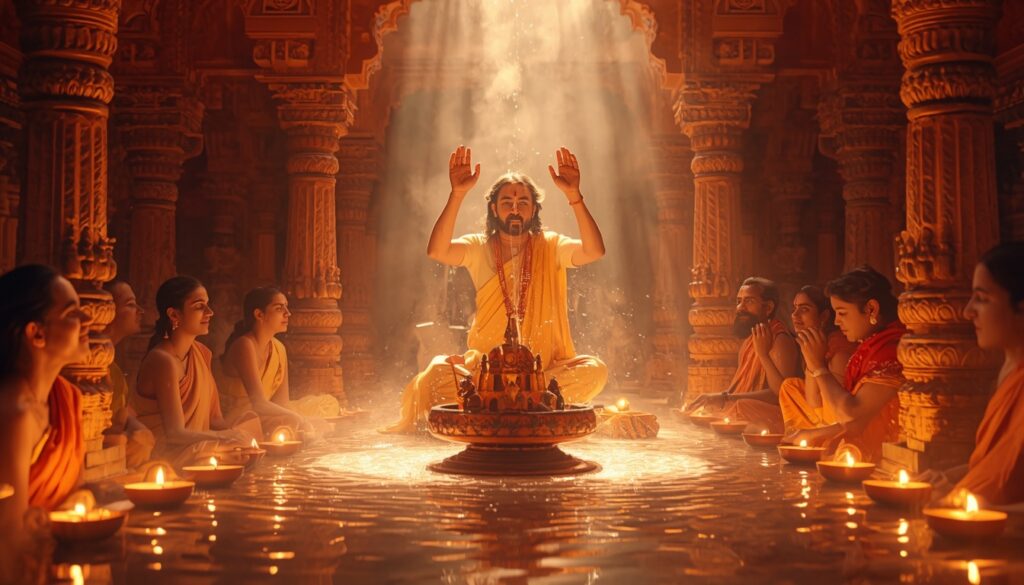
For many devotees, simply seeing the Jyotirlinga is meaningful, while others want to participate in Abhishekam or another Shiva worship ritual.
The associated priest-service portal currently lists options including Rudrabhishek, Jalabhishek and Panchamrit Abhishek. It states that offline versions of these rituals can be conducted inside the Garbhagriha, with touching of the Shivling permitted during the ritual in that offline context. However, the same source cautions that exceptionally heavy crowds can cause the temple authority to restrict where a pooja is performed. GGrishneshwar Temple+1
This is an important detail for anyone purchasing an Abhishekam booking. Read the conditions rather than assuming that every booking guarantees the exact same physical experience.
Traditional offerings may include holy water, milk, curd, honey and bilva leaves, depending on the ritual and prevailing temple practice. The soundscape can be beautiful in its own rough-edged way: bells, conch sounds, chanting and the occasional drum beat mixing together instead of politely waiting their turn.
If you book a ritual, confirm the meeting point and arrival instructions with the authorised priest. The current priest-service information recommends contacting the priest before the scheduled date for offline arrangements and notes that devotees should arrive sufficiently early according to the priest’s instructions. GGrishneshwar Temple
The present form of the shrine is closely associated with Ahilyabai Holkar, the celebrated Maratha queen known for rebuilding and restoring important Hindu pilgrimage sites. The temple’s stone architecture, sculptural detailing and traditional design make it more than a place where visitors simply walk in, pray and walk out.
Look upwards for the shikhara, then look closer at the stonework. The craftsmanship rewards a slower glance. Intricate carvings, mythological figures and the dark, substantial quality of the temple stone give the complex a distinctly historic character.
The larger region is equally fascinating. The temple stands near Ellora, one of India’s great archaeological landscapes, so the pilgrimage can naturally become a journey through several centuries of religious and
artistic history. Maharashtra Tourism specifically highlights the combination of Grishneshwar with nearby Ellora as a powerful spiritual and heritage experience. Maharashtra Tourism
There is an easy rule for Grishneshwar Temple dress code: when in doubt, dress modestly.
Traditional Indian attire such as a dhoti, saree, salwar kameez or other respectful clothing is a sensible choice. Men and women should avoid clothing that may conflict with temple customs, particularly if they intend to participate in rituals or enter areas with stricter Garbhagriha rules.
Temple etiquette matters just as much as clothing. Keep your voice low, follow instructions from temple staff and priests, don’t push in queues, and don’t assume photography is allowed merely because someone else has taken a picture.
Phones, cameras and personal belongings may be subject to restrictions. Facilities such as storage or lockers can change, so it is smarter to travel light. Carry only what you genuinely need for the pilgrimage.
The temple is located at Verul, Maharashtra, close to the Ellora Caves. The nearest major urban base for many travellers is Chhatrapati Sambhajinagar, historically known as Aurangabad.
By road, private cars, taxis, buses and shared transport are practical options. If you are already visiting Ellora, combining the cave complex and temple in the same outing is one of the easiest ways to organise the day.
By air, travellers generally use Aurangabad Airport, then continue by road.
By rail, Aurangabad Railway Station is the commonly used rail gateway for the region, followed by road transport to Verul.
The exact travel time depends heavily on traffic, weather and where you start. Rather than promising an artificial “30-minute” or “29-km” figure for everyone, use your actual starting point when planning.
A person staying in central Sambhajinagar and a person arriving from Pune obviously aren’t having the same journey, even if the search engine insists on giving them the same cheerful number.
A Grishneshwar and Ellora Caves one day trip makes excellent sense because the two experiences complement each other beautifully.
Start early with the temple while your energy is still reasonably human. After darshan and breakfast, move towards the Ellora Caves and give yourself enough time to explore rather than performing the modern tourist ritual of taking three photographs and declaring the monument “done.”
If time permits, build the day around the broader Chhatrapati Sambhajinagar region, but don’t cram five major attractions into one schedule. Pilgrimage is already a journey; it doesn’t need to become a race.
For travellers arriving from Mumbai or Pune, an overnight stay can make the experience far less exhausting. Families with elderly parents should especially avoid aggressive same-day schedules.
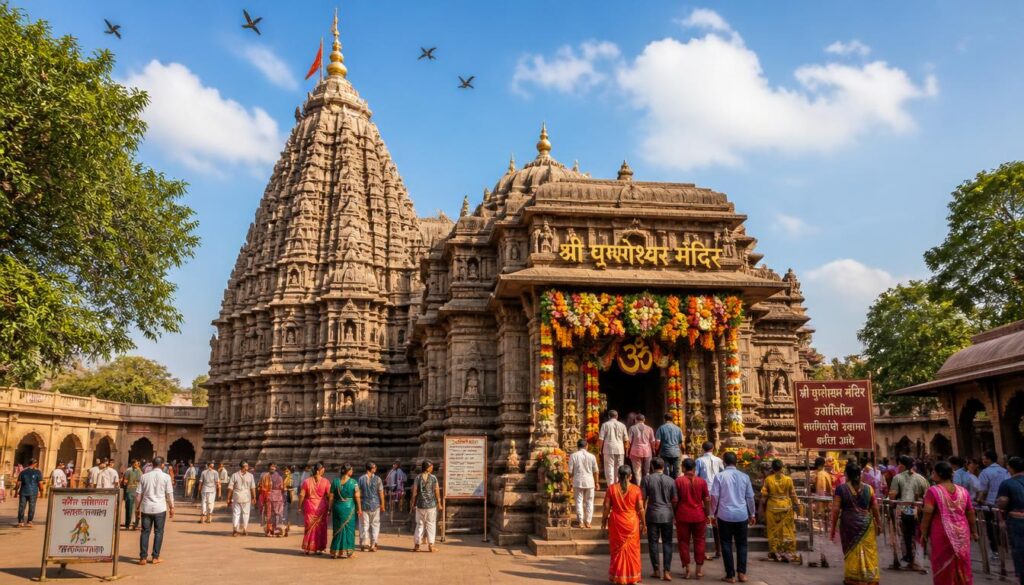
According to Maharashtra Tourism, October to March is generally the most comfortable season because the weather is cooler and more pleasant for sightseeing. Maharashtra Tourism
That does not mean the monsoon or Shravan Month is without charm. Quite the opposite. For Shiva devotees, Shravan carries immense spiritual importance, and visiting during this season can feel especially meaningful. The trade-off is crowds, particularly around Mondays and major religious occasions.
Maha Shivratri is another extraordinary time, but it is also exactly when a casual traveller should stop pretending they can arrive five minutes before the ceremony and somehow enjoy a peaceful empty temple. Large crowds, special rituals and altered schedules are part of the experience.
If your goal is quiet contemplation, choose an ordinary weekday outside major festivals. If your goal is to feel the full pulse of Shiva devotion, a major festival can be unforgettable.
Keep your bag boring. Boring is good.
Carry a valid ID if your booking requires it, some cash for incidental expenses, drinking water where permitted, essential medicines, comfortable clothing and a small bag for personal necessities. Wear footwear that you can remove easily.
During crowded seasons, avoid carrying expensive jewellery, oversized luggage or unnecessary electronics. If travelling with children, pack snacks and water for the road even if you expect to find everything nearby.
And keep a little patience in the bag too. It weighs nothing, yet somehow people forget it at home.
A meaningful pilgrimage doesn’t need a complicated ritual. Before entering, decide what you actually want to pray for. Maybe it is health and happiness for your parents. Maybe it is courage for a new chapter. Maybe you’re carrying grief that you haven’t been able to explain to anyone.
Write the intention down if that helps.
You can also create a simple family tradition: each person says one thing they are grateful for before entering the shrine.
Children can be told the story of Shiva in language they understand, rather than being ordered to “stand quietly” for an hour without knowing why the place matters.
A grandparent might simply say, “We came here because faith should be visited, not only spoken about.” That kind of sentence can stay with a child longer than a brochure ever will.
The temple generally opens early in the morning and remains open into the evening, but darshan and pooja timings can vary. Check the latest schedule before visiting.
Online booking may be available for selected poojas and religious services through authorised channels. Always verify the booking portal before making any payment.
Special or priority darshan arrangements may be available depending on the date and temple administration. Confirm the current availability and charges from an authorised source.
Devotees should wear modest, respectful clothing, with traditional Indian attire being a suitable choice. Additional dress rules may apply for specific ritual or sanctum access.
The temple is located at Verul near Chhatrapati Sambhajinagar, Maharashtra, close to the Ellora Caves. It can be reached by road from the city’s railway station or airport.
A good Grishneshwar Temple travel guide 2026 should tell you about timings, booking, transport and dress code, yes. But the practical details are only the outer shell of the journey.
At the heart of it is a sacred place in Verul where mythology, architecture, living worship and Maharashtra’s long religious history meet in a surprisingly small space.
The temple is connected with one of India’s most important Shiva traditions, while nearby Ellora adds another layer of history and wonder. Maharashtra Tourism+1
Before travelling, verify your darshan timing, ritual booking, festival arrangements and any claimed VIP Darshan facility through an appropriate official or authorised source. Don’t rely on an old blog post for a schedule that may have changed yesterday.
And once you arrive, perhaps don’t rush.
Let the bells ring. Let the queue move at its own imperfect speed. Look at the stone. Listen to the chanting. Say your prayer in whatever words come naturally.
Some pilgrimages give you photographs.
The better ones give you a quieter version of yourself to take home.