Physical Address
304 North Cardinal St.
Dorchester Center, MA 02124
Physical Address
304 North Cardinal St.
Dorchester Center, MA 02124

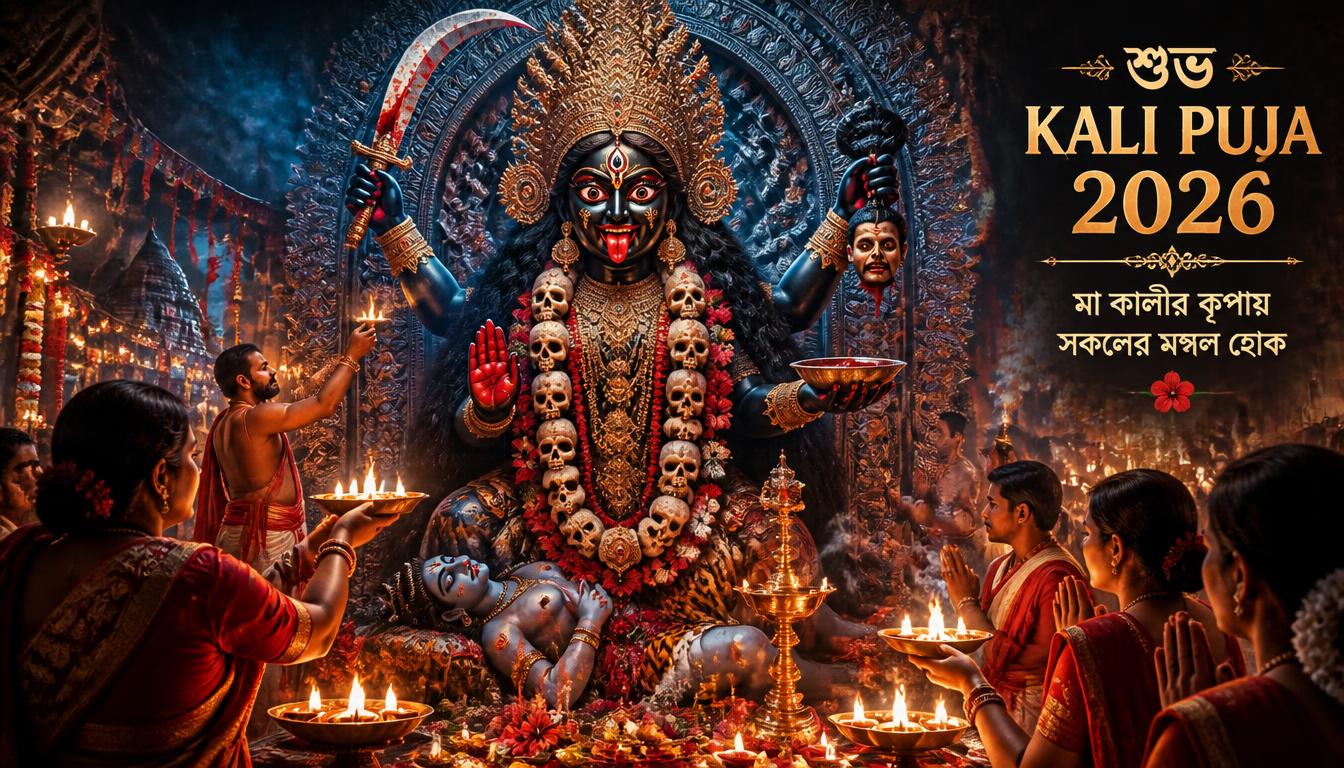
There are some nights in the Hindu calendar that feel different even before the lamps are lit. Kali Puja 2026 is one of those nights, when darkness itself becomes part of the worship, and the fierce form of the Divine Mother is remembered with devotion, courage, and quiet hope.
For millions of devotees, Kali Puja is not simply another Hindu festival. It is a deeply emotional observance dedicated to Goddess Kali, the powerful mother who represents time, transformation, protection, and spiritual freedom.
Her appearance may look fierce, but devotees often see behind that fierceness a very different face the loving mother who destroys fear.
In 2026, the festival falls on Sunday, November 8, 2026, on Kartik Amavasya, the new-moon night of the Hindu lunar calendar. The celebration is especially important in Bengal and eastern India, where homes, temples, and community pandals come alive after sunset.
The most important part of the night is the midnight worship, traditionally associated with Nishitha Puja. While the world outside becomes quieter, devotees gather before the image of Kali, light lamps, offer flowers, recite mantras and pray for protection and inner strength.
If you are searching for when is Kali Puja 2026, the answer is straightforward: Kali Puja 2026 will be observed on Sunday, November 8, 2026.
The Kali Puja 2026 date falls on Kartik Amavasya, the new moon associated with the dark fortnight, or Krishna Paksha, of the lunar month of Kartik. This is why the festival is observed at night rather than during the bright daytime hours.
The Kali Puja 2026 day is Sunday, and in many regions the observance overlaps with Diwali 2026. Yet the two celebrations can have different religious emphasis. Diwali broadly celebrates light, prosperity, and victory over darkness, while Kali worship gives special attention to the fierce and protective form of Shakti.
So, if someone asks about the Kali Puja date 2026, remember November 8, 2026. Local calendars and temple schedules can still differ slightly regarding exact ritual timings, especially because the principal worship depends on the lunar tithi.
One of the most interesting things about the festival is its close connection with Diwali night. In many parts of eastern India, Diwali and Kali Puja are experienced together, but the devotional focus is different.
During Kali Puja on Diwali, homes may glow with diyas, while temples and community pandals prepare elaborate images of Goddess Kali. Fireworks, lamps, flowers, music, and devotional chanting can turn an otherwise dark night into something wonderfully alive.
In Bengal, Kali Puja in West Bengal has a particularly strong cultural presence. Kolkata and other cities may feature temporary shrines and beautifully decorated pandals, while Bengali families also perform worship in their own homes.
The contrast is rather beautiful: outside there may be fireworks and celebration, but before the deity there is often a deeply personal prayer. A person may simply ask for courage to get through something difficult no grand speech needed.
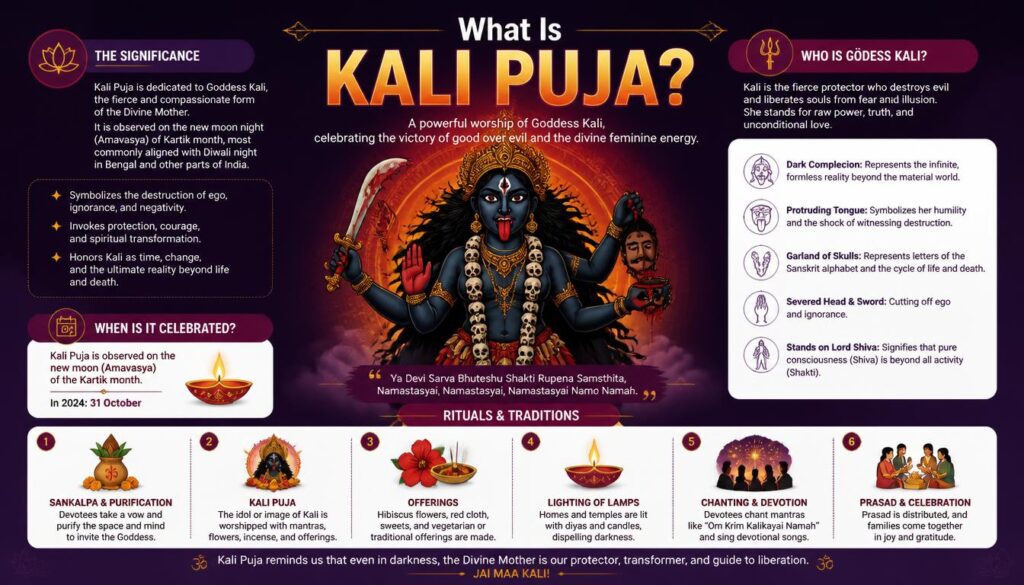
Kali Puja, also known as Shyama Puja, is a Hindu worship festival devoted to Kali, one of the most powerful manifestations of Shakti.
In the Shakta tradition, Goddess Kali represents the dynamic power of the Divine Mother. She is associated with time, death, transformation, liberation, and the destruction of forces that prevent spiritual growth.
Her fierce appearance is symbolic rather than simply frightening. Her dark form can represent the vastness beyond ordinary perception, while her weapons and skull imagery remind devotees of impermanence and the temporary nature of worldly existence.
This is where Kali Puja significance becomes more personal. The festival can be understood as an invitation to face fear rather than keep running from it. The darkness of Amavasya becomes almost like a spiritual mirror, quietly asking what needs to be removed from our own lives.
Goddess Kali is often described as the dark mother, the goddess of time, and the goddess of liberation. In devotional traditions, she is both terrifying to evil and compassionate toward her devotees.
Traditional depictions show Kali with four arms, wild hair, a protruding tongue, and a garland of skulls. She may hold a sword and a severed head, while her other hands offer protection and blessing.
The imagery has several philosophical meanings. The sword can represent the cutting away of ignorance and ego, while the severed head can symbolize the destruction of the false ego that keeps a person trapped in illusion.
The famous image of Kali standing on Lord Shiva is also highly symbolic. Shiva can represent consciousness, while Kali represents dynamic Shakti. Their relationship expresses a profound connection between consciousness and creative power.
For devotees, therefore, Kali is not merely a goddess of destruction. She is also associated with transformation, fearlessness, protection, and the possibility of spiritual awakening.
Several sacred traditions describe the emergence and deeds of Kali. One well-known account connects her with Goddess Durga and the battle against powerful demons.
In stories associated with the Devi Mahatmya, Kali emerges during a fierce battle and helps destroy demonic forces. The stories involving Raktabija are especially important because his blood was said to produce more demons whenever it touched the ground.
Kali defeats this threat by preventing the blood from falling onto the earth. The story dramatizes the idea that certain forms of evil cannot be defeated through ordinary methods — they must be confronted completely.
Another famous episode concerns Chanda and Munda, demons defeated by the fierce power of the Goddess. These stories have remained important within Shakta worship for generations, although different traditions explain the mythology in slightly different ways.
The story of Kali and Shiva gives another layer to her symbolism. When Kali becomes unstoppable, Shiva lies before her, and she steps on him. Realizing what has happened, she extends her tongue in a gesture often interpreted as surprise, humility, or awareness.
The exact procedures for Kali Puja rituals can vary between temples, households, and traditions. Some observances are simple and devotional, while others follow elaborate ritual systems connected with Shakta or tantric practice.
A typical worship may begin with cleaning and preparing the puja space. Devotees arrange the idol or image, flowers, lamps, incense, offerings, and other sacred items before the principal worship begins.
In more formal traditions, rituals may include Kalasha Sthapana, Prana Pratishtha, invocation of the deity, offerings, prayers, and Arati. Traditional sequences can include services such as Avahana, Asana, Padya, Arghya, Achamana, Snana, Vastra, Yajnopavita, Gandha, Pushpa, Dhupa, Dipa, Naivedya, Tambula, and Dakshina.
The names can sound technical, but the heart of the ritual is much simpler: welcome the deity, offer what is considered sacred, pray sincerely, and express gratitude.
The central worship often reaches its spiritual intensity around midnight. This is why Kali Puja midnight worship is such an important phrase associated with the festival.
Nishitha Puja refers to worship performed during the spiritually significant midnight period. For Kali devotees, this timing is particularly meaningful because Kali worship has traditionally been associated with the deep stillness of night.
The darkness of Amavasya is not treated as something to fear. Instead, it creates a setting for contemplation, prayer, and the recognition of the Divine Mother beyond ordinary daylight imagery.
At temples, devotees may wait for the appropriate ritual period to receive darshan. At home, families may remain awake for the puja, lighting lamps and participating in prayers together.
Exact timings can vary according to location and local Hindu calendars, so anyone planning a formal ritual should check the local Nishitha Puja timing rather than assuming that midnight means exactly 12:00 a.m.
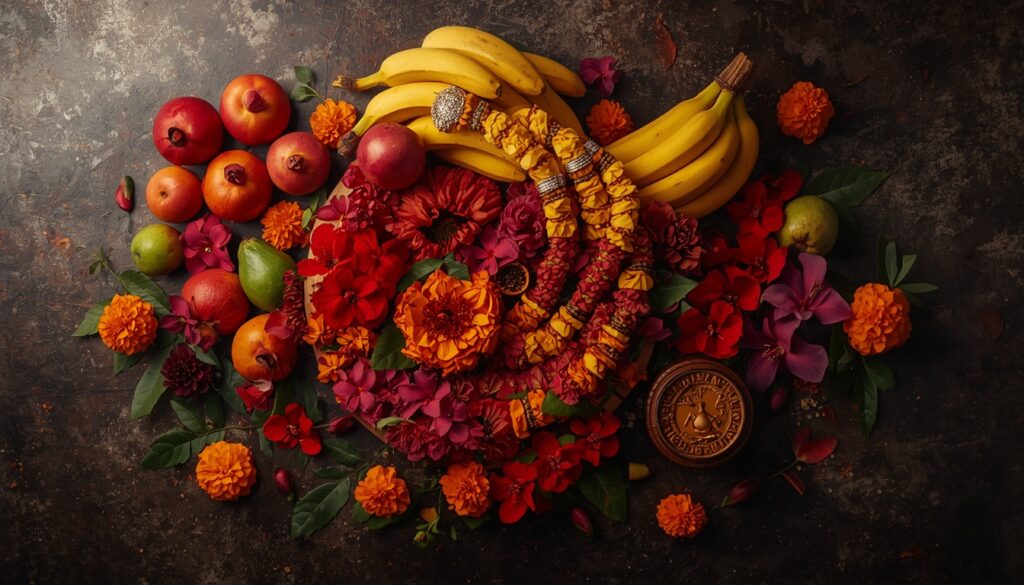
Offerings differ according to regional custom, family tradition, and the particular temple. Common Kali Puja offerings can include flowers, fruits, sweets, cooked food, incense, lamps, and other devotional items.
Red hibiscus, also called Jaba flowers, has a particularly strong association with Goddess Kali. Their bright red appearance is often connected symbolically with Shakti and devotion.
Other traditional items mentioned in different practices include red sindoor, banana, coconut, mango leaves, pumpkin, sugarcane, sandalwood, betel, and sacred thread.
Some Bengali and tantric traditions may include offerings such as fish, while other devotees follow vegetarian practices. There is no single household routine that represents every form of Kali worship, and local customs matter greatly here.
The most important thing is not making a huge display. A small flower offered with genuine devotion can mean more to a worshipper than a table overflowing with things but lacking attention.
Kali Puja in West Bengal is one of the most recognizable forms of the festival. Kolkata, in particular, becomes closely associated with Kali worship during this period.
Community organizers create Kali Puja pandals, often building temporary shrines around carefully crafted Kali idols. Master artisans may spend weeks or months preparing the figures and decorative structures.
Homes also participate. Bengali families may clean their shrines, prepare offerings, light diyas, and stay awake for portions of the night. The celebration can move naturally between family devotion and public community life.
The city feels different during the festival. Lights appear everywhere, streets become busier, and the sound of devotional music mixes with the general noise of celebration — it is a little chaotic, but in a very festive way.
The festival is not limited to Bengal. Kali Puja in Assam also has an important place within regional religious life, with devotees visiting temples and observing household and community worship.
In Odisha, Kali worship exists alongside many other powerful Shakti traditions. Devotees may visit temples, participate in regional ceremonies, and follow family customs connected with the Goddess.
Kali Puja in Bihar is also observed by devotees, although the scale and style can vary considerably from one community to another.
Across these regions, the same Goddess may be approached through somewhat different rituals. That variety is not a weakness of the tradition; it is one of its most interesting features.
For many devotees, Kali Puja at Kalighat Temple carries special significance. Kalighat Temple in Kolkata is one of the best-known Shakti pilgrimage sites and is traditionally regarded as a Kalighat Shakti Peetha.
The temple is deeply connected with the religious identity of Kolkata and attracts devotees throughout the year, not only during Kali Puja.
The broader cultural landscape of Bengal also connects Kali worship with the sacred geography around the Hooghly River, while Kali temples and shrines can be found in many other parts of eastern India.
Other Shakti pilgrimage destinations, such as Kamakhya Devi Temple Guwahati, Biraja Devi Temple Jajpur, and Tripura Sundari Temple, also reflect the wide geographical reach of Goddess-centered worship.
The Shakta tradition places the Divine Feminine at the center of spiritual practice. Within this broad tradition, Kali may be understood as Supreme Shakti, the primordial energy behind creation, transformation, and dissolution.
Some practitioners also connect Kali worship with tantric tradition, Tantra, and forms of tantric sadhana. These practices can be highly specialized and should not be confused with the simple household worship performed by ordinary devotees.
Concepts such as Kundalini Shakti, spiritual awakening, liberation, and divine consciousness appear in different Shakta and tantric philosophical contexts.
It is useful to remember that not every person celebrating Kali Puja is practicing Tantra. For many Bengali families, the festival is simply an important religious celebration centered around prayer, family, community, and devotion.
The symbolism surrounding Kali can feel intense at first glance, but almost every element carries a deeper interpretation.
Her dark-skinned form can symbolize the infinite and the reality beyond ordinary categories. Her wild hair suggests untamed divine energy, while the sword can represent spiritual knowledge cutting through ignorance.
The garland of skulls, sometimes described as 51 human skulls, is associated with mortality, language, transformation, and the impermanence of embodied life in different interpretive traditions.
Her tongue, weapons, and association with cremation grounds or shamshans can appear frightening. Yet these images also challenge devotees to look directly at death and impermanence rather than pretending they do not exist.
This is one reason Kali can represent both fear and freedom. She destroys what must end, while giving the devotee courage to accept change.
Devotees may recite different Kali Puja mantras depending on their family tradition, spiritual teacher, or form of worship.
Among commonly known devotional formulas is the Kali Moola Mantra, including the widely recognized Sanskrit mantra “Om Krim Kalikayai Namah.” Here, Krim is traditionally understood as a Kali seed mantra or bija associated with her energy.
Other texts and prayers connected with Kali include Kali Dhyana Mantra, Mahakali Ashtakam, Kali Kavach, Mahakali Stotra, and Dasa Mahavidya Stotras.
Mantras associated with tantric practice can have specific initiation and pronunciation requirements. For that reason, people interested in formal tantric practice should learn from an appropriate qualified teacher rather than treating every mantra found online as a casual formula.
For a household celebration, simple devotional prayer can be entirely appropriate. The emotional sincerity of worship should never be lost underneath the search for complicated rituals.
The Kali Puja spiritual benefits described in devotional traditions are largely connected with inner transformation rather than material gain alone.
Devotees may pray for fearlessness, courage, divine protection, freedom from harmful influences, and strength during difficult periods of life.
Kali is also associated with ego destruction. In this philosophical sense, destruction does not mean physical harm; it can mean breaking down arrogance, attachment, ignorance, and unhealthy patterns.
Some traditions connect Kali with Moksha, or liberation, because she represents freedom from attachments and the cycle of conditioned existence.
People may also approach her while seeking protection from the evil eye, negative influences, or what they understand as spiritual obstacles. Such beliefs vary across families and communities, so they are best understood within their particular devotional context.
If you are wondering how to celebrate Kali Puja, you do not necessarily need a huge setup. A clean prayer area, a picture or appropriate image of Kali, flowers, a lamp, incense, and simple food offerings can provide the basis for a respectful home observance.
Begin by cleaning the worship area and arranging the items neatly. Light a lamp and incense, offer flowers such as red hibiscus, and spend some quiet time in prayer.
Families may recite familiar Kali worship mantras, devotional songs, or prayers. If you already follow a family puja tradition, it is generally best to continue that rather than copying a completely different ritual from somewhere else.
If performing an elaborate ceremony, follow a trusted regional calendar or the guidance of a knowledgeable priest because the exact Amavasya and Nishitha Puja timings can matter.
And remember the simplest part: stay present. A person can perform ten rituals while thinking about their phone, or offer one flower with a completely focused heart. The difference is bigger than it sounds.
Many community celebrations include idol installation followed by worship throughout the festival period. The idol may become the center of a temporary shrine where families and neighborhood groups gather.
After the worship concludes, some communities perform Kali Puja idol immersion, also known as Visarjan. The idol is carried in a procession and immersed according to local custom.
The immersion symbolizes the temporary nature of the physical form. The deity is worshipped through an image, but divine presence is understood as something much larger than clay or decoration.
Modern celebrations may also place greater emphasis on environmentally responsible immersion practices. Local rules should always be followed, particularly where immersion takes place in rivers or other natural water bodies.
Read more; https://templetimingsdaily.com/nidhivan-temple-timings-today/
People sometimes ask about Kali Puja vs Durga Puja, since both festivals involve powerful forms of the Divine Mother.
Durga Puja primarily celebrates Goddess Durga and her victory over Mahishasura, while Kali Puja centers on Goddess Kali. Both belong to broader Goddess-centered traditions, but their stories, imagery, ritual emphasis, and festival timing are different.
There is also a close theological relationship between Kali and Durga. Some traditions understand Kali as emerging from or representing a fierce aspect of Durga’s power.
So they should not simply be treated as two unrelated goddesses. The traditions around Shakti are complex, and different communities can describe their relationship in different ways.
The nighttime setting is one of the defining characteristics of Kali worship.
The New Moon creates a naturally dark sky, while Kali’s symbolism embraces themes such as time, death, transformation, and the unknown. Instead of avoiding darkness, devotees turn toward it with prayer.
The practice of midnight worship gives the festival an atmosphere unlike many daytime religious celebrations. Lamps seem brighter, devotional sounds feel deeper, and even a quiet home shrine can become remarkably peaceful.
There is a philosophical message hiding inside this timing: light does not become meaningful because darkness never existed. It becomes meaningful because darkness is real.
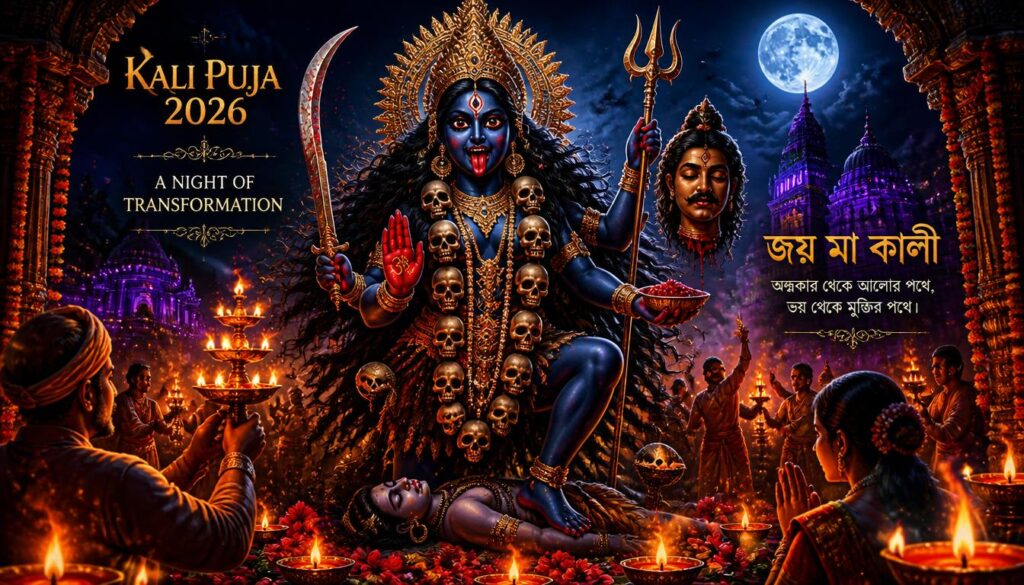
The deeper message of Kali Puja 2026 can be understood without needing to become an expert in every ritual detail.
Kali represents the courage to face what frightens us. She reminds devotees that everything changes, that ego is temporary, and that destruction can sometimes create the space required for renewal.
For one person, that prayer might mean overcoming fear. For another, it may mean accepting a painful change. Someone else may simply want protection for their family.
This is where the idea of maternal love becomes important. Kali may appear fierce, but devotees often approach her as a mother — a mother who does not flatter her children, but protects them by removing what harms them.
Kali Puja 2026 will be observed on Sunday, November 8, 2026, according to the supplied festival date, on Kartik Amavasya.
The Kali Puja 2026 date is November 8, 2026. The principal worship is associated with the night of Kartik Amavasya.
Yes. In regions such as Bengal, Kali Puja is closely associated with Diwali night, although the religious focus is specifically on Goddess Kali.
Kali Puja is also widely known as Shyama Puja. Shyama is another devotional name associated with Goddess Kali.
The central worship is traditionally associated with Nishitha Puja, the midnight period. Nighttime worship also reflects Kali’s connection with darkness, transformation, and the deeper spiritual aspects of existence.
Red hibiscus, or Jaba flowers, are among the flowers traditionally associated with Kali worship. Other offerings vary according to regional and family traditions.
Devotees traditionally associate Kali worship with fearlessness, courage, protection from evil, spiritual awakening, transformation, and liberation. Interpretations differ among traditions and individuals.
The festival is especially prominent in West Bengal, including Kolkata, and is also observed in Assam, Odisha, Bihar, and other areas of eastern India and among the Bengali diaspora.
Within the Shakta tradition, Kali represents a powerful manifestation of Shakti, the Divine Feminine. She is associated with time, transformation, destruction of evil, spiritual freedom, and liberation.
In community celebrations where an idol is installed, worship may conclude with idol immersion or Visarjan. Local customs determine the exact process and timing.
Kali Puja 2026 arrives on Sunday, November 8, 2026, bringing together the darkness of Kartik Amavasya, the glow of Diwali lamps, the strength of Shakti, and the devotion of millions of worshippers.
From the busy Kali Puja pandals of Kolkata to a small home shrine where one family quietly lights a lamp, the festival can take many forms. Yet the emotional center remains remarkably similar: people turn toward Goddess Kali seeking courage, protection, transformation, and peace.
Her fierce image teaches a surprisingly gentle lesson. Darkness is not always something that must be escaped. Sometimes, you sit inside it for a while, light one little lamp, and discover that you were stronger than you thought.
That may be one of the most beautiful meanings of Kali Puja — not simply celebrating the destruction of evil, but finding the courage to destroy fear within ourselves and walk forward with greater spiritual freedom.
As November 8, 2026 approaches, devotees can prepare not only flowers, lamps, and offerings, but also the heart. A sincere prayer, a moment of silence, or a simple act of kindness can become part of the spirit of the festival.
May Goddess Kali bless devotees with courage in difficult moments, wisdom during change, protection for their families, and the strength to welcome a new beginning when an old chapter finally ends.