Physical Address
304 North Cardinal St.
Dorchester Center, MA 02124
Physical Address
304 North Cardinal St.
Dorchester Center, MA 02124

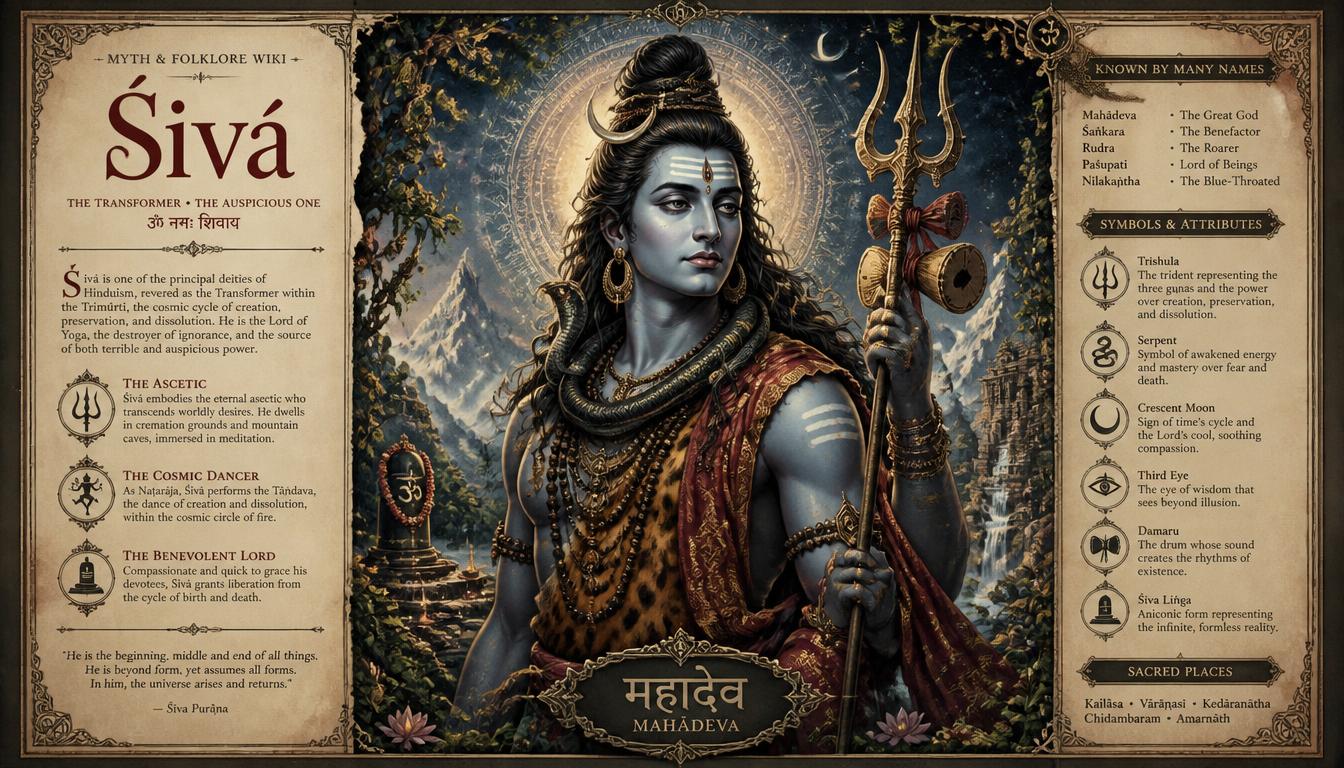
There are some gods who seem to belong to one story, one temple, or one particular corner of an old religious world. Śivá, however, refuses to stay inside such a small frame.
He appears as the quiet ascetic sitting among the mountains, the fierce Rudra who arrives with the storm, the cosmic dancer Nataraj, and the mysterious deity represented through the Shiva Lingam.
Each form feels different, yet somehow they all point toward the same strange idea: destruction is not always an ending. Sometimes, it is the doorway to becoming something else.
In Hindu mythology, Shiva is traditionally understood as one of the three principal gods of the Trimurti, alongside Brahma, the Creator, and Vishnu, the Preserver.
Shiva is associated with destruction and transformation, but calling him only the “God of Destruction” can make his mythology sound much simpler than it really is.
His stories also involve meditation, compassion, asceticism, family, cosmic dance, death, renewal, and the strange balance between wildness and order.
The spelling Śiva, Siva, Shivá, and Śivá reflects different transliteration and language traditions. In Sanskrit, the name is connected with meanings such as auspiciousness and benevolence.
That contrast is important because Shiva’s mythology constantly places apparently opposite ideas beside one another.
Śivá, more commonly written as Shiva or Lord Shiva, is one of the most important deities in Hinduism. He is often described as the destroyer in the Trimurti, but the broader tradition presents him as a God of Transformation rather than merely a destructive force.
His mythology is enormous, stretching across the Vedas, Puranas, epics, temple traditions, regional folklore, devotional poetry, and countless oral stories. Because of this, there isn’t one single Shiva story that explains everything about him.
He can be terrifying and tender in the same breath. One story may show the Angry Lord with immense cosmic power, while another presents a meditating ascetic who seems almost completely detached from worldly affairs. Thats part of what makes Shiva so fascinating.
The concept of the Trimurti describes three major divine functions: creation, preservation, and destruction. Brahma is associated with creation, Vishnu with preservation, and Shiva with destruction and transformation.
This does not necessarily mean Shiva simply destroys things for the sake of destruction. In Hindu philosophical and mythological traditions, destruction can clear the way for renewal. A cycle cannot continue forever without change.
Shiva therefore occupies an unusual position within the Hindu trinity. He represents the force that brings one phase to its conclusion so another can begin. The old disappears, the new emerges, and existence continues moving.
The famous description Shiva the Destroyer can sound frightening when removed from its religious context. Yet destruction in Shiva’s mythology is often connected with transformation, impermanence, and the breaking down of illusion.
His association with death is especially strong in forms such as Mahakala, whose name carries the sense of great time or great death. Time consumes everything eventually, and Mahakala represents that overwhelming reality.
At the same time, Shiva is not simply a symbol of death. His mythology repeatedly connects destruction with regeneration. Something must sometimes end before another possibility can appear. That rather uncomfortable truth is one of the most enduring ideas surrounding Shiva.
The history of Shiva is complex. Many scholars connect the later figure of Shiva with Rudra, a powerful and fearsome deity appearing in the Vedic tradition.
Rudra is associated with storms, wildness, healing, and dangerous natural forces. His character is not exactly identical to the later Puranic Shiva, but over centuries religious traditions developed and merged in ways that helped shape Shiva’s later identity.
This makes the origins of Shiva especially interesting. Rather than imagining a single moment when Shiva suddenly appeared in Hindu religion, it is more accurate to think about a long historical development involving Vedic traditions, regional worship, mythology, philosophy, and devotional practice.
The transformation from Vedic god Rudra toward the multifaceted Shiva of later Hinduism is one of the remarkable developments in ancient Indian religious history.
Few Hindu deities have an iconography as immediately recognizable as Shiva’s. His appearance is filled with symbols, and almost every detail can carry a religious or philosophical meaning.
He is commonly portrayed with matted hair, a crescent moon, a third eye, a serpent around his neck, and sometimes the sacred river Ganges flowing from his hair.
He may carry a trident, known as the trishula, and a small drum called the damaru. His clothing can include a tiger pelt, reinforcing his connection with wildness, forests, animals, and ascetic life.
His imagery isn’t merely decoration. Shiva iconography creates a visual language in which seemingly opposite qualities sit together: serenity and fury, asceticism and family life, death and fertility, isolation and divine companionship.
The Shiva third eye is one of his most famous symbols. It is traditionally located in the center of his forehead and represents a form of higher perception.
In several myths, opening this eye produces an overwhelming fiery power. The third eye is therefore not simply another physical eye. It is associated with insight, spiritual knowledge, and the destruction of illusion.
The image works beautifully as mythology because ordinary sight is not enough here. Shiva’s third eye suggests seeing beyond the surface of things, which is a very different kind of vision.
The Shiva trident, or trishula, is another major symbol. It is commonly associated with Shiva’s power and can be interpreted through different theological traditions in several ways.
The small drum, known as the damaru, is connected with sound and rhythm. Together, the trident and drum create a striking contrast: one represents immense power, while the other produces rhythm and sound.
In the hands of Nataraj, these symbols become part of a larger cosmic picture where creation, preservation, destruction, concealment, and release are represented through divine movement.
The crescent moon in Shiva’s hair is among the details that make his appearance instantly recognizable. The moon can symbolize time, cycles, and renewal.
The river Ganges is also deeply connected with Shiva. According to a famous myth, the descent of the heavenly river toward Earth was so powerful that Shiva received it through his matted hair, preventing its force from overwhelming the world.
The story gives another glimpse of Shiva as a mediator between immense cosmic power and earthly existence. He is wild enough to contain the river, yet controlled enough to release it safely.
Nandi, the sacred bull, is closely associated with Shiva and is traditionally regarded as his vehicle and devoted companion.
In many Shiva temples, visitors encounter an image of Nandi facing the shrine where the Shiva Lingam is worshipped. This arrangement is not merely architectural decoration. Nandi represents devotion, strength, patience, and faithful attention.
The quiet bull sitting before Shiva creates a beautiful temple image: the devotee waits, watches, and remains focused.
The relationship between Shiva and Parvati is central to Hindu mythology. Their stories bring together two powerful but contrasting personalities.
Shiva is often portrayed as an ascetic who has withdrawn from ordinary worldly life, while Parvati represents determination, devotion, divine feminine power, and family life. Their union therefore becomes more than a romantic story.
Together they form a divine household that includes Ganesha and Kartikeya, also known in different traditions as Murugan.
Their mythology explores marriage, devotion, parenthood, disagreement, reconciliation, and divine power. It is one reason Shiva is not simply remembered as a lonely mountain ascetic.
Ganesha, or Ganesh, is traditionally known as Shiva and Parvati’s son. His elephant head and distinctive stories have made him one of the most recognizable Hindu deities worldwide.
Another important son is Kartikeya, known as Murugan in many South Indian traditions. He is strongly associated with courage, warfare, leadership, and divine strength.
Together, Shiva, Parvati, Ganesha, and Kartikeya form an important image of the Hindu divine family. Their stories can be humorous, dramatic, emotional, and sometimes surprisingly human in the way family disagreements unfold.
Shiva’s mythology also intersects with other major divine figures such as Kali and Durga. In Hindu traditions, divine identities and relationships can vary according to theological school, regional tradition, and particular text.
Kali is especially associated with time, death, fierce transformation, and the destruction of evil. Her relationship with Shiva appears in several powerful stories and artistic traditions.
Durga is another major form of divine feminine power. Although the exact relationships among these deities can differ between traditions, they belong to a broader mythological universe in which divine masculine and feminine powers continually interact.
The Shivling, also called the Shiva Lingam or simply Lingam, is one of the most important sacred symbols connected with Shiva.
Rather than being a conventional human-shaped statue, the Lingam is often understood as an aniconic representation of Shiva. It appears in countless temples and shrines and is central to Lingam worship.
Devotees may offer milk, coconut water, bel leaves, flowers, rice, fruit, and other religious offerings according to local and family traditions.
These rituals are not identical everywhere. Hindu worship varies considerably between regions, temples, communities, and traditions. What remains consistent is the reverence with which the sacred symbol is approached.
A Shiva temple can be a place of quiet prayer, elaborate ritual, pilgrimage, music, festival celebrations, or all of these at once.
Devotees may perform prayers, offer flowers and water, circle the shrine, and participate in ceremonies conducted by temple priests. Some temples have ancient legends explaining their origin, while others are associated with specific forms or manifestations of Shiva.
The experience of Shiva devotion is therefore not limited to mythology written in books. It continues through living traditions, family practices, temple rituals, festivals, songs, and pilgrimage.
Perhaps the most visually dramatic form of Shiva is Nataraj, the Lord of Dance.
In the famous Nataraj image, Shiva dances within a circle of flames. One foot is raised while another presses down upon a small figure representing ignorance. His hands hold or display significant symbols, including the damaru and fire.
The dance is not simply entertainment. It represents cosmic processes and the continual movement of existence. Creation and destruction become part of one rhythm.
This is why Nataraj is such a powerful representation of the God of Transformation. The universe itself is imagined as movement rather than something permanently frozen in one condition.
The form of Mahakala presents Shiva through an especially intense association with time and mortality.
Mahakala is often understood as the great force before which ordinary measures of time become insignificant. Kings, ordinary people, mountains, civilizations, and even worlds are ultimately subject to change.
There is something almost unsettlingly beautiful about this concept. Shiva does not promise that everything will remain unchanged. Instead, his mythology confronts the fact that nothing material lasts forever.
That is one reason Mahakala remains such a powerful figure in Hindu religious imagination.
The Puranas contain many of the stories that helped shape the popular understanding of Shiva.
These texts describe divine battles, family stories, manifestations, sacred places, cosmic events, ascetic practices, and relationships among Hindu deities.
Because Puranic literature developed over long periods and across different traditions, stories can sometimes differ from one source to another. A variation is not necessarily a mistake; mythology often grows through retelling.
Regional traditions add even more layers, allowing the mythology of Shiva to develop distinctive local forms while retaining familiar central symbols.
The idea of Shiva avatars is not always structured in exactly the same way as the avatar tradition associated with Vishnu.
Instead, Hindu traditions speak of various Shiva manifestations, forms, emanations, and divine appearances. Rudra, Mahakala, and Nataraj represent different aspects of Shiva’s immense mythological personality.
Figures such as Hanuman are also associated with Shiva in particular traditions that describe Hanuman as a manifestation or aspect of Shiva. These relationships can vary depending on the text and religious tradition being followed.
So when discussing Shiva incarnations, it is useful to avoid treating every tradition as though it follows one universal list.
Read more: https://templetimingsdaily.com/desi-talas/
The mythology of Shiva does not live only inside ancient Sanskrit texts. It also appears in songs, village legends, temple stories, pilgrimage traditions, folk performances, and regional storytelling.
In one region, Shiva may be remembered through a particular mountain shrine. Somewhere else, a local legend may explain how a temple’s sacred Lingam appeared.
These stories give Hindu folklore its living quality. People do not simply read mythology; they inherit it, retell it, sing it, perform it, and sometimes attach their own family memories to it.
The form Śiva comes from Sanskrit, while spellings such as Shiva and Siva are commonly used when Sanskrit diacritics are omitted.
The Sanskrit word is associated with meanings such as auspicious, benevolent, or gracious. This is an interesting contrast to the popular English label “Destroyer.”
It reminds us that translating a divine name into one short English phrase can leave out a lot. The word itself carries a gentler sense, while the mythology surrounding the deity contains both fierce and compassionate dimensions.
As Indian religions and cultures interacted with neighboring civilizations, ideas connected with Shiva were sometimes compared with other divine figures and traditions.
Historical discussions may mention figures and names such as Oesho, Weshparkar, or other deities from Indo-Iranian and Central Asian contexts. Such comparisons are fascinating, but they require caution because resemblance does not automatically prove that two figures were the same deity.
The history of religion is full of cultural exchange, adaptation, and reinterpretation. Shiva’s story is best understood through evidence from texts, inscriptions, archaeology, art, and living religious traditions rather than through simple one-to-one comparisons.
Modern culture has carried Shiva far beyond traditional temples and religious texts. The deity has appeared in comic books, video games, fantasy fiction, television, animation, and other forms of popular entertainment.
Examples can be found in works and franchises such as SMITE, Final Fantasy, Marvel Comics, Fables, Rage of Bahamut, and Record of Ragnarok, although each fictional portrayal interprets Shiva differently.
These versions should not be confused with traditional Hindu theology. A fictional Shiva may borrow a name, appearance, weapon, or mythological feature while changing the character dramatically for a modern story.
That difference matters, especially when discussing a living religious tradition.
Shiva has survived across centuries partly because his mythology does not offer only one emotional experience.
He can represent stillness when the world becomes noisy. He can represent destruction when something has reached its natural end. He can represent family through Shiva and Parvati, fatherhood through Ganesha and Kartikeya, devotion through Nandi, and cosmic movement through Nataraj.
His symbols also invite interpretation. The third eye suggests deeper perception. The serpent challenges ordinary ideas of fear. The crescent moon evokes cycles. The Ganges connects heaven and earth. The tiger pelt points toward wildness and ascetic power.
None of these symbols needs to be reduced to one rigid meaning.
Yes. Śivá, Śiva, Siva, and Shiva are different transliteration or spelling forms referring to the same major Hindu deity.
Shiva is associated with destruction within the Trimurti, but destruction in his mythology is closely connected with transformation, renewal, and the ending of one cosmic phase.
Parvati is the principal consort of Shiva in many Hindu traditions. Their mythology forms one of the central divine relationships in Hindu storytelling.
Ganesha and Kartikeya, also widely known as Murugan, are traditionally regarded as sons of Shiva and Parvati.
The Shiva Lingam is a sacred aniconic representation associated with Shiva and is central to many forms of Shiva worship in Hindu temples.
The third eye on Shiva’s forehead symbolizes extraordinary spiritual perception and, in mythology, can release destructive fiery power.
Nataraj is Shiva as the cosmic dancer. His dance represents powerful processes of creation, destruction, transformation, and cosmic order.
Rudra is an important Vedic deity traditionally associated with fierce natural forces, storms, healing, and wildness, and is closely connected with the later development of Shiva.
The serpent is a major part of Shiva’s iconography and can be interpreted through several symbolic traditions involving power, fear, mortality, and mastery over dangerous forces.
Shiva is one of the principal deities of Hinduism, known as the god of destruction, transformation, meditation, and spiritual power.
Shiva is a major Hindu god and one of the three deities of the Trimurti, representing destruction and transformation alongside Brahma and Vishnu.
Hindu god Shiva is worshipped as a powerful deity associated with destruction, renewal, asceticism, meditation, and cosmic transformation.
Lord Siva, also spelled Shiva, is a revered Hindu deity known for his third eye, trident, matted hair, crescent moon, and association with spiritual liberation.
Shiva, the Hindu god, is one of the most important figures in Hindu mythology and is traditionally regarded as the destroyer and transformer within the Trimurti.
The easiest way to misunderstand Shiva is to reduce him to one title.
Shiva the Destroyer is only one doorway into a much larger mythology. Behind that title are the meditating ascetic, the devoted husband, the father of Ganesha and Kartikeya, the companion of Nandi, the cosmic dancer Nataraj, the fierce Mahakala, and the deity worshipped through the sacred Lingam.
His mythology is full of contradictions that somehow belong together. He is terrifying and compassionate, solitary and deeply connected to family, wild and disciplined, associated with death yet continually linked with transformation.
That complexity is perhaps the most interesting thing about Śivá.
Across Hindu mythology, Sanskrit literature, Puranic stories, temple traditions, folklore, art, and modern culture, his image keeps changing while remaining recognizably Shiva. The stories have been retold for generations, and each retelling adds another little piece to a figure who was never simple to begin with.
In the end, Shiva’s mythology asks a surprisingly timeless question: what happens when we stop seeing destruction as merely an ending? Sometimes an ending is a turning point, sometimes a transformation, and sometimes the beginning of something we could not have imagined before.
That is where the old stories of Śiva still feel strangely alive.
I kept the article within the exact Śivá/Shiva mythology topic rather than following the unrelated baby-girl-wishes instructions.