Physical Address
304 North Cardinal St.
Dorchester Center, MA 02124
Physical Address
304 North Cardinal St.
Dorchester Center, MA 02124

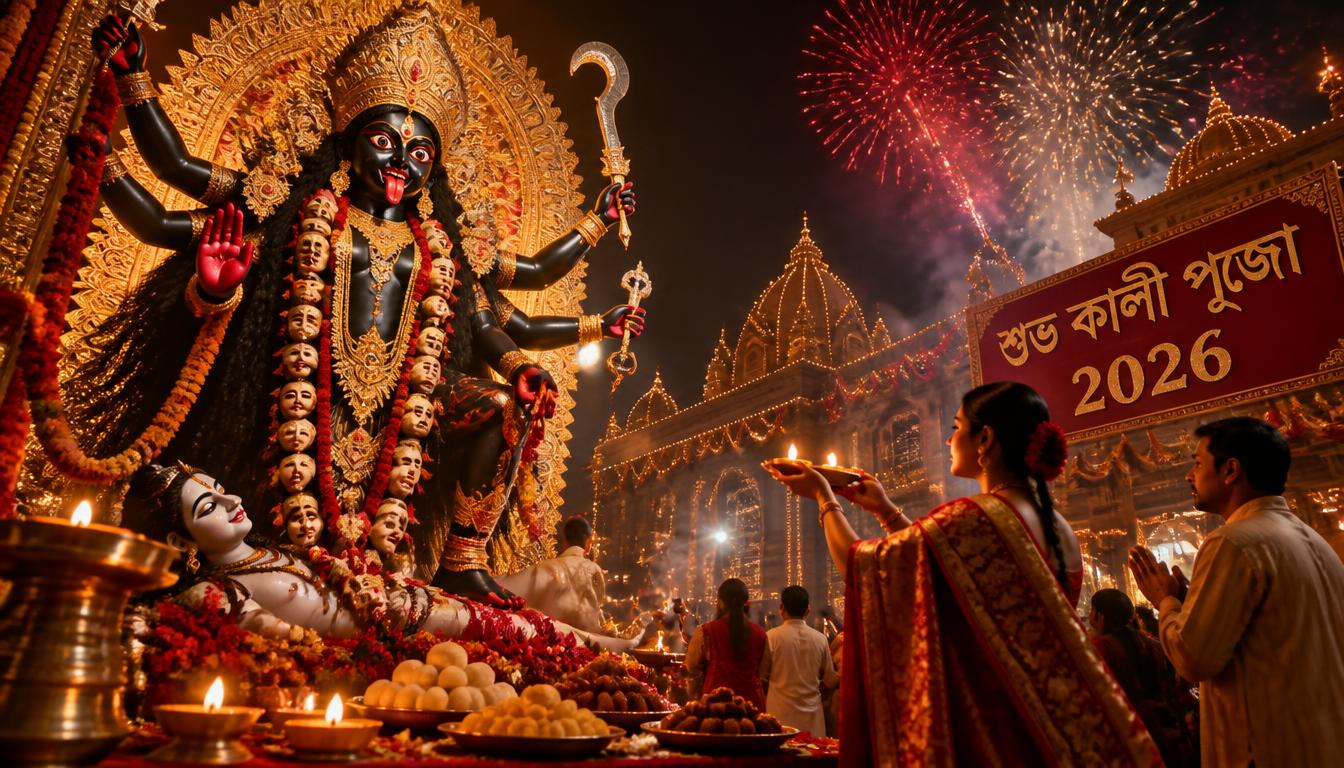
There is something deeply unusual about a night that looks completely dark yet feels full of spiritual light. Kali Puja 2026 arrives on Sunday, November 8, 2026, on Kartik Amavasya, the new-moon night that also coincides with Diwali 2026.
In Bengal and several parts of eastern India, this night is not only about lamps and celebration; it becomes a night of remembering Goddess Kali, the powerful mother associated with time, transformation, courage, and liberation.
For many families, the beauty of Kali Puja is difficult to explain in one sentence. A clay idol may stand quietly beneath hundreds of lights, incense may curl into the night air, and somewhere nearby an elderly
devotee may be whispering a prayer that has been in the family for generations. It feels ancient and present at the same time, which is perhaps the magic of the festival.
The Kali Puja 2026 date is November 8, 2026, and the festival falls on a Sunday. It is observed on Kartik Amavasya, the new-moon day of the lunar calendar. The same Amavasya night is associated with Diwali across much of India, although the principal deity and style of worship differ by region.
So, if you are searching when is Kali Puja 2026, the simple answer is November 8. The religious calculations behind the date are more detailed, though, because the observance is connected with the Amavasya tithi and the midnight period.
In Kolkata-based calculations, Amavasya in 2026 begins on the morning of November 8 and continues into November 9. This is why the night of November 8 is the important Kali Puja night.
Exact timings can vary according to location and the local Panchang, so devotees should check a city-specific calendar before performing important rituals. The commonly listed Delhi timing for Nishitha Puja is around 11:39 PM to 12:31 AM, but this should not automatically be treated as the timing for every city.
The name Shyama Puja is especially familiar in Bengal. Shyama is another name associated with Kali, and the festival expresses devotion to the goddess in her powerful yet deeply maternal form.
At first glance, Kali’s traditional image can look frightening: wild hair, a dark complexion, a sword, a garland of skulls and a protruding tongue. But devotees do not simply see a frightening goddess. They see a mother who destroys fear, ignorance and destructive forces. That contrast is a big part of her spiritual appeal.
Kali is often understood through the idea of Shakti, the divine feminine power. She represents a force that cannot be politely tucked into a corner. Time moves, bodies change, pride disappears and life eventually transforms into something else. Kali’s symbolism faces those realities directly.
That is why Kali Puja significance is not limited to asking for material blessings. For many worshippers, it is also a moment to seek fearlessness, inner strength, protection and spiritual transformation.
One of the most distinctive features of the festival is midnight worship. Unlike many ordinary forms of daily prayer, Kali Puja at midnight is closely connected with the darkest part of the Amavasya night.
The midnight period is known as Nishitha Kaal, and Kali worship is traditionally associated with this time. In simple words, the festival deliberately enters the darkness instead of pretending darkness does not exist.
This gives the celebration a powerful symbolic meaning. Darkness can represent fear, ignorance, ego and uncertainty, while Kali represents the courage to face those things.
The exact Kali Puja 2026 midnight time depends on location. For Delhi, one published calculation gives approximately 11:39 PM to 12:31 AM, while other calendars show slightly different calculations because local astronomical conditions and calculation methods can differ.
For that reason, anyone performing a formal Nishitha Puja should use the Panchang for their own city rather than copying a time from Kolkata, Delhi or another location.
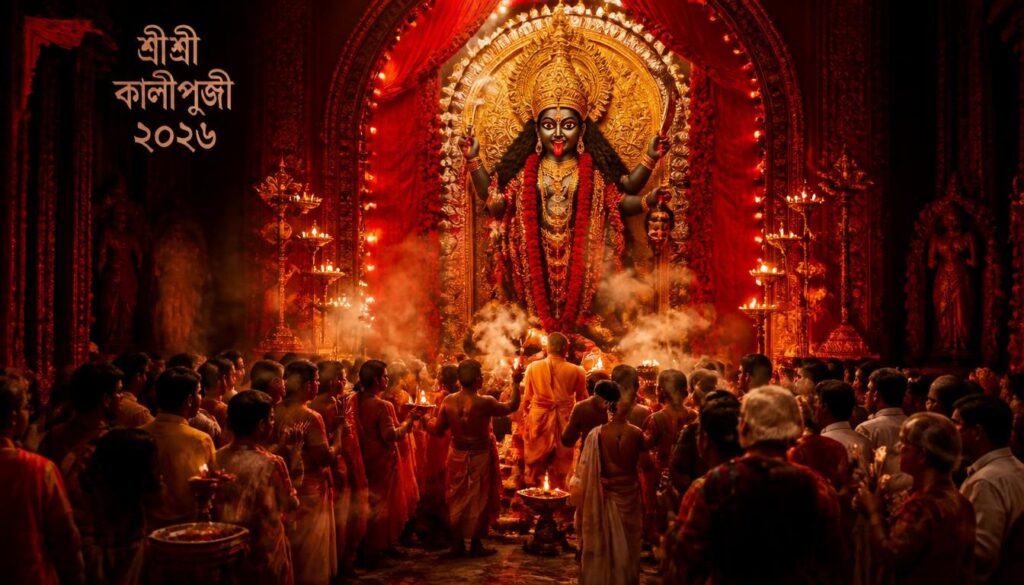
The Kali Puja rituals can differ considerably between a large community celebration, a household shrine and a specialized Shakta or tantric practice. There is no single simple procedure that accurately represents every tradition.
A household celebration may begin with cleaning the worship space and preparing an image or Kali idol. Lamps, flowers, incense, fruits, sweets and other offerings are arranged with care.
Some traditions include Kalasha Sthapana, prayers, meditation, chanting and offerings. More elaborate worship can involve Prana Pratishtha, Shodashopachara and a series of traditional offerings.
Common ritual elements may include:
The important thing is not to turn someone else’s highly specialized ritual into a universal rule. Household worship can be simple and devotional, while advanced tantric worship belongs to traditions where proper guidance matters.
Flowers have a special place in Goddess Kali worship, and the red hibiscus is particularly associated with Kali. In Bengal it is often called Jaba, and its bright red appearance is closely connected with traditional devotional imagery.
Other offerings may include fruits, sweets, coconut, bananas, incense, lamps and prepared food. Depending on the community and family tradition, devotees may prepare dishes such as khichdi or luchi as part of the festive offerings.
Some Kali traditions historically include Bali, or animal sacrifice, while many households and temples follow vegetarian or symbolic offerings instead. These practices vary by region, temple and religious lineage, so it is better to describe them as traditions rather than claiming one practice applies to all Kali worshippers.
The heart of an offering is devotion. A small flower placed with genuine reverence can mean far more to a devotee than an expensive arrangement made without attention.
One of the most recognizable images shows Goddess Kali standing upon Lord Shiva. It is an image that can look startling at first, but its symbolism is much deeper than the picture alone suggests.
In Shakta interpretations, Shakti represents dynamic divine energy, while Shiva is associated with consciousness. Their relationship is often expressed as inseparable aspects of cosmic reality.
Kali’s fierce movement can therefore be understood alongside Shiva’s stillness. Energy and consciousness, movement and silence, destruction and renewal all appear together.
This is why the image of Shiva and Kali has remained so powerful. It does not simply tell a story about two divine figures. It invites devotees to think about the relationship between action and awareness.
Kali appears in several Hindu traditions and texts, including the Devi Mahatmya. Different stories describe her emergence and her battles against destructive forces.
One famous narrative connects Kali with Goddess Durga and the battle against demons such as Chanda and Munda. Another well-known story involves Raktabija, whose unusual ability made defeating him especially difficult.
These stories are often interpreted symbolically as well as literally. The demons can represent destructive tendencies, while Kali’s fierce form represents the force required to overcome them.
The story of Kali standing on Shiva is similarly understood in several ways. In one popular telling, Kali’s intense cosmic activity becomes so fierce that Shiva intervenes, and her realization brings the destructive movement to an end.
The mythology is not merely decoration around the festival. For devotees, these stories help explain why Kali can simultaneously be viewed as a fierce goddess, a protector and a compassionate mother.
Few places are as strongly associated with the festival as West Bengal. Kali Puja in Kolkata turns neighborhoods into glowing spaces of devotion, art and community activity.
Large Kali Puja pandals may be decorated with elaborate themes, lights and artistic installations. Families visit different pandals, offer prayers and spend time together late into the night.
The city can feel almost like it has grown another layer after sunset. A quiet street becomes a meeting place, children stare at illuminated idols, older people discuss which puja is the most beautiful, and the smell of incense seems to follow everyone home.
Kalighat Temple in Kolkata is another major center associated with Kali worship. Kalighat is also regarded as a Shakti Peetha, connecting the site with the broader sacred geography surrounding Goddess Sati and Shakti traditions.
Although Bengali Kali Puja is perhaps the most widely recognized form, Kali worship is not limited to Bengal.
Kali Puja traditions are also found in Odisha, Assam, Bihar, Tripura and other areas of eastern and northeastern India. Bengali communities outside India also preserve many elements of the festival.
In Assam, the relationship between Shakta worship and the wider religious culture of the region gives the festival its own local character. In Odisha and other eastern regions, community celebrations can likewise combine regional customs with broader Kali traditions.
This variety is worth remembering because there is no single “correct-looking” Kali Puja celebration. The details change, while devotion to the goddess remains the common thread.
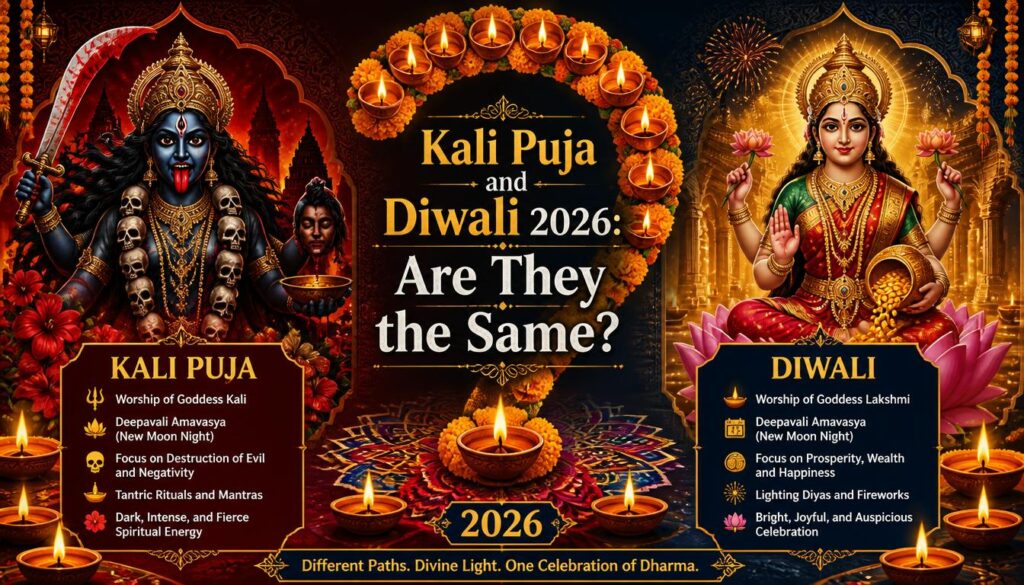
Kali Puja and Diwali occur on the same Amavasya night in 2026, but they are not simply two names for exactly the same worship.
In many parts of India, Diwali night is strongly associated with Lakshmi Puja, while in Bengal and some eastern regions, the night is especially dedicated to Goddess Kali.
This means a person searching for Kali Puja vs Diwali should understand the regional difference. The festivals share the lunar date and the atmosphere of lamps, but their central religious emphasis can be different.
In Bengal, therefore, Diwali night can become a dramatic Kali Puja celebration, with temples, homes and pandals focusing their devotion on Kali.
Devotees may use different Kali Puja mantras depending on their family tradition, temple practice or spiritual lineage.
Names such as Kali Moola Mantra, Kali Dhyana Mantra, Kali Kavach, Mahakali Ashtakam and other prayers are found in different devotional contexts.
One commonly known devotional phrase is “Om Krim Kalikayai Namah.” However, advanced mantra practices, particularly those connected with tantric traditions, should not be treated like casual internet instructions. Some practices traditionally require initiation or guidance from a qualified teacher.
For ordinary household devotion, sincere prayer, respectful chanting and meditation can provide a meaningful spiritual atmosphere without turning the festival into a complicated technical exercise.
People often search for Kali Puja benefits, but these benefits are best understood spiritually rather than as guaranteed supernatural results.
Devotees may see the festival as a time to develop:
The idea of liberation, or moksha, also appears in broader Kali traditions. Kali’s connection with time and mortality can encourage devotees to reflect on what truly matters rather than becoming trapped by temporary fears.
That reflection can be uncomfortable sometimes, but maybe that is exactly why it can be useful.
A beautifully created Kali idol often becomes the visual center of the celebration. In public celebrations, artists may create enormous clay idols with elaborate clothing, jewelry and traditional symbolism.
The Kali Puja pandal then becomes more than a temporary shelter. It can become a work of community art where families, neighbors and visitors gather.
Homes may use lamps, flowers, candles and simple decorations around the home shrine. Community organizations may create much larger installations with elaborate lighting.
The contrast between Kali’s dark imagery and thousands of small lights is especially striking. The festival seems to say, without saying it directly, that darkness itself does not have the final word.
The night of Kali Puja has a character that daytime festivals simply cannot reproduce.
After the evening crowds begin settling around pandals and temples, the celebration gradually moves toward the midnight puja. Lamps burn, incense fills the air and devotional songs continue.
For some devotees, the quietest moment comes after the crowd becomes less noisy. Sitting before the image of Kali at that hour can turn the festival from a public celebration into something intensely personal.
This is also where the idea of Nishitha Puja becomes meaningful. Midnight is not simply a convenient time on the clock. It represents a symbolic meeting with darkness, silence and inner awareness.
Read : https://templetimingsdaily.com/nidhivan-temple-timings-today/
Perhaps the most enduring message of Kali is transformation.
Kali is connected with time, destruction and the ending of forms. Yet destruction in Hindu philosophical thought does not necessarily mean meaningless ruin. It can make space for renewal.
A person may enter the festival carrying fear, grief, anger or confusion and use the night as a moment to pray for strength. The external rituals remain important, but the internal movement may be even more valuable.
This is why Kali is often understood as both destroyer and mother. She destroys what must end, while devotees turn toward her for protection and courage.
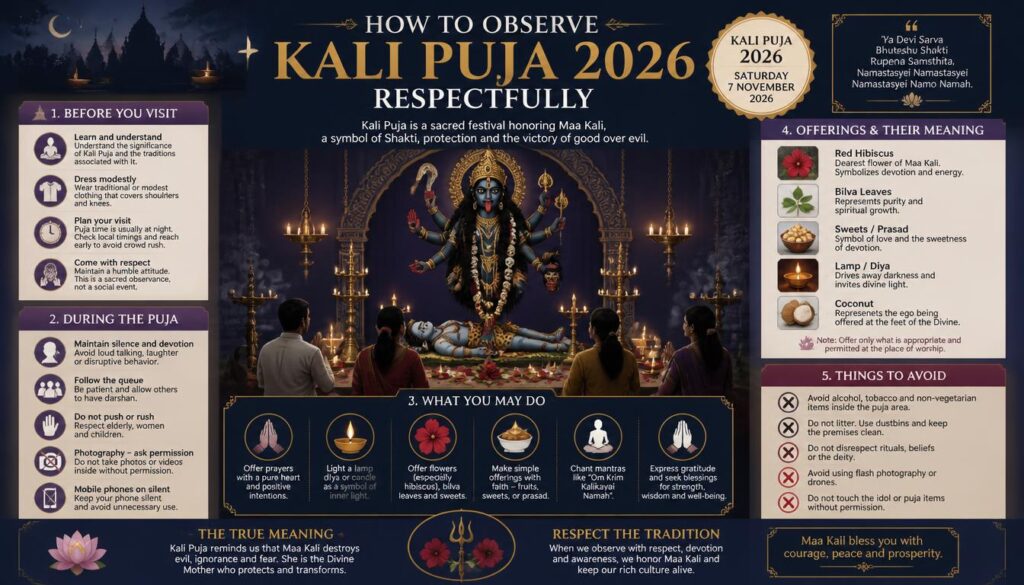
If you are celebrating Kali Puja 2026 at home, simplicity is perfectly meaningful. Clean the worship area, place a respectful image of Kali, light a lamp, offer flowers or fruit and spend some quiet time in prayer.
If you plan to follow a detailed Kali Puja Vidhi, use the traditions of your family, temple or trusted religious teacher rather than combining random instructions from different sources.
For a public celebration, visiting a local temple or community pandal can be a beautiful way to experience the festival. Be respectful of worshippers, temple rules, photography restrictions and local customs.
And if you are traveling to a major temple, check the temple’s own schedule because festival-day arrangements can be very different from ordinary days.
Kali Puja 2026 will be celebrated on Sunday, November 8, 2026, on the Kartik Amavasya night.
Kali Puja is commonly known as Shyama Puja and is also associated with names such as Mahanisha Puja in some traditions.
Yes. In 2026, Kali Puja and Diwali fall on November 8, although the religious focus differs between regions.
The principal worship is traditionally connected with Nishitha Kaal, the midnight period of Amavasya night. Exact timings vary by location.
West Bengal, especially Kolkata, is strongly associated with Kali Puja. The festival is also celebrated in Odisha, Assam, Bihar, Tripura and among Bengali communities elsewhere.
Red hibiscus, commonly called Jaba in Bengal, is one of the flowers traditionally associated with Kali worship.
Yes, many families observe a simple household form of Kali worship with an image or idol, flowers, lamps, offerings and prayer. More specialized tantric practices are a different matter and may require traditional guidance.
Kali Puja 2026 will arrive on a moonless Sunday night, but the darkness will not feel empty. Across Bengal and other regions, lamps will glow, pandals will fill with people, temples will echo with prayers,
and devotees will turn toward Goddess Kali with hopes that are sometimes very simple: courage to continue, protection for loved ones, peace in the heart and strength to face whatever comes next.
The festival’s deepest beauty may be found in that meeting of opposites. Kali is fierce, yet she is a mother. The night is dark, yet it is filled with lamps. Destruction is present, yet transformation is possible.
As November 8, 2026 approaches, the most meaningful way to celebrate may not be to make the biggest decoration or the loudest celebration.
It may simply be to pause before the image of Mahakali, offer a flower with sincerity, and remember that even the darkest chapter of life does not have to be the final one.