Physical Address
304 North Cardinal St.
Dorchester Center, MA 02124
Physical Address
304 North Cardinal St.
Dorchester Center, MA 02124

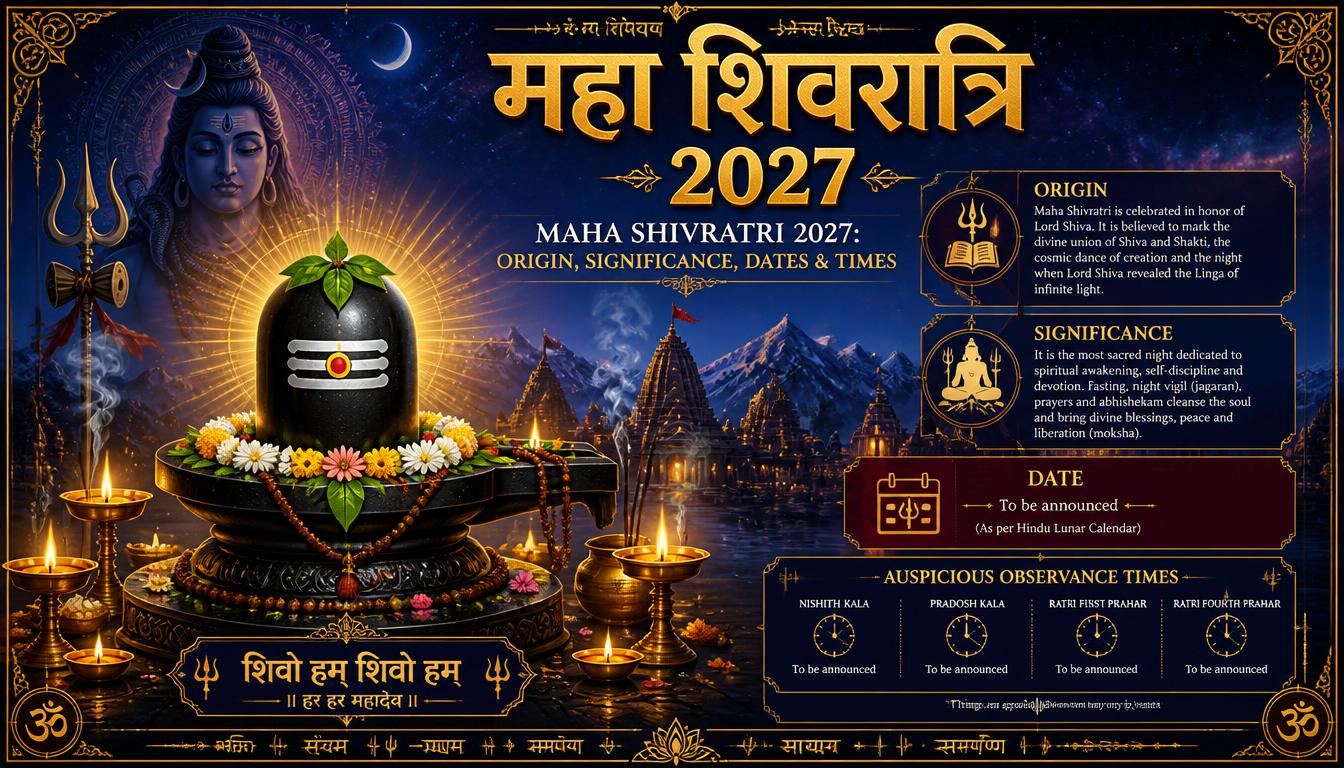
There are nights that pass quietly, and then there is Maha Shivratri, a night traditionally understood as a time when ordinary noise becomes a little less important and the mind is invited to turn inward. In 2027, devotees will observe this sacred Great Night of Lord Shiva on Saturday, 6 March 2027, with the most important night worship continuing into the early hours of 7 March.
For many devotees, Shivratri is not simply a festival marked on a calendar. It is a pause, a vigil, a fast, a prayer, and sometimes a very personal conversation with Lord Shiva that does not need many words. The darkness of the night is not treated as something frightening; instead, it becomes a setting for stillness, meditation, devotion, and awareness.
The festival is associated with Krishna Paksha Chaturdashi, the 14th lunar day of the dark fortnight. According to different Hindu calendar traditions, this Chaturdashi is described in relation to Magha or Phalguna, although the observance itself falls on the same day across these calendar conventions.
The Maha Shivratri 2027 date is Saturday, 6 March 2027. The important night worship, however, extends after midnight into 7 March 2027, which is why some timings associated with the festival show the following calendar date.
For New Delhi, the Chaturdashi Tithi begins at 12:03 PM on 6 March 2027 and ends at 1:46 PM on 7 March 2027. The Nishita Kaal Puja is given as approximately 12:07 AM to 12:57 AM on 7 March for New Delhi.
The exact Maha Shivratri date and time should always be checked according to the devotee’s location because sunrise, sunset, and local Panchang calculations affect the worship windows.
For example, the published timings for Amritsar give Nishita Kaal as 12:17 AM to 1:06 AM on 7 March, while New Delhi has a slightly earlier window. This little difference is normal in Panchang calculations and is one reason a single nationwide clock time should not be assumed.
The central lunar date is Krishna Paksha Chaturdashi, also called Chaturdashi Tithi. It represents the 14th lunar day during the dark fortnight of the Hindu lunar calendar.
The 2027 Chaturdashi Tithi begins on 6 March and ends on 7 March, meaning the sacred night naturally stretches across two civil dates. That’s why someone looking only at a normal calendar can get slightly confused about whether the important Puja happens on the 6th or 7th. The festival date is 6 March, while the midnight worship falls in the early hours of 7 March.
Among all the timings associated with Shivratri, Nishita Kaal holds special importance. It refers to the middle portion of the night and is traditionally considered an especially suitable period for Maha Shivratri Puja.
For New Delhi in 2027, Nishita Kaal Puja is approximately 12:07 AM to 12:57 AM on 7 March.
The night can also be divided into four Prahar, allowing devotees to perform Shiva worship at different stages rather than treating the entire night as one single block.
For New Delhi, the four night periods are approximately:
Not everyone needs to remain awake for every Prahar. Devotional practice can be adapted according to health, age, family tradition, and personal circumstances. The purpose is devotion, not turning worship into an exhausting competition.
The Maha Shivratri origin is explained through several traditions rather than one universally accepted historical account. Hindu religious literature and Shaiva traditions preserve different stories that illuminate different aspects of Shiva’s nature.
One major tradition connects Shivratri with the manifestation of Shiva as an infinite pillar of light, or Jyotirlinga. In this story, Lord Brahma and Lord Vishnu encounter an immeasurable column of divine light and attempt to discover its beginning and end.
Brahma travels upward while Vishnu searches downward. Neither can find the limits of this mysterious manifestation. The story becomes more than a contest between two divine figures; it becomes a lesson about the limits of intellectual pride when confronted with the Supreme Reality.
The infinite light is identified with Shiva, suggesting that Shiva cannot be reduced to a finite form or a simple description. The Jyotirlinga therefore carries an important symbolic meaning: divine reality is presented as limitless, beginningless, and beyond ordinary measurement.
Another popular understanding associates Maha Shivratri with the divine union of Shiva and Goddess Parvati. In this tradition, the festival celebrates their sacred marriage and the meeting of Shiva and Shakti.
These stories aren’t necessarily competing explanations. Hindu traditions often allow several layers of meaning to live together, which is rather beautiful when you think about it.
The Maha Shivratri history is closely connected with the broader Shaiva religious tradition. Stories and teachings related to Shiva appear across texts including the Shiva Purana, Linga Purana, and Skanda Purana, while the Shaiva Agamas provide extensive traditions concerning Shiva worship, temple practices, rituals, and spiritual disciplines.
The Vidyeshvara Samhita, associated with the Shiva Purana tradition, is particularly relevant to Shaiva discussions concerning Shiva’s supremacy and the significance of the Linga.
These scriptures should not be approached like a modern newspaper describing one historical event on one particular night. They operate through mythology, symbolism, theology, ritual instruction, and spiritual philosophy. Their stories often carry meaning at several levels at once.
For a devotee, the pillar of light can represent divine infinity. For a spiritual practitioner, it can become an image of consciousness without boundaries. For someone simply participating in a family Puja, it may remain a sacred story heard from grandparents. All three relationships with the tradition can exist together.
So, why is Mahashivratri celebrated with such devotion?
At its heart, the festival provides an opportunity for Shiva worship, fasting, prayer, night vigil, meditation, and spiritual reflection. Devotees turn their attention toward Lord Shiva and seek inner purification and divine grace.
The festival is often associated with the movement from activity toward stillness. The night becomes a symbolic space where the devotee attempts to quiet the Manas, or thinking mind, and observe what remains when constant mental movement slows down.
This is where the deeper spiritual significance of Shivratri begins to appear.
Shiva is frequently understood as consciousness, stillness, dissolution, and transformation. Destruction in this context does not simply mean physical destruction. It can represent the dissolution of ignorance, attachment, pride, and limiting patterns.
In that sense, Shivratri can become an invitation to ask a very old question: what needs to end inside me so something clearer can begin?
The Maha Shivratri significance extends far beyond temple rituals.
The dark fortnight naturally provides a powerful symbolic background. The moon is traditionally connected with the mind, while the decreasing lunar light can be understood symbolically as a movement away from mental distraction.
During Shivratri, devotees may practice meditation, Yoga, Japa, mantra chanting, fasting, silence, and other forms of Sadhana.
The purpose is not merely to stay awake until sunrise. The deeper idea is to remain inwardly awake.
This is where concepts such as witness consciousness, pure awareness, and spiritual realization become relevant. Instead of identifying completely with every thought, emotion, desire, or fear, the practitioner attempts to observe them.
The thinking mind says, “I am this thought.”
Meditation gently asks, “Who is aware of the thought?”
That shift, even when experienced only for a few moments, is part of what makes Shiva-centered spiritual practice meaningful for many people.
Maha Shivratri fasting is one of the best-known observances of the festival. Many devotees observe a day-long fast and break it the following day during the prescribed Paran Time.
Fasting can have a devotional, disciplinary, and contemplative purpose. By temporarily reducing ordinary food-related activity, devotees create more space for prayer and spiritual practice.
Traditional fasting practices vary considerably. Some people consume only water, while others take fruits, milk, nuts, or foods permitted by their family tradition.
People with medical conditions, those taking medication, pregnant people, children, older adults, or anyone for whom fasting may be unsafe should not treat religious fasting as a test of endurance. Devotion does not become more valuable because someone makes themselves unwell.
The spirit of Shivratri fasting is discipline and devotion, not unnecessary suffering.
The most recognizable Maha Shivratri rituals revolve around worship of Lord Shiva, especially the Shiva Linga.
Devotees may perform or participate in Shiva Abhishekam, offering substances such as water and milk according to their tradition. Bilva leaves, flowers, lamps, incense, and other offerings may also be used.
The simple repetition of Om Namah Shivaya is another central devotional practice associated with Shivratri. The mantra is short, but its repetition can create a surprisingly steady rhythm through a long night.
A typical observance may include:
Some devotees also participate in Yagna, Rudra Sadhana, or other forms of spiritual practice depending on their lineage and family tradition.
Abhishekam is among the most visually recognizable parts of Shiva worship.
Water or other traditional offerings are poured over the Shiva Linga while prayers and mantras are recited. The flowing water has a striking simplicity to it: it moves continuously, touches the sacred form, and disappears.
Symbolically, devotees may understand this act as an offering of the self, the mind, one’s actions, and one’s devotion.
The Linga itself is not simply treated as an ordinary statue. In Shaiva traditions, it can represent Shiva’s formless and transcendent reality as well as divine presence.
During Maha Shivratri Abhishekam, the ritual therefore becomes both an external act of worship and, for many practitioners, an internal reminder of surrender and purification.
The name Rudra is deeply connected with Shiva’s fierce and transformative dimensions. Rudra represents a force that can shake complacency and destroy what has become spiritually limiting.
Bhairav, or Kala Bhairava, is another important form associated with Shiva. Bhairav is often connected with time, protection, fierce awareness, and the destruction of fear and ignorance.
Within Tantric traditions, Shiva and Bhairav can be understood through more specialized forms of Sadhana, while the divine feminine is represented through Devi and traditions of Mahavidyas.
These practices can be highly specialized and lineage-dependent. A person should not assume that every advanced Tantra Sadhana, mantra, ritual, or Maha Rudra Sadhana is appropriate for casual experimentation. Traditional spiritual disciplines often have their own teachings, initiation systems, and guidance.
For most household devotees, simple Shiva worship, prayer, fasting, mantra, meditation, and temple observance are more than enough.
Shiva is often described as the destroyer in the familiar Hindu understanding of the Trimurti, but “destruction” can sound harsher than the underlying philosophy actually is.
Transformation requires endings.
A season ends. A habit ends. An identity changes. An old attachment loses its grip. Something that once seemed permanent quietly becomes yesterday.
This is why the dissolution of ego becomes an important spiritual theme around Shiva.
The ego here does not simply mean arrogance. It can refer to the narrow sense of “I” that constantly divides experience into what belongs to me and what does not.
Through meditation, Japa, devotion, and self-observation, a practitioner may try to loosen that identification and move toward pure awareness.
That is one reason Shiva’s imagery can feel simultaneously fierce and peaceful. Destruction and stillness are not necessarily opposites.
The famous story involving Lord Brahma and Lord Vishnu provides one of the most memorable mythological explanations of Shiva’s transcendence.
When the two deities encounter the infinite pillar of light, they attempt to discover its boundaries. Vishnu takes the form of a boar and travels downward, while Brahma travels upward.
Neither can truly measure the infinite manifestation.
The story emphasizes a profound point: the ultimate reality cannot be captured by ordinary measurement.
Brahma’s pride in claiming success becomes part of the story’s lesson about ego and truth. In some versions and interpretations, Shiva’s fierce aspect is associated with Kal Bhairav, including the story involving Brahma’s fifth head.
The imagery is intense, but its philosophical message is less about violence and more about the consequences of false pride and the confrontation between limited identity and limitless reality.
The night vigil is one of the defining practices of Shivratri.
Devotees may remain awake through one or more Prahar, singing devotional songs, chanting mantras, listening to religious stories, meditating, or performing Puja.
Staying awake has a practical effect too: it interrupts the normal rhythm of sleep and routine. Instead of letting the night disappear unconsciously, the devotee deliberately gives it to spiritual practice.
The symbolism becomes especially interesting here. A sleeping mind follows dreams without choosing them. A vigilant mind attempts to remain aware.
That is why spiritual awakening and night vigil naturally fit together in the Shivratri tradition.
Another important interpretation connects Shivratri with Shiva and Shakti.
Shiva is often associated with consciousness, stillness, and the unchanging principle, while Shakti represents dynamic energy and manifestation. Their relationship appears throughout Shaiva and Shakta traditions.
The story of Shiva’s marriage with Parvati therefore carries more than romantic meaning. It can symbolize the meeting of stillness and energy, consciousness and manifestation, transcendence and life.
This theme also appears in traditions surrounding Devi, Bhairavi, and the wider divine feminine.
Maha Shivratri can thus be understood not only as devotion to one deity in isolation but as participation in a larger Hindu vision of cosmic balance and divine reality.
There is no single way that every devotee must observe Maha Shivratri 2027.
A simple observance can begin with a morning bath and a personal Sankalp, followed by fasting according to one’s ability. During the day, devotees may read Shiva-related texts, visit a temple, chant mantras, or spend some time in quiet meditation.
As evening arrives, Shiva Puja can be performed at home or in a temple. Those following a traditional four-Prahar practice may continue worship throughout the night.
The most important thing is sincerity.
A small lamp lit with genuine devotion can be more meaningful to a person than an elaborate ritual performed only because everyone else is doing it. Spiritual practice is not supposed to become a social performance.
The fast is generally broken on the following day, during Paran Time, according to the relevant local Panchang.
For New Delhi, the published Shivratri Parana window on 7 March 2027 is approximately 6:40 AM to 1:46 PM.
Amritsar’s corresponding published window begins at approximately 6:51 AM and continues until 1:46 PM.
Because the correct time depends on location and traditional calculation, devotees should check a reliable local Panchang rather than copying a time from another city. A few minutes on a digital clock may look insignificant, but religious timings are calculated geographically.
Many festivals celebrate abundance, harvest, family, victory, or divine stories. Maha Shivratri has a noticeably inward character.
There is less emphasis on outward celebration and more emphasis on the night, silence, fasting, prayer, worship, and awareness.
The festival asks devotees to sit with darkness rather than immediately trying to remove it.
That makes Shivratri especially meaningful for people who understand spirituality as an inward journey. The central experience is not simply seeing something spectacular outside oneself. It is attempting to become quiet enough to notice what is happening within.
For someone observing the festival at home, the practice can remain beautifully simple.
Sit comfortably in a clean and quiet place. Light a lamp if that is part of your tradition. Place an image or Shiva Linga before you and take a few moments to settle the breath.
Then repeat Om Namah Shivaya slowly.
Do not force the mind to become completely empty. Minds are noisy creatures, frankly. Let thoughts arrive and leave without chasing every one of them.
After some time, sit quietly.
This small period of witness consciousness can become the most meaningful part of the night. The ritual outside creates a doorway; the stillness inside is where many practitioners feel the deeper purpose begins.
Ambubachi Mela 2026 will be observed at Kamakhya Temple in Guwahati, Assam, with the main rituals taking place during the annual Ambubachi period.
Ambubachi 2026 is celebrated in June at the Kamakhya Temple, marking the annual festival associated with Goddess Kamakhya and the fertility of Mother Earth.
The Ambubachi Mela 2026 will take place in June 2026 at the Kamakhya Temple in Guwahati, Assam, attracting devotees from across India.
The 2026 Ambubachi observance follows the traditional Hindu calendar and includes temple closure, spiritual rituals, and the reopening of the Kamakhya Temple.
Ambubachi timings in 2026 include the beginning and ending of the festival period, along with important temple rituals and darshan timings.
Read Articul: https://templetimingsdaily.com/ambubachi-mela-2026/
The story of Maha Shivratri 2027 reaches across mythology, ritual, philosophy, and personal devotion.
Its origin is remembered through sacred stories of Shiva’s infinite manifestation, his union with Shakti, and other traditional accounts. Its significance is expressed through fasting, worship, meditation, night vigil, mantra, and the contemplation of consciousness.
The date is 6 March 2027, while the most important midnight worship takes place in the early hours of 7 March, with exact Nishita Kaal, Prahar, and Paran timings changing according to location.
Whether someone spends the night inside a crowded temple, beside a small home shrine, quietly repeating a mantra, or simply learning about Shiva for the first time, the central invitation remains remarkably simple.
Become a little quieter.
Look beyond the restless surface of the mind.
Let something unnecessary fall away.
And perhaps, in that unusual stillness of the Great Night of Lord Shiva, discover that spiritual transformation does not always arrive like thunder. Sometimes it comes softly, almost invisibly, like a small flame continuing to burn while the whole world sleeps.
May Maha Shivratri 2027 bring devotion to the heart, clarity to the mind, strength during difficult moments, and the grace of Lord Shiva to every sincere seeker.