Physical Address
304 North Cardinal St.
Dorchester Center, MA 02124
Physical Address
304 North Cardinal St.
Dorchester Center, MA 02124

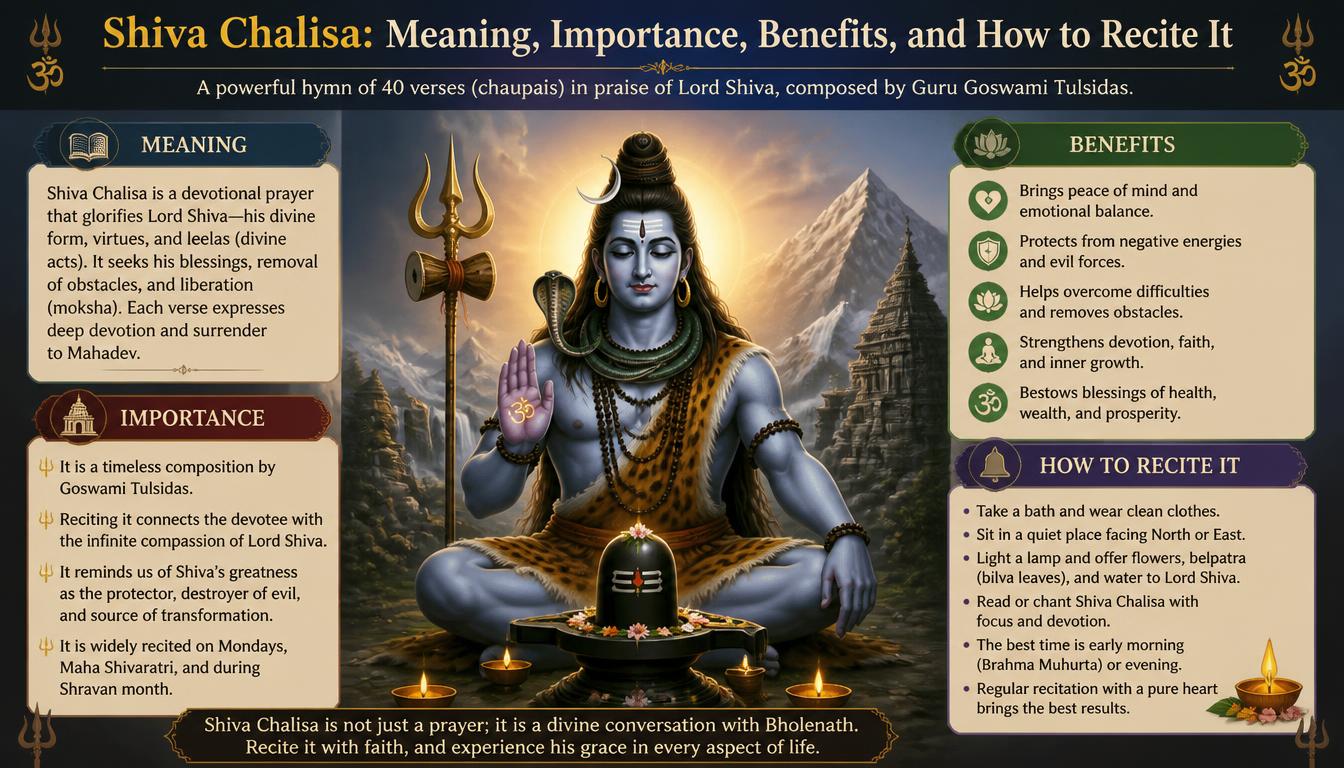
There are prayers that feel like formal words, and then there are prayers that become part of a person’s ordinary life. Shiva Chalisa belongs to that second kind for many devotees. It can be read quietly in the morning, during a Monday puja, in the peaceful hours of the evening, or whenever the heart feels a little too crowded with worries.
The hymn is dedicated to Lord Shiva, also remembered as Mahadev, Shankar, Shambhu, Neelkanth, and Girijapati. Its forty chaupais praise Shiva’s appearance, compassion, strength, divine acts, and relationship with devotees. The word “Chalisa” itself refers to the forty-verse body of the hymn.
What makes the prayer interesting is that it doesn’t present Shiva in only one mood. He appears as the powerful deity carrying the Trishul, the ascetic associated with sacred ash and the Ganga, and the compassionate Lord who responds when devotees call upon him. That mixture of strength and simplicity is one reason the prayer remains meaningful to many people.
Shiva Chalisa is a Hindi devotional hymn praising Lord Shiva. Traditional editions generally present an opening doha, followed by forty chaupais, and a concluding doha. The composition is traditionally attributed to Ayodhyadas, whose name appears within the text, although detailed historical information about the poet and the exact date of composition is not firmly established.
The language is devotional Hindi with Awadhi-influenced wording, which gives the verses a flowing, memorable sound. You don’t need to be a scholar of religious literature to approach it; its basic purpose is prayer, remembrance, and praise.
The opening invokes Ganesha, the son of Girija (Parvati), before the hymn turns its attention toward Shiva. This opening is not just a decorative beginning. It places the prayer inside a familiar devotional tradition where an auspicious invocation comes before the main worship.
For someone searching for Shiva Chalisa lyrics, Shiv Chalisa full text, or Shiva Chalisa in Hindi, understanding this structure makes the prayer easier to follow rather than treating it as simply a collection of verses.
The traditional Shiva Chalisa lyrics contain forty chaupais surrounded by dohas. The exact presentation can vary slightly between printed and online editions, particularly in transliteration and punctuation, so readers may notice small wording differences.
The opening doha begins by invoking Ganesha and asking for fearlessness and divine blessing. After that, the verses begin describing Shiva’s extraordinary form.
The hymn mentions the crescent moon, Ganga, serpents, sacred ash, tiger skin, the Trishul, Nandi, Ganesha, Kartikeya, and Parvati. These aren’t random decorations. They are familiar elements of Shiva’s iconography, and together they create a vivid picture of Mahadev.
The later verses move from appearance toward stories connected with Shiva’s divine power. Episodes involving Tarakasura, Jalandhar, Tripurasura, Neelkanth, and other figures appear within the traditional narrative of the hymn.
So, if you are reading the complete Shiva Chalisa, you’re not only praising a deity. You’re also moving through a compact devotional retelling of several well-known Shiva traditions.
The Shiva Chalisa meaning becomes clearer when the verses are viewed as a whole rather than translated word by word.
At the beginning, Shiva is praised as Girijapati, the compassionate Lord of Parvati. The prayer then describes his unusual appearance: the moon rests on his forehead, Ganga flows from his matted hair, serpents are associated with his ornaments, and sacred ash covers his body.
To a first-time reader, these images can seem strange. Yet Shiva’s iconography often brings together things that ordinary social life keeps apart: beauty and fear, destruction and creation, solitude and family life. The Chalisa keeps returning to that unusual character of Mahadev.
The hymn also remembers Shiva as a protector. Whenever divine beings face difficulty, they turn toward him for help. Stories of battles with powerful demons show another side of the deity: the force that confronts disorder when compassion alone cannot resolve it.
There is also a deeply personal element. The prayer eventually turns toward the devotee’s own difficulties, asking Shiva for protection, grace, and relief. In that moment, the ancient stories become surprisingly close to everyday life.
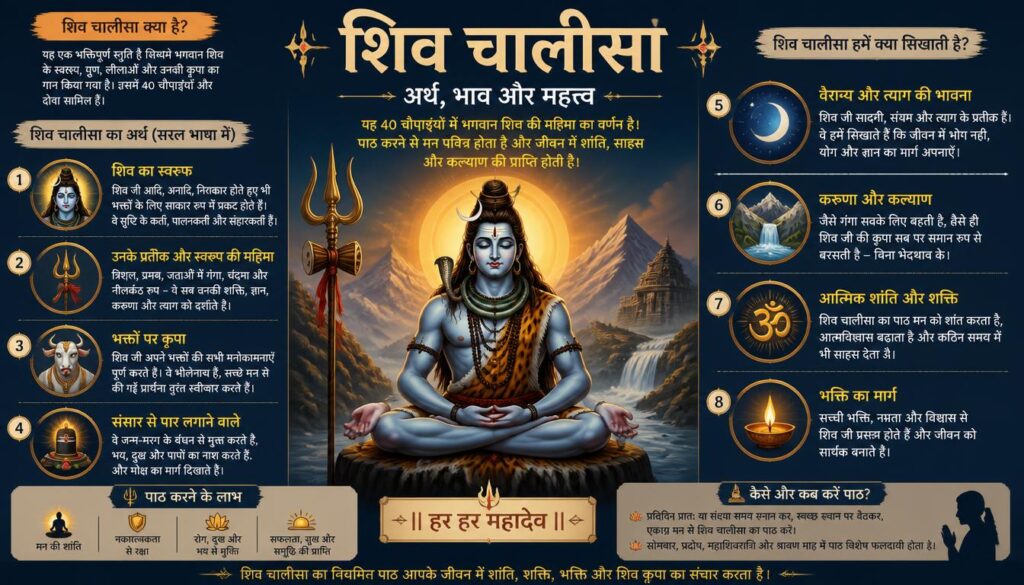
In simple language, the central message can be understood as an expression of devotion: remember Shiva, recognize his greatness, surrender fear, and seek his grace.
The hymn doesn’t ask the reader to admire only Shiva’s power. It repeatedly presents him as compassionate toward devotees and as someone who responds to sincere prayer.
This is important because Shiva Chalisa meaning in Hindi or English isn’t only about dictionary definitions. Religious poetry often carries layers of symbolism, and one image may communicate more than one idea.
For example, Neelkanth, the blue-throated form of Shiva, recalls the traditional story in which Shiva consumes the poison produced during the churning of the cosmic ocean. The image is commonly understood within devotional traditions as one of Shiva’s acts of protection.
The Ganga in Shiva’s hair, meanwhile, connects the deity with the sacred river and with the familiar mythology surrounding her descent to Earth. The Trishul represents Shiva’s distinctive divine weapon, while Nandi reflects his close association with the sacred bull.
One of the most memorable qualities of the hymn is the way it builds a picture of Lord Shiva through individual details.
His forehead carries the crescent moon. Ganga flows from his hair. A serpent appears around him. Sacred ash covers his body. He carries the Trishul, and his family is present around him.
These images create a Shiva who is simultaneously majestic and unconventional.
He is not portrayed like an ordinary royal figure wearing ordinary ornaments. Instead, the tiger skin, serpents, ash, matted hair, moon, and Ganga create the distinctive image devotees immediately associate with Mahadev.
That contrast is part of what makes the Shiv Chalisa memorable. A line about a divine ornament can sit close to a line about an intense battle, and then the hymn can suddenly return to compassion. It moves like a devotional story rather than a dry list of attributes.
People often search for Shiva Chalisa benefits, especially when they are beginning a regular devotional practice.
Traditionally, devotees recite the hymn seeking Lord Shiva’s blessings, peace of mind, courage, protection, spiritual progress, and relief during difficult periods. Different devotional traditions describe these benefits in different ways, so they are best understood as matters of faith and spiritual practice rather than guaranteed worldly results.
One practical benefit is that regular recitation can create a quiet moment in the day. Sitting down, slowing the breath, and focusing on familiar verses can give the mind a break from its constant jumping around.
For some devotees, the practice is connected with positive energy and inner peace. For others, it is simply a way of remembering Shiva every day. Both approaches can exist comfortably within personal devotion.
The important thing is not to turn prayer into a mechanical transaction. Reading a hymn doesn’t need to feel like completing a task on a checklist. Sometimes one sincere recitation means more personally than many hurried repetitions.
There is no single universally required time that every devotee must follow. Traditional practice commonly associates Shiva Chalisa chanting with Monday, Pradosh, Maha Shivaratri, and the month of Shravan/Sawan.
Many people prefer the morning because the house is quieter and the mind hasn’t yet become tangled in the day’s work. Others recite it in the evening after completing their responsibilities.
If Monday is meaningful to you, you can make Shiva Chalisa Monday recitation part of your weekly routine.
A simple routine might be:
There is something nice about keeping the routine simple. You don’t need an elaborate setup every single time.
If you are new to Shiva Chalisa chanting, begin with one complete recitation.
Don’t worry if the pronunciation isn’t perfect on the first day. Read slowly, listen to a reliable recording if necessary, and gradually become familiar with the rhythm.
You can use Shiva Chalisa audio to learn pronunciation and rhythm, especially if you have grown up hearing the prayer but never learned to read it yourself.
Some devotees also follow a specific number of repetitions, such as 11 or 108, as part of personal devotional practices. Such counts belong to particular traditions and personal observances; there is no need for a beginner to assume that a higher number automatically makes prayer more meaningful.
The quality of attention matters too. Eleven hurried readings may leave the mind nowhere near the prayer, while one careful recitation can become a peaceful pause in the day.
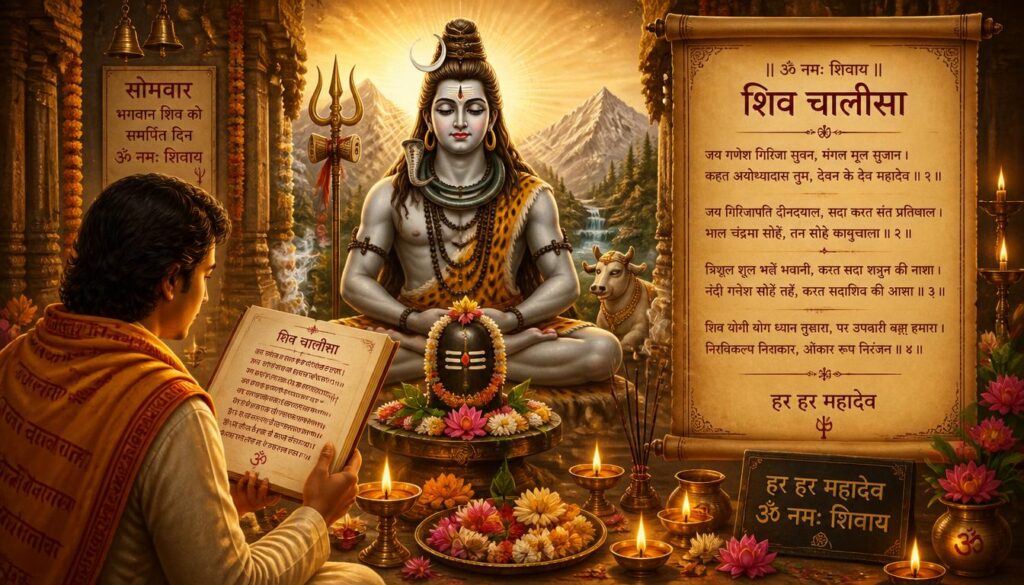
Monday, traditionally called Somvar, has a special association with Shiva worship in many Hindu traditions. Devotees may visit a Shiva temple, offer prayers, observe a fast according to their tradition, or recite Shiva-related hymns.
Reading the Shiva Chalisa on Monday can therefore become part of a weekly devotional rhythm.
Some families have their own little routines. One person may prepare the puja space while another reads the Chalisa. Children might sit nearby, half-listening and half-watching, until eventually they know the familiar opening by heart.
That is how devotional traditions often survive—not only through books, but through repetition inside ordinary homes.
The month of Shravan, also called Sawan in many parts of North India, is strongly associated with Shiva worship. Devotees may increase their prayers and temple visits during this period.
Maha Shivaratri is another major occasion when Shiva devotion becomes especially prominent. People may observe fasting, night-long worship, meditation, temple rituals, and devotional singing according to their traditions.
Reciting the Shiv Chalisa during these occasions can provide a familiar devotional focus. The forty verses offer something manageable enough to repeat while still carrying stories and imagery connected with Shiva.
The atmosphere can be very different from an ordinary weekday morning. Bells, lamps, flowers, incense, and the sound of many voices can turn a simple prayer into a shared experience.
The hymn becomes much richer when its mythological references are understood.
One important episode concerns Neelkanth. In Hindu mythology, during the churning of the cosmic ocean, a dangerous poison emerges. Shiva takes the poison to protect creation, and his throat becomes blue, giving rise to the name Neelkanth. The episode is remembered as an expression of Shiva’s protective power.
The Chalisa also refers to conflicts involving Tarakasura, Jalandhar, and Tripurasura. These stories place Shiva within a wider mythological world where divine beings face powerful forces and seek his help.
Another striking theme involves Rama’s devotion to Shiva and the offering of lotus flowers. The reference connects different strands of Hindu devotional tradition rather neatly inside a few verses.
Knowing these stories changes the experience of reading the hymn. Suddenly, a name that seemed unfamiliar becomes a small doorway into a much larger story.
Many readers search for Shiva Chalisa PDF, Shiva Chalisa audio, or versions in different languages because they want to keep the prayer accessible during daily worship.
A PDF can be useful for regular reading, while an audio version can help with pronunciation and rhythm. Readers who are more comfortable with English can also look for Shiva Chalisa in English or a transliteration alongside the original Hindi.
Similarly, people may search for Shiva Chalisa Telugu, Hindi, or Roman-script versions depending on their language background.
When using an online version, it is sensible to compare the text with a reputable devotional publication or established source because minor spelling and wording differences can appear between editions.
For devotional material, understanding what you are reading is valuable. Don’t pick a random copy merely because it appears first in search results.
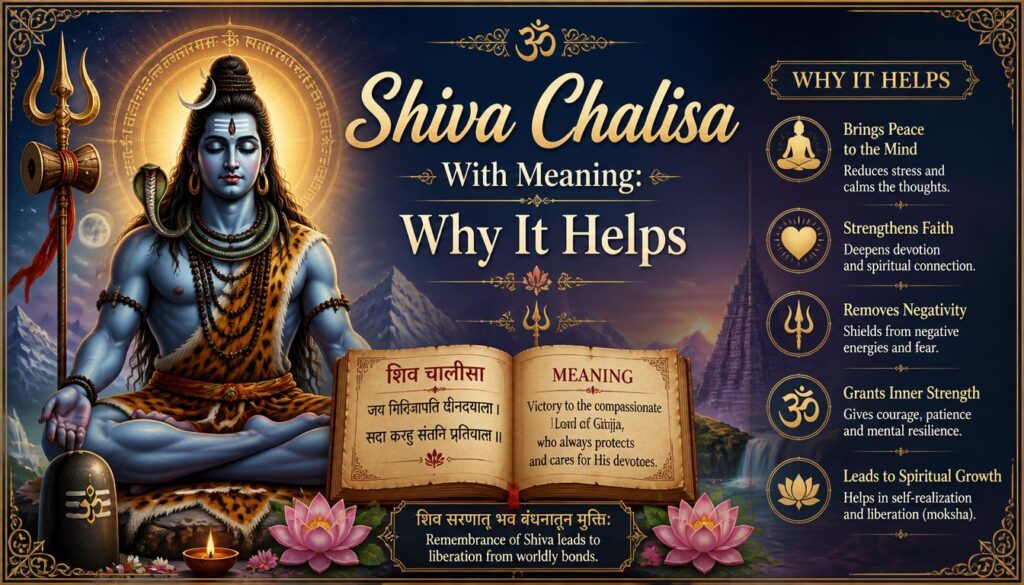
Reading Shiva Chalisa with meaning can make the prayer more personal.
Suppose you encounter a line mentioning the crescent moon or Ganga. Without context, it is simply a beautiful image. Once you know what those symbols represent in Shiva tradition, the same line has another layer.
The same applies to names such as Girijapati, Neelkanth, Tripurari, and Shambhu. These names aren’t just alternate spellings for Shiva; they highlight different aspects of how devotees remember him.
That is why a good Shiva Chalisa meaning in English or Hindi should explain the ideas naturally instead of replacing every word with a stiff dictionary translation.
A prayer is meant to be felt as well as understood.
The Shiva Chalisa author is traditionally identified as Ayodhyadas. His name appears in the opening portion of the traditional text, and devotional sources commonly attribute the composition to him.
However, historical details about Ayodhyadas are limited, and modern sources do not all agree on precise biographical information or dating. Some online sources give a specific historical date, while others treat the date as uncertain. It is therefore better to describe the authorship as traditional attribution rather than present every historical detail as proven fact.
This distinction is small but important. Devotional tradition and modern historical documentation are not always the same thing.
The beauty of a daily Shiva Chalisa prayer is that it doesn’t have to remain inside a temple.
A person can read it after waking up, before beginning work, during a quiet evening, or as part of a family puja. Someone might read it with a printed book, another person from a phone, and someone else from memory.
The circumstances change, but the basic act remains similar: pause, remember Shiva, and recite.
For many people, that pause itself has value. Life can become noisy very quickly, and a familiar prayer gives the mind somewhere steady to return.
Read more:

If you’re starting a regular practice, don’t make it unnecessarily complicated.
Choose a time you can realistically maintain. Keep your Shiva Chalisa PDF or prayer book in an easy-to-reach place. If pronunciation is difficult, use Shiva Chalisa audio for practice.
You can also learn a few verses at a time instead of trying to memorize everything immediately.
Most importantly, learn the meaning behind the images. Understanding why Shiva is called Neelkanth, why Ganga is associated with his hair, or why Nandi is beside him makes the recitation feel less like reading unfamiliar words.
And if one day you are tired and your recitation is shorter or quieter than usual, don’t turn devotion into another source of pressure. A spiritual routine should create space, not anxiety.
Shiva Chalisa is a forty-verse devotional hymn dedicated to Lord Shiva. Traditional versions contain an opening doha, forty chaupais, and a concluding doha.
The hymn is traditionally attributed to Ayodhyadas, whose name appears within the text. Precise historical information about the poet is limited, so the attribution is best described as traditional.
The central body traditionally contains forty chaupais, which is why it is called a Chalisa, from the Hindi term associated with forty. The hymn is also framed by dohas.
Many devotees recite it on Monday, during Shravan/Sawan, on Pradosh, or during Maha Shivaratri. Others include it in their daily prayer routine.
Yes, daily recitation can be part of a personal devotional routine. The important thing is to approach the prayer sincerely rather than worrying excessively about a particular number of repetitions.
Devotional traditions associate its recitation with peace, courage, spiritual progress, divine grace, and relief from difficulties. These are religious and spiritual beliefs, not guaranteed material outcomes.
Absolutely. Beginners can start by reading one complete recitation slowly and learning the pronunciation over time. A transliteration or audio recording can make the first few attempts much easier.
Yes. English translations and Roman-script transliterations are widely available, although wording can vary between editions. For devotional study, keeping the original Hindi alongside the translation can help preserve the rhythm and meaning.
The lasting appeal of Shiva Chalisa is not simply that it contains forty verses. Its strength comes from the world it creates in those verses—a world of Mahadev, Parvati, Ganga, Nandi, Ganesha, Kartikeya, the Trishul, the crescent moon, ancient stories, human worries, and the hope for divine grace.
For one person, the prayer may be a Monday tradition. For another, it may be something heard from a grandparent years ago and suddenly remembered again. Someone else may discover it through an online Shiva Chalisa audio recording and slowly make it part of everyday life.
There is no need to rush through it.
Read the Shiva Chalisa lyrics, learn the Shiva Chalisa meaning, understand the stories behind its names and symbols, and let the recitation become familiar in its own time. Sometimes devotion grows quietly, almost unnoticed, until a prayer that once looked like a page of words starts feeling like an old friend.
And perhaps that is the gentlest beauty of remembering Lord Shiva—the prayer ends, the room becomes quiet again, and yet something inside you feels a little more settled.