Physical Address
304 North Cardinal St.
Dorchester Center, MA 02124
Physical Address
304 North Cardinal St.
Dorchester Center, MA 02124

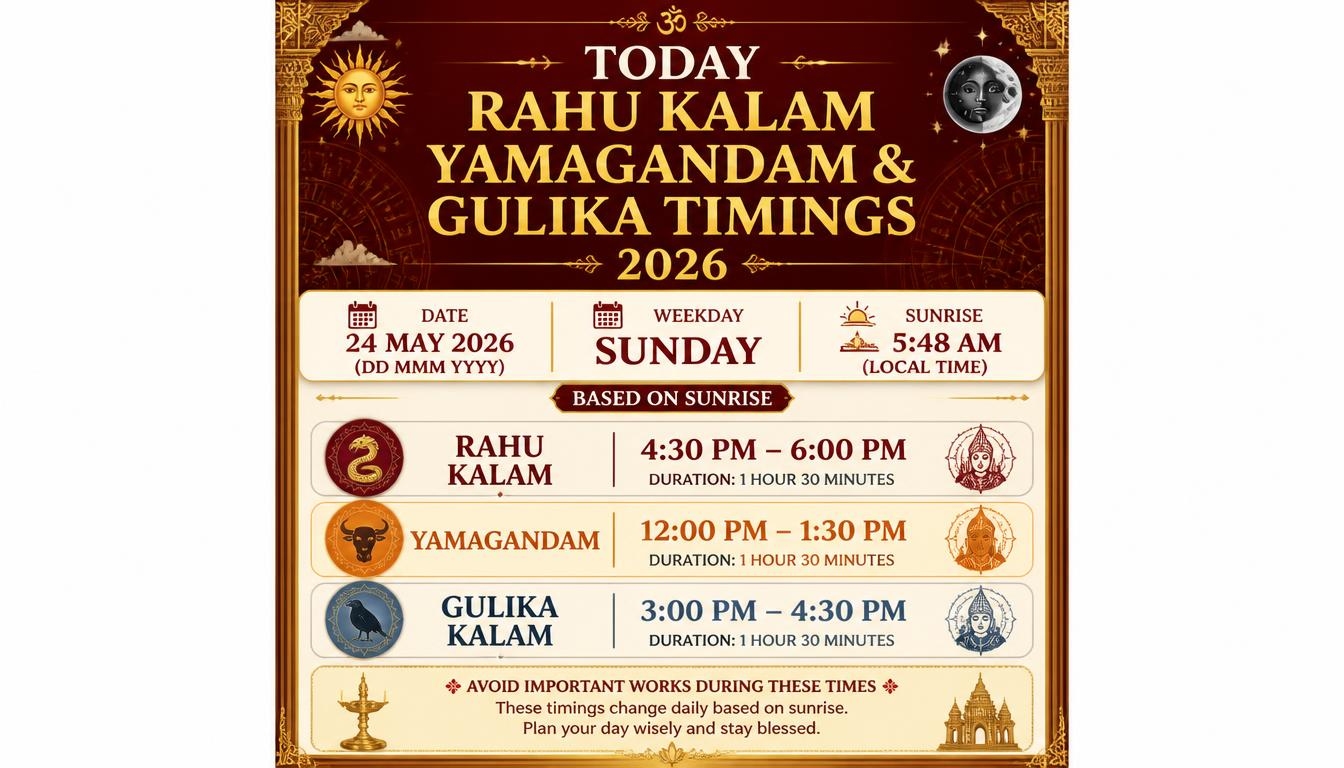
Some days begin with an alarm clock. Others begin with a glance at the Panchangam, a quiet prayer, and that familiar question: “What is the Rahu Kalam Today?” For many Hindu families, especially across South India, checking the day’s traditional time periods is simply part of planning things with a little more care.
Rahu Kalam, Yamagandam, and Gulika Kalam are recurring periods calculated from the daytime between local sunrise and sunset. They aren’t random fixed hours stamped permanently onto every calendar. Their actual clock times can move a bit depending on your city, date, sunrise, and season, which is an important detail people sometimes miss.
This guide explains Today Rahu Kalam, Yamagandam & Gulika Timings 2026, how these periods are calculated, the traditional Sunday-to-Saturday schedule, and why your local Panchangam timings may differ from a generic online table.
If you’re checking the clock before beginning something important, here’s the part worth remembering: use the weekly table as a quick reference, but use your location’s sunrise-based Panchang for exact daily timing.
For a quick reference, traditional weekday timings are often shown using an assumed sunrise of approximately 6:00 AM and sunset of approximately 6:00 PM. Under that 12-hour-day assumption, daylight is divided into eight equal portions of 90 minutes each.
| Day | Rahu Kalam | Yamagandam | Gulika Kalam |
|---|---|---|---|
| Sunday | 4:30 PM – 6:00 PM | 12:00 PM – 1:30 PM | 3:00 PM – 4:30 PM |
| Monday | 7:30 AM – 9:00 AM | 10:30 AM – 12:00 PM | 1:30 PM – 3:00 PM |
| Tuesday | 3:00 PM – 4:30 PM | 9:00 AM – 10:30 AM | 12:00 PM – 1:30 PM |
| Wednesday | 12:00 PM – 1:30 PM | 7:30 AM – 9:00 AM | 10:30 AM – 12:00 PM |
| Thursday | 1:30 PM – 3:00 PM | 6:00 AM – 7:30 AM | 9:00 AM – 10:30 AM |
| Friday | 10:30 AM – 12:00 PM | 3:00 PM – 4:30 PM | 7:30 AM – 9:00 AM |
| Saturday | 9:00 AM – 10:30 AM | 1:30 PM – 3:00 PM | 6:00 AM – 7:30 AM |
These are convenient weekly Rahu Kalam timings, but they are reference values rather than universal minute-perfect timings. If your local sunrise time is 6:24 AM instead of 6:00 AM, for example, the calculated periods won’t exactly match this table.
That little difference matters more than it looks. A calendar saying 9:00 AM should not automatically overrule a properly calculated local Panchang showing a slightly shifted period.
Rahu Kalam, also written as Rahu Kala or Rahukalam, is a daily period associated with Rahu in traditional Hindu astrology. It occurs during daylight and its position changes according to the weekday.
Traditionally, this period is regarded as an inauspicious time for starting certain new or important activities. People may therefore check the Rahu Kalam time today before beginning a journey, ceremony, business venture, purchase, or another significant undertaking.
The important phrase here is “starting.” Traditional practice generally focuses on avoiding the commencement of an auspicious activity during Rahu Kalam rather than suggesting that ordinary life has to stop completely. You still eat lunch, answer calls, travel when necessary, and live your day, of course.
This distinction makes the custom much easier to understand.
Anyone searching what time is Rahu Kalam today needs two pieces of information: the weekday and the day’s sunrise and sunset at their location.
The weekday determines which eighth portion of daylight belongs to Rahu, while sunrise and sunset determine the actual clock boundaries.
For a standard 6:00 AM to 6:00 PM example:
This pattern repeats each week, but the precise clock time moves with daylight length. That’s why a search for today’s Rahu Kalam is best answered with a city-specific calculation instead of blindly copying a static chart.
The calculation sounds more mysterious than it actually is. Take the period between sunrise and sunset and divide it into eight equal portions.
Suppose sunrise occurs at 6:00 AM and sunset at 6:00 PM. The daytime lasts 12 hours, or 720 minutes.
Divide 720 minutes by eight and you get 90 minutes for each segment.
So the eight segments become:
Different weekday rules assign particular segments to Rahu Kalam, Yamagandam, and Gulika.
Now imagine sunrise is earlier and sunset is later. Each segment becomes longer than 90 minutes. During shorter days, each becomes shorter. Simple idea, but it explains why sunrise based timings are so important.
Yamagandam is another traditional daytime period considered unsuitable for beginning certain auspicious activities. You’ll often find Yamagandam timings today displayed beside Rahu Kalam in Hindu calendars and Panchang apps.
Like Rahu Kalam, it isn’t attached to one identical clock time every day. Its position depends on the weekday, while the exact beginning and ending depend upon local daylight.
Traditional daily Yamagandam timings using a 6:00 AM sunrise and 6:00 PM sunset are:
If you see slightly different Yamagandam timings elsewhere, it doesn’t necessarily mean one calendar is wrong. First check whether both calculations use the same location and sunrise.
Gulika, commonly called Gulika Kalam, may also appear as Guliga or Kuligai depending on regional language and tradition. This is another daily period calculated by dividing daylight into eight sections.
Its traditional interpretation isn’t always presented identically across communities. Some astrological traditions treat Gulika differently from Rahu Kalam and Yamagandam, so context matters here rather than forcing every period into exactly the same box.
The commonly listed weekly Gulika timings, under the 6:00 AM–6:00 PM assumption, are:
When searching for Gulika timings today, Guliga timings, or Kuligai timings, therefore, don’t be confused if different regional websites use different names. Often they’re referring to the same underlying daily period, though local interpretive customs can vary.
Rahu Kalam and Yamagandam are both traditionally consulted before commencing auspicious work, but they aren’t the same period.
Rahu Kalam is associated with Rahu, while Yamagandam has its own traditional astrological significance. Their weekday positions are different, which means their time windows don’t normally overlap.
Someone checking only Rahukalam timings may therefore miss Yamagandam. That’s why detailed Hindu astrology timings often show Rahu Kalam, Yamagandam, Gulika, and sometimes Durmuhurtam together.
Think of the Panchang as a map with several layers. One layer doesn’t tell the whole story.
If you’ve opened a detailed Hindu calendar, you’ve probably noticed Durmuhurtam sitting somewhere near these daily periods. It is another time interval traditionally considered unfavorable for starting auspicious activities.
However, Durmuhurtam timings are not simply interchangeable with Rahu Kalam. They follow their own calculations and should be checked separately in a reliable local Panchang.
This is also why a page containing daily inauspicious timings may have several entries for one date. They represent different traditional calculations rather than repeated names for one identical time.
Likewise, daily auspicious timings such as favorable Muhurta periods should be evaluated according to the specific event and tradition involved.
This is perhaps the most useful thing to understand about daily Rahu Kalam timings.
A generic chart usually assumes a neat 6:00 AM sunrise and 6:00 PM sunset because it makes the weekly pattern easy to remember. Real skies, inconveniently, don’t follow our tidy tables.
Sunrise changes with season and location.
The sunrise in Tirupati will not always be identical to sunrise in another Indian city. Likewise, the length of daylight changes during the year. Because these periods are fractions of daytime, the final clock values shift as well.
Therefore, when checking today Hindu calendar timings, choose your city or nearest location whenever possible.
For important religious ceremonies, families may also consult a knowledgeable priest or astrologer and use the appropriate local Panchang rather than depending on a generic internet table.
People who regularly check Rahu Kalam weekly table sometimes memorize the general pattern. It’s surprisingly handy when you don’t have a calendar sitting nearby.
Under the standard 6-to-6 reference day, Rahu Kalam Sunday comes late in the afternoon at 4:30 PM. Rahu Kalam Monday arrives early, around 7:30 AM.
Rahu Kalam Tuesday occurs around 3:00 PM, while Rahu Kalam Wednesday begins around noon.
Rahu Kalam Thursday starts around 1:30 PM. Rahu Kalam Friday appears around 10:30 AM, and Rahu Kalam Saturday begins around 9:00 AM.
Still, memorizing these values should never make us forget the sunrise rule. They’re a framework, not a location-aware daily calculation.
In traditional practice, many people avoid initiating auspicious or significant activities during Rahu Kalam. Weddings, important purchases, ceremonies, first-time journeys, and major business beginnings are examples where a suitable Muhurta may be preferred.
But religious practice varies widely among families, regions, and communities. Not everybody follows these periods in exactly the same way, and these astrological conventions shouldn’t be presented as scientific predictions of what will happen during a particular hour.
For devotees who observe them, their importance comes from religious and cultural tradition.
That balanced understanding keeps the information both useful and respectful.
People researching Rahu Ketu often encounter information about Rahu Ketu Pooja, especially in connection with temples such as Sri Kalahasti and Thirunageswaram.
A Rahu Ketu puja or practices associated with Kala Sarpa Dosha belong to a broader religious and astrological context. They shouldn’t automatically be assumed to follow the ordinary Rahu Kalam Pooja timing simply because the word “Rahu” appears in both.
Temple-specific rituals can have their own schedules.
If you’re traveling from Tirupati or Tirumala for a temple visit, check the temple’s current official schedule before making plans. Darshan, ticketing, Puja availability, and ritual timings can change independently of Rahu Kalam.
That’s one of those small planning details that can save a surprisingly big headache.
A daily Panchang often displays tithi, nakshatra, sunrise, sunset, Rahu Kalam, Yamagandam, Gulika and several other elements on the same page.
That can create the impression that all of them are calculated in exactly the same way. They aren’t.
The weekday placement of Rahu Kalam follows its recurring weekly pattern, while its exact clock boundaries depend on daytime duration. Tithi and nakshatra are separate calendrical and astronomical elements used in broader Panchang calculations.
For selecting a detailed Muhurta, practitioners may consider several Panchang factors together rather than deciding solely from Rahu Kalam Yamagandam timings.
For an accurate Rahu Kala time today, start by confirming your location, date, weekday, local sunrise, and sunset.
Then use a location-aware Hindu calendar or Panchang. Check whether it calculates periods from actual local sunrise rather than presenting only the generic 6:00 AM–6:00 PM table.
The same rule applies when searching Yamagandam today, Gulika Kalam today, or Durmuhurtam today.
Also pay attention to AM and PM. It sounds ridiculously obvious until somebody reads 4:30 PM as 4:30 AM while rushing out the door. Tiny details have a talent for becoming big ones.
No. Rahu Kalam occurs in a different daytime segment depending on the weekday. Its exact clock time also changes according to local sunrise and sunset.
The answer depends on your weekday, date, and location. Use the standard weekly schedule for reference, but check local sunrise and sunset for accurate Rahu Kalam timings today.
Yes. Traditional Rahukalam timings are based on dividing the period from sunrise to sunset into eight equal sections and assigning a weekday-specific section to Rahu.
Yamagandam today is a weekday-specific period traditionally considered unfavorable for beginning certain auspicious activities. Its exact clock time depends on local daylight.
Gulika Kalam today is another weekday-based period calculated from daylight. It is also called Guliga or Kuligai in some regional traditions.
No. The weekday pattern remains recurring, but exact 2026 clock times vary by date and location because sunrise and sunset change.
Use it as a quick reference only. For precise Panchangam timings, calculate using the local sunrise time and sunset for your city.
No. Rahu Kalam and Durmuhurtam are separate traditional time periods and follow different calculations.
Traditional observance mainly concerns beginning certain auspicious activities. Practices differ between families and communities, so ordinary daily activities aren’t universally treated the same way.
The commonly referenced daily Rahu Kalam discussed here is calculated from the daytime between sunrise and sunset.
Read Articul: https://templetimingsdaily.com/tirumala-darshan-crowd-status-today/
Yamagandam timings today vary by weekday and local sunrise. Check your location-specific Panchangam for the exact starting and ending time.
Yamagandam today is traditionally considered an inauspicious period for beginning important or auspicious activities. Its exact timing depends on the day and location.
Today Yamagandam timings are calculated using the time between local sunrise and sunset. Therefore, the timing may differ slightly from one city to another.
Today Rahu Kalam Yamagandam timings are separate daily periods used in Hindu astrology. Both vary according to the weekday and local sunrise and sunset.
Today Yamagandam time depends on your location, weekday, and sunrise time. A local Panchangam provides the most accurate daily timing.
Checking Today Rahu Kalam, Yamagandam & Gulika Timings 2026 becomes much simpler once you understand what’s behind the clock. The weekday provides the pattern, but your local sunrise and sunset turn that pattern into actual daily times.
The familiar weekly chart remains useful. Monday Rahu Kalam generally appears in the morning, Tuesday’s in the afternoon, Wednesday’s around midday, and so on. Yet those neat 90-minute blocks assume a 12-hour day, and nature rarely keeps exactly the same office hours throughout the year.
For precise Rahu Kalam timings today, Yamagandam timings today, Gulika timings, or Durmuhurtam timings, always consult a current, location-specific Panchangam. For temple rituals such as Rahu Ketu Pooja or matters related to Kala Sarpa Dosha Puja, check the relevant temple or trusted religious guidance separately.
Tradition becomes far more meaningful when we understand it instead of merely copying a table. Keep the weekly timings nearby, check the day’s sunrise when precision matters, and let your calendar become a quiet companion rather than another thing shouting from the screen.