Physical Address
304 North Cardinal St.
Dorchester Center, MA 02124
Physical Address
304 North Cardinal St.
Dorchester Center, MA 02124

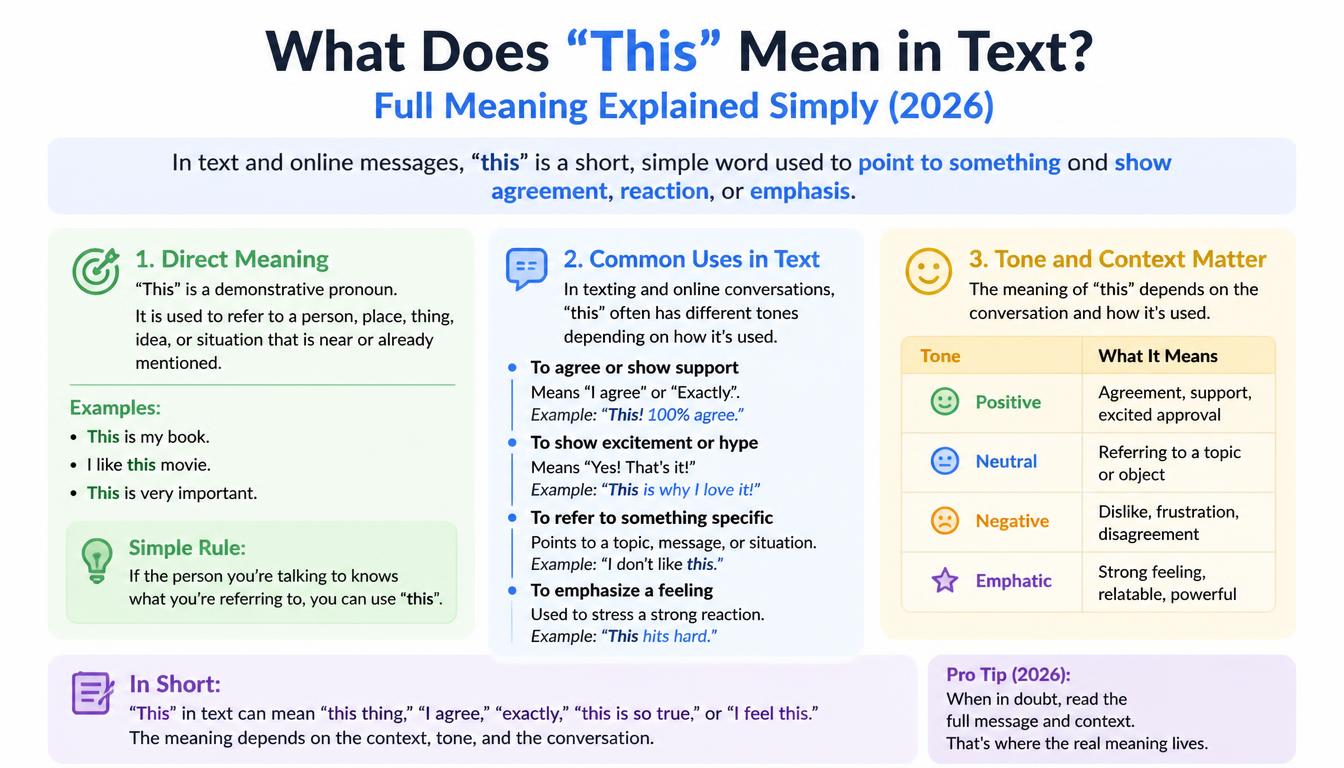
Have you ever received a message that simply says “This.” and wondered what the sender actually meant? You’re not alone.
Many people search for what does “this” mean in text because, although it’s a common English word, its meaning changes depending on the conversation, tone, and context. In today’s digital world, even a single word can express agreement, emotion, humor, or sarcasm.
Whether you’re chatting with friends, replying to comments on social media, or participating in a group conversation, understanding how “this” is used can help you interpret messages more accurately. This guide explains everything you need to know in simple language, with plenty of real-life examples.
In text messages, “this” usually means “I completely agree,” “I relate to this,” or “This is exactly what I wanted to say.” It is commonly used to show strong agreement or support for a statement that someone has just made.
For example:
Person A: “Getting enough sleep is more important than working all night.”
Person B: “This.”
In this conversation, Person B is saying, “I completely agree with what you just said.”
The meaning is simple, but the emotion behind it can be much stronger than replying with just “yes.”
Modern communication is fast. People often prefer short replies instead of typing long sentences.
Using “this” allows someone to:
Because texting values speed and simplicity, a single word often says enough.
At its heart, “this” is a demonstrative pronoun. In grammar, it points toward something nearby or something that has just been mentioned.
In digital communication, the same idea applies.
Instead of pointing to a physical object, “this” points to the previous message, photo, opinion, joke, or idea.
For example:
Message:
“Being kind costs nothing.”
Reply:
“This.”
The reply points directly back to the previous statement.
The most common use of “this” is expressing agreement.
Instead of saying:
People simply reply:
“This.”
Friend:
“Consistency beats motivation every single time.”
Reply:
“This.”
Meaning:
“I completely agree.”
Coworker:
“Planning ahead saves so much stress.”
Reply:
“This.”
Meaning:
“Exactly.”
Notice that “this” expresses stronger agreement than simply saying “yes.”

Sometimes people use “this” because they personally relate to what someone says.
For example:
“I’ve been trying my best, but lately I’ve just felt exhausted.”
Reply:
“This.”
The person replying isn’t only agreeing they’re also saying:
This creates emotional connection without writing a long explanation.
Another common meaning is emphasis.
Someone may write:
“Respect should always come before money.”
Then another person replies:
“This.”
The message means:
“This idea deserves attention.”
It adds weight to the original statement.
On social media platforms like X, Reddit, Facebook, Instagram, and TikTok, “this” is often used in comments.
Someone posts:
“People should normalize taking breaks instead of glorifying burnout.”
Comment:
“This.”
The commenter is publicly supporting the opinion.
Sometimes you’ll even see:
Each version adds stronger emphasis.
Group chats move quickly.
Instead of everyone repeating the same opinion, people often reply with “this.”
Example:
Friend:
“We should leave earlier tomorrow because traffic will be terrible.”
Replies:
“This.”
“Exactly.”
“Good idea.”
The word helps everyone express agreement without making the conversation repetitive.
Although both words show agreement, they aren’t identical.
| Reply | Meaning | Strength |
|---|---|---|
| Yes | Simple confirmation | Moderate |
| This | Strong agreement and support | Strong |
For example:
Question:
“Are you coming?”
Answer:
“Yes.”
This simply answers the question.
Now compare:
Statement:
“Family time matters more than expensive gifts.”
Reply:
“This.”
Here, the person is endorsing the entire opinion rather than answering a question.
One of the biggest mistakes people make is assuming “this” always means agreement.
Context matters.
The same word can express:
Always read the surrounding messages before deciding what the sender means.
“This” usually means:
“I agree.”
It often means:
“I understand exactly how you feel.”
It means:
“This argument is correct.”
It can mean:
“That joke was accurate.”
It often highlights an important point people should notice.
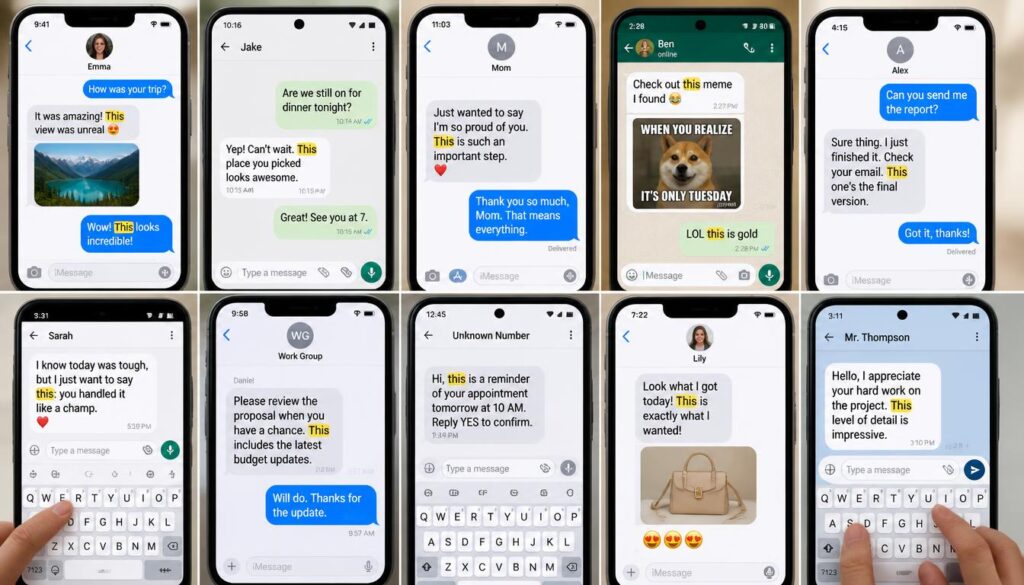
Here are some common examples.
Example 1
“I wish weekends were three days long.”
Reply:
“This.”
Meaning:
“I completely agree.”
Example 2
“Small daily improvements matter more than huge changes.”
Reply:
“This.”
Meaning:
“Exactly right.”
Example 3
“Taking care of your mental health isn’t selfish.”
Reply:
“This!”
Meaning:
“This deserves attention.”
Example 4
“Sometimes doing nothing is actually productive.”
Reply:
“THIS.”
Meaning:
“I strongly support this statement.”
There are several reasons why people choose this simple reply.
First, it’s incredibly short.
Second, it immediately communicates agreement.
Third, it keeps conversations moving.
Fourth, it feels more expressive than typing “yes.”
Finally, it’s become part of modern internet culture, where quick reactions are common.
Yes.
Although it’s usually positive, “this” can sound negative depending on the surrounding words.
Example:
“Oh great… this again.”
Now the speaker is expressing frustration.
Another example:
“So we’re doing this?”
This may suggest annoyance or disbelief rather than agreement.
Tone completely changes the interpretation.
Absolutely.
Sarcasm depends on context.
Imagine someone says:
“Well, deleting the entire project was definitely a smart idea.”
Reply:
“This.”
Here, the person clearly doesn’t mean genuine agreement.
Instead, they’re being sarcastic.
Because text messages don’t include facial expressions or voice tone, sarcasm can sometimes be misunderstood.
Not exactly. “This” is not slang by itself, because it’s a standard English demonstrative pronoun. However, using “This.” as a complete reply is an example of modern internet language and informal digital communication.
In everyday texting, people often use single-word responses because they’re quick and easy to understand. So while the word isn’t slang, its standalone use has become a common part of online culture.
You’ll frequently see it in:
From a linguistic perspective, “this” is a demonstrative pronoun and a deictic word.
A deictic word points to something whose meaning depends on context. In everyday speech, “this” often refers to something nearby.
For example:
In digital communication, however, “this” usually points to the previous message, comment, image, or idea rather than a physical object.
Deixis refers to words whose meaning changes depending on the situation.
Examples include:
When someone replies with “This.”, they’re pointing back to the message that came immediately before it. That’s why context determines the meaning of “this.”
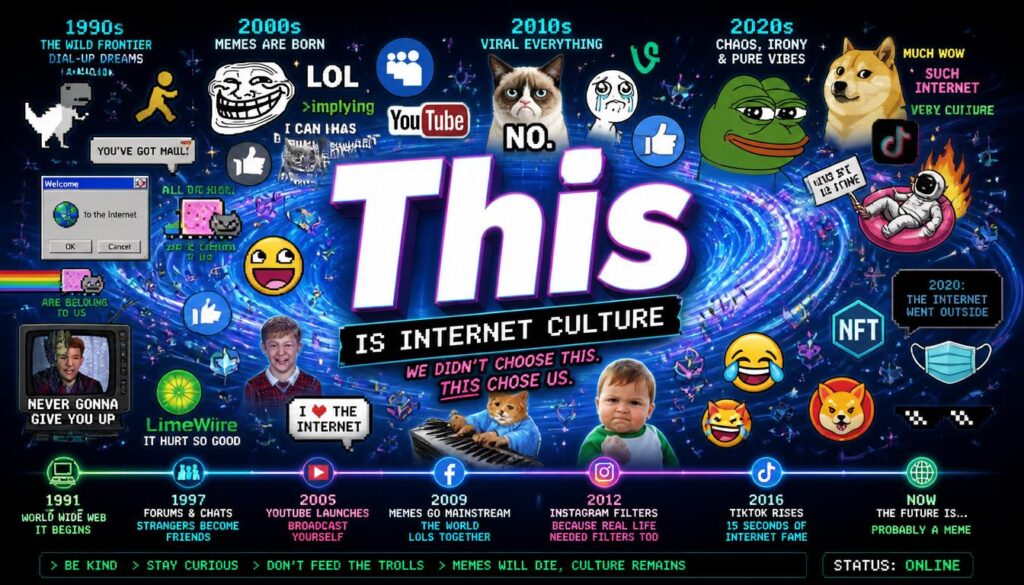
The standalone reply “This.” became popular through online forums and social media communities.
Instead of writing:
Users simply replied:
This.
Over time, the response spread across different platforms because it was:
Today, millions of people use it every day in online conversations.
Although the core meaning stays similar, the way people use “this” varies slightly across platforms.
| Platform | Common Meaning |
|---|---|
| Agreement with a friend’s message | |
| Supporting a comment or caption | |
| Public agreement with a post | |
| Endorsing another user’s opinion | |
| X (Twitter) | Highlighting a statement worth sharing |
| Discord | Quick reaction during conversations |
| Slack | Agreeing with a teammate’s suggestion |
| Microsoft Teams | Supporting an idea in workplace discussions |
Regardless of the platform, “this” expresses agreement, support, or emphasis most of the time.
Several short replies have similar meanings, but they aren’t exactly the same.
Exactly confirms that a statement is completely accurate.
This points directly to the statement and endorses it.
Facts is modern internet slang used to say a statement is true.
This feels slightly more neutral and works in more situations.
Same means:
“I’ve had the same experience.”
This often means:
“I agree with what you just said.”
The two overlap sometimes, but they’re not identical.
Although it’s common in casual conversations, there are situations where using “This.” alone isn’t the best choice.
Avoid it when:
Instead, write complete responses such as:
Clear communication is usually better in formal settings.
If someone replies with “This.”, they’re usually agreeing with you.
You can simply continue the conversation.
Possible responses include:
In many cases, no response is required, because “This.” already signals agreement.
People sometimes misinterpret the reply because it’s so short.
Here are a few myths.
Myth 1: It always means “yes.”
Reality: It usually expresses stronger agreement than “yes.”
Myth 2: It’s rude.
Reality: On its own, it’s neutral. The surrounding conversation determines whether it sounds polite or impolite.
Myth 3: It’s slang.
Reality: The word itself isn’t slang. Only its standalone use is considered informal internet language.
Myth 4: It always has one meaning.
Reality: Context, tone, and timing all influence its meaning.
Digital communication has changed the way people express agreement.
Instead of repeating an entire sentence, users often choose the shortest possible response that still conveys emotion.
Psychologically, replying with “This.” helps people:
This is one reason why social media comments often contain short replies instead of lengthy explanations.
Language constantly evolves as technology changes the way people communicate.
The standalone use of “This.” is a great example of how a traditional English word has taken on a new role in digital conversations. Rather than simply identifying an object, it now acts as a quick signal of agreement, emotional alignment, and support.
This shift reflects a broader trend in online communication: people value messages that are both concise and meaningful.
Here are the most important points to remember:
Now you know exactly what “this” means in text and why it’s become one of the most common one-word replies online. Most of the time, “This.” expresses strong agreement, support, or emotional connection with something that has just been said. It’s a simple yet powerful way to acknowledge an idea without repeating it.
As digital communication continues to evolve, short responses like “This.” have become a natural part of texting culture, social media discussions, and group chats. The key to understanding its meaning is always the same: look at the context, consider the tone, and read the conversation as a whole.
In most text conversations, “This” means “I completely agree” or “I relate to what you just said.” It’s commonly used to support a statement, emphasize an important point, or express shared feelings without repeating the original message.
They’re very similar, but “This” often feels stronger and more expressive than simply saying “I agree.” It highlights the previous statement and signals enthusiastic support or emotional alignment, especially in online conversations and social media comments.
Yes. While “This” is usually positive, it can be sarcastic if the surrounding conversation is ironic or critical. Since text lacks facial expressions and vocal tone, reading the context carefully is essential to understand the intended meaning.
Generally, no. While it’s acceptable in casual chats and informal workplace messaging, it’s better to use complete sentences in professional emails, reports, or formal discussions. Clear and direct communication is more appropriate in business and academic settings.