Physical Address
304 North Cardinal St.
Dorchester Center, MA 02124
Physical Address
304 North Cardinal St.
Dorchester Center, MA 02124

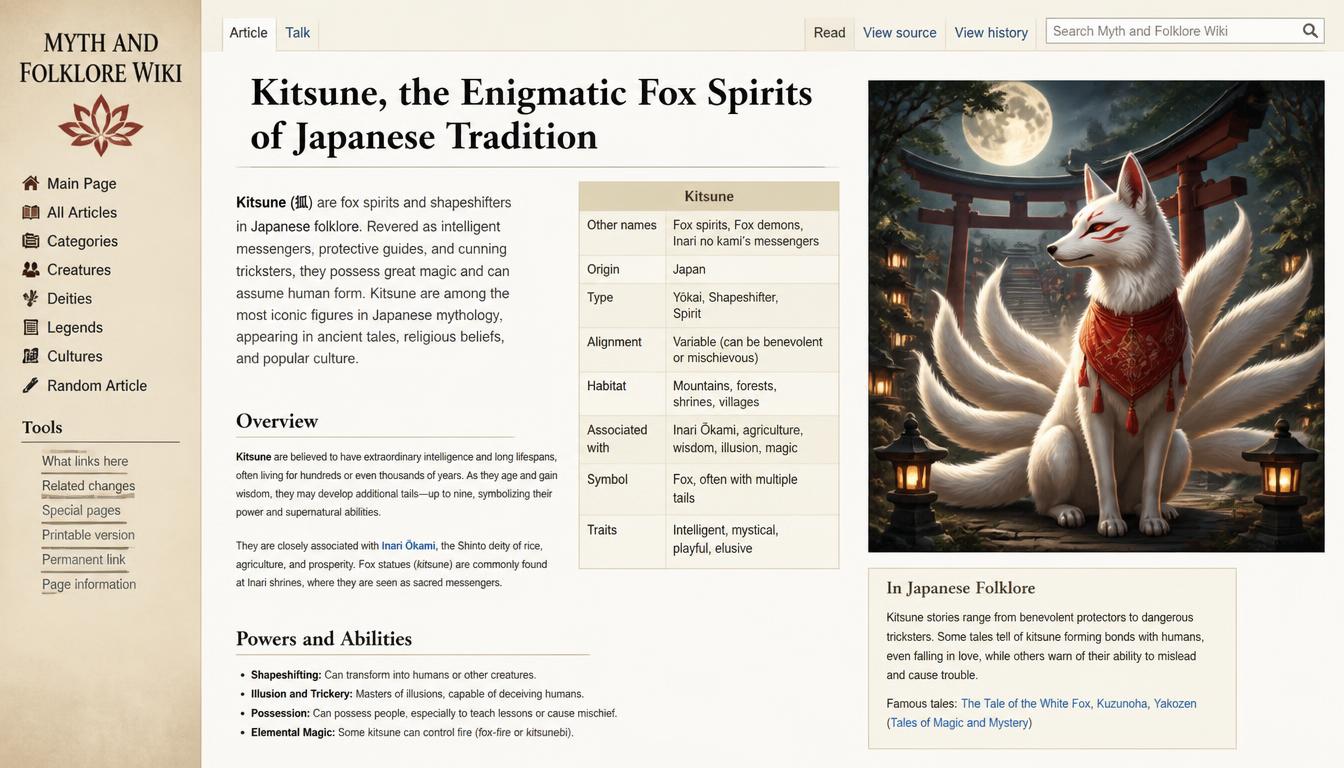
There are some creatures in mythology that feel as if they belong halfway between a whispered bedtime story and an old temple tale. Kitsune is one of them. A fox walking beneath the moon may simply be a fox, but in Japanese mythology, that same animal can become something far stranger in the imagination: a fox spirit, a guardian, a trickster, a lover, or even a supernatural being with several tails.
The word Kitsune is closely tied to Japanese folklore, where foxes have been surrounded by stories of intelligence, mystery, transformation, and magic for centuries. These legends aren’t all saying the same thing either, which makes them more interesting. Some portray Kitsune as helpful and loyal, while others warn that their cleverness can become dangerous.
Understanding kitsune mythology means stepping into a world where the boundary between the human world and the supernatural world is unusually thin. A promise may matter for generations, an illusion can look completely real, and an ordinary fox might be hiding a rather extraordinary secret.
Kitsune is the Japanese word for fox, but in folklore it commonly refers to supernatural fox beings with extraordinary abilities. These Japanese fox spirits are among the best-known Japanese supernatural creatures, and their stories have developed across many periods and regions.
A Kitsune may possess intelligence, magical abilities, and an unusual understanding of human behavior. In many stories, its powers grow with age and wisdom, meaning an older fox can become considerably more powerful than a young one.
One of the most fascinating ideas is that kitsune can shapeshift into humans. They may adopt a human form, imitate voices, create illusions, or disguise themselves so convincingly that people don’t realize what they have encountered.
This makes Kitsune different from an ordinary monster. They are often clever before they are violent, and their greatest weapon may simply be knowing what a person wants to believe.
Stories about foxes appear throughout ancient Japanese folklore, and foxes became deeply woven into Japanese culture. Their image developed through oral stories, religious traditions, regional legends, and later written works.
During the Edo period, folklore became especially rich with stories involving strange animals, spirits, ghosts, and supernatural encounters. Foxes appeared as beings capable of entering human society while remaining connected to the wild.
The traditional kitsune meaning therefore isn’t limited to one simple definition. A Kitsune might be a helpful spirit in one story and a mischievous trickster in another.
This contradiction is actually part of their charm. Kitsune legends often explore human weaknesses such as greed, vanity, jealousy, curiosity, and pride. Sometimes the fox doesn’t need claws at all; a clever illusion does the job nicely.
The relationship between Kitsune and Inari is one of the most recognizable parts of Japanese fox mythology. Inari is a major Shinto kami associated with rice, prosperity, agriculture, and other aspects of worldly well-being.
Foxes associated with Inari are often understood as spiritual messengers, rather than Inari themselves. This distinction matters because people sometimes simply call the foxes “Inari.”
At Shinto shrines, visitors may see fox statues placed near entrances or around sacred areas. These statues are commonly shown with symbolic objects such as rice, jewels, or keys.
The connection helped create the familiar image of the Inari fox as a protector and divine messenger. In this tradition, foxes can represent service, protection, wisdom, and good fortune, rather than only deception.
Inari Kitsune are frequently described as messengers serving the kami. Their presence connects the ordinary world with the sacred one in a way that feels almost poetic.
The fox becomes more than an animal; it becomes a symbolic bridge between humans and the divine. In this context, the idea of divine foxes or celestial foxes carries a very different mood from the mischievous fox of a village tale.
Perhaps the most famous Kitsune ability is shapeshifting. Folklore describes foxes transforming themselves into human beings, sometimes with astonishing skill.
The concept of kitsune transformation is especially important because these stories often focus on identity. A fox may take on a human likeness, enter a village, form friendships, or even marry a person.
Some traditions suggest that older foxes become better at transformation. Their growing age and power are connected with increasing wisdom and supernatural ability.
The transformed Kitsune may appear as a man, an elderly person, a child, or famously, a beautiful woman. These stories should be understood as folklore rather than historical descriptions of actual supernatural events.
The supernatural abilities attributed to Kitsune vary considerably between stories. There isn’t one universally fixed list, but several powers appear again and again.
Shapeshifting is the best-known ability, allowing a fox to imitate humans or sometimes other creatures. Alongside it comes illusion, which lets a Kitsune manipulate what people see or hear.
Some legends describe possession, in which a fox spirit influences or enters a human being. Others mention mind manipulation, telepathic influence, or the ability to create convincing phantom experiences.
The stories also give Kitsune unusual control over supernatural fire. This phenomenon is known as kitsunebi, commonly translated as fox-fire.
Kitsunebi is one of the most visually memorable parts of kitsune folklore. It describes mysterious lights or flames associated with fox spirits.
In legends, fox-fire may appear during nighttime journeys, strange gatherings, or supernatural encounters. Depending on the story, it can guide, frighten, confuse, or simply announce that something unusual is nearby.
It is easy to see why such mysterious lights became connected with a magical fox wandering through darkness. The forest already has enough mysteries; add floating fire and suddenly the fox has a reputation to maintain.
The number of tails is one of the most famous characteristics of a supernatural Kitsune. In many traditions, kitsune tails symbolize increasing age, experience, and magical power.
The nine-tailed fox, known as Kyūbi no kitsune, is generally presented as an exceptionally powerful form of Kitsune.
The idea that nine-tailed kitsune are the most powerful appears widely in popular culture, although details differ between individual legends and modern adaptations.
The nine tails can therefore be read as a visual shorthand for accumulated experience. One tail suggests a fox; nine tails suggest a creature that has had a very, very long time to learn how humans behave.
Traditional Kitsune usually retain recognizable fox features, even when depicted in supernatural form. Fur, ears, a tail, sharp teeth, and other vulpine features may remain visible.
In some stories, however, the transformation is so complete that the Kitsune looks entirely human. This creates the classic image of the fox-human hybrid, where animal nature and human appearance exist together.
Some legends especially associate Kitsune transformations with attractive women. The beautiful appearance is not merely decorative in these stories; it can become part of the fox’s ability to charm, deceive, or establish relationships.
Their appearance can therefore range from an ordinary fox to an almost entirely human figure, depending on the particular folklore tradition.
Not every Kitsune is a guardian. Some are famous for mischief, pranks, deception, and trickery.
A Kitsune might fool a greedy merchant, embarrass a boastful drunkard, confuse a dishonest traveler, or make someone hear sounds that aren’t actually there.
This kind of folklore often contains a moral lesson. The victim may deserve the deception because of greed, arrogance, dishonesty, or cruelty.
In such stories, the Kitsune becomes a strange judge of human behavior. The fox doesn’t always punish people because it is evil; sometimes it exposes the foolishness people already carry around with them.
The answer is wonderfully complicated: they can be either.
Some Kitsune are guardians, friends, lovers, protectors, or loyal companions. Others are deceptive, dangerous, or openly malicious.
This moral flexibility is one reason kitsune behavior is difficult to reduce to a single personality type. Folklore often treats supernatural creatures as individuals rather than members of a species with identical behavior.
A Kitsune may keep a promise faithfully, repay a debt, protect a family, or punish someone who has behaved cruelly. Another may deceive humans simply because trickery is part of its nature.
So calling every Kitsune a “good spirit” or every fox a “demon” misses the richness of the tradition.
The relationship between kitsune and humans forms some of the most emotional stories in Japanese folklore.
There are legends of fox spirits becoming friends with humans, serving families, falling in love, or becoming wives. These kitsune marriage legends often revolve around secrecy.
A human may marry someone who appears perfectly ordinary, only to discover the spouse’s supernatural identity later. Sometimes the relationship ends sadly because the human learns the truth or breaks a promise.
These stories explore trust, loyalty, promises, and separation. Underneath the magical fox, there is something recognizably human: the fear that someone we love may be keeping a part of themselves hidden.
Some traditional stories portray Kitsune as lovers or wives, creating a fascinating mixture of romance and supernatural folklore.
A fox spirit may live with a human family, raise children, and behave almost entirely like an ordinary person. Yet the supernatural identity remains a fragile secret.
These stories about kitsune human relationships aren’t simply romance tales. They can explore the limits of belonging, the difference between human and supernatural worlds, and the painful consequences of broken trust.
The emotional center is often surprisingly gentle. A creature feared by villagers can become the most devoted member of a household, which is exactly the sort of contradiction folklore loves.
Another important side of kitsune mythology is their role as protectors.
In connection with Inari, foxes may be seen as shrine protectors, spiritual messengers, and defenders against harmful supernatural forces.
The idea of a fox spirit guardian gives Kitsune a more benevolent identity. Their supernatural powers are not necessarily used to deceive; they can be associated with protection, service, prosperity, and good luck.
At Inari-related sites, fox imagery can therefore carry a sacred significance that differs greatly from stories about mischievous fox spirits.
Japanese folklore contains several famous fox figures, but some names have become especially recognizable.
Tamamo no Mae is perhaps the most famous legendary fox woman. She appears in stories involving supernatural transformation, political intrigue, beauty, and the identity of a powerful nine-tailed fox.
Prince Hanzoku is another name associated with Japanese fox stories and later representations of Kitsune traditions.
These characters show how folklore can transform a fox into a figure of enormous symbolic importance. They aren’t merely animals with magic powers; they become characters through which stories discuss ambition, beauty, deception, danger, and power.
Kitsune exist within a much larger world of Japanese supernatural beings.
The Tanuki, for example, is another animal strongly associated with transformation and trickery. Cats also appear in supernatural folklore through creatures such as the Bakeneko and Nekomata.
These beings are not identical, however. Their stories, symbolism, and traditions developed differently.
Comparisons with badgers, cats, and other magical animals can help show how Japanese folklore repeatedly gives ordinary creatures extraordinary personalities. The forest, village, shrine, and household all become places where the supernatural might quietly appear.
Modern entertainment has turned Kitsune into an international cultural symbol. Kitsune appear in anime, manga, and video games, often borrowing traditional features while creating entirely new characters.
Series such as Naruto, Yu Yu Hakusho, and Inuyasha helped introduce fox-related supernatural ideas to huge audiences.
In Naruto, the Nine-Tails became one of the franchise’s most recognizable creatures. Other works use fox spirits more playfully, romantically, or humorously.
This modern popularity sometimes mixes traditional Japanese folklore with completely new fantasy concepts. That’s perfectly normal for mythology’s modern life; old creatures rarely sit quietly in a museum.
The influence continues beyond anime.
Pokémon features fox-inspired creatures such as Ninetales and Zoroark, while Digimon includes characters such as Renamon and Kyuubimon.
Other fictional representations include Yae Miko and Guuji Yae from Genshin Impact, as well as fox-related characters and themes appearing across games and fantasy franchises.
The broader influence can also be seen in works such as Okami, Sonic the Hedgehog, One Piece, Fer.al, and other modern media.
These versions aren’t necessarily accurate representations of historical kitsune folklore. They are creative interpretations inspired by the older idea of a magical Japanese fox.
Kitsune symbolism can include intelligence, adaptability, mystery, transformation, fertility, prosperity, protection, deception, and wisdom.
The meaning changes depending on the context. An Inari fox near a shrine may communicate protection and sacred service, while a fox in a village folktale may symbolize trickery.
This flexibility is one of the reasons Kitsune have survived as powerful cultural symbols. They can represent opposing qualities without the story falling apart.
A Kitsune may be beautiful but dangerous, clever but compassionate, mischievous but loyal. Real life is full of contradictions too, perhaps that’s why these old stories still feel strangely modern.
The enduring appeal of Kitsune comes from their ability to make ordinary things feel uncertain.
A fox crossing a road becomes a possible messenger. A stranger becomes someone who may be hiding another identity. A mysterious light in the distance becomes kitsunebi.
But beneath the supernatural imagery are very human themes: trust, temptation, loyalty, greed, wisdom, love, deception, and consequences.
Kitsune legends remind readers that intelligence can be used kindly or cruelly, and appearances rarely tell the whole story. That is probably why these stories continue to change without completely losing their old character.
When learning about Japanese fox mythology, it is useful to remember that there isn’t one single official Kitsune story.
Different regions, historical periods, religious traditions, storytellers, and modern creators have produced different versions. Some emphasize Shinto connections, while others focus on tricksters, romance, magic, or frightening supernatural encounters.
Modern media also frequently combines Kitsune with unrelated fantasy traditions. Enjoying those adaptations is perfectly fine, but separating fictional invention from traditional folklore helps keep the original cultural background visible.
The most interesting approach is not asking, “Which Kitsune story is the correct one?” but rather asking why different communities imagined the fox in such different ways.
Kitsune are supernatural fox spirits from Japanese folklore, known for intelligence, shapeshifting, magic, and multiple tails.
Kitsune folklore includes stories of fox spirits acting as tricksters, guardians, messengers, lovers, and mysterious supernatural beings.
Mythical kitsune are legendary fox creatures believed to possess magical powers, including transformation, illusion, and supernatural wisdom.
Kitsunr is likely a misspelling of “kitsune,” the Japanese fox spirit associated with shapeshifting, magic, and traditional folklore.
Evil kitsune are portrayed in some legends as dangerous fox spirits that use deception, possession, illusions, or supernatural powers to harm humans.
Read more: https://templetimingsdaily.com/shiva
Kitsune remain one of the most fascinating figures in Japanese folklore because they refuse to stay inside one little box. They can be foxes, spirits, messengers, guardians, lovers, tricksters, protectors, or frightening supernatural beings.
Their stories move between the forest and the shrine, between the human world and the celestial world, between ancient legend and modern entertainment. The nine-tailed fox mythology has survived because its central ideas are still meaningful: wisdom grows with experience, appearances can deceive, promises matter, and cleverness can be both a blessing and a danger.
From Inari Kitsune at sacred shrines to Tamamo no Mae, and from old folklore to anime, manga, and video games, the Kitsune continues changing shape while keeping its unmistakable identity.
Perhaps that is the perfect ending for a creature famous for transformation. The Kitsune itself has changed many times across centuries, yet somehow the old fox is still there, watching from the edge of the story with bright eyes and a secret that it probably isn’t going to tell you just yet.