Physical Address
304 North Cardinal St.
Dorchester Center, MA 02124
Physical Address
304 North Cardinal St.
Dorchester Center, MA 02124

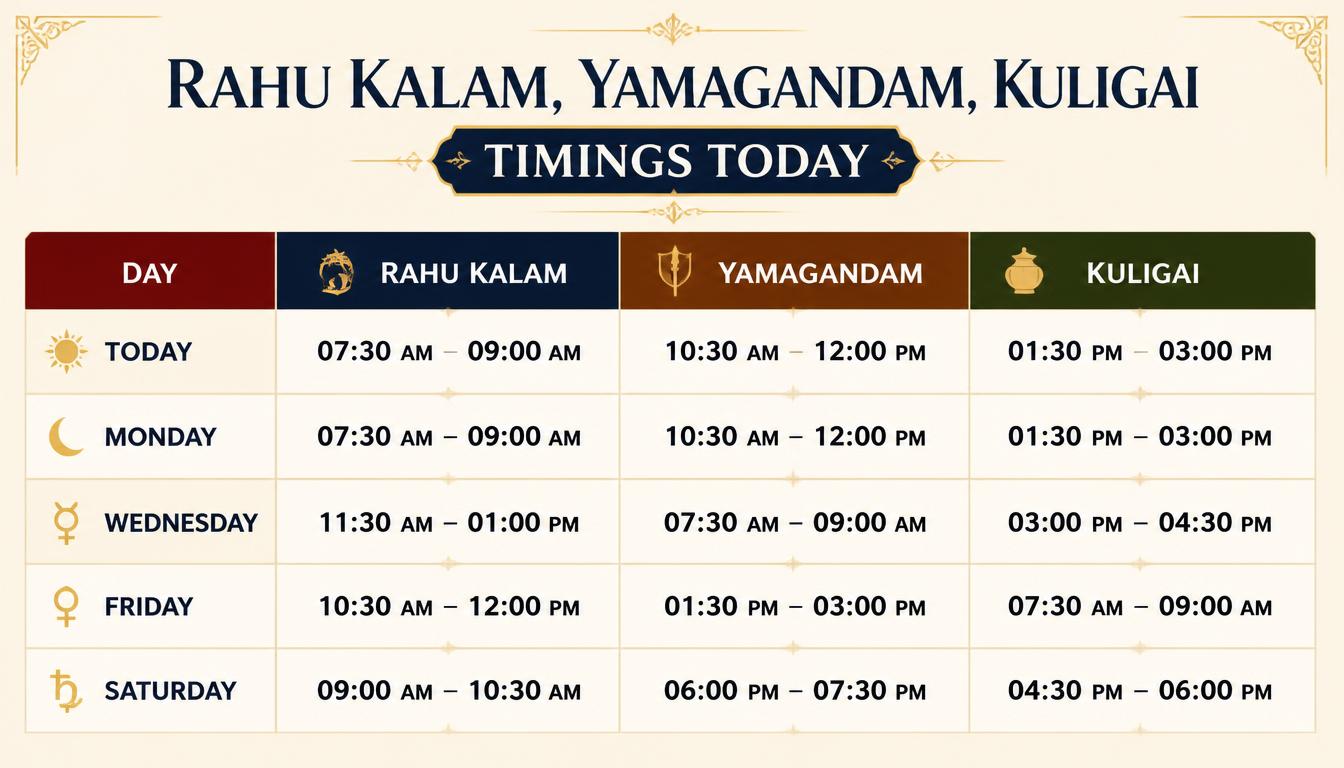
There are certain parts of the day that many Hindu families traditionally check before beginning an important activity. Rahu Kalam, Yamagandam, and Kuligai are three such time periods. People may look at these daily timings before starting travel, business activities, important ceremonies, financial work, or other significant tasks.
The interesting part is that these periods are not fixed by the clock throughout the year. Their calculation is connected with the daytime period between sunrise and sunset, so the actual Rahu Kalam timings today, Yamagandam timings today, and Kuligai timings today can change according to the location and season.
For devotees who follow traditional Hindu astrology, knowing these periods is less about fear and more about choosing a suitable time with awareness. A person may simply check the day’s schedule, postpone a new beginning when practical, or use a traditionally preferred period for Pooja and spiritual practices.
The three periods are traditionally associated with different astrological and religious beliefs. Rahu Kalam is connected with Rahu, Yamagandam with Yama, and Kuligai or Gulika with Gulika.
They are generally calculated by dividing daylight into eight equal parts. If sunrise is approximately 6:00 am and sunset is approximately 6:00 pm, the daytime becomes eight periods of 90 minutes each.
That produces the familiar sequence:
Each section has a 90-minute duration, or a 1.5-hour duration, in this example. But don’t treat these clock times as universal, because an actual sunrise at your location may be earlier or later.
The weekday determines which one of these eight daytime sections is assigned to Rahu, Yamagandam, and Kuligai. That’s why the timings for Monday, Wednesday, Friday, and Saturday are different.
Rahu Kalam timings today are traditionally used to identify the daily period associated with Rahu. In many Hindu traditions, people avoid starting a major new activity during this period when they have the freedom to choose another time.
The commonly used approximate schedule, assuming a 6:00 am sunrise and 6:00 pm sunset, is:
| Day | Rahu Kalam |
|---|---|
| Sunday | 4:30 pm – 6:00 pm |
| Monday | 7:30 am – 9:00 am |
| Tuesday | 3:00 pm – 4:30 pm |
| Wednesday | 12:00 pm – 1:30 pm |
| Thursday | 1:30 pm – 3:00 pm |
| Friday | 10:30 am – 12:00 pm |
| Saturday | 9:00 am – 10:30 am |
So, when someone searches for Rahu Kalam Monday, Rahu Kalam Wednesday, Rahu Kalam Friday, or Rahu Kalam Saturday, they are generally looking for these weekday-specific periods.
The important detail is that these are example clock times based on an assumed 6:00 am to 6:00 pm daylight period. For accurate local Rahu Kaal timings, sunrise and sunset for the particular place should be used.
For a typical 6:00 am sunrise and 6:00 pm sunset, Rahu Kalam today on Wednesday falls between 12:00 pm and 1:30 pm.
Wednesday’s Rahu period is the sixth daytime segment in the traditional sequence. If your local sunrise or sunset differs considerably, however, the exact clock time will also shift.
This is especially important when searching for Rahu Kalam time online. A website showing a fixed time without mentioning the location may be giving only a generalized schedule.
Many people simply use an almanac or Panchang that automatically calculates the period for their city. That makes the result much more practical than copying a timing from another place.
Yamagandam is another traditional period that people check along with Rahu Kalam. It is also known as Yamagandam Kalam, and its calculation follows the eight-part division of daylight.
A commonly used approximate timetable is:
| Day | Yamagandam |
|---|---|
| Sunday | 12:00 pm – 1:30 pm |
| Monday | 10:30 am – 12:00 pm |
| Tuesday | 9:00 am – 10:30 am |
| Wednesday | 7:30 am – 9:00 am |
| Thursday | 6:00 am – 7:30 am |
| Friday | 3:00 pm – 4:30 pm |
| Saturday | 1:30 pm – 3:00 pm |
Therefore, Yamagandam timings today on a Wednesday are commonly represented as 7:30 am to 9:00 am, when the day is based on a 6:00 am sunrise and 6:00 pm sunset.
The traditional association of this period is with Yamaraja, the deity connected with death and justice in Hindu religious tradition. Because of this association, some devotees prefer not to begin particularly important new undertakings during Yamagandam.
Still, the practice differs between families and traditions. Not every person treats Yamagandam as a strict prohibition, and ordinary daily responsibilities obviously cannot always be postponed.
People often specifically search for Yamagandam Monday, Yamagandam Wednesday, Yamagandam Friday, and Yamagandam Saturday because these days are part of their regular work or religious schedule.
For the standard 6-to-6 example, the periods are:
These are not universal fixed times. A location with a different sunrise and sunset will have a corresponding adjustment.
That small detail is easy to miss, but it matters if you’re planning something at an exact minute. The Yamagandam duration remains approximately one-eighth of the daytime, while its clock position changes with daylight length.
Kuligai, also called Gulika, is another period calculated from the daytime division. The terms Kuligai Kalam and Gulika Kalam are commonly used for this period.
Unlike Rahu Kalam, some traditional practices consider Kuligai to be useful for certain activities. Therefore, it isn’t simply accurate to describe every traditional time period as universally “bad.” The purpose and nature of the activity can matter.
Using the standard 6:00 am to 6:00 pm example, the approximate Kuligai timings are:
| Day | Kuligai / Gulika |
|---|---|
| Sunday | 3:00 pm – 4:30 pm |
| Monday | 1:30 pm – 3:00 pm |
| Tuesday | 12:00 pm – 1:30 pm |
| Wednesday | 10:30 am – 12:00 pm |
| Thursday | 9:00 am – 10:30 am |
| Friday | 7:30 am – 9:00 am |
| Saturday | 6:00 am – 7:30 am |
Thus, for a standard Wednesday, Kuligai timings today would be approximately 10:30 am to 12:00 pm.
Again, the word “approximately” is doing some important work here. The actual Kuligai time should be calculated from the local sunrise and sunset rather than blindly applying the same clock schedule everywhere.
For those checking individual weekdays, the traditional approximate schedule gives:
The Kuligai duration in the standard example is 90 minutes. If daylight lasts longer than 12 hours, each segment becomes longer; if daylight is shorter, each segment becomes shorter.
This is why Panchang-based calculations are preferable when exact Gulika timings are needed.
The basic calculation is easier than it first appears. Traditional daytime calculations divide the period between sunrise and sunset into eight equal portions.
Suppose sunrise occurs at 6:00 am and sunset occurs at 6:00 pm. That’s exactly 12 hours of daylight.
Dividing 12 hours into eight portions gives:
12 hours ÷ 8 = 1.5 hours
So every section lasts 90 minutes.
If sunrise is 6:20 am and sunset is 5:50 pm, though, the daylight period is not exactly 12 hours. The eight portions must therefore be recalculated.
This explains why a website displaying Rahu Kalam timings today may show a slightly different result from another website. One may be using a different city, sunrise data, time zone setting, or calculation method.
A common question is whether people can perform Rahu Kalam pooja during Rahu Kalam. In many traditions, specific worship and spiritual remedies are performed during this period precisely because of its association with Rahu.
For devotees following this practice, Rahu Ketu Pooja, prayers, mantra recitation, and certain religious remedies may be planned according to the guidance of their family tradition, priest, or temple.
Some people also light a ghee lamp during Rahu Kalam. In particular traditions, a ghee lemon lamp may be associated with prayers connected with Rahu. Practices vary considerably by region, temple, and lineage, so it is better to follow an established religious practice rather than combining rituals randomly.
A temple pooja can also have its own schedule. Temple timings should therefore be checked directly with the temple instead of assuming that its ritual schedule is identical to the general Rahu Kalam calculation.
Traditional Rahu Kalam remedies differ from one community to another. Some devotees prefer prayer, meditation, temple visits, charitable acts, or specific forms of worship rather than simply avoiding the period.
Lighting a lamp, praying to the chosen deity, maintaining devotion, and observing one’s religious practices with sincerity are often considered more meaningful than becoming anxious about every minute on the clock.
Some traditions mention a Tulasi plant, lamps, mantras, and devotional practices as part of spiritual routines. Others may recommend specific Rahu Ketu pooja or temple rituals.
These practices should be understood as religious or spiritual traditions rather than guaranteed solutions for practical problems. Claims about removing a Dosha, eliminating financial problems, or guaranteeing particular outcomes should be treated with appropriate caution.
Rahu and Ketu also appear prominently in traditional Jyotisha discussions about Kala Sarpa Dosha. People who believe they are experiencing Kala Sarpa Dosha effects may seek advice from astrologers or religious practitioners.
A Kala Sarpa Dosha Nivarana Pooja is performed in some traditions as a form of religious remedy. Devotees may associate such rituals with seeking relief from dosha, spiritual peace, or the reduction of perceived malefic effects.
People sometimes connect dosha-related concerns with financial issues, marriage delay, pregnancy delay, career growth, or other difficulties. These are traditional astrological interpretations, however, and should not be treated as medical, financial, or professional diagnoses.
For serious financial, relationship, career, or health concerns, practical guidance should still be taken alongside any personal religious practice.
The phrase Rahu Kalam benefits can sound confusing because Rahu Kalam is commonly described as a period during which new beginnings are avoided. Yet some traditions specifically use the period for prayer, worship, and remedies associated with Rahu.
Similarly, Kuligai benefits are interpreted differently in different astrological traditions. Some consider Kuligai suitable for particular types of activities, while others follow more specific Panchang recommendations.
The safest approach is to understand the traditional purpose of each period rather than labeling it simply “good” or “bad.”
Astrology and religious timing have developed through different regional traditions, and the advice found in one community may not be identical to another. That’s normal, and it is worth respecting.
For quick reference, this traditional 6:00 am to 6:00 pm example can be useful:
| Day | Rahu Kalam | Yamagandam | Kuligai |
|---|---|---|---|
| Sunday | 4:30–6:00 pm | 12:00–1:30 pm | 3:00–4:30 pm |
| Monday | 7:30–9:00 am | 10:30 am–12:00 pm | 1:30–3:00 pm |
| Tuesday | 3:00–4:30 pm | 9:00–10:30 am | 12:00–1:30 pm |
| Wednesday | 12:00–1:30 pm | 7:30–9:00 am | 10:30 am–12:00 pm |
| Thursday | 1:30–3:00 pm | 6:00–7:30 am | 9:00–10:30 am |
| Friday | 10:30 am–12:00 pm | 3:00–4:30 pm | 7:30–9:00 am |
| Saturday | 9:00–10:30 am | 1:30–3:00 pm | 6:00–7:30 am |
This table is a reference pattern, not a universal city-specific timetable. If your local sunrise is not 6:00 am or your sunset is not 6:00 pm, the periods should be recalculated.
The easiest approach is to first identify your location and obtain the local sunrise and sunset. Then divide the daylight period into eight equal sections.
Next, identify the weekday and locate the corresponding Rahu Kalam, Yamagandam, and Kuligai segment.
If you’re planning a new activity, you can compare those periods with other auspicious timings provided by a reliable Panchang. For religious activities, follow the instructions of the relevant temple or priest when they differ from a general online timetable.
And remember, daily life doesn’t stop because one of these periods arrives. Missing a preferred window is not something that should create unnecessary fear or stress.
For devotees who perform worship during Rahu Kalam, the spiritual value may come from discipline, prayer, concentration, and devotion. Some believe such practices help them seek protection from perceived malefic effects and gain mental peace.
Traditional practices may include lighting ghee lamp, chanting prayers, visiting a temple, or performing a prescribed Rahu Ketu Pooja.
The claimed Pooja benefits are religious beliefs rather than scientifically established outcomes. A sincere spiritual practice can still have personal meaning, especially when it encourages reflection, discipline, hope, and devotion.
The same principle applies to claims about Dosha removal, Dosha reduction, or obtaining good results. These belong to the religious and astrological framework in which the practice is understood.
One of the most overlooked details about Rahu Kalam timings, Yamagandam timings, and Kuligai timings is location.
The weekday remains the same, but sunrise and sunset can differ from one place to another. Even cities in the same country can therefore have slightly different clock times.
For someone searching Rahu Kalam today, it is better to search with the city or use a Panchang that automatically applies local astronomical data.
The same applies to Yamagandam today and Kuligai today. A generic timetable is helpful for understanding the pattern, but it should not be mistaken for an exact local calculation.
Bilkul, H3 headings exactly same rakhta hoon aur har heading ke neeche 1–2 lines English answer deta hoon.
Today’s Rahu Kalam and Yamagandam timings indicate the periods traditionally considered unsuitable for starting important activities. Check the day-specific timings before planning any auspicious work.
Rahu Kalam and Yamagandam timings are daily periods calculated according to the day of the week. These timings are commonly checked for religious activities, travel, and other important tasks.
Today’s Rahu Kalam and Yamagandam can help devotees identify the specific periods traditionally avoided for beginning new activities. The exact timings change according to the weekday.
Rahukalam and Yamagandam timings today provide the day’s specific time periods associated with these traditional Hindu astrological calculations. Timings vary from one weekday to another.
Rahukalam and Yamagandam today show the periods traditionally considered less favorable for starting important work. Devotees can check the applicable timings according to their location and weekday.
rEad ARticuL: https://templetimingsdaily.com/tirumala-tirupati-devasthanam/
Rahu Kalam Yamagandam Kuligai timings remain an important part of traditional Hindu timekeeping for many devotees. Whether someone follows them strictly or simply checks them occasionally, understanding how they work makes the practice much clearer.
The key point is simple: Rahu Kalam, Yamagandam, and Kuligai are traditionally calculated from the daylight period, divided into eight parts, with different sections assigned according to the weekday.
For today’s schedule, remember that a standard timetable based on 6:00 am to 6:00 pm is only an example. Your actual today’s timings depend on local sunrise and sunset.
Use these traditional timings thoughtfully, without unnecessary fear. For religious remedies, Pooja timings, or Dosha Nivarana Pooja, follow the customs of your family, temple, or trusted spiritual guide. A clock can tell us when a period begins, but faith, intention, and calmness are what make any spiritual practice personally meaningful.