Physical Address
304 North Cardinal St.
Dorchester Center, MA 02124
Physical Address
304 North Cardinal St.
Dorchester Center, MA 02124

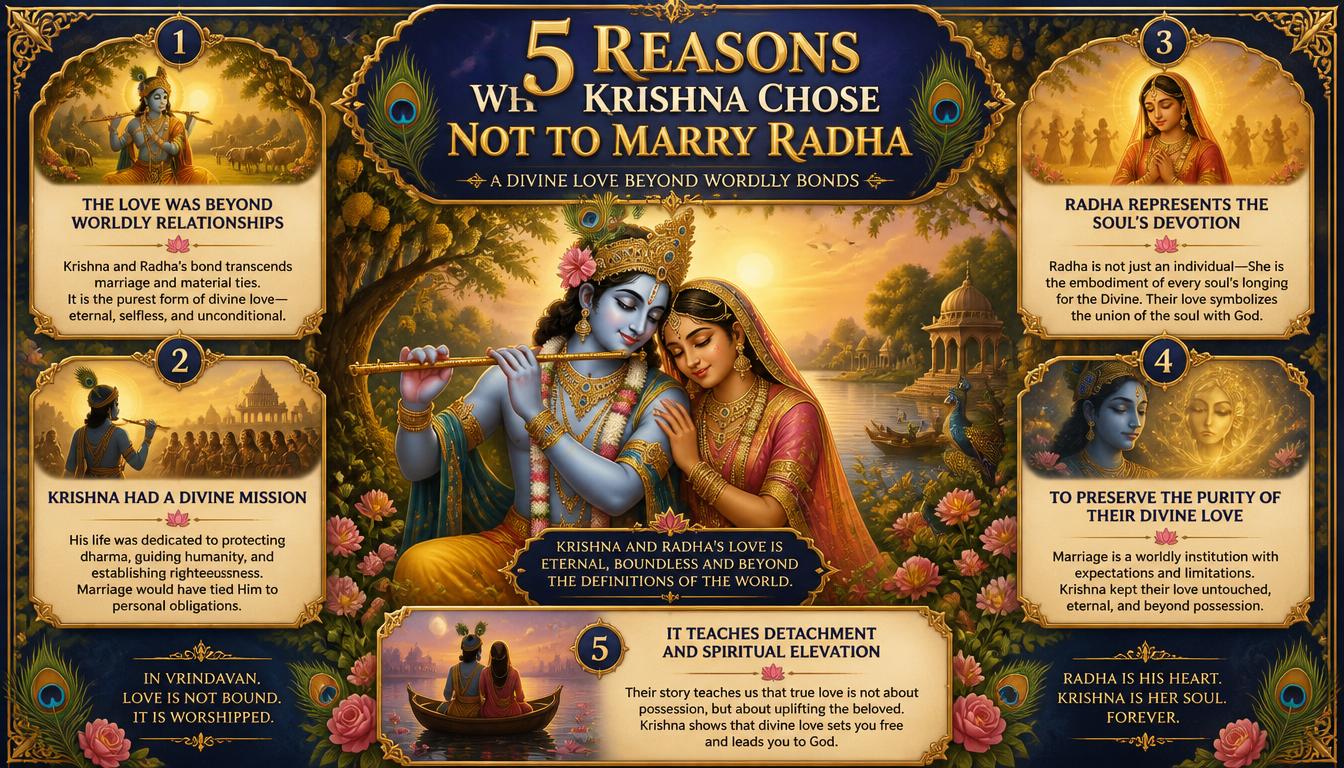
Few love stories have survived centuries with the strange tenderness of Radha Krishna. Their names are spoken together so naturally that separating them almost feels wrong. In temples, devotional songs, paintings, poetry, and the quiet prayers of devotees, Radha and Krishna appear as two names carrying one feeling. Yet there is one question that keeps returning: if their love was so deep, why Krishna did not marry Radha?
It sounds like a simple question, but Hindu devotional traditions don’t really give it one simple answer. The story sits somewhere between theology, poetry, regional tradition, philosophy, and later devotional literature. Different traditions explain Radha and Krishna differently, and some early Sanskrit texts do not narrate their relationship in the familiar form known today.
That makes the question more beautiful, maybe a little complicated too. Their relationship is often understood not as an unfinished romance but as a symbol of something marriage itself cannot fully contain—the longing of the individual soul for the divine.
Here are 5 reasons why Krishna chose not to marry Radha, based on widely told religious, philosophical, and devotional interpretations.
Perhaps the most famous explanation for why Krishna never married Radha is that their relationship was never meant to become an ordinary husband and wife relationship.
Marriage creates a recognized social bond between two individuals. The divine love of Radha Krishna, however, is commonly interpreted by devotees as something beyond social possession, family responsibility, and materialistic expectations. Their love wasn’t waiting for a wedding ceremony to make it complete.
In devotional philosophy, Radha and Krishna relationship represents the attraction between the human soul and the Divine. Radha becomes the image of absolute devotion, while Krishna represents the divine toward whom that devotion flows.
Their separation therefore carries meaning too.
If Radha had simply become one of the wives of Krishna, some devotional interpretations suggest that their relationship could have appeared like another royal marriage. Instead, their longing became a timeless image of spiritual love, surrender, remembrance, and unconditional love.
This is why asking did Krishna want to marry Radha can sometimes apply an ordinary human framework to a relationship that devotional traditions deliberately place beyond it.
Their sacred bond wasn’t considered incomplete because there was no wedding. In this interpretation, it was complete precisely because it required no worldly certificate of togetherness.
Radha loved Krishna when he was physically present, and she remained connected with him when he wasn’t. That second part is crucial. Anyone can understand love through presence; Radha’s story asks whether love can survive absence.
It did.
This idea became particularly important within Bhakti traditions, where separation from the divine can intensify remembrance. Longing itself becomes devotion, which sounds almost upside-down until you sit with it for a bit.
The spiritual meaning of Radha Krishna love, therefore, is less about romantic success or failure and more about a love that transforms the person who loves.
Another question naturally follows: why Krishna married Rukmini not Radha?
This is where distinctions among different Hindu traditions become important.
Krishna’s marriage to Rukmini, the princess of Vidarbha and daughter of King Bhishmaka, belongs to Krishna’s royal life. Rukmini is prominently celebrated as Krishna’s principal queen and is widely regarded in Hindu traditions as a manifestation or incarnation of Goddess Lakshmi.
Krishna, meanwhile, is worshipped as an incarnation of Lord Vishnu. In popular Hindu tradition, he is commonly described as Vishnu’s eighth avatar.
The Krishna and Rukmini marriage, then, carries a different theological and narrative role from Krishna’s Vrindavan relationship with Radha.
This doesn’t necessarily turn the discussion into Radha divine love versus Rukmini human love, as though one woman must somehow defeat the other. Such comparisons can flatten traditions that are much richer than a romantic triangle.
In different Vaishnava traditions, Radha and Rukmini may be understood in distinct theological ways. Some devotional interpretations connect both with divine feminine power or Shakti, while giving Radha a uniquely central position in Krishna bhakti.
So, did Krishna love Radha or Rukmini?
Within devotional understanding, divine love doesn’t have to operate like human romantic competition. Krishna’s relationship with Rukmini represents marriage, royal duty, companionship, and dharmic life. His relationship with Radha is frequently used to express mystical longing and complete spiritual surrender.
The two aren’t necessarily fighting for the same symbolic space.
Krishna later had other queens, including Satyabhama and Jambavanti, and traditions surrounding the Krishna favorite wife question vary. Rukmini nevertheless holds an especially prominent place among his queens.
Radha occupies another sort of place altogether.
She becomes the beloved whose name, quite remarkably, is often spoken before Krishna’s: Radha-Krishna.
Maybe that’s the unusual point of the story. She didn’t need a royal throne beside him for devotees to place her beside him forever.
A third explanation concerns Radha’s own marital traditions.
In several later and regional narratives, Radha married Ayan, whose identity and story can vary considerably between traditions. He is sometimes known by other names or represented differently depending upon the text and region.
Therefore, the question who was Ayan doesn’t have one universally agreed answer across Hindu literature.
These traditions are frequently brought into discussions about why Radha married Ayan instead of Krishna. From a purely social reading, Radha’s marriage would obviously prevent an ordinary marriage between Radha and Krishna.
But devotional literature often uses that very impossibility to deepen the symbolism.
Radha’s devotion isn’t presented merely as affection created by social convenience. Her inner attachment to Krishna transcends external circumstances, and this makes their divine relationship fundamentally different from conventional married life.
Stories concerning Radha’s marriage also contain numerous regional variations. One should be careful, therefore, about treating every popular retelling as if it comes directly from the Bhagavad Gita or Mahabharata. It doesn’t.
Some later narratives even contain mystical episodes involving Krishna, Radha, Ayan, and Goddess Kali, including traditions about Krishna assuming a Krishnakali roop. Such stories belong to particular devotional and regional streams rather than one universally accepted biography.
This distinction matters because Hindu mythology and devotional literature developed across many centuries, communities, languages, and schools of thought.
The deeper message remains surprisingly consistent, though.
Outer circumstances could separate Radha from Krishna, but they couldn’t erase the spiritual connection between them.
This is why the Radha Krishna love story is remembered less as “two people who failed to marry” and more as a meditation on love and devotion.
Perhaps the most emotionally powerful explanation for why did Krishna leave Radha comes from Krishna’s departure from Vrindavan.
Krishna’s childhood world was filled with Yashoda’s affection, Nanda, cowherds, gopis, forests, playful miracles, the Raas Leela, and the music associated with Krishna’s flute. This pastoral Krishna feels intimate and close—you can almost imagine hearing his flute somewhere beyond the trees.
But Krishna’s story could not remain there forever.
Born to Devaki and Vasudeva, Krishna had a larger destiny connected with Kansa, royal conflicts, the protection of Dharma, and events that ultimately lead toward the world of the Mahabharata and Shrimad Bhagavad Gita.
Even Krishna’s childhood narratives—from the episode of Putna to lifting Govardhan Mountain—present him as more than an ordinary village boy.
Eventually, Krishna leaving Vrindavan marks a dramatic change.
The playful child and beloved cowherd steps toward another stage of his divine purpose.
He becomes a prince, statesman, warrior, teacher, guide, and protector of devotees. In theological interpretations, his role includes being a defender of Dharma and participating in restoring moral order on Earth.
His education under Sandipani and later life take him increasingly away from the pastoral world associated with Vrindavan.
This separation became enormously important in devotional poetry. Radha’s longing after Krishna’s departure isn’t merely heartbreak; it becomes an intensified form of faithfulness, remembrance, and inward devotion.
People also frequently ask why Krishna stopped playing the flute.
Popular devotional retellings sometimes connect the flute with Krishna’s Vrindavan life and especially his relationship with Radha. However, specific claims about Krishna permanently abandoning or breaking his flute should be treated as devotional traditions rather than as one uncontested scriptural event.
Still, the symbolism is gorgeous.
The flute belongs to the Krishna of moonlit Vrindavan—the Krishna of the gopis, laughter, forests, and Raas Leela. His departure closes that chapter, even if devotion refuses to close the book.
Thus, one answer to what happened after Krishna left Vrindavan is geographical: Krishna’s life moved elsewhere.
The spiritual answer is different.
Vrindavan went with him.
And he remained with Vrindavan.
That’s the paradox at the center of their separation.
The fifth reason is less romantic but extremely important when asking why Radha and Krishna didn’t marry: the textual history surrounding Radha is complex.
Many readers are surprised when they start searching for Radha in Bhagavad Gita or Radha in Mahabharata expecting the complete love story familiar from modern devotional culture.
The Bhagavad Gita does not narrate a Radha-Krishna romance or a Radha Krishna marriage. Radha likewise doesn’t occupy the familiar central role in the Mahabharata that she later receives in major devotional traditions.
Questions about Radha in Harivansham and other early Krishna literature are also part of scholarly and theological discussion about how Radha’s literary prominence developed.
This is why the question is Radha mentioned in ancient Hindu scriptures needs nuance rather than a quick yes-or-no answer.
Krishna appears prominently in early and classical Sanskrit traditions, whereas the fully developed image of Radha as Krishna’s supreme beloved becomes especially influential through later devotional literature and theological traditions.
Figures and poets associated with Radha-Krishna devotion, including Acharya Nimbark and Jayadeva, became enormously influential in shaping devotional understandings of Radha. Jayadeva’s medieval Sanskrit poetry, in particular, played a major role in celebrating the intense love between Radha and Krishna.
That doesn’t automatically answer did Radha really exist, either.
Religious faith and historical verification are different kinds of questions. Devotees may accept Radha as a divine and historical reality through tradition and faith, while historians examine textual chronology, manuscripts, and literary development.
Neither discussion should be carelessly disguised as the other.
So when someone asks when was Radha first mentioned in scriptures, the answer depends partly on what counts as a reference to Radha, which texts are included, how they are dated, and which religious tradition is being followed.
This textual complexity gives us another way of understanding the marriage question.
The famous Radha and Krishna love story isn’t presented as one continuous historical biography across all ancient Hindu texts. It emerges through a vast devotional tradition in which poetry, theology, worship, philosophy, and storytelling interact.
Consequently, there isn’t one universally accepted scriptural scene where Krishna simply sits Radha down and gives her five reasons why he won’t marry her.
The “five reasons” are better understood as explanations drawn from different devotional and interpretive traditions.
Another popular question is whether Yashoda prevented the marriage.
Stories involving family objections appear in later retellings and popular narratives, sometimes involving Radha’s family background and social circumstances. Radha is traditionally associated with Barsana and her father Vrishabhanu, while Krishna’s childhood is associated with Yashoda and Nanda.
However, saying categorically that Yashoda prevented the wedding and that this is the historical or universally scriptural explanation would go too far.
The Radha-Krishna tradition has many versions.
That’s worth remembering whenever a dramatic story online claims to reveal the “secret reason” they didn’t marry. Hindu devotional literature isn’t one single novel written by one author. It is a huge landscape of texts and traditions formed over centuries.
The relationship between Radha and Rukmini becomes even more interesting when questions of divine identity appear.
Rukmini is widely worshipped as an incarnation or manifestation of Goddess Lakshmi, the divine consort of Lord Vishnu.
Radha’s theological identity varies more by tradition. Certain Vaishnava schools understand Radha as Krishna’s supreme divine energy, often described in terms of Shakti and the highest expression of loving devotion. Other traditions relate her differently to Lakshmi.
Therefore, both was Radha an incarnation of Lakshmi and was Rukmini an incarnation of Lakshmi need answers sensitive to the particular tradition being discussed.
Hindu theology frequently allows divine manifestations to be understood in ways that don’t fit neatly into an either/or box.
This also helps explain why turning Radha and Rukmini into romantic rivals misses much of their religious significance.
Modern romance teaches us a fairly tidy sequence: meet, fall in love, marry, stay together.
Krishna and Radha eternal love breaks that sequence entirely.
There is love. There is separation. There is longing. There is no conventional marriage between them in the best-known devotional narrative—and yet their names become inseparable.
What kind of failed love story does that?
Not much of a failure, really.
Their story suggests that true love can sometimes be understood as transformation rather than possession. Radha doesn’t need to possess Krishna for her devotion to become meaningful. Krishna’s physical departure doesn’t empty Radha’s heart of him.
In Bhakti thought, that idea can become intensely spiritual.
A devotee may not see the deity physically, yet continues in worship, remembrance, prayer, and surrender. Distance can produce longing; longing can deepen devotion; devotion can lead toward inner peace and inward transformation.
Radha therefore becomes more than a romantic character.
She becomes an image of what it means to desire closeness with the divine so completely that separation itself becomes another form of connection.
When we put the traditions together, the answer to why Krishna chose not to marry Radha becomes clearer, although never completely simple.
Their relationship is commonly understood as transcending an ordinary marriage bond. Traditions about Radha married Ayan create another social dimension to their separation. Krishna’s departure from Vrindavan reflects his movement toward a wider divine mission. His marriage to Rukmini belongs to a different phase and theological aspect of his life. And the complex development of Radha’s role across ancient scriptures and medieval scriptures means there is no single universally accepted textual explanation for the marriage question.
Together, these ideas transform the question.
Instead of only asking, “Why didn’t Krishna marry Radha?” we can ask, “Why has their love remained so powerful even without marriage?”
That question reaches the heart of their devotional significance.
Their relationship isn’t celebrated because everything went according to plan. It is celebrated because physical separation seemingly couldn’t finish what spiritual union had begun.
According to some later devotional traditions, Radha married Ayan because of family and social circumstances. Her spiritual love and devotion to Krishna, however, remained central to the Radha-Krishna tradition.
Krishna did not marry Radha because their bond is often understood as divine and spiritual love beyond a conventional marriage. Different Hindu traditions offer different explanations for their separation.
Read more: https://templetimingsdaily.com/darshanam/
Radha and Krishna are often seen as symbolizing the eternal union between the soul and the Divine. Their relationship therefore did not require marriage to represent complete love and devotion.
Krishna’s departure from Vrindavan and his larger divine responsibilities are commonly given as reasons they did not marry. Their separation later became an important symbol of eternal devotion.
There is no widely accepted scriptural tradition stating that Radha and Ayan had a child. Stories about Radha’s marriage to Ayan vary considerably across later texts and regional traditions.
The 5 reasons why Krishna chose not to marry Radha reveal something far richer than an abandoned wedding.
In devotional interpretations, Krishna’s love for Radha represents a form of love liberated from possession. Radha’s devotion represents complete surrender. Their separation after Krishna left Vrindavan gives longing a spiritual meaning, while Krishna’s later responsibilities and marriage to Rukmini belong to another dimension of his earthly story.
At the same time, readers should remember that Hindu traditions aren’t uniform. Stories about Radha, Krishna, Rukmini, Ayan, and their relationships can differ among scriptures, regions, sects, poets, and devotional communities.
Perhaps that diversity is part of why Radha Krishna sacred bond continues to fascinate people.
They did not need to stand together as king and queen for generations of devotees to remember them together. They didn’t need a conventional wedding for their names to become almost impossible to separate.
Radha without Krishna feels unfinished in devotional imagination. Krishna without Radha can feel strangely quiet.
And maybe that’s the loveliest answer of all: their union wasn’t ultimately written on a marriage document. It was written into devotion itself.