Physical Address
304 North Cardinal St.
Dorchester Center, MA 02124
Physical Address
304 North Cardinal St.
Dorchester Center, MA 02124

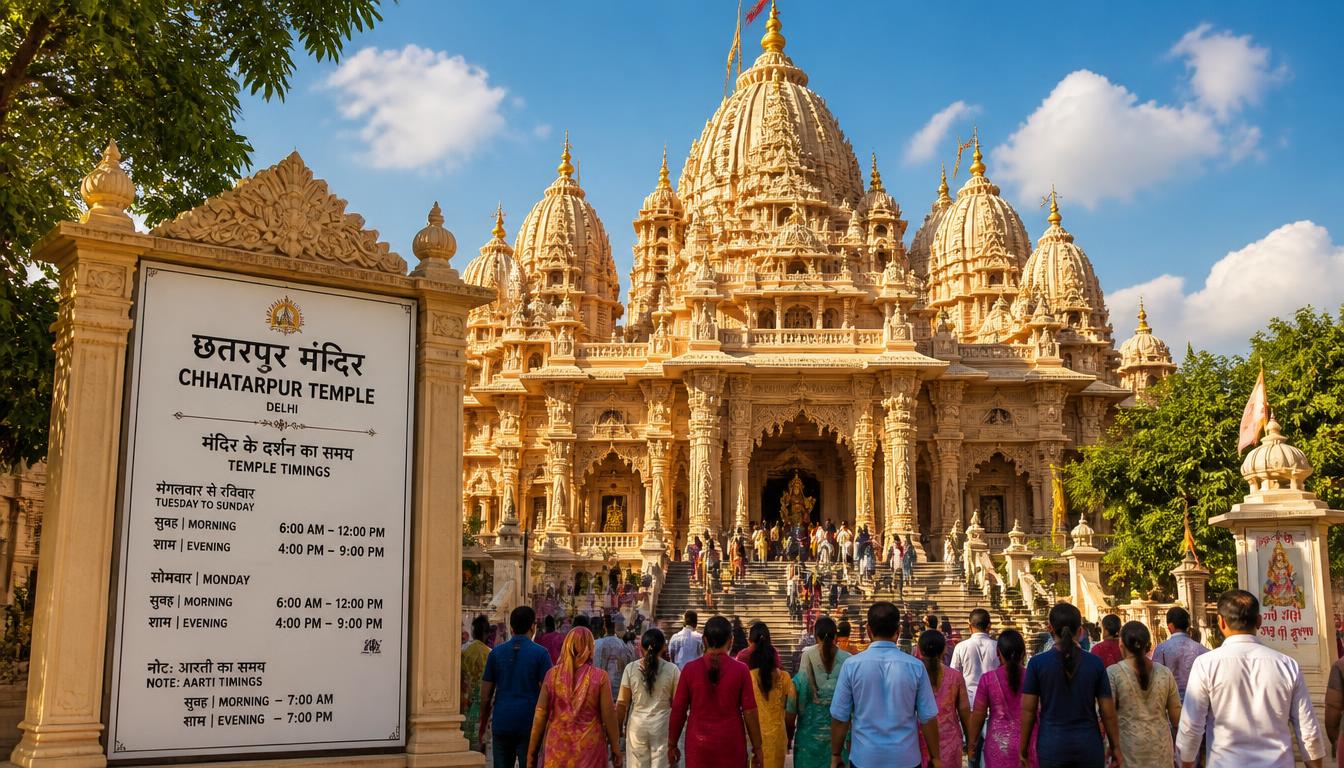
There are some places in Delhi where you don’t simply “go for a visit”; you arrive with a little hope tucked somewhere inside you.
Chhatarpur Temple, formally known as Shree Adya Katyayani Shaktipeeth Mandir, is one of those places.
The white marble, the bells, the long courtyards and the sight of devotees quietly folding their hands can make even a rushed Delhi morning feel strangely slower, for a few minutes at least.
Dedicated to Maa Katyayani, a form of Goddess Durga, the temple complex in South Delhi was developed under the guidance of Baba Sant Nagpal Ji.
The official temple history describes how Baba came to Delhi after years of pilgrimage and gradually developed the Shaktipeeth at Chhatarpur from what was once largely an undeveloped stretch of land. Today, the complex covers about 70 acres and includes several shrines and associated facilities.
But here is the bit many visitors discover only after reaching the gate: Chhatarpur Temple timings 2026 are not as simple as copying one timing table from a random website.
The temple’s official website gives contact-office hours, while its religious-activities page specifically says that the Mandir remains open round the clock during Navratras.
Third-party websites publish different regular darshan and aarti schedules, so it is sensible to confirm the exact arrangement before travelling, specially on a festival day.
If you are searching “What are Chhatarpur Temple timings?” because you want to leave home right now, pause for one minute.
The official website currently lists Monday–Thursday, 6:00 AM–9:00 PM and Friday–Sunday, 10:30 AM–5:30 PM under its contact information, but these appear to be contact/office hours rather than a complete public darshan timetable.
That distinction matters. A number of online guides claim a regular schedule such as 6:00 AM–12:00 PM and 4:00 PM–10:00 PM, while another gives 4:00 AM–12:00 PM and 4:00 PM–10:00 PM.
Because these published schedules disagree, treating any one of them as an unquestionable Chhatarpur Temple opening time would be a bit careless.
For a normal visit, therefore, the most reliable approach is to check the temple’s own updates or call the Trust before setting out, particularly if your plan depends on a particular darshan time, aarti, or pooja.
The official contact page lists the Trust at Chhattarpur, New Delhi-110074, with the numbers +91-011-35060900, +91-011-35060901 and +91-011-35060902.
There is a funny little truth about temple visits: the “best time” is rarely just a number on a clock. If you want quieter surroundings, early morning generally feels more peaceful than a busy festival evening, although the exact access arrangements can change.
A morning darshan can be especially lovely. The air is cooler, devotional sounds are softer, and you can walk through parts of the complex without feeling that half of South Delhi has had the same idea as you. On weekends and major religious occasions, however, even an early visit may become crowded.
For first-time visitors, these practical habits help:
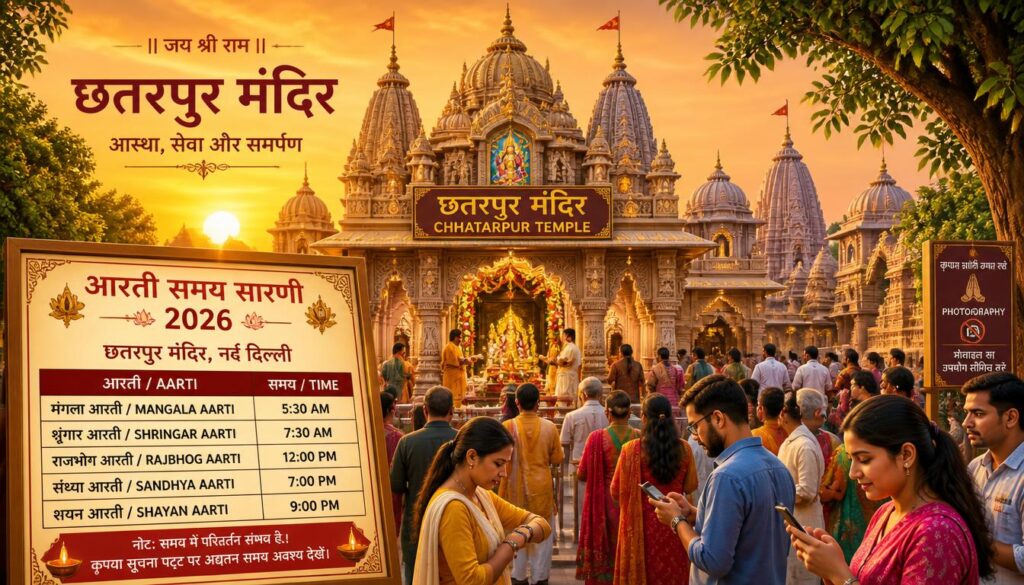
The sound of an aarti has a different character when it rises inside a large temple complex. Bells, lamps, devotional singing and the gathered prayers create an atmosphere that is hard to reduce into a timetable, though of course visitors still need to know when to arrive.
Several third-party guides publish morning and evening aarti times, including schedules around early morning and early evening.
Yet these published timings aren’t consistent with one another, and the official temple website does not currently provide a single year-round public table confirming every daily Chhatarpur Temple aarti timing 2026. So, please don’t treat an internet timetable as guaranteed.
If attending a particular aarti is the whole reason for your trip, call the Trust first and ask specifically about that day’s ceremony.
This tiny phone call can save you from reaching the temple after the lamps have already been waved and everyone is walking away, which is a rather sad way to discover a timing issue.
During major festivals, the rhythm changes again. The official religious-activities page says that Navratras involve daily ceremonies including Havan, Rudrabhishek, Durga Saptsati Path, Ramayan Path, Rath Puja and Lungar Puja, and that the Mandir remains open around the clock during Navratras.
For devotees looking beyond ordinary darshan, the temple’s official website provides a published list of pooja donation rates. This is much more useful than relying on vague social-media posts because the list names the ritual, location, number of people and stated donation amount.
The current published list includes Rudrabhishek with three pandits at the Shiv Gauri Nageshwar Mandir for five persons at ₹4,100, while the listed Sawan-month Rudrabhishek is ₹5,100. A 1,250,000 Mahamrityunjaya Mantra Path with nine pandits is listed at ₹41,000.
These figures are published by the temple and should still be reconfirmed before payment because rates and arrangements can change.
Other listed services include Ramayan Path, Sunderkand Path, Durga Saptsati Path, Shri Vishnu Sahasranam Path, Shri Laxmi Sahasranam Path, Satyanarayan Katha, Shodshopachar Puja, Mundan, and Vehicle Pooja. The official page also lists various langar arrangements and bhog-related services.
This is important for anyone searching “Can I book pooja online?” The official website has a registration facility, but the public pages do not clearly explain a universal online booking workflow for every ritual.
In other words, don’t assume that creating an account automatically means your chosen pooja is booked. Confirm the procedure with the Trust before transferring money.
A good booking enquiry is surprisingly simple. You don’t need a long speech, just the right questions, because temple offices handle many kinds of requests.
Before paying for a special pooja, ask:
The official donation page says that donations once made are not refundable/cancellable on its registration terms, so this is another reason to verify the ritual, date and payment instructions carefully before proceeding.
Calling it merely a “temple” doesn’t quite capture the scale. The official tour of the complex describes shrines associated with Lord Shiva and Maa Parvati, Sankatmochan Hanuman, Sri Ram with Sita and Lakshman, and Sri Radha Krishna, followed by the sanctum of Maa Katyayani, identified as a form of Maa Durga.
The complex also includes the Laxmi Vinayak Temple, langar facilities, the Satsang area, a museum connected with Baba Sant Nagpal Ji, a Yagyashala and other buildings.
The architectural styles are deliberately varied, reflecting influences from different parts of India, so walking around can feel a little like moving through several regional traditions within one campus.
The story of Baba Sant Nagpal Ji is central to the identity of the place. The official account recalls that Baba personally participated in the early construction work, even carrying bricks on his shoulders.
Whatever one’s personal religious belief, that image of a spiritual founder physically helping build the place he envisioned gives the temple’s history a very human texture.
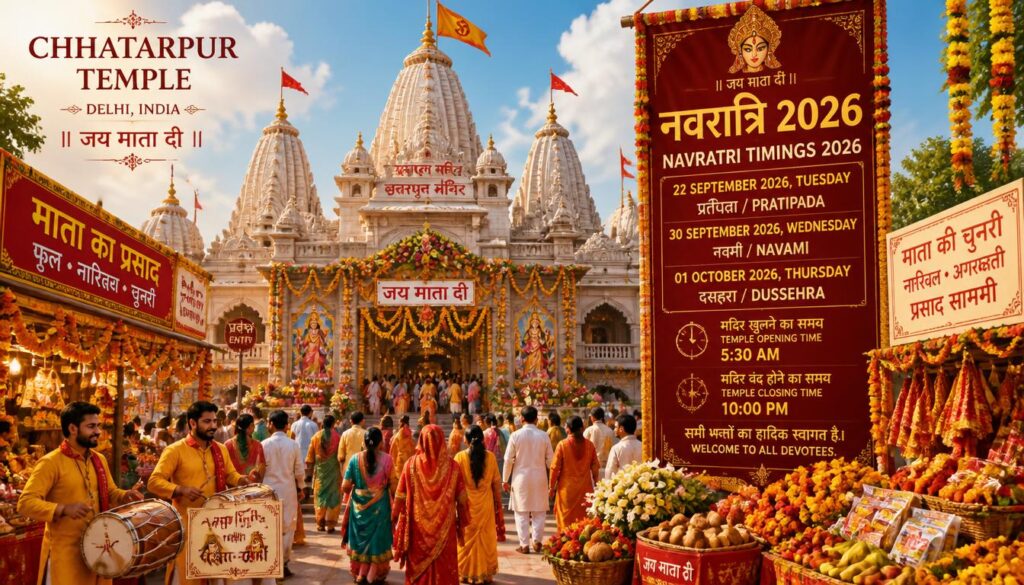
Navratri 2026 deserves its own paragraph, because this is when the temple changes character most dramatically.
The official religious page says both Chaitra and Sharad Navratras are major celebrations, attracting large numbers of devotees, and specifically states that the Mandir remains open round the clock during Navratras.
The official description also mentions a 4 AM daily Shringar of the deity during Navratras, along with Havan, Rudrabhishek, Durga Saptsati Path, Ramayan Path, Rath Puja and Langar-related activities. Cultural programmes are held in the Satsang hall, while free food and prasad are arranged for devotees.
So if you are looking for Chhatarpur Temple Navratri timings 2026, don’t use the ordinary-day schedule as your guide.
Festival arrangements can involve different queues, ceremonies and access patterns, and the official site explicitly describes round-the-clock opening during Navratras.
It is also worth remembering that Navratri is not one single cultural experience across India. In some regions, Durga Puja dominates the atmosphere; elsewhere, Rama Lila and Dussehra traditions take centre stage.
The Chhatarpur temple’s own account recognises these regional variations, which is one reason the festival feels so layered here.
For ordinary darshan, visitors generally come to the temple without purchasing a standard “ticket” in the way one would enter a tourist attraction. But a distinction should be made between general temple entry and paid or donation-based pooja/seva arrangements.
The temple’s official pages emphasise worship, volunteer management, parking, queues and prasad rather than a general admission ticket. If you are specifically booking a ritual, that is a separate matter and may involve a listed donation.
There does not appear to be a complicated uniform dress code published on the official pages, but modest and respectful clothing is the sensible choice.
Think comfortable, clean and suitable for a religious setting, specially if you plan to sit for prayer or participate in a ceremony.
Photography also deserves some common sense. Even where photography is permitted in certain areas, avoid photographing people who are praying, performing rituals or clearly not comfortable being photographed. A sacred moment is not improved merely because somebody put a camera in front of it.
One of the easiest ways to reach the temple is Delhi Metro. The official temple contact page says Chhatarpur Metro Station is at the boundary of the temple complex and that the main Mandir is within walking distance.
For visitors coming by road, taxis, cabs and auto-rickshaws are readily used in Delhi. The temple is in South Delhi, near the Qutub Minar area, and road access makes it practical for families carrying children or elderly relatives.
If you are arriving from outside Delhi, New Delhi Railway Station can be followed by metro or road transport, while Indira Gandhi International Airport provides the nearest major air connection.
Traffic, naturally, has its own spiritual timetable and doesn’t always respect Google Maps, so allow a healthy buffer.
The temple also provides parking. Its official complex guide says visitors can use a free parking lot in the Dharamshala complex across the road and opposite the main Mandir entrance.
Imagine reaching Chhatarpur at around the time you’ve confirmed with the temple. Instead of rushing straight toward the main shrine, give yourself a little breathing room.
First, locate the appropriate entrance and understand where footwear and other belongings should go. Then walk through the complex calmly, visiting the shrines that interest you.
You may encounter Lord Shiva, Lord Hanuman, Sri Radha Krishna, Sri Ram Parivar and other sacred spaces before reaching the principal shrine associated with Maa Katyayani.
If your purpose is pooja, arrive earlier than the required reporting time. If your purpose is only darshan, avoid turning the visit into a race. And if you’re visiting with parents or grandparents, let the older family members set the pace. A temple visit should not become a cardio test, honestly.

For current Chhatarpur Temple contact details 2026, the official Trust page lists:
The temple’s official website is Chhattarpur Mandir official website, and it is the best place to check temple notices, religious activities and current contact information before a special visit.
A little preparation can make the difference between “beautiful morning” and “why did we do this without checking anything?” These small habits are worth keeping:
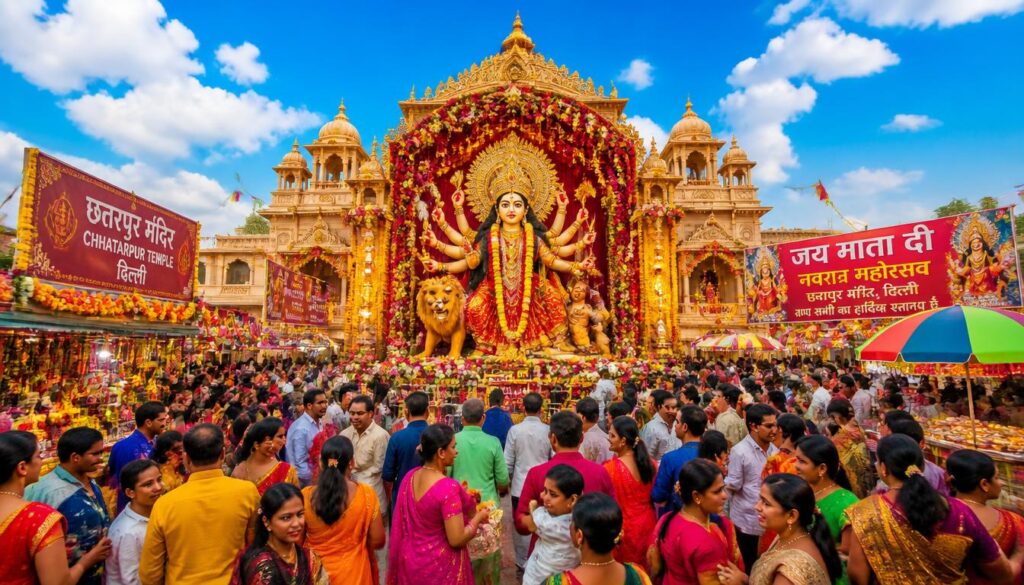
There is something almost theatrical about Navratri at a large Shakti temple, but theatrical in the old, devotional sense rather than a stage-show sense. Lamps glow, flowers appear everywhere, chants travel across courtyards and volunteers keep thousands of tiny practical details moving.
The official temple account says that during Navratras, around 5,000 sewadars assist with langar, shoe stands, parking, queues, security and prasad distribution, while the complex describes very large numbers of devotees taking langar each day.
That community element is perhaps what a visitor remembers longest. You may arrive thinking your purpose is only darshan, but you leave remembering the volunteer who helped your grandmother,
the stranger who showed you where to go, or the sound of a bhajan that somehow stayed in your head all evening.
Chhatarpur Mandir is generally open for darshan from 6:00 AM to 12:00 PM and 4:00 PM to 10:00 PM. Timings may be extended during Navratri and other major festivals.
The daily Chattarpur Mandir timings allow devotees to visit in both the morning and evening. Morning darshan is from 6:00 AM to 12:00 PM, while evening darshan is from 4:00 PM to 10:00 PM.
Chhatarpur Temple remains open throughout the week for devotees. Regular darshan hours are 6:00 AM–12:00 PM and 4:00 PM–10:00 PM.
Entry to Chhatarpur Temple is free, and devotees do not need to purchase a ticket for regular darshan. Voluntary donations are accepted for temple services and maintenance.
The biggest lesson from researching Chhatarpur Temple timings 2026 is actually a simple one: don’t confuse an unofficial timetable with an official guarantee.
Online sources currently publish differing regular darshan and aarti hours, while the temple’s own website provides contact hours and confirms round-the-clock opening during Navratras.
For an ordinary visit, check before travelling. For aarti, confirm the exact ceremony time. For pooja booking, confirm the ritual, date, donation and reporting instructions. For Navratri, prepare for crowds and festival-specific arrangements.
And perhaps go with a little less hurry than usual. A temple visit is not improved by ticking every shrine off a checklist.
Sometimes the most memorable part is simply standing quietly for a moment, hearing the bells, watching the lamps move through the darkness, and letting the mind become still for five minutes.
Whether you come seeking Maa Katyayani’s blessings, accompanying family, attending a Rudrabhishek, joining a Satyanarayan Katha,
exploring the temple’s spiritual heritage, or simply wanting to understand one of the best-known South Delhi temples, Chhatarpur offers much more than a photograph and a location pin.
The timings may change, festival crowds may test your patience, and Delhi traffic will probably have its own opinion.
But if you arrive prepared, respectfully and with enough time, the experience can become one of those small journeys you remember long after you’ve returned home. And that, really, is the nicest kind of temple visit.