Physical Address
304 North Cardinal St.
Dorchester Center, MA 02124
Physical Address
304 North Cardinal St.
Dorchester Center, MA 02124

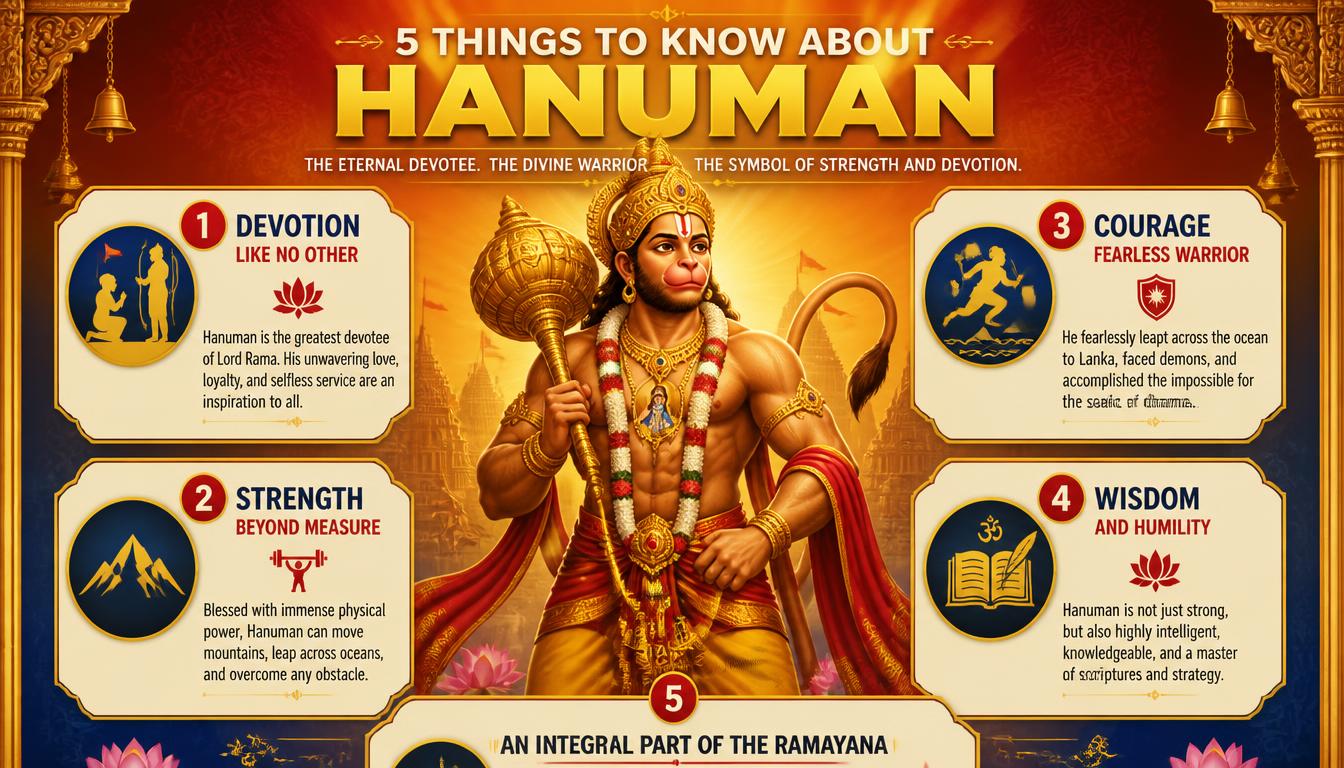
There are some figures in Hindu mythology who are remembered because of great battles, some because of royal power, and some because people feel a strange warmth when their name is spoken. Hanuman belongs to that last group, and also somehow to all the others. He is the mighty warrior, the devoted servant, the wise counselor, and the spiritual figure whose strength never seems separate from humility.
For millions of devotees, Lord Hanuman is not simply a character from the Ramayana. He represents what devotion looks like when it becomes action. His famous relationship with Rama, his fearless search for Sita, his incredible journey to Sri Lanka, and his legendary powers have made his story live for centuries.
But Hanuman is more interesting than the simple image of a powerful monkey warrior. Behind the strength is intelligence. Behind the supernatural abilities is discipline. And behind every dramatic achievement sits one quality that keeps returning again and again: devotion.
Here are five important things to know about Hanuman that help explain why his story remains so powerful.
The first thing to understand about Hanuman is his extraordinary devotion to Rama. His greatness in the Ramayana is not presented as something he uses for personal fame. Instead, his strength, intelligence, speed, and courage become instruments of divine service.
The Sanskrit Ramayana, traditionally attributed to Sage Valmiki, tells the story of Prince Rama, his wife Sita, and his brother Lakshman. When Sita is taken away by Ravana, Rama’s search eventually brings him into contact with Hanuman and the Vanaras.
Their meeting changes the direction of the story.
Hanuman quickly becomes one of Rama’s most trusted companions. What makes their relationship remarkable is that Hanuman does not serve Rama because he expects a reward. His service is almost the reward itself. That’s a powerful idea, especially in a world where people often ask what they will get before asking what they can give.
The relationship between Rama and Hanuman is often described as one of the greatest examples of devotion in Hindu tradition. Hanuman’s loyalty remains steady even when the task ahead appears completely impossible.
When Rama needs help finding Sita, Hanuman accepts the responsibility. When he must cross the ocean, he does not spend his energy explaining why the journey is difficult. He acts.
That quality gives Hanuman a very human lesson beneath all the mythology: courage does not always mean feeling fearless. Sometimes it means remembering who you are serving and taking the next step anyway.
Hanuman’s selfless service is closely connected with the idea of bhakti yoga, the path of loving devotion. In bhakti, spiritual life is not necessarily about becoming distant from the world. It can mean transforming ordinary action into an offering.
Hanuman does exactly that.
Hanuman possesses extraordinary abilities, yet he rarely behaves like someone desperate to prove how powerful he is. His strength stays under the control of devotion and wisdom.
This is one reason Hanuman is often admired as a model of loyalty, dedication, and humility. He can become enormous when the situation demands it, but his personality is not built around showing off.
There is something almost refreshing about that.
A person may have immense talent, but if that talent serves only the ego, it can become destructive. Hanuman’s story suggests another possibility: strength becomes meaningful when it is placed in the service of something greater than oneself.
Hanuman’s devotion is sometimes described through his remembrance of Rama. His mind, speech, and actions repeatedly return to his beloved Lord.
The Hanuman Chalisa, one of the most widely recited devotional hymns dedicated to Hanuman, celebrates this relationship and describes many of his virtues. Devotees recite it as a form of prayer, remembrance, and spiritual practice.
For many people, reciting the Hanuman Chalisa is not only about asking for protection or strength. It can also be a way of slowing down the mind and remembering courage, discipline, and faith.
That may be why Hanuman’s story continues to feel surprisingly close, even after so many centuries.
The second important thing to know about Hanuman is that his birth and childhood are surrounded by fascinating traditions.
Hanuman is traditionally associated with Anjana and Vayu, the wind god. In different Hindu traditions, details surrounding his divine origin vary, and some traditions also connect Hanuman with Shiva, describing him as an aspect or manifestation of Shiva’s divine power.
So, when people search for “Hanuman son of Vayu” or “Hanuman son of wind god,” they are touching an important part of the traditional story.
The connection with Vayu is especially meaningful because Hanuman’s personality is often associated with movement, speed, immense energy, and freedom. Wind cannot easily be held in one place, and Hanuman’s abilities seem to carry that same restless force.
One of the most entertaining episodes from Hanuman’s childhood concerns the sun.
According to a famous tradition, young Hanuman looked toward the sun and thought it resembled a delicious fruit. Being a divine and extraordinarily energetic child, he leapt toward it.
Imagine that scene for a moment: a child looking at the sky, seeing the sun, and deciding that perhaps breakfast is floating up there.
Hanuman reaches toward the sun, and Indra intervenes. Indra strikes him with his thunderbolt, causing Hanuman to fall and injuring his jaw.
The event becomes important because Vayu, angered by what happened to his son, withdraws the wind. The disturbance threatens the balance of the world, and the gods eventually intervene.
Brahma and other divine beings restore Hanuman and grant him blessings and extraordinary abilities.
This childhood story helps explain both Hanuman’s name and his unusual powers.
The traditional explanation of Hanuman name meaning is connected with his jaw. The Sanskrit term hanu can refer to the jaw or cheek, while traditional explanations connect the name with the injury caused during his childhood encounter with Indra.
Thus, the story of the broken jaw is not just a funny childhood episode. It becomes part of the explanation for why he is called Hanuman.
Different linguistic and religious traditions may explain the name somewhat differently, so it is useful not to treat one interpretation as the only possible explanation.
After the childhood incident, Hanuman receives numerous blessings from the gods. These divine gifts contribute to his extraordinary resilience and abilities.
His story therefore begins with an unusual mixture of innocence, divine power, mischief, and destiny.
He is powerful from childhood, but the story also teaches something subtle: possessing ability is not the same as knowing how to use it.
That lesson becomes especially important later in the Ramayana.
The third thing to know about Hanuman is perhaps the most famous: his incredible powers.
Traditional accounts describe Hanuman as possessing extraordinary abilities and, in devotional traditions, the eight siddhis or mystic perfections are particularly associated with him.
These powers are often described as:
The exact descriptions can vary between traditions and texts, so the eight siddhis of Hanuman should be understood within the broader framework of Hindu spiritual literature rather than as a modern list of supernatural abilities.
Hanuman’s ability to change his form becomes particularly important during his journey to Lanka.
At times he becomes enormous, demonstrating mahima. At other moments he becomes extremely small, using anima to move with secrecy and precision.
This ability is more than a spectacular detail.
It reflects Hanuman’s adaptability. He does not insist on using the same approach in every situation. Sometimes strength is required. Sometimes intelligence is better. Sometimes becoming unnoticed is the wisest choice.
That is actually a useful lesson outside mythology too.
Not every problem should be attacked with maximum force.
One of the greatest demonstrations of Hanuman’s powers occurs when he prepares to cross the ocean to reach Lanka.
The distance seems impossible.
For a moment, Hanuman’s own awareness of his abilities is clouded. This brings us to one of the most interesting parts of his story: Hanuman forgot his powers.
According to the traditional story, Hanuman had been cursed to forget his extraordinary powers until someone reminded him of them.
Later, when the Vanaras face the challenge of crossing the ocean, the wise Jambavan, the bear king, reminds Hanuman of his true strength.
Jambavan’s words awaken Hanuman’s memory.
Suddenly, the quiet servant becomes aware of the immense power already within him.
Hanuman expands his body, gathers his energy, and prepares for the legendary leap toward Lanka. The ocean is no longer simply a body of water between him and his goal. It becomes the final boundary between doubt and action.
That moment is one reason the story of Hanuman feels surprisingly relevant today.
Sometimes a person doesn’t need new power. They need someone trustworthy to remind them of the power they already possess.
The fourth thing to know about Hanuman is that his importance in the Ramayana goes far beyond physical strength.
He becomes an essential figure in Rama’s mission to rescue Sita from Ravana’s kingdom.
After reaching Lanka, Hanuman searches for Sita and eventually finds her in the Ashoka grove. His mission is delicate. He must reassure her that Rama is searching for her without creating unnecessary danger.
He identifies himself as Rama’s messenger and gives Sita a sign of Rama’s identity.
This scene demonstrates another side of Hanuman.
The warrior can also be gentle.
The powerful figure can also be sensitive.
And the being capable of immense destruction can also understand when patience is necessary.
After finding Sita, Hanuman’s mission becomes increasingly dramatic. He faces the forces of Ravana and demonstrates his extraordinary strength.
His actions in Lanka eventually lead to the destruction of parts of the city, including the famous episode in which his burning tail becomes an instrument of destruction.
Yet even here, the story is not simply about violence.
Hanuman’s actions are connected with his mission to serve Rama and help locate Sita. His courage has a purpose.
Hanuman also plays a major role when Lakshman is seriously injured during the battle.
He is sent to obtain a life-saving herb from the Himalayan region. Unable to identify the exact herb among the plants, Hanuman lifts the entire mountain and carries it back.
It’s one of those moments where the story seems to say: if the exact answer cannot be found, bring the whole mountain.
That dramatic act has become one of the most recognizable images associated with Hanuman.
It also reflects his determination. He does not allow uncertainty to become an excuse for doing nothing.
The eventual defeat of Ravana belongs to Rama, but Hanuman’s contribution to the entire campaign is enormous.
From finding Sita to gathering intelligence, crossing the ocean, fighting enemies, supporting the Vanara army, and helping Lakshman, Hanuman repeatedly becomes essential to the mission.
His role demonstrates that great achievements are rarely the work of one person alone.
Rama is central to the story, but Hanuman’s service makes the journey possible in many crucial moments.
The fifth and perhaps deepest thing to know about Hanuman is that his strength cannot be separated from his spirituality.
He is not remembered merely because he could fight or leap across oceans. He is remembered because his extraordinary abilities are connected with devotion, discipline, remembrance, and selfless service.
This is why Hanuman is sometimes described as a perfected yogi.
Hanuman has a strong connection with ideas associated with yoga, concentration, discipline, and spiritual absorption.
The modern yoga pose Hanumanasana, commonly known as the splits pose, is traditionally associated with Hanuman’s legendary leap across the ocean.
The pose itself is physically demanding, but its traditional association points toward something deeper: determination, flexibility, courage, and devotion.
Hanuman’s example also fits naturally with bhakti yoga, where love and devotion toward the Divine become a path of spiritual practice.
He does not pursue spirituality by escaping responsibility.
He pursues it through service.
Read Articul: https://templetimingsdaily.com/raksha-bandan/
The image of Hanuman is often associated with meditation, remembrance, and spiritual concentration.
The idea is not that devotion requires dramatic miracles every day. Quite the opposite, actually. Spiritual practice can be built through remembrance repeated again and again.
For Hanuman, remembrance of Rama becomes a kind of inner anchor.
His body can move across enormous distances, but his mind remains centered on the Divine.
That combination of physical action and inner focus is one of the most compelling aspects of his character.
People often turn to Hanuman when they need strength, courage, protection, or confidence.
His story speaks to fear because he repeatedly encounters situations where fear would be completely understandable.
He faces enormous distances, powerful enemies, uncertainty, and impossible tasks.
Yet his courage is not presented as personal arrogance.
It grows from devotion.
This distinction matters.
There is a kind of confidence that says, “I am powerful.”
Hanuman represents another kind: “I will do what must be done because the purpose is greater than my fear.”
That is a much quieter form of strength.
The continuing popularity of Hanuman worship shows how strongly these ideas resonate with devotees.
People visit Hanuman temples, offer prayers, recite the Hanuman Chalisa, observe Hanuman birthday traditions, and seek his blessings for courage and spiritual strength.
For some devotees, Tuesday and Saturday have particular importance for Hanuman worship, although practices vary by region and tradition.
The devotional focus may be different from one household to another.
One family may recite the Hanuman Chalisa together. Another may visit a temple. Someone else may simply sit quietly and remember Rama and Hanuman for a few minutes.
There isn’t always a dramatic ceremony.
Sometimes devotion is very simple.
Among all his qualities, selfless service may be the one that deserves the most attention.
Hanuman possesses strength but does not make strength his identity.
He possesses knowledge but does not use knowledge to humiliate others.
He possesses divine abilities but does not place himself above Rama.
His greatness comes through service.
That is why his story continues to appeal to people who are interested in spirituality, meditation, yoga, and devotional practice, as well as those who simply enjoy the stories of the Ramayana.
There are many gods and divine figures in the vast Hindu pantheon, but Hanuman occupies a distinctive emotional space.
He is simultaneously powerful and humble.
He is a warrior and a devotee.
He is energetic and deeply focused.
He is capable of extraordinary actions, yet his heart remains fixed on Rama.
His story also brings together many major figures of Hindu tradition, including Rama, Sita, Lakshman, Ravana, Vayu, Anjana, and the Vanaras.
Through these relationships, Hanuman becomes more than an isolated character. His story is woven into one of the central narratives of Hindu religious and cultural tradition.
And perhaps that’s why people keep returning to him.
Not only for the miracles.
For the character.
If you want to reduce the entire story to five simple ideas, these are the ones worth carrying with you:
These five points make it easier to understand why Hanuman is much more than a powerful figure from an ancient epic.
The most memorable lesson from Hanuman may be that real strength does not always announce itself.
Sometimes strength looks like crossing an ocean.
Sometimes it looks like carrying a mountain.
And sometimes it looks like quietly doing your duty when nobody is watching.
Hanuman teaches that devotion and courage can work together. Wisdom does not make strength weaker, and humility does not mean lacking confidence.
His story suggests that the greatest abilities become meaningful when they are used for a purpose beyond the self.
That idea is perhaps why his image has survived for generations, moving from ancient Sanskrit stories into temples, homes, devotional songs, yoga traditions, paintings, festivals, and everyday prayers.
Hanuman is a revered Hindu deity known for his extraordinary strength, courage, wisdom, and unwavering devotion to Lord Rama.
Hanumanji is a respectful and affectionate name for Lord Hanuman, especially commonly used by devotees in India and during prayers and worship.
Lord Hanuman is a central figure in the Ramayana, celebrated as Rama’s devoted servant, a fearless warrior, and a symbol of selfless service.
God Hanuman is worshipped as a divine figure associated with strength, protection, courage, devotion, and spiritual discipline in Hindu traditions.
Traditional Hindu beliefs generally do not describe Hanuman as having died like an ordinary human; he is often regarded as Chiranjivi, an immortal being who continues to exist.
The story of Lord Hanuman is ultimately a story about what happens when immense ability is guided by an even greater devotion.
He is the child who reaches for the sun, the divine figure who receives extraordinary blessings, the warrior who crosses the ocean, the servant who searches for Sita, and the devotee whose heart remains devoted to Rama.
His story contains supernatural powers, yes, but its deepest message is surprisingly grounded.
Be courageous.
Remember your purpose.
Serve without constantly asking for recognition.
And when you forget your own strength, perhaps you only need someone wise, like Jambavan, to remind you that it was there all along.
That is one of the beautiful reasons Hanuman continues to inspire devotees and readers across generations. His greatest power was never simply the ability to become larger, faster, or stronger. It was his ability to place every gift he possessed in the service of devotion.
And perhaps that is the real lesson hidden inside these 5 things to know about Hanuman: strength becomes truly powerful when the heart knows what it is serving.