Physical Address
304 North Cardinal St.
Dorchester Center, MA 02124
Physical Address
304 North Cardinal St.
Dorchester Center, MA 02124

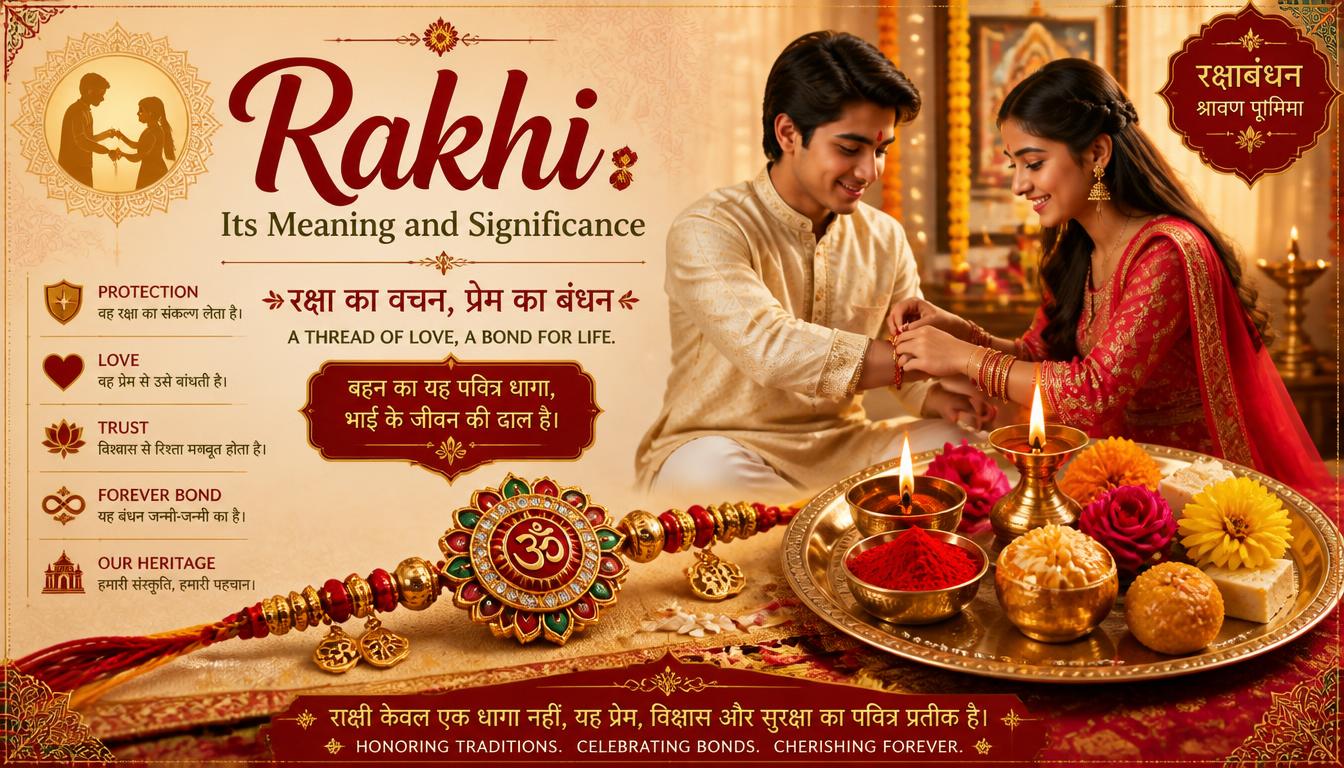
There are some festivals that arrive with loud celebrations, gifts, sweets, and crowded family gatherings. Rakhi, however, can feel surprisingly simple. A tiny thread is placed around a wrist, a tilak touches the forehead, prayers are whispered, and suddenly an ordinary family moment carries a much bigger meaning.
The heart of Raksha Bandhan is the relationship between people who promise to care for one another. Traditionally, a sister ties the sacred thread on her brother’s wrist and prays for his well-being,
while the brother expresses a commitment to care, respect, and support. Yet the meaning of Rakhi has grown wider over time. It can speak about family, trust, responsibility, affection, and even the idea that people should protect one another.
The festival is observed on Shravana Poornima, the full moon day of the Hindu lunar month of Shravana. In 2026, Raksha Bandhan was observed in India on August 28, although local religious calendars can differ when determining the precise ritual timing.
So, what does that little thread actually mean? The answer is more beautiful than simply saying, “It means protection.”
The word Raksha Bandhan is commonly understood through two ideas: raksha, meaning protection, and bandhan, meaning bond or binding. A Rakhi therefore becomes a visible symbol of a promise, not just a decorative bracelet tied for the occasion.
Its traditional meaning is closely connected with a bond of protection, but protection here can be understood in a wider emotional sense. A brother may protect his sister, while a sister also stands beside her brother through difficult days. It is really about mutual care, even if the ritual has traditionally been described through the language of a brother’s responsibility.
The thread says something without speaking: “I am connected to you.” That may sound simple, but families know that simple things can sometimes carry the heaviest feelings.
The meaning of Rakhi also includes love, care, respect, responsibility, and trust. The physical thread eventually breaks or is removed, but the relationship it represents is expected to continue.
The Raksha Bandhan meaning becomes clearer when the festival is viewed as more than a single ceremony. It is a reminder that relationships survive through actions, not only through words.
A sibling may live in another city, have a completely different personality, or spend most of the year busy with work and studies. Still, when Rakhi arrives, an old emotional door opens again. Sometimes that is what family festivals do best.
The significance of Raksha Bandhan can therefore be understood through several connected ideas:
That last idea is especially interesting. The festival has never been only about a piece of thread. In different communities and periods, its symbolism has been connected with friendship, social unity, spiritual protection, and collective responsibility.
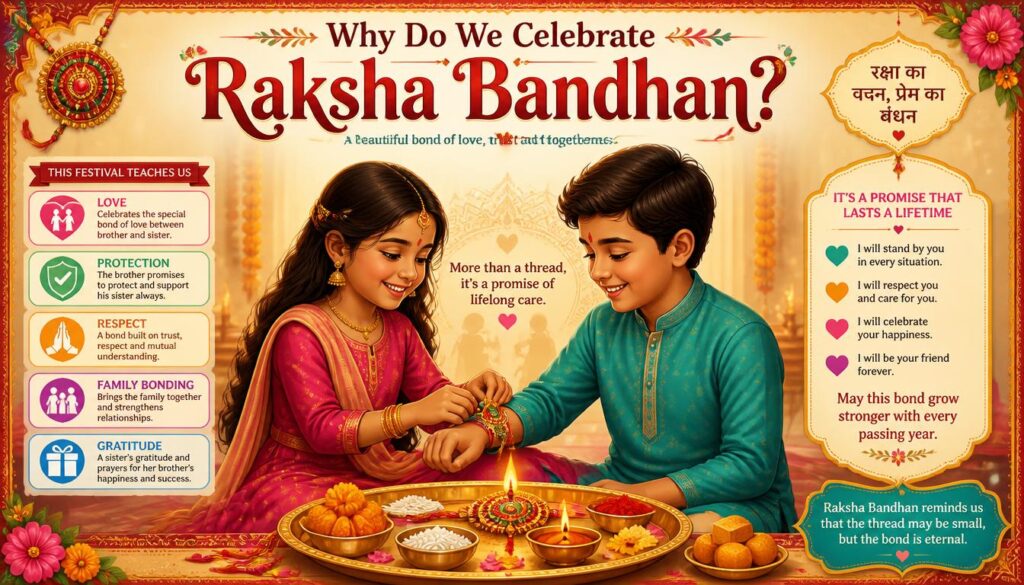
The question why do we celebrate Raksha Bandhan has more than one answer because the festival has developed through many traditions, stories, and regional customs.
For many families, the immediate answer is beautifully uncomplicated: siblings celebrate their relationship. A sister ties the Rakhi, performs the customary rituals, offers prayers, and her brother responds with affection, a gift, blessings, or a promise of support.
But the festival also falls on Shravana Poornima, a day associated with several religious observances across India. This means Raksha Bandhan exists within a much larger cultural and religious calendar.
The festival can therefore be understood on two levels. One is intimate and family-centered; the other is cultural and spiritual. The first is about my brother and my sister. The second asks a wider question: How should people care for one another?
A typical Rakhi tying ceremony is not complicated, although individual families naturally follow their own customs.
A traditional Rakhi thali may contain the Rakhi, roli or kumkum, rice or akshat, sweets, flowers, and a diya. Some families include additional items according to their regional or household traditions.
The sister may begin by applying tilak to her brother’s forehead. She then ties the sacred thread around his wrist while offering prayers for his health, happiness, and well-being.
An arati may follow, and sweets are shared afterward. The brother may give his sister a Rakhi gift, although the gift itself is not the heart of the ceremony.
The most meaningful gift can be much smaller than something wrapped in expensive paper. A phone call, a sincere apology, a promise to stay connected, or simply sitting together for an extra half-hour can sometimes say much more.
Why a thread?
That is one of the charming things about Rakhi. A thread is physically weak, yet symbolically powerful. It can snap with very little force, but it represents a relationship expected to withstand years of distance, arguments, changes, and growing responsibilities.
The sacred thread is therefore symbolic rather than a literal protective object. Its importance comes from the intention behind tying it.
The thread of protection can represent a prayer: may you remain safe, healthy, and happy. It can also represent a promise: when life becomes difficult, I will not forget you.
This is where the spiritual significance of Rakhi becomes noticeable. The ritual gives physical form to an invisible emotional connection.
The familiar sequence of Raksha Bandhan rituals creates a small ceremonial world inside the home.
First comes preparation. The family arranges the Rakhi and other puja items. Then the brother and sister sit together, often after bathing and wearing clean or festive clothes according to family custom.
The sister applies tilak to the brother’s forehead and places rice as part of the customary ritual. She then ties the Rakhi while praying for his well-being.
Afterward, an arati may be performed, followed by sweets and the exchange of gifts. Contemporary families may modify the ritual, and there is no single household version followed by everyone.
The important element is intention. The ceremony is supposed to express affection and responsibility, not become a competition about who bought the costliest gift. That part, thankfully, is not written on the thread.
Raksha Bandhan takes place during Shravana, a month considered important in many Hindu traditions. The full moon day is known as Shravana Poornima or Rakhi Poornima in contexts associated with Rakhi.
The same full moon day has different names and observances in different parts of India. This regional variety is one of the reasons the festival is culturally richer than a simple brother-sister celebration.
In parts of western India, the day is associated with Nariyal Poornima or Narali Purnima, particularly among coastal and fishing communities. Offerings of coconut to the sea are associated with Varuna, the deity connected with water and oceans.
In parts of South India, the same period is associated with Avani Avittam and Upakarma, involving traditional sacred-thread observances in communities that follow them.
So one full moon can hold several cultural meanings at once. That is rather lovely, actually.
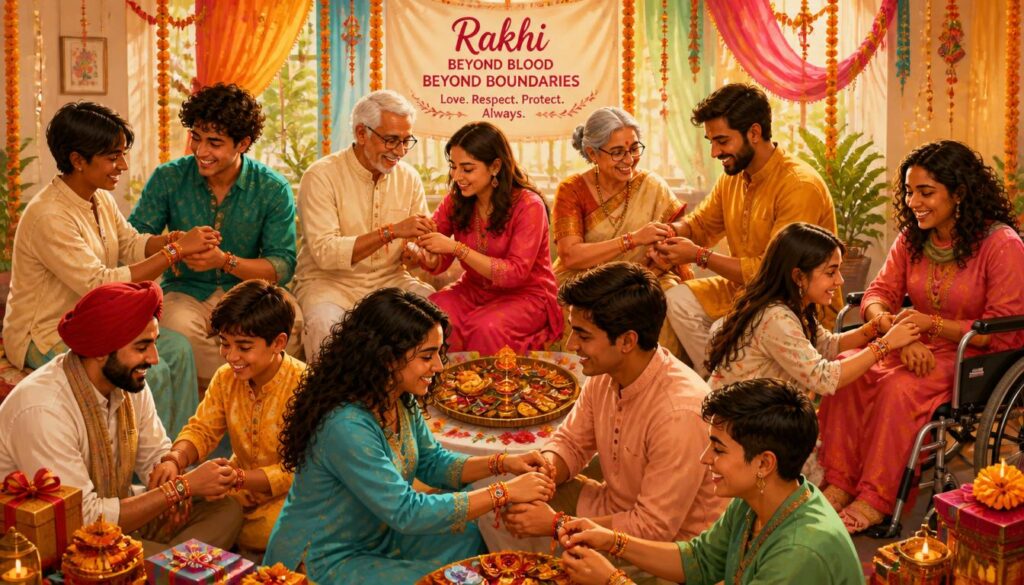
Although the brother and sister relationship remains central to modern Rakhi celebrations, the symbolism of Rakhi can extend further.
Some communities and families have used the idea of tying a protective thread to express friendship, solidarity, respect, or a broader social connection. The emotional principle remains similar: I value this relationship, and I wish for your well-being.
Rakhi can therefore become a symbol of universal brotherhood and universal sisterhood when its message is understood beyond biological relationships.
Friends may celebrate together. Adopted siblings may share the ceremony. People who have grown up like siblings may consider themselves family even without a blood relationship.
That broader interpretation does not erase the traditional brother-sister meaning. Instead, it shows how the idea of protection can travel beyond family boundaries.
A particularly broad philosophical connection can be made with the Sanskrit idea Vasudhaiva Kutumbakam, commonly translated as “the world is one family.”
Raksha Bandhan is not itself simply a festival about this phrase, but the concept offers a useful way of understanding the festival’s wider message.
If a thread can symbolize responsibility toward one loved one, the same principle can inspire responsibility toward other people, communities, and even nature.
This is why ideas such as compassion, mutual protection, social unity, and harmonious relationships often appear alongside discussions of Rakhi.
The thread begins on one wrist, but its meaning does not have to stop there.
One of the more interesting extensions of the festival is Vriksha Raksha Bandhan, or the idea of tying a protective thread to trees.
Some environmental and community initiatives have used Rakhi symbolism to encourage tree protection and care for nature. A Rakhi tied to a peepal tree, Tulasi plant, or another valued plant transforms the traditional symbolism into an environmental message.
The idea is simple: if we speak about protection on Raksha Bandhan, why should protection only mean protecting people?
Trees provide shade, oxygen, habitats, food, and ecological benefits. Caring for them gives the symbolism of Rakhi a practical direction.
This interpretation should be understood as an extension of Rakhi’s symbolism rather than a single universal ritual followed by every Hindu family.
Several stories are connected with the Raksha Bandhan mythology, although they belong to different textual and cultural traditions and should not be treated as one single historical origin story.
One traditional account involves Indra, the King of Devas, and the conflict with Vritra Asura. In versions associated with the Bhavishya Purana, a protective thread is connected with the prayers of Indra’s wife, Sachi Devi, and the guidance of Brihaspati.
The story presents Raksha as something connected with divine protection during danger. It helps explain why protective-thread symbolism appears in religious traditions beyond the modern sibling ceremony.
Another set of traditions connects protective threads with religious rituals, vows, and blessings. These stories show that the symbolism of a thread can be much older and broader than today’s familiar Rakhi ceremony.
Mythological traditions can vary considerably by source and region, so it is better to appreciate them as part of the festival’s rich religious lore rather than insisting that one story alone explains its complete origin.
Protective-thread traditions are also found in stories and rituals involving Hindu deities such as Lord Shiva and Goddess Parvati.
Across Hindu religious practice, sacred threads can represent vows, blessings, ritual protection, or a person’s participation in a ceremony. The symbolism of Raksha therefore has a larger religious background.
This is one reason the religious significance of Raksha Bandhan cannot be reduced to a modern exchange of gifts.
The thread has a long symbolic vocabulary: protection, sanctity, prayer, commitment, and connection. Rakhi inherits some of that emotional and ritual language while developing its own strong identity around family relationships.
People sometimes mention stories involving Alexander and Purushottam, or Rani Karnavati and Emperor Humayun, when discussing the history of Raksha Bandhan.
These stories are popular in discussions of the festival, but their historical status is not as straightforward as the stories sometimes suggest.
The account involving Alexander’s wife and the Hindu King Purushottam is often repeated as an example of Rakhi’s protective symbolism, but historians have questioned whether the episode provides reliable evidence for the origin of Raksha Bandhan.
Likewise, the story of Rani Karnavati of Chittor sending a Rakhi to Humayun is widely circulated in popular histories. However, historians have disputed aspects of the account, and it should not be presented as firmly established historical fact.
This distinction matters. A beautiful story can have cultural importance without being proven history.
The festival’s significance does not depend on proving either story. Its living traditions are already deeply rooted in families and communities across India.
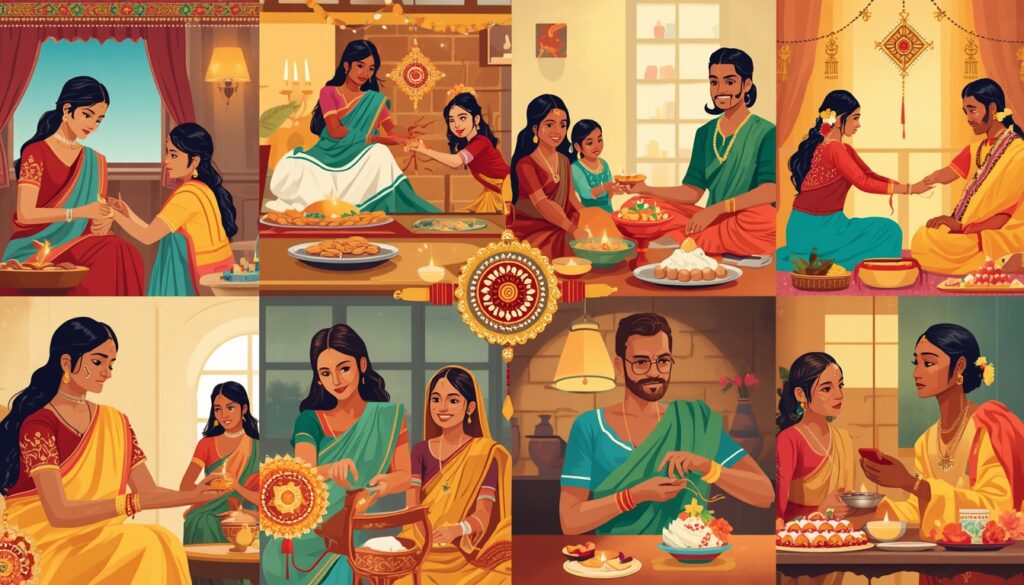
One of the most fascinating parts of Rakhi is how differently the same full moon day can be experienced across different states of India.
In western coastal areas, Nariyal Poornima emphasizes the relationship between communities, the sea, and Varuna. In South India, Avani Avittam and Upakarma have their own religious and sacred-thread traditions. In northern regions, Rakhi Poornima and related observances are celebrated through local customs.
This regional diversity reminds us that Indian festivals are rarely one-size-fits-all.
The same date can carry different names, foods, prayers, ceremonies, and memories depending on where a family lives. Yet the common themes of renewal, connection, protection, and community can still be recognized.
The phrase Rakhi beyond brother and sister is increasingly useful for understanding contemporary celebrations.
A person may tie a Rakhi to someone who has become like a brother through years of friendship. Another family may include a cousin, adopted sibling, or close family friend.
There are also traditions involving a Guru and disciple, where sacred threads and ritual bonds have their own meanings.
The important thing is not to flatten all these relationships into one identical ritual. Each has its own cultural context. Rather, they demonstrate how the symbolism of a protective bond can adapt to real human relationships.
Rakhi ultimately asks people to recognize the relationships that give life emotional strength.
Not really.
If Rakhi were only about protection, the festival would miss half its emotional story. Protection without affection can become duty; affection without responsibility can become temporary.
The deeper Rakhi significance lies in combining the two.
There is love, but also responsibility. There is celebration, but also remembrance. There is a gift, but also gratitude. There is a ritual, but also a relationship behind it.
That is why the festival can feel meaningful even to siblings who joke around all year and pretend they don’t care much.
They care. They just have a very strange way of showing it sometimes.
The spiritual significance of Rakhi can be understood through the intention behind the ritual.
A prayer for another person’s health is an act of care. A promise to remain supportive is an act of responsibility. Remembering a sibling after months apart is an act of gratitude.
In this sense, Rakhi encourages positive qualities such as compassion, patience, respect, and generosity.
Traditional Hindu thought often places importance on purity of thought, word, and deed. While families may interpret the festival differently, Raksha Bandhan can be a practical reminder to bring those values into everyday relationships.
The sacred thread is visible for a short while. The behavior it inspires is supposed to last much longer.
Modern Rakhi celebrations may look very different from those of grandparents or great-grandparents.
Siblings living in different countries may celebrate through video calls. A Rakhi may arrive in the mail weeks before the festival. Digital gifts, online shopping, photographs, and virtual family gatherings have become normal parts of contemporary celebrations.
Yet the central emotion has not necessarily disappeared.
A sister tying a Rakhi through a video call may still feel the same happiness as someone sitting beside her brother. A brother sending a gift online may still be expressing affection. Technology changes the method, but it does not automatically erase the meaning.
Sometimes a screen is the only bridge available, and bridges are useful things.
The importance of Raksha Bandhan is perhaps easiest to see in ordinary family life.
Sibling relationships are not always smooth. Brothers and sisters argue, tease each other, compete, borrow things without asking, and occasionally remember every embarrassing childhood story at exactly the wrong moment.
Rakhi creates a pause in all of that.
For one day, the relationship is deliberately celebrated. People remember childhood, relatives who are no longer present, old family homes, shared festivals, and countless tiny memories that nobody thought were important at the time.
That emotional remembering is part of the festival’s real value.
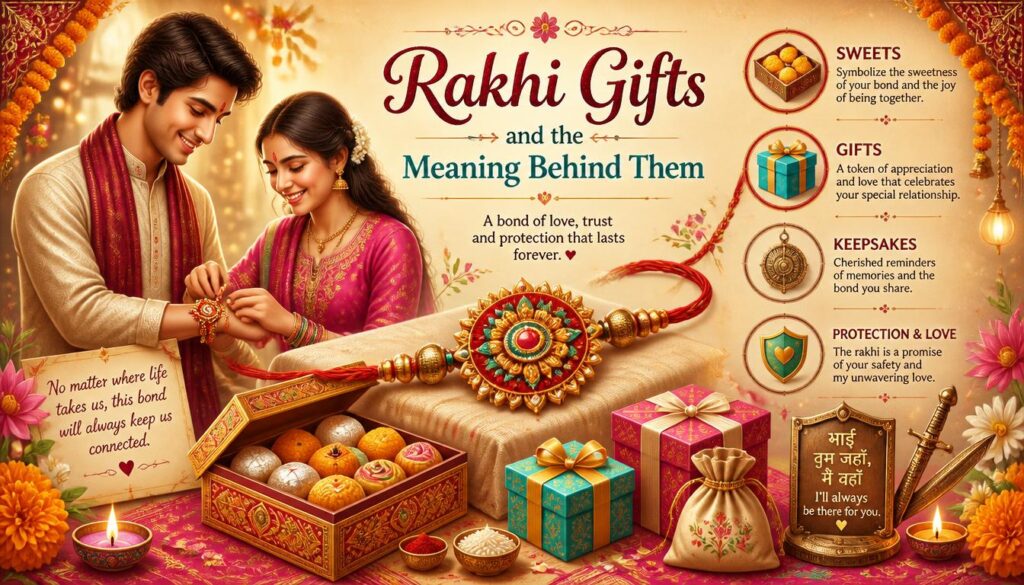
A Rakhi gift can be traditional, practical, personal, or wonderfully simple.
Some people choose clothes, books, jewelry, sweets, electronics, or money. Others give something handmade or plan an experience together.
There is no universal requirement that the gift must be expensive. The stronger principle is thoughtfulness.
A gift that reflects a sibling’s personality can carry more emotional meaning than something purchased simply because it looks impressive.
Maybe your brother has wanted a particular book for six months. Maybe your sister needs a quiet day rather than another decorative item. Maybe the best gift is taking them out for tea and actually listening.
Rakhi is about the person, not the price tag.
A meaningful Rakhi celebration does not need a huge arrangement.
You can keep the traditional ceremony while adding one personal element. Write a short note about a childhood memory. Mention something you genuinely admire about your sibling. Give a photograph from years ago. Cook a favorite family dish.
Another beautiful idea is to make one promise that is realistic rather than dramatic.
Instead of saying, “I will always solve every problem for you,” say, “I will make sure you never have to face a difficult time completely alone.”
That kind of promise sounds smaller, but perhaps it means more because a real person can actually keep it.
At its heart, Rakhi represents a relationship made visible.
The thread is small. The promise can be large.
It represents love without needing a long speech. It represents care through a simple ritual. It represents respect between family members. It represents protection, but also mutual support and responsibility.
And when the festival is viewed through ideas such as universal brotherhood, universal sisterhood, and Vasudhaiva Kutumbakam, its message becomes even wider: people are stronger when they treat one another as worthy of care.
That is perhaps why Rakhi has remained emotionally relevant despite changing lifestyles.
Rakhi Purnima is another name for Raksha Bandhan, celebrated on the full moon day of the Hindu month of Shravana. It celebrates the bond of love, care, and protection between siblings.
Rakshabandhan ka mahatva is the celebration of love, protection, and respect between brothers and sisters. The Rakhi symbolizes a sacred bond and the promise to care for one another.
Raksha Bandhan is celebrated to honor the special bond between brothers and sisters. On this day, sisters tie Rakhi on their brothers’ wrists and pray for their health, happiness, and long life.
रक्षाबंधन is celebrated on the full moon day of the Shravana month according to the Hindu lunar calendar. The exact date changes each year according to the lunar calendar.
Read more: https://templetimingsdaily.com/dharmasthala-manjunatha-temple-timings-today/
Raksha means protection or safety. In Raksha Bandhan, it represents the promise of care, support, and protection between loved ones.
The true meaning of Rakhi is not locked inside the thread itself. It lives in the intention with which the thread is tied.
It is found in a sister’s prayer, a brother’s promise, a mother’s smile, a family’s gathering, a childhood memory suddenly remembered, and even in the quiet moment after everyone has finished the sweets.
Raksha Bandhan reminds us that relationships need more than affection. They need respect, responsibility, patience, and presence. The festival may have deep roots in Hindu traditions and Shravana Poornima, but its emotional language is easy to understand: care for the people who matter to you.
And perhaps that is the loveliest part of Rakhi.
A thread may sit around the wrist for a few days. The bond it represents can sit in the heart for a lifetime.