Physical Address
304 North Cardinal St.
Dorchester Center, MA 02124
Physical Address
304 North Cardinal St.
Dorchester Center, MA 02124

Planning a visit to Sri Kalahasti Temple can feel exciting right up until the moment you begin wondering about tickets, pooja slots, ID requirements, and which booking page you’re actually supposed to use. A spiritual journey should begin with devotion, not fifteen browser tabs and a payment screen that leaves you confused.
Thankfully, much of the planning can be handled before reaching Srikalahasti. Depending on the service and current availability, pilgrims may be able to arrange darshan booking, Rahu Ketu Pooja booking, special sevas, and related services through the authorized booking system. Still, temple schedules, ticket categories, prices, and online availability can change, so checking the current official information before paying is really important.
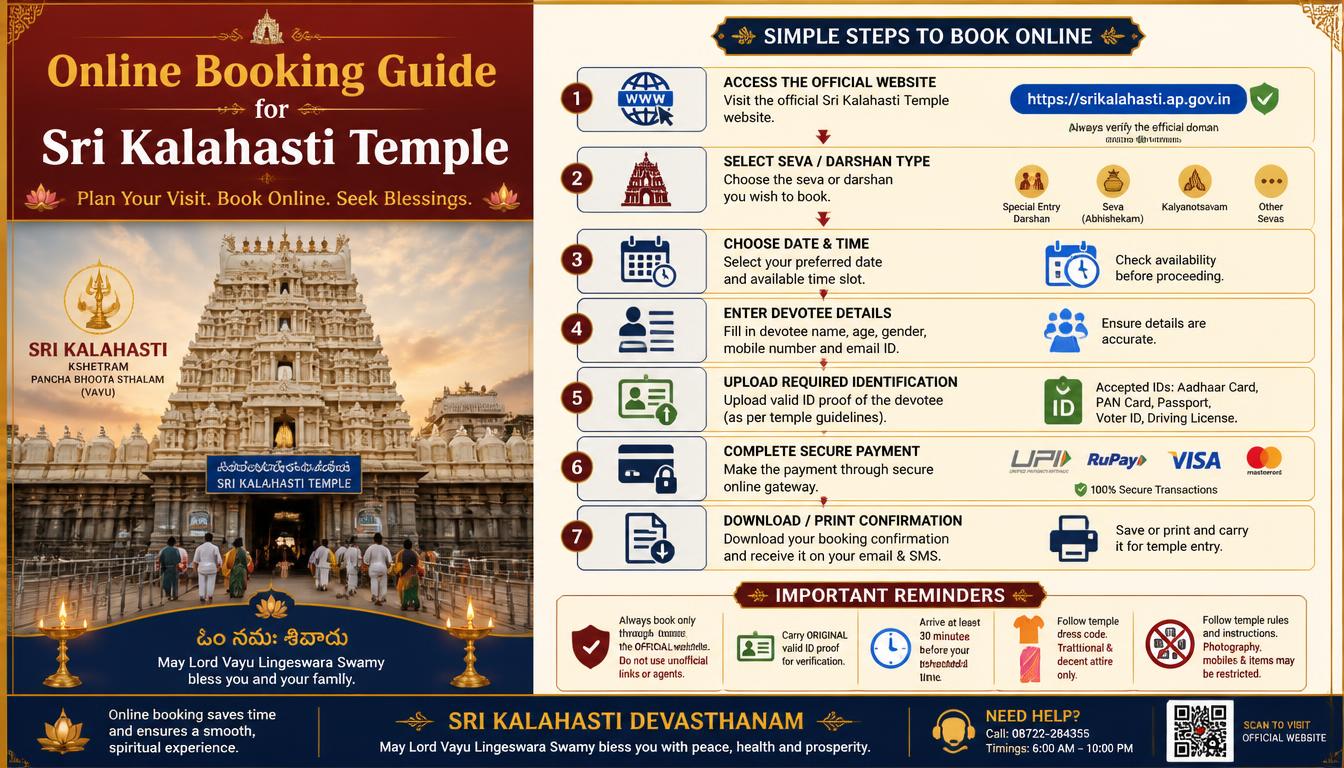
This Online Booking Guide for Sri Kalahasti Temple walks through the process in practical language—from choosing a service and entering devotee details to payment, OTP verification, downloading an e-ticket, and preparing for entry. Keep this guide beside you while booking; it may save a surprising amount of back-and-forth.
Sri Kalahasti Temple online booking is intended to make pilgrimage planning more predictable. Rather than reaching the temple and only then discovering whether a particular pooja or seva has availability, devotees can check applicable options beforehand and plan their day around the confirmed service.
The temple is also known as Sri Kalahastheeswara Swamy Vari Devasthanam and is one of the prominent Shiva temples visited by pilgrims in Andhra Pradesh. Rahu Ketu Pooja is particularly associated with Srikalahasti, which is why its booking information gets so much attention online.
Depending on the current system, temple-related services may be presented through the Srikalahasti Devasthanam, an authorized official booking portal, or relevant AP Endowments services. Do not assume that every website appearing high in search results is an official ticketing site. That tiny distinction can save both money and headache.
Before proceeding with payment, verify the domain and booking information through current official temple or Andhra Pradesh Endowments sources. Ticket rules can be revised, especially around festivals and high-demand dates.
Not every visitor needs the same ticket. One family may simply want darshan, another may specifically travel for Rahu Ketu Pooja, while somebody else is looking for Rudrabhishekam or accommodation.
Common categories visitors should look for include:
The exact services offered online can vary. A ritual being performed at the temple doesn’t automatically mean it can always be reserved digitally, which is one of those little details pilgrims sometimes discover too late.
The actual screens can change over time, but the underlying booking process is generally straightforward. Keep your identification, phone, email, and payment method ready before starting so the session doesn’t sit idle while you’re hunting through a drawer for an ID card.
Begin from the current official temple or government-authorized booking source. Look for Srikalahasti Devasthanam, the relevant AP Endowments Portal, or another officially identified booking service.
Avoid paying through an unknown website merely because its page title says “official.” Search-result titles can say almost anything these days, sadly.
Choose the service you actually intend to attend. Depending on what is presently offered, categories could include darshan booking, Rahu Ketu Pooja booking, seva booking, or accommodation.
Read the description attached to the service before continuing. The ticket may have conditions concerning the number of people covered, reporting time, dress expectations, or identification.
Select your intended date and check the available slots. If multiple available time slots appear, pick one that realistically works with your travel schedule.
Don’t select the earliest slot simply because it looks convenient on screen. Consider how long it will take to reach Srikalahasti, park or arrive from the station, deposit restricted belongings, and complete security procedures.
The portal may ask for pilgrim details such as the devotee’s name, age or date of birth, gender where applicable, mobile number, email ID, and identification details.
Enter names exactly as they appear on the identification you’ll carry. A casual spelling shortcut seems harmless at home, but it becomes much less cute when ticket and ID details don’t match at verification.
Keep a valid photo ID nearby. Depending on the applicable booking rules, accepted identification may include an Aadhaar Card, Passport, Voter ID, or another permitted government ID.
For overseas visitors, a passport is generally the most relevant identification document to keep ready. Always follow whatever ID instructions are displayed for the particular service you’re booking.
Some online systems use OTP verification to confirm a mobile number or transaction. Enter the OTP carefully and don’t repeatedly request new codes unless necessary, because older codes can become invalid.
If an OTP doesn’t arrive immediately, wait a little, check network reception, and use the resend option when available.
Proceed through the authorized payment gateway. Available online payment methods may vary and can include UPI, cards, or net banking depending on what the portal currently supports.
Never refresh the browser in panic while the payment is being processed. Payment gateways sometimes need a few extra seconds to return confirmation, and repeated clicks can make an already nervous moment even more confusing.
After successful payment, look for the booking confirmation, booking number, transaction ID, and ticket download option.
Download the e-ticket PDF immediately if provided. Save another copy on your phone or email, and consider carrying a printed ticket too. Batteries have a funny habit of becoming philosophical about life precisely when a QR code is needed.
Preparing your documents beforehand makes online ticket booking considerably easier. Requirements can differ according to the ticket or service, but basic booking preparation usually means keeping identification and contact details accessible.
Useful items to have ready include:
Don’t rely solely on a screenshot cropped so tightly that the booking number or pilgrim name disappears. Save the complete ticket wherever possible.
For many visitors, Sri Kalahasti Rahu Ketu Pooja online booking is the part requiring the most careful planning. The temple is widely associated with rituals involving Rahu and Ketu, and pilgrims often visit specifically for this purpose.
When a Rahu Ketu Pooja online booking option is officially available, first check the date, ticket category, number of persons covered, reporting instructions, and slot details. Don’t assume that one ticket automatically covers an entire family unless the booking terms explicitly say so.
Devotees traditionally seek this ritual in connection with astrological concerns or planetary doshas. Whatever your personal reason for attending, following the temple’s actual procedure matters more than random instructions copied from an old travel blog.
Keep your Rahu Ketu Pooja tickets, booking reference, and original ID ready on the day. Arriving comfortably before the reporting time is far nicer than sprinting toward a temple counter while trying to open a PDF on weak mobile data.
Pilgrims researching Sri Kalahasti darshan online booking may encounter references to general darshan, Sheeghra Darshan, special-entry arrangements, Antharalaya Darshanam, or seva-linked access. Availability and terminology can change, though, so the current official listing should decide what you book.
Some rituals, including Abhishekam, Rudrabhishekam, and other special sevas, may have their own reporting conditions. A seva ticket shouldn’t be treated as interchangeable with an ordinary darshan option.
Before paying, check whether the service includes darshan access, how many devotees are covered, where reporting takes place, and what time you’re expected to arrive. Five minutes of reading here can prevent an hour of confusion there.
Popular dates can fill faster than ordinary weekdays. Weekends, Maha Shivaratri, Brahmotsavam, Karthika Pournami, Sankranti and other significant religious or holiday periods can bring much heavier pilgrim traffic.
If the portal operates an advance booking window, use the currently displayed calendar rather than assuming an old “30-day” or “60-day” rule still applies. Booking windows can be revised.
If your preferred slot isn’t available, check another time on the same date or a nearby date. A little flexibility is often more useful than refreshing the exact same sold-out slot forty-seven times, which we’ve all probably done with some booking website.
An online reservation isn’t complete merely because money left your bank account. You need an actual ticket confirmation or confirmed booking status.
Depending on the gateway, available methods may include:
If a transaction failed but the amount debited from your account, don’t immediately make several additional payments. First check your booking history, SMS, email, and transaction status.
Save the transaction ID and payment reference. If no ticket is issued and the booking remains unsuccessful, follow the official support or payment-reversal procedure shown by the portal or your payment provider.
A bank debit notification by itself is not an e-ticket issued confirmation. That distinction is small on paper but quite large when you’re standing at the temple entrance.
Online booking systems sometimes choose the least convenient moment to behave strangely. Fortunately, several ordinary problems have equally ordinary fixes.
If OTP not received appears to be the issue, check your number, mobile signal, SMS inbox, and the resend option. Avoid requesting codes continuously because multiple OTPs can cause confusion.
For a session expired message, restart the process rather than repeatedly using the browser’s back button. Have your details ready beforehand so the next attempt moves faster.
If a payment gateway redirect loop occurs, confirm that your connection is stable. Trying a current browser or a clean browser session can sometimes help, but don’t make duplicate payments while an earlier transaction is still unresolved.
A slot disappeared during checkout usually means availability changed before the transaction was finalized. Return to the slot selection screen and look for a neighbouring time or date.
For a wrong name, date, or other ticket detail, don’t simply edit a screenshot or PDF. Check the official correction, cancellation, or support policy because ticket details may be linked to identity verification.
Before booking, read the displayed cancellation conditions. Some temple services may have strict policies, and particular tickets can be non-refundable tickets or non-transferable tickets.
Likewise, don’t assume reschedule booking is always available. If plans change, the permitted action depends on the terms attached to your specific ticket.
This becomes especially important when arranging several tickets for family members. Confirm everyone’s travel plan before paying where possible, because a tiny date mistake multiplied across five people is suddenly not tiny anymore.
Online booking is convenient, but pilgrims may also encounter offline booking options for services that are offered through authorized counters. This can be useful for walk-in pilgrims or visitors looking for applicable same-day booking.
Depending on the current arrangements, visitors may need to enquire at an authorized temple ticket counter, temple seva counters, or another designated information/booking facility.
Same-day availability should never be guaranteed in advance. During weekends or festivals, counter availability, a particular pooja slot, or desired darshan slot may be limited.
If a service is extremely important to your pilgrimage, arranging it in advance through the authorized channel, where available, is generally less stressful than depending completely on a same-day counter.
Visitors travelling from another city may also investigate Sri Kalahasti accommodation and temple accommodation options. Depending on current facilities and booking availability, pilgrims may find Devasthanam-linked guest houses or other lodging arrangements.
Names commonly associated with pilgrim accommodation can include facilities such as Kailasa Sadan, Bhakta Kannappa Sadan, or Ganga Sadan, but current availability, names, room categories, booking methods, and rates should always be checked through official information before planning around them.
Remember that accommodation booking can be separate from temple ticket booking. Completing a darshan reservation doesn’t necessarily reserve a room, and booking a room doesn’t automatically secure a pooja ticket.
During major festival periods, reserve lodging early wherever possible. A peaceful pilgrimage becomes rather less peaceful when the night’s accommodation plan is still “we’ll figure something out.”
For a family booking or group visit, collect everyone’s correct details before opening the portal. This sounds obvious until four relatives begin sending four different spellings of their names while the booking session is ticking away.
Check whether the service allows multi-traveller booking and how many participants each ticket covers. For a family Rahu Ketu Pooja, particularly, verify the current ticket rules rather than assuming the same conditions apply to every category.
Keep each person’s original accepted identification accessible. If separate tickets are generated, save them in clearly named files instead of having six PDFs called “download(1), download(2), final-final-ticket.”
Future you will be grateful.
Read more: https://templetimingsdaily.com/sri-kalahasti-temple-darshan-timings-2/
Visitors searching for Sri Kalahasti senior citizen darshan should verify whether a dedicated arrangement currently exists and what age, identification, timing, or entry conditions apply. Such facilities can change, so outdated articles shouldn’t be treated as entry authorization.
Similarly, NRIs, overseas pilgrims, and foreign visitors should carry their passports and follow the identification rules displayed for their booking category. Search terms like Sri Kalahasti NRI darshan booking may produce many third-party pages, but current official instructions should always come first.
For elderly or differently abled devotees, it can also be useful to check present accessibility assistance, wheelchair access, and reporting arrangements before arrival.
Once the confirmed ticket arrives, don’t close everything and forget about it until travel morning. Open the ticket and check every important detail while there is still time to address a problem.
Confirm:
Save the ticket offline. Mobile internet around crowded pilgrimage locations isn’t something I’d personally appoint as guardian of an important reservation.
Plan to arrive before slot time rather than at the exact minute printed on the ticket. You may need time for parking or transport, walking, security check, ticket verification, footwear arrangements, and locating the correct queue.
Carry the same original ID connected with the reservation. At the appropriate checkpoint, the booking may be verified using ticket information or a QR code where that system is used.
Follow staff directions even if another visitor tells you a “faster route.” Temple crowd procedures can change through the day, particularly when queue pressure rises.
Respectful clothing is the safest choice when visiting a major Hindu temple. Traditional clothing such as a dhoti, angavastram, saree, salwar-kameez, or chudidaar may be suitable depending on current temple guidelines.
Check the latest rules regarding mobile phones, cameras, bags, and other prohibited items. Storage or deposit arrangements can also change, so carrying fewer unnecessary belongings usually makes entry easier.
Keep essential documents together in a small secure pouch. Your ticket and identification shouldn’t be hiding beneath chargers, snacks, receipts, and a mysterious cable nobody remembers packing.
A successful Sri Kalahasti Temple ticket booking begins before the payment page. A few simple habits can make the whole process calmer.
Most importantly, don’t trust screenshots of old price charts or booking instructions shared without a date. Temple administration, fees, services, entry procedures, and online systems can change.
Searching for Sri Kalahasti Temple booking official website can bring up advertisements, travel websites, blogs, agents, and informational pages alongside genuine government or temple resources.
Before entering your Aadhaar information, phone number, card details, or UPI credentials, verify that you’re using the legitimate authorized booking service. Be particularly careful with websites promising guaranteed VIP darshan, impossible last-minute slots, or “special access” for unusually high fees.
An informational travel website may be perfectly useful for planning while still not being authorized to sell temple tickets. Reading information and making a financial transaction are two very different levels of trust.
When uncertain, navigate to the booking facility through official temple or Andhra Pradesh government/endowments sources instead of clicking an unfamiliar payment link.
There’s no universal perfect day because ticket availability changes with the calendar. Ordinary weekdays are often easier to plan around than heavily demanded religious occasions, though actual availability is what matters.
For Maha Shivaratri, festival periods, weekends, or other peak-demand dates, check booking availability as soon as your travel plans become firm and the applicable booking window opens.
Pilgrims who have flexibility should compare several dates before arranging non-refundable transportation or hotels. Booking the hardest-to-secure part of the trip first can save a surprising amount of rearranging later.
Before leaving home, mentally run through one last checklist. It takes about a minute and can save an uncomfortable return trip.
Then stop checking the ticket every eleven minutes. You’ve prepared; now the journey deserves some space to actually feel like a pilgrimage.
Srikalahasti is a famous temple town in Andhra Pradesh, India, known for the ancient Sri Kalahasteeswara Temple and Rahu Ketu Pooja.
Srikalahasti Temple special darshan tickets offer devotees a faster darshan option compared with the general queue. Tickets can be booked according to availability.
Srikalahasti Temple online booking allows devotees to reserve darshan, pooja, seva, and accommodation services before visiting the temple.
Sri Kalahasti Temple online seva booking helps devotees reserve sevas such as Rahu Ketu Pooja and Rudrabhishekam by selecting an available date and time slot.
Devotees can check available timings and booking slots online before planning their Sri Kalahasti Temple visit. Booking in advance can help ensure a smoother temple experience.
The best Online Booking Guide for Sri Kalahasti Temple isn’t one that makes the process sound complicated. It is one that helps you reach the temple with the practical details already settled, leaving your attention for the reason you travelled there in the first place.
Whether you’re arranging Sri Kalahasti Temple online booking, looking for darshan tickets, planning Rahu Ketu Pooja booking, checking special sevas, or considering accommodation booking, work from current authorized information. Choose your service carefully, enter accurate devotee details, complete payment securely, save the booking confirmation, and carry the required identification.
And perhaps that’s the nicest part of planning ahead. When the ticket is saved, the documents are packed, and the reporting time is clear, the administrative noise gets quieter. You can arrive at Sri Kalahasti Temple with fewer worries in your pocket and a little more room for devotion in your mind.
Remove unsupported service namesCondense repeated booking advice