Physical Address
304 North Cardinal St.
Dorchester Center, MA 02124
Physical Address
304 North Cardinal St.
Dorchester Center, MA 02124

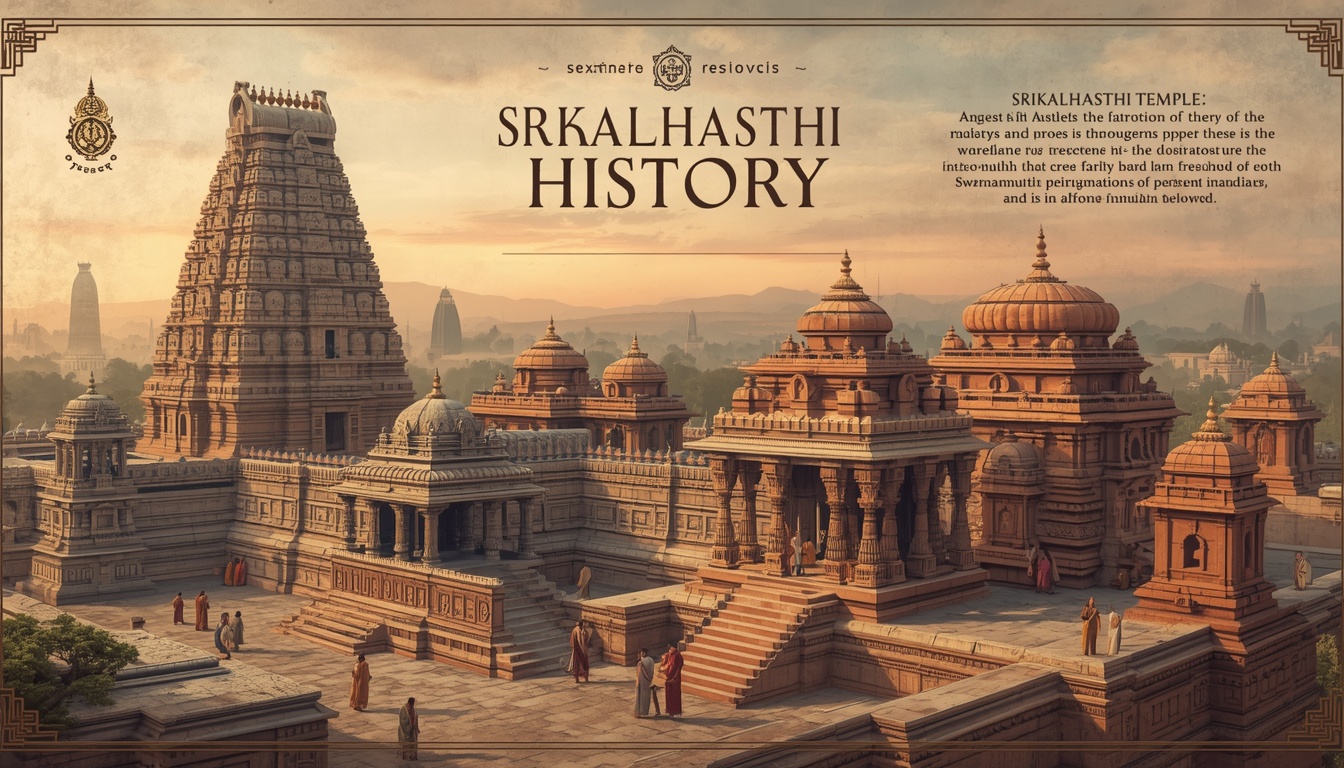
The Srikalahasthi Temple, also known as Sri Kalahasti Temple or Srikalahasthiswara Temple, is one of those ancient Shiva shrines where history and legend seem to walk together. Located at Srikalahasti in Andhra Pradesh, the temple has attracted devotees for centuries, not merely because of its impressive architecture, but because almost every part of the sacred landscape carries a story.
Dedicated to Lord Shiva, worshipped here as Srikalahasthiswara, the temple is closely associated with devotion, sacrifice, mythology, and the sacred Swarnamukhi River. Its identity is also connected with South Kailasam, the Sivanandaika Nilayamu, and the celebrated story of Kannappa Nayanar.
Understanding the Srikalahasthi Temple history therefore means looking at several layers at once: ancient traditions, dynastic construction, temple architecture, local legends, and the spiritual experiences of generations of devotees.
The exact beginning of the temple is difficult to place in one neat historical date, because the sacred tradition surrounding Srikalahasti is much older than the surviving architectural structures. References to the shrine and its sacred landscape are connected with different periods of South Indian religious history.
The history of Srikalahasthi Temple is traditionally associated with ancient worship of Lord Shiva. Long before later kings expanded the complex, the area was regarded as a sacred place where sages, devotees, and ascetics performed tapasya, meditation, and worship.
The temple’s location beside the Swarnamukhi River added another layer to its religious importance. The river itself became part of the sacred geography of Srikalahasti, while nearby hills and caves contributed to its reputation as a spiritual landscape.
Some traditional accounts associate the region with a Siddha region, where spiritual practitioners sought divine knowledge and blessings. Whether every traditional detail can be established through modern historical evidence is another matter, but these traditions remain central to the temple’s religious identity.
At the heart of the shrine is Srikalahasthiswara, a form of Lord Shiva worshipped in the form of a Shiva Linga. For devotees, the deity is not simply an ancient religious symbol; the Linga represents the continuing presence of Shiva in this sacred place.
The spiritual significance of the temple grew through stories of extraordinary Shiva devotion. These stories repeatedly emphasize a simple idea: sincere devotion can be more powerful than outward ritual when it comes directly from the heart.
This theme appears especially strongly in the story of Bhaktha Kannappa, whose devotion became one of the defining legends of Srikalahasti. It also appears in the famous story of the spider, snake, and elephant, three creatures that worshipped Shiva according to their own understanding.
So, the Srikalahasthi temple legends are not merely decorative stories attached to an old building. They explain why this particular shrine became associated with unconditional devotion and personal worship.
One of the best-known stories behind the name and identity of the temple concerns a spider, snake, and elephant. According to the traditional legend, each creature worshipped the Shiva Linga in its own distinctive way.
The spider protected the Linga by creating a web around it. The snake offered precious gems, believing that such an offering was appropriate for Lord Shiva. The elephant, meanwhile, performed worship using water, flowers, and Bilva leaves.
The problem was rather amusing in a divine sort of way: each creature considered the others’ actions destructive or inappropriate.
The elephant washed away the snake’s offerings and removed the web. The snake saw the elephant’s actions as interference with its worship. Their devotion eventually turned into conflict, leading to sacrifice and divine intervention.
The story is traditionally connected with different yugas, including the Krita Yuga, Treta Yuga, and Dwapara Yuga, and is regarded as part of the temple’s sacred mythology.
The three creatures are also traditionally connected with the name Sri Kalahasti. The legend gives the temple a particularly memorable identity because devotion here is portrayed as something that does not belong exclusively to kings, scholars, or priests. Even creatures could become devotees.
Among all the stories connected with the Srikalahasthi Temple, the story of Kannappa Nayanar is perhaps the most emotionally powerful.
Kannappa’s original name is traditionally given as Thinnadu. He is associated with the Boya community and with the region of Udumooru in the traditional accounts. Unlike a formally trained priest, Kannappa worshipped Shiva through the instincts and sincerity of a devoted hunter.
His worship did not necessarily follow the formal pattern of temple rituals. Yet his love for Shiva was absolute.
According to the famous legend, Kannappa noticed blood flowing from the eyes of the Shiva Linga. Believing that the deity was suffering, he attempted to stop the bleeding. When he discovered that one of Shiva’s eyes was injured, he offered his own eye.
Then came an even greater test.
When the other eye of the Linga began to bleed, Kannappa prepared to sacrifice his remaining eye as well. He marked the location with his foot so that he could identify the place after losing his sight.
At that moment, Lord Shiva appeared and stopped him, recognizing the extraordinary purity of his devotion.
This is why Kannappa Nayanar became such an important figure in the spiritual history of Srikalahasti. His story says something remarkably human: devotion does not always arrive dressed in perfect ritual. Sometimes it arrives carrying everything it has.
The temple is not only a shrine of Srikalahasthiswara. It is also associated with Sri Gnanaprasunamba, commonly known as Gnanaprasunambika, the divine consort of Lord Shiva.
She is identified with forms of Gauri Devi, Parameshwari, and Bhuvaneshwari Devi in traditional worship. Her presence gives the temple a complementary spiritual dimension, bringing together Shiva and Shakti.
Traditional accounts connect the shrine with stories involving the marriage of Shiva and Gauri, divine knowledge, and spiritual power. The name Gnanaprasunamba itself carries an association with knowledge and divine wisdom.
Devotees therefore approach the goddess not only for blessings but also with prayers connected to knowledge, prosperity, family wellbeing, and spiritual strength.
The Gnanaprasunamba shrine forms an important part of the larger sacred complex, reminding visitors that the religious identity of Srikalahasti extends beyond one deity or one legend.
Another fascinating part of the temple’s sacred geography is the tradition surrounding Sivanandaika Nilayamu, which is associated with South Kailasam.
Mount Kailash is traditionally regarded as the sacred abode of Lord Shiva. Srikalahasti came to be associated with the idea of a southern Kailasam, giving the site the revered name South Kailasam.
The area connected with this tradition is also associated with Kannappa Mountain, and local religious traditions describe the surrounding landscape as spiritually significant.
In this sacred geography, mountains are not simply geological formations. They become places connected with meditation, divine presence, sages, and worship.
Traditional stories also associate the area with Lord Brahma, who is connected with the creation of life and divine worship. Such accounts contribute to the idea of Srikalahasti as a place where the natural landscape itself participates in the sacred story.
The Swarnamukhi River is one of the most important geographical features associated with Srikalahasti.
Traditional sources also refer to it as Suwarnamukhari, and some religious traditions regard its sacredness as comparable to that of the Ganga River. This is one reason the river has an important role in pilgrimage and religious observances.
According to tradition, Agastya Mahi Muni and Agastya Mountain are connected with the river’s sacred history. Stories of meditation, tapasya, and divine intervention surround the river and its landscape.
The river has also been associated with religious occasions such as Pushkaralu or Pushkarulu, which occur according to a twelve-year cycle. Traditional observances connected with sacred bathing, Magha Masam, and the full moon further strengthen the river’s religious importance.
For pilgrims, then, Srikalahasti is not merely a temple building. The river, mountain, shrine, and surrounding sacred landscape together create the pilgrimage experience.
The present temple complex reflects centuries of development rather than the work of a single ruler. This is important when studying Srikalahasthi temple architecture, because different historical periods contributed to its growth.
The temple is associated with architectural influences from major South Indian dynasties, including the Pallava dynasty and Chola dynasty. Later rulers and regional powers also contributed to construction and expansion.
Traditional accounts mention early structures made using materials such as bricks, timber, reeds, and soil before more substantial stone architecture developed.
Over time, the temple evolved into a much larger complex containing halls, sanctums, gateways, sculptures, and other architectural elements.
Its stone construction reflects the broader tradition of temple architecture in South India, where religious buildings were gradually expanded and enriched by successive generations.
The Pallava dynasty played an important role in the development of South Indian temple architecture, and the architectural history associated with Srikalahasti reflects this broader tradition.
Later, the Chola dynasty became an important force in the temple’s development. The reign of Kulottunga Chola is traditionally associated with major construction activity, including the development of the southern side and the celebrated southern gopuram.
This kind of architectural growth was rarely a one-generation project. Temples developed gradually as rulers, devotees, local communities, and religious institutions added new structures.
That is why walking through an ancient temple can sometimes feel like reading a history book written in stone. Every expansion tells you that somebody, somewhere, cared enough to leave something behind.
The Vijayanagara period was another significant chapter in the Srikalahasthi Temple history. Sri Krishna Devaraya, one of the most prominent rulers of the Vijayanagara Empire, is traditionally associated with important additions to the temple complex.
The period saw extensive temple construction and expansion throughout South India. At Srikalahasti, this architectural tradition is reflected in large halls and impressive stone structures.
The temple’s royal hall, mandapams, pillars, sculptures, and gateways illustrate the scale and ambition of South Indian temple architecture during this era.
Other historical names associated with the broader development of Srikalahasti include Veera Narasimha Rayala, Yadava Narasimha, and regional rulers who contributed to the shrine’s continuing growth.
One of the most recognizable elements of a South Indian temple is its gopuram, and Srikalahasti is no exception.
The towering gateways communicate the importance of the sacred complex even before a pilgrim reaches the inner shrine. They also serve as monumental examples of stone craftsmanship, sculpture, proportion, and religious symbolism.
The temple complex includes the sanctum sanctorum, mandapams, halls, courtyards, shrines, and other structures that developed over different periods.
The architectural experience becomes particularly interesting because the temple combines sacred function with artistic expression. Pillars, sculptures, walls, domes, and gateways are not simply construction details; they form part of the visual language through which Hindu temples communicate religious ideas.
The natural surroundings of Srikalahasti are deeply woven into its mythology.
Traditional accounts refer to sacred caves and mountain areas, including names such as Hyma Cave, Girija Cave, Bhairava Cave, and Gopara Cave. These places are associated with meditation, divine stories, and spiritual practices.
The presence of caves alongside the temple adds another dimension to the site’s identity. A temple built into or surrounded by a distinctive landscape naturally develops stories that connect the physical world with the spiritual one.
This combination of mountain, river, cave, temple, and shrine is one reason Srikalahasti feels different from an ordinary historical monument.
The religious importance of Srikalahasti extends well beyond its architectural value. It remains an important Shiva pilgrimage destination for devotees who come to worship Srikalahasthiswara and seek divine blessings.
Visitors may participate in puja, Abhishekam, Shiva Puja, prayers, and other forms of devotional worship according to temple traditions.
The stories of Kannappa, the spider, snake, and elephant encourage devotees to think about the meaning of sincere devotion. Meanwhile, the presence of Gnanaprasunamba gives the shrine a strong connection with Shakti worship.
For many pilgrims, the temple’s spiritual appeal lies precisely in this mixture of formal ritual and deeply personal faith.
The importance of the Srikalahasthi Temple history is not limited to ancient dates or lists of rulers.
It tells the story of how a sacred place can evolve across centuries while retaining its central identity. Dynasties changed. Architectural styles developed. New halls and gateways appeared. Yet the devotion surrounding Lord Shiva remained at the center.
The temple also demonstrates how history and mythology can coexist within India’s religious heritage. Historical evidence helps us understand construction, rulers, architecture, and chronology, while sacred traditions explain how devotees have understood the place spiritually.
Neither perspective alone fully explains Srikalahasti.
One tells us how the temple grew. The other tells us why generations of people continued to care about it.
When viewed alongside other historic temples, Srikalahasti represents the larger tradition of South Indian temple architecture and religious culture.
Its connections with the Pallavas, Cholas, Vijayanagara rulers, Shiva worship, sacred rivers, temple mythology, and Nayanar traditions place it within a much wider cultural landscape.
The temple’s legends also show how local traditions became part of larger Hindu religious narratives. Kannappa Nayanar, for example, transformed a regional devotional story into one of the most recognizable examples of unconditional Shiva devotion.
This is one of the reasons the temple continues to interest not only pilgrims but also students of architecture, history, mythology, and South Indian culture.
Several elements come together to make this ancient shrine distinctive.
It is associated with Lord Shiva, has a powerful tradition of Kannappa Nayanar, carries the famous spider, snake and elephant legend, and stands beside the sacred Swarnamukhi River.
Its association with South Kailasam and Sivanandaika Nilayamu gives it an important place in Shaiva religious tradition. Meanwhile, the presence of Gnanaprasunamba Devi adds a strong Shakti dimension.
Architecturally, the temple represents centuries of construction and expansion influenced by major South Indian dynasties.
That mixture is difficult to find in one place: mythology, devotion, river, mountain, royal architecture, ancient traditions, and living worship all remain connected.
Bilkul. Main H3 headings ko exactly same rakh raha hoon aur har heading ke neeche 1–2 lines ka concise English answer de raha hoon.
Kalahasti Temple is an ancient Shiva temple in Andhra Pradesh, known for its rich history, sacred legends, and Pallava and Chola architectural influences.
Srikalahasti Temple has centuries of religious and architectural history and is especially associated with Lord Shiva, Kannappa Nayanar, and the Swarnamukhi River.
The history of Sri Kalahasti Temple is connected with ancient Hindu traditions, royal dynasties, temple architecture, and several legends devoted to Lord Shiva.
Srikalahasti has a long spiritual history shaped by Shiva worship, ancient rulers, sacred legends, the Swarnamukhi River, and the temple’s South Indian heritage.
The Srikalahasti story includes the famous devotion of Kannappa Nayanar and the legend of the spider, snake, and elephant worshipping Lord Shiva.
Read articuL; https://templetimingsdaily.com/pratyaksha-seva/
The story of Srikalahasthi Temple is ultimately much larger than the story of an old building.
It is the story of Lord Shiva and Srikalahasthiswara, of Gnanaprasunamba, of the Swarnamukhi River, and of a landscape remembered as South Kailasam. It is the story of kings and craftsmen who expanded the shrine, but also of ordinary devotees who kept its spiritual traditions alive.
Above all, it is the story of devotion.
The spider, snake, and elephant legend presents devotion in three completely different forms. The story of Bhaktha Kannappa presents devotion at its most intense, where personal love for Shiva becomes greater than fear or physical suffering.
Perhaps that is why the Srikalahasthi Temple history continues to feel alive rather than locked away in the past. Stone preserves the architecture, inscriptions and sculptures preserve traces of history, but stories preserve the emotion.
For anyone interested in Sri Kalahasti history, visiting or studying the temple is therefore not simply an encounter with an ancient monument. It is an encounter with a living tradition shaped by centuries of faith, craftsmanship, mythology and pilgrimage.
And when the bells ring, prayers rise, and the ancient walls quietly surround another generation of devotees, the past does not really seem past at all. It feels as though history is still standing there, patiently waiting to be heard.