Physical Address
304 North Cardinal St.
Dorchester Center, MA 02124
Physical Address
304 North Cardinal St.
Dorchester Center, MA 02124

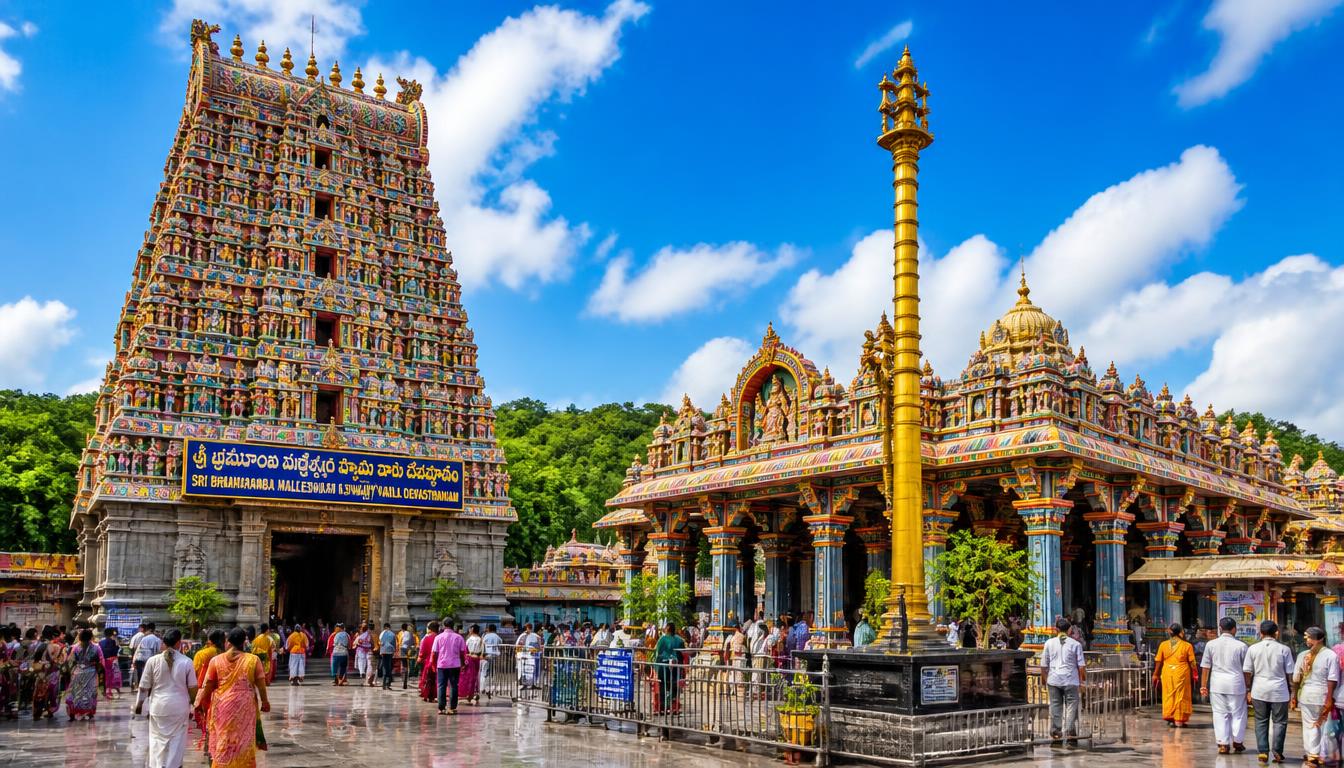
There are temples you visit because they are famous, and then there are temples you visit because, somehow, the road itself seems to become quieter as you get closer.
Pedakakani Sri Bhramaramba Malleswara Swamy Temple belongs rather beautifully to the second kind.
Situated at Pedakakani in the Guntur region of Andhra Pradesh, this ancient Shiva temple draws devotees for regular darshan, special sevas and, especially, Rahu Ketu Pooja.
For a first-time visitor, though, the spiritual part is only half the planning. You also want to know when the gates are open, whether there is a midday break, what time the pooja happens, how much a seva costs, where to book it, and whether you should reach before the scheduled time.
These little details matter, because nobody wants to arrive after travelling for hours and then discover that the temple has gone into its afternoon break. Happens, sadly.
This 2026 guide brings those practical pieces together while also looking at the temple’s religious significance, architecture, traditions, travel options and things worth knowing before you go.
Timings and seva charges can change on festival days or through administrative updates, so use the official Andhra Pradesh temple-management system for the final check before making a payment.
The government portal specifically says it offers online services for darshan and sevas and warns devotees not to use unauthorised agents or third-party booking agencies.
The shrine is commonly called Pedakakani Temple or Sri Bhramaramba Malleswara Swamy Temple. The principal deities are Sri Malleswara Swamy, a form of Lord Shiva, and Goddess Bhramaramba Devi, giving the temple its distinctive Shiva-Shakti character.
Pedakakani has long been associated with religious traditions, legends and pilgrimage in the Guntur area. Sources describing the shrine place its origins many centuries ago,
with some traditions connecting it to Adi Shankaracharya, while later accounts associate renovation or expansion with the Vijayanagara Empire and Sri Krishnadevaraya.
These historical details are part of the temple’s traditional narrative and should be understood as such rather than as a single uncontested archaeological timeline.
The temple’s visual identity is hard to miss. Its 60-foot Rajagopuram, Dhwajasthambam and traditional South Indian architectural elements give the complex a distinctly old-world character.
The temple also has mandapas and spaces where devotees undertake different rituals and sevas. It is not the sort of place where you need to rush from one photo point to another; the charm is more in standing still for a minute.
A particularly interesting part of the temple’s devotional identity is its connection with Rahu Ketu Pooja. Devotees who follow Vedic astrology may visit seeking remedies for Rahu Dosha, Ketu Dosha or
Kalasarpa Dosha, and some come with concerns involving marriage, career, finances or other long-standing difficulties. These are matters of religious and astrological belief, of course, not medically or scientifically established effects.
For ordinary temple visits, the commonly published schedule is:
The 5:00 AM opening makes early morning darshan a particularly attractive option for devotees who want a calmer visit. The temple’s published schedule has been reported consistently as a morning session followed by an afternoon break and evening opening.
Still, don’t treat an online timing table like it is carved in the temple stone. Special festivals, major sevas, crowd-management arrangements and administrative decisions can affect the daily routine.
If you are travelling specifically for a ritual rather than ordinary darshan, check the booking confirmation and official portal before leaving.
The early hours can be especially pleasant. There is something different about entering a Shiva temple while the surrounding day is only just waking up, and devotees often prefer this time for its quieter
atmosphere. During Maha Shivaratri, Kartika Masam, Navratri and other important occasions, however, the experience can be much busier, so a little extra time is sensible.
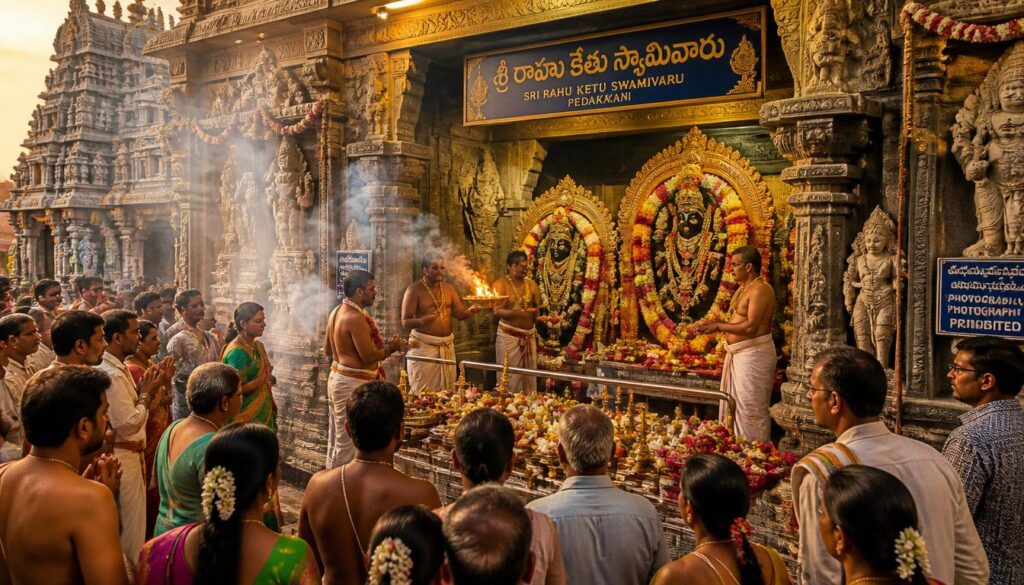
The Rahu Ketu Pooja is among the main reasons devotees specifically travel to Pedakakani. In traditional Hindu astrology, Rahu and Ketu are treated as lunar nodes and are associated with particular planetary influences. Devotees may undertake the ritual as a spiritual remedy for perceived Rahu Dosha, Ketu Dosha or Kalasarpa Dosha.
It is important to frame the ritual properly: devotees perform the pooja because of their religious faith and astrological traditions. Claims that a ritual can medically cure an illness or guarantee marriage,
employment, financial success or other outcomes should not be treated as established fact. For many people, however, the ceremony is meaningful as an act of prayer, discipline and spiritual reassurance.
Older published temple information describes Rahu Ketu Pooja sessions in the morning, traditionally in multiple batches, with additional sessions associated with Rahu Kalam on certain days.
A 2026 listing reports Tuesday, Saturday and Sunday timings around the relevant Rahukalam periods, but because these times can vary by date and temple administration, devotees should verify the exact slot shown for their selected day before travelling.
That point is worth stressing. Rahu Kalam is not the same clock time every day. It changes according to the day of the week and local sunrise/sunset calculations.
So a statement such as “Rahu Ketu Pooja is always at 3 PM” is too simplistic. Tuesday Rahukalam, for example, is traditionally different from Saturday or Sunday Rahukalam.
The safest starting point for Rahu Ketu Pooja booking is the official Andhra Pradesh Endowments Department’s temple-management portal.
The government system provides online services for darshan and sevas, and its own website specifically warns that it does not authorise agents or third-party agencies for online booking.
Official Andhra Pradesh Endowments Temple Management System
The booking process generally involves selecting the temple, choosing the required seva, checking the available date or slot, entering devotee details and completing the online payment where the service is available.
The exact screens can change as the government portal is updated, so follow what the official system displays rather than an old screenshot found somewhere online.
After payment, keep your booking confirmation, receipt and transaction details safely. A screenshot on your phone is useful, but carrying a downloaded or printed copy can be a nice backup when travelling. Mobile networks have an irritating habit of becoming shy precisely when you need them.
Most importantly, never send an OTP, UPI PIN, card PIN or CVV to somebody claiming to be a temple booking agent. The official portal itself carries a warning not to share sensitive banking credentials by phone or email.
The following prices are reported in current 2026 temple-information listings. They should be regarded as indicative rather than permanently guaranteed, because seva charges can be revised and the official booking system is the final authority at the time of purchase.
| Seva / Pooja | Reported price |
|---|---|
| Rahu Ketu Pooja | ₹500 |
| Anthralaya Abhishekam | ₹400 |
| Astothara Archana | ₹50 |
| Chandi Homam | ₹1,500 |
| Dasara Ubhayam | ₹2,500 |
| Dasara Ubhayam – Mula Nakshatram | ₹3,500 |
| Rudrabhishekam with Mahanyasa | ₹1,000 |
| Navagraha Puja | ₹150 |
| Naga Pratishta | ₹3,000 |
| Shani Puja | ₹50 |
| Kartika Masam Paroksha Abhishekam | ₹2,000 |
The reported ₹500 Rahu Ketu Pooja price is one of the most searched details about Pedakakani, but don’t simply hand ₹500 to a person outside the temple because somebody says that’s the official amount. Check the current official listing, select the actual seva and retain the receipt.
Likewise, the fact that one seva is listed at ₹50 or ₹150 doesn’t necessarily mean every participant, ritual arrangement or special-day version will follow the same terms. Read the booking description carefully before payment.
Pedakakani is not only about one planetary ritual. The temple’s listed services include Abhishekam, Archana, Homam, Rudrabhishekam, Mahanyasa, Navagraha Puja, Naga Pratishta and Shani Puja, along with festival-linked offerings.
Rudrabhishekam with Mahanyasa is especially connected with Shaiva worship, while Navagraha Puja is directed toward the nine planetary deities in the traditional Hindu framework. Shani Puja focuses on Saturn, while Naga-related worship has its own place in South Indian devotional practice.
During Kartika Masam, an especially sacred period for Shiva devotees, additional rituals and abhishekams may attract pilgrims. Similarly, Dasara and Navratri bring their own devotional programmes and special sevas. Festival calendars can change from year to year, so 2026 visitors should check the temple’s current announcement rather than relying entirely on last year’s timetable.
The temple is located at Pedakakani, Guntur District, Andhra Pradesh – 522509. Pedakakani is close to Guntur and lies along the important Guntur–Vijayawada transport corridor.
Different travel sources give slightly different distances because they measure from different points in the city. The temple is commonly described as roughly 8–10 km from Guntur, while Guntur Junction is around 9 km away by road according to one temple reference.
This makes the temple quite convenient for travellers staying in Guntur. You don’t really need to turn the visit into a complicated expedition; a local auto, taxi, bus or private vehicle can usually handle the final stretch.
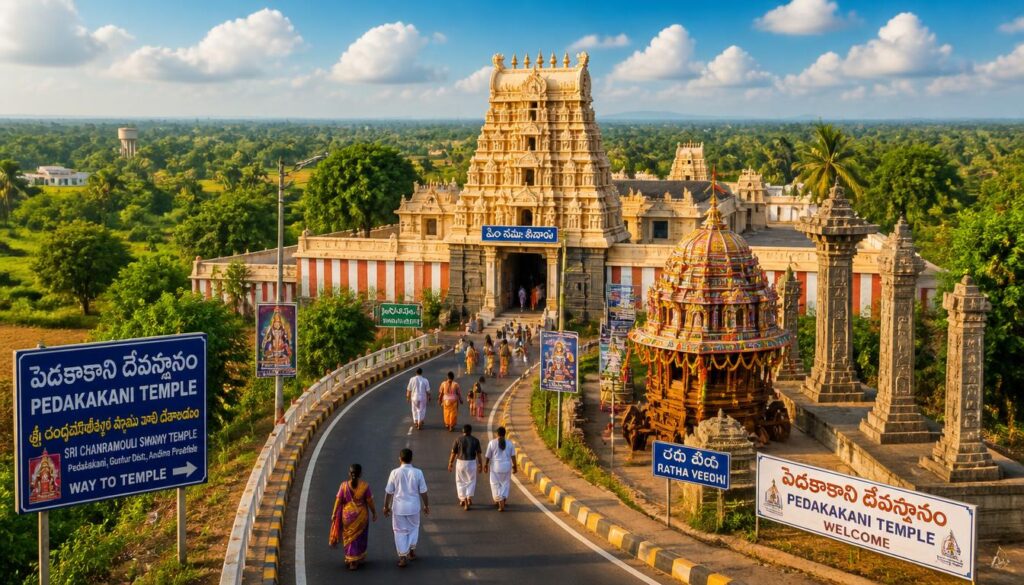
Road travel is probably the simplest option. Pedakakani is connected to the Guntur–Vijayawada highway corridor, with government and private buses serving the area. Travellers from Guntur can take a local bus, taxi or auto-rickshaw toward Pedakakani.
If you’re driving from Vijayawada, follow the route toward Guntur and look for the Pedakakani area. Traffic conditions can make travel times vary, so it is better to budget extra time on festival days instead of trusting a very optimistic navigation estimate.
Pedakakani Halt is the closest railway stop, while Guntur Junction is the more practical major station for many long-distance travellers. The rail distance between Guntur Junction and Pedakakani Halt is roughly 7 km.
If your train does not stop at Pedakakani Halt, Guntur Junction is the sensible choice. From there, take an auto or taxi to the temple. A little local transport planning here saves more headache than it sounds.
For air travellers, Vijayawada International Airport is the nearest major airport. Travel sources place it roughly 44–50 km from the Pedakakani area, depending on the exact route and measuring point.
A taxi from the airport is the most straightforward option if you are carrying luggage or travelling with family. During peak travel periods, allow extra road time.
If your priority is peaceful temple darshan, early morning is generally the most attractive choice. The 5:00 AM opening gives devotees a chance to arrive before the daytime heat and before crowds build up.
For comfortable travel weather, the cooler months from roughly October through March are often preferable, though religious festivals during this period can also mean much larger crowds. In other words, the weather may be kinder but the queue might not be.
Maha Shivaratri, Kartika Masam, Navratri and other auspicious occasions can be spiritually vibrant times to visit, but they are not necessarily the best days for somebody seeking a quiet, quick darshan. If you enjoy the festival atmosphere, go for it; if you want stillness, pick an ordinary weekday.
For Rahu Ketu Pooja, choose the date according to the available official seva slot rather than arriving casually and hoping to fit into the ritual. Popular days can fill faster.
Read more: https://templetimingsdaily.com/salasar-balaji-temple/
For ordinary darshan, keep things simple. Carry your identification, booking confirmation if you have a reserved seva, payment method, drinking water for the journey and any personally necessary medicines.
If you have booked a pooja, don’t assume you need to buy every ritual item from an outside vendor. Check the seva description to see what is included. Some published listings indicate that materials are supplied for particular rituals, but the exact inclusions should be confirmed against the current temple booking information.
Wear clean, respectful clothing and follow the temple’s instructions regarding photography, footwear and entry into restricted areas. A temple is not the place to argue with a volunteer over one tiny rule; just smile, follow the instruction and continue your darshan.
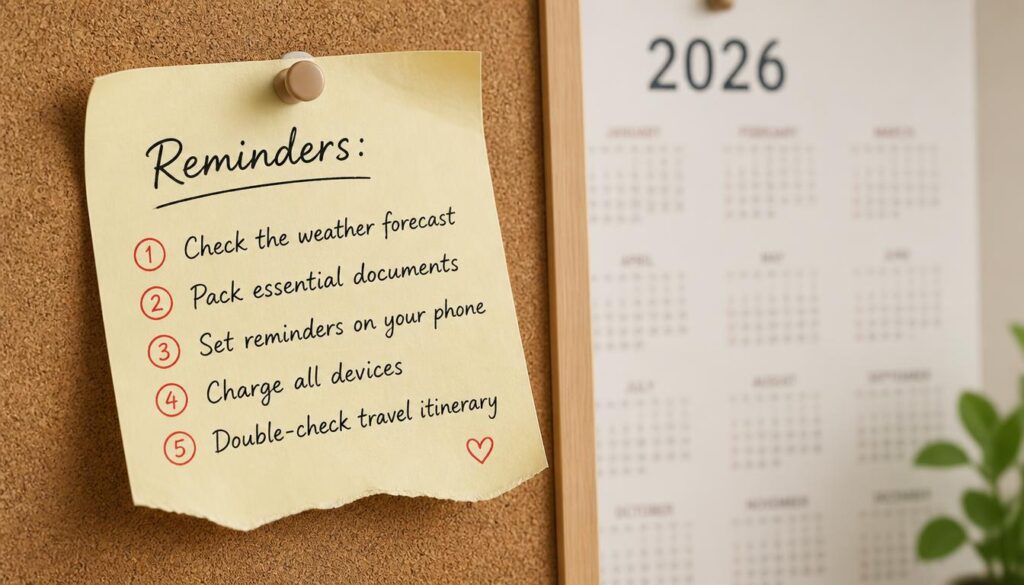
First, check the timing twice. Ordinary darshan hours and seva timings are not necessarily identical.
Second, if your purpose is Rahu Ketu Pooja, book through the government temple system where online booking is available. The Andhra Pradesh Endowments Department explicitly says that third-party agents are not authorised for online bookings.
Third, arrive early. Even when your ticket gives you a particular slot, you still need time for parking, footwear arrangements, queues and locating the relevant counter or mandapam.
Fourth, keep your payment receipt. It is boring advice until the one day you desperately need the receipt.
And finally, verify the current 2026 ticket price before paying. Online articles can remain unchanged for months or years, while temple charges may be revised.
The commonly published regular schedule is 5:00 AM to 1:30 PM and 4:00 PM to 8:00 PM, with an afternoon break. Confirm the day’s schedule before travelling, especially during festivals.
Current 2026 listings report ₹500 for Rahu Ketu Pooja, but devotees should verify the amount and booking terms on the official temple-management portal before payment.
Online seva booking is available through the Andhra Pradesh Endowments Department’s temple-management system when the relevant seva and date are enabled. Use the official portal rather than an agent.
The temple’s published information associates the ritual with Rahu Kalam, with specific sessions varying by day. Because Rahukalam changes according to the weekday, check the exact date and slot when booking.
The temple is approximately 8–10 km from Guntur, depending on the starting point and route. Guntur Junction is roughly 9 km away by road in one commonly cited temple reference.
Vijayawada International Airport is the nearest major airport, generally around 44–50 km from Pedakakani depending on the route used.
Early morning, particularly around the opening hours, is generally preferable if you want a quieter experience. Festival days can be much more crowded.
Yes. Published 2026 listings include Anthralaya Abhishekam, Astothara Archana, Chandi Homam, Rudrabhishekam with Mahanyasa, Navagraha Puja, Naga Pratishta, Shani Puja and other offerings. Availability and charges should be checked through the current temple booking system.
A visit to Pedakakani Sri Bhramaramba Malleswara Swamy Temple does not need to become an exhausting checklist.
Know the opening hours, reserve your seva if required, verify the price, arrive with some spare time and then let the visit unfold at its own pace.
For devotees coming specifically for Rahu Ketu Pooja, the most important practical lesson is simple: don’t rely on a random website, agent or social-media message for the final slot or price.
The Andhra Pradesh Endowments Department’s official temple system should be your first reference for online services and booking.
For everyone else, an early morning darshan of Lord Malleswara Swamy and Goddess Bhramaramba Devi can be the quieter sort of pilgrimage, the kind where you don’t need to prove anything or rush anywhere.
You arrive, pray, walk through the temple surroundings, maybe sit for a few minutes longer than planned and somehow that extra five minutes becomes the part you remember.
If you are planning a 2026 visit, save the official portal, check the latest schedule shortly before travelling and keep your booking receipt handy.
Temple information changes, but the basic wisdom of pilgrimage doesn’t: travel respectfully, leave enough time, and let the sacred place be more than just another destination on the map.