Physical Address
304 North Cardinal St.
Dorchester Center, MA 02124
Physical Address
304 North Cardinal St.
Dorchester Center, MA 02124

There are pilgrimages where you arrive with a camera, a list of places, maybe a hotel reservation tucked somewhere in your phone.
And then there are pilgrimages where you arrive carrying something much quieter a prayer, a family hope, a promise made years ago, or simply the wish to sit before a deity for a few moments and breathe properly.
Salasar Balaji Temple in Rajasthan belongs very much to the second kind.
Located in Salasar town in Churu district, this celebrated Hanuman temple is visited by devotees from across India and beyond.
People come to seek the blessings of Lord Hanuman, also lovingly called Balaji or Bajrang Bali, and for many visitors the journey itself becomes part of the devotion.
The temple is particularly famous for its distinctive Hanuman idol, traditionally depicted with a beard and moustache, a form that immediately catches the attention of first-time visitors.
If you are planning your first visit, though, faith is only half the preparation. The other half is knowing when to arrive, what the current Salasar Balaji Temple timings are, how darshan works, what to expect during festival rush, where to stay and which booking claims should be treated carefully.
Temple information can change, and honestly, this is one place where checking the latest official update before leaving home can save you a fair amount of confusion.
Salasar Balaji is not simply another stop on a Rajasthan sightseeing itinerary. For Hanuman devotees, it is a major pilgrimage destination with a strong devotional identity built over centuries.
The temple’s official history describes the appearance of the Balaji idol at Asota village in 1755 and the later establishment of the temple at Salasar.
The story is deeply connected with Shri Mohandas Ji Maharaj and the devotional tradition that developed around him.
As with many sacred traditions, devotees hold these accounts as matters of faith rather than something to be reduced to a dry historical paragraph.
Then there is the idol itself.
The Salasar Balaji idol is traditionally recognised by its round face, beard and moustache. It looks different from the more familiar representations of Hanuman seen in many temples, and that difference has become one of the temple’s most recognisable features. The temple’s own Seva Samiti describes it as a distinctive form of Hanuman worship.
Around the shrine, you will notice something else an atmosphere that is less about sightseeing and more about purpose. People arrive with coconuts, prasad, family members, old vows and fresh hopes.
Someone may be whispering a prayer while another person is already walking toward the exit with tears in their eyes. Pilgrimage is like that; it doesn’t always explain itself.
This is one area where online information can become messy very quickly. Different travel websites currently publish different opening and closing schedules, while the Shri Hanuman Seva Samiti has published its own darshan update.
The Seva Samiti’s current temple timing page lists darshan from 6:00 AM to 9:00 PM, with separate summer and winter schedules for aarti and other rituals. Its published update also states that Shree Balaji darshan at the temple is from 6:00 AM to 8:45 PM.
Because these official pages show slightly different end times, visitors should confirm the prevailing schedule directly before travelling, particularly if their plan depends on reaching for the final darshan.
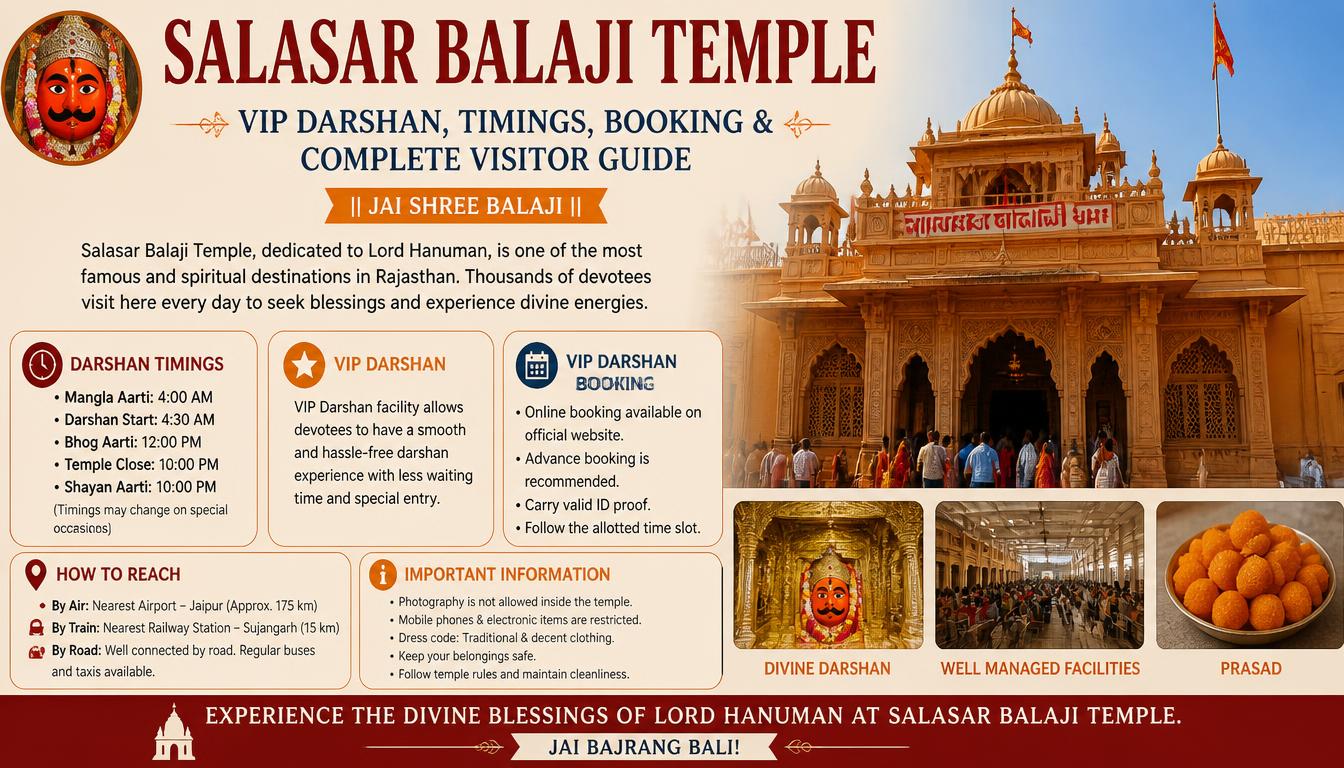
The published ritual schedule is more useful than simply memorising an opening hour. In the summer schedule, the Seva Samiti lists Mangla Aarti at 5:00 AM, Mohandas Ji Aarti at 5:30 AM, Rajbhog Aarti at 10:15 AM, evening rituals beginning later in the day, and Shayan Aarti at 10:00 PM. Winter timings are different.
So, if your heart says, “I want the early morning experience,” don’t just turn up based on a random blog saying 4:00 AM. Check the official schedule first. That tiny bit of planning matters.
On an ordinary day, early morning is generally the more sensible choice for pilgrims who prefer a quieter atmosphere and cooler weather.
Rajasthan’s daytime heat can become pretty serious, especially outside the pleasant winter months, so arriving early can make the whole visit easier on elderly family members and children.
There is also a devotional reason many pilgrims like the morning. The temple is already awake with its rituals, and the atmosphere feels less like a busy public space and more like a pilgrimage beginning. If you are comfortable waking before sunrise, an early arrival is worth considering.
But there is a catch.
Tuesdays, Saturdays, full-moon occasions and major religious festivals can bring significantly higher footfall. The biggest crowds are associated with the Chaitra Purnima and Ashwin Purnima fairs.
Rajasthan Tourism says these occasions can draw crowds of several lakhs, so the idea of a “quick darshan” becomes rather optimistic on such days.
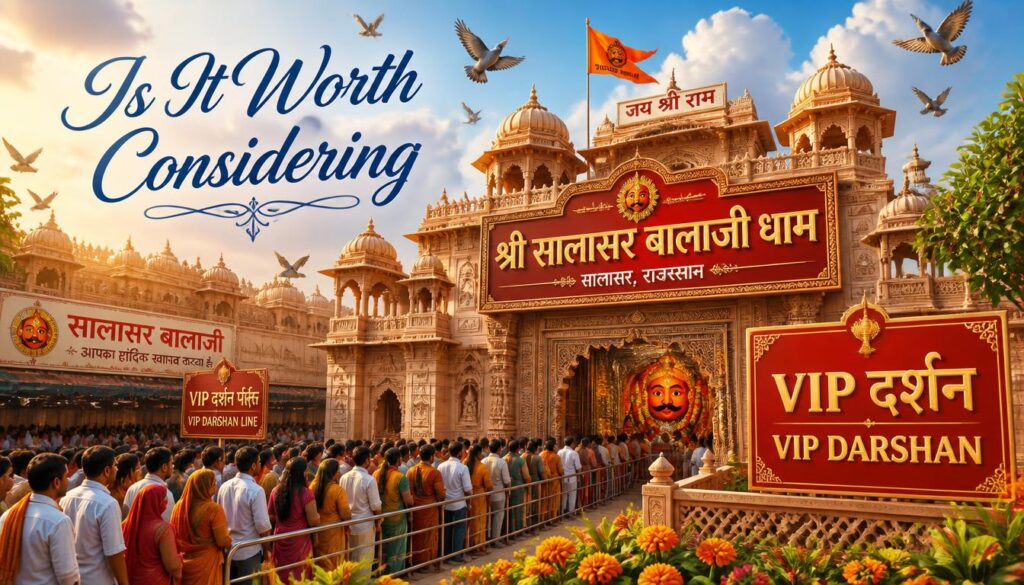
The phrase Salasar Balaji VIP Darshan appears frequently online, and this is where visitors need to separate verified information from promotional claims.
A priority or special-darshan facility may be available through arrangements made by the temple authorities, but the official sources I checked do not currently publish a clearly confirmed universal VIP ticket price or a ₹5,100 family VIP tariff.
Several third-party websites quote figures such as ₹200–₹500 or ₹5,100 for family darshan, but those amounts should not be treated as official unless the temple confirms them for your visit date.
That distinction is important. A pilgrimage should not begin with sending money to a random website because it has the words “official booking” in a large red button. Check the temple’s own channels first.
The official Salasar Balaji website provides temple information, live darshan, upcoming events and temple timing resources. The Shri Hanuman Seva Samiti also publishes official contact information and visitor-related updates.
If priority access is particularly important to you perhaps you are travelling with senior citizens, small children, someone with limited mobility, or you have a very tight same-day travel schedule contact
the temple office directly and ask what facility is operating on your chosen date. That’s more reliable than trusting an old price table floating around online.
People searching for Salasar Balaji VIP Darshan booking often expect a straightforward system where they select a date, pay online and receive a QR code. Do not assume that such a system exists in exactly that form merely because another temple uses one.
The official Salasar Balaji website currently provides online devotional services and information, including live darshan and temple timing resources, but I could not verify a current official page confirming a standard online VIP-darshan ticket system with fixed prices and slots.
For this reason, the safest booking approach is simple:
The Seva Samiti currently lists its office near Gate No. 1 and gives contact numbers including 01568-252010 and +91 96022 52749.
For most devotees, the heart of the visit is simply general darshan. You do not need to turn a spiritual visit into a transaction if you don’t want to.
The experience may involve a queue, especially on busy days, but that shared waiting is itself part of the atmosphere of a major pilgrimage centre.
Special or priority arrangements can be useful when circumstances make a long queue difficult. But the precise categories, charges and availability can change, so don’t rely on a copied table from an old travel article.
A good rule is almost boringly simple: the closer the information is to the temple administration, the more seriously you should take it.
This matters particularly during fairs. Rajasthan Tourism notes that Salasar becomes especially crowded during Chaitra Purnima and Ashvin Purnima, with the associated fairs attracting devotees from many places.
The two major pilgrimage occasions associated with Salasar are Chaitra Purnima and Ashwin Purnima. The temple and Seva Samiti describe these fairs as major annual events, with very large numbers of devotees arriving for darshan.
Chaitra Purnima is especially connected with Hanuman Janmotsav, while Ashwin Purnima brings another major gathering. If you want to experience Salasar during a fair, the atmosphere can be unforgettable
devotional singing, pilgrims arriving in groups, temporary arrangements, food and water services, and an entire town moving around the rhythm of the pilgrimage.
But don’t confuse “unforgettable” with “easy.”
Accommodation fills faster, roads become busier and walking may be unavoidable. The Seva Samiti says arrangements during fairs include drinking water, sanitation, medical assistance, temporary facilities and crowd-management measures.
If you are visiting mainly for a peaceful darshan, a non-festival weekday is usually the smarter bet.
One of the best-known devotional customs at Salasar involves coconut tying. The temple’s official history describes devotees tying coconuts in devotion and explains the deep faith associated with this practice.
Visitors may also hear about Savamani Seva, a traditional offering associated with preparing a large quantity of food for Balaji.
The exact procedure, availability and current arrangements should be confirmed locally rather than assumed from a generic internet description.
Other religious practices may include pooja, prasad and special devotional services. If you are travelling with a family and want to perform a particular ritual, ask the temple authorities beforehand about timing, procedure and whether prior arrangements are needed.
And perhaps this is the nicest way to approach it: don’t arrive with twenty rituals on a checklist. Arrive with some patience. The temple is not going anywhere, but your attention can disappear surprisingly fast when you are worried about what comes next.
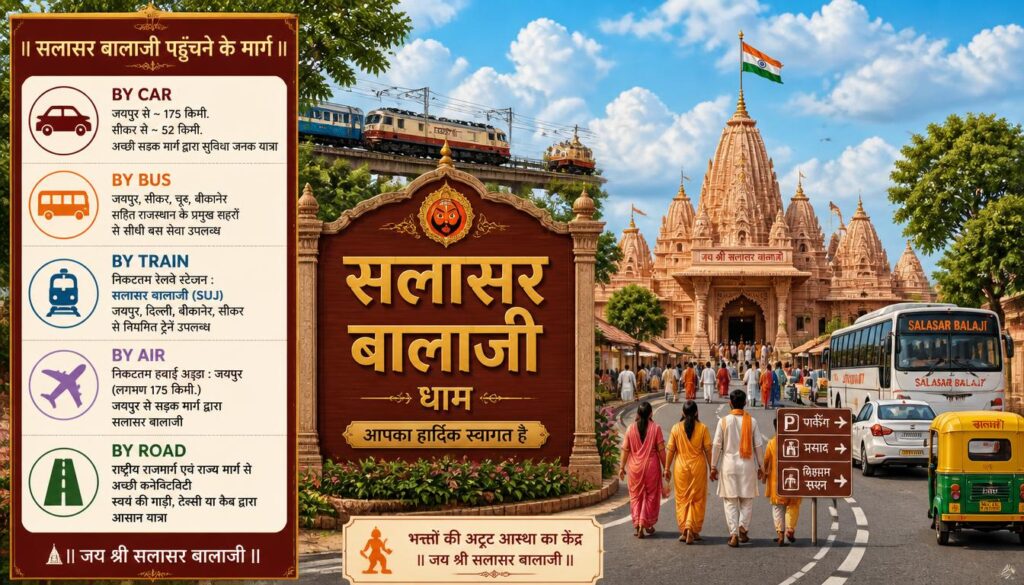
Salasar Balaji Temple Rajasthan is located in Salasar town in Churu district. Rajasthan Tourism identifies Salasar as a major pilgrimage destination in the region and notes its connection with nearby religious centres including Jeen Mata, Rani Sati Temple and Khatushyamji.
Road travel is one of the most practical ways to reach Salasar. The Rajasthan road network connects the area with cities and pilgrimage routes across the state.
A Rajasthan Transport Department route record specifically identifies the Sikar–Nokha route via Salasar and Sujangarh, showing the town’s position on an established road corridor.
Buses, taxis and private vehicles are therefore common choices. If you are travelling in a group, a private vehicle can be particularly convenient because you can control arrival time and return plans.
Sujangarh Railway Station is commonly used by pilgrims travelling toward Salasar, with onward road transport required for the temple town.
Distances quoted online vary slightly depending on the starting point used, so it is better to check your actual train route and then arrange the final road leg.
Don’t book a train simply because a website calls a station “nearest” without checking the onward transport. The last part of a pilgrimage can sometimes be the part nobody planned for.
For travellers arriving from distant cities, Jaipur International Airport is a practical major-airport option, followed by road travel toward Salasar.
The exact driving time can vary substantially with traffic, road conditions and your chosen route, so don’t build a five-minute margin into the itinerary. Rajasthan is beautiful, but highways have their own opinions about your schedule.
The good news for pilgrims is that Salasar has a substantial ecosystem of dharamshalas, guest houses, hotels and food facilities.
The Shri Hanuman Seva Samiti says the town has more than 125 dharamshalas with modern amenities, while its work profile describes accommodation arrangements and facilities created for travellers.
The Samiti also publishes a contact list containing numerous dharamshalas, guest houses and hotels.
During normal periods, visitors have more flexibility. During Chaitra Purnima and Ashwin Purnima, however, booking ahead is strongly advisable.
If you are travelling with elderly parents or children, choose accommodation based not only on price but also on walking distance, bathroom facilities and the ability to rest properly.
A cheap room that leaves everyone exhausted isn’t really a bargain, is it.
Pilgrimage towns tend to have a practical rhythm of their own, and Salasar is no different. Restaurants, bhojanalayas and food facilities serve the large number of devotees who pass through the town.
The Seva Samiti says it works to provide drinking-water facilities, food, accommodation and other visitor services, including arrangements during major fairs. It also describes sanitation, medical assistance and other public facilities intended to support pilgrims.
Even with these facilities, carry a water bottle when appropriate, especially during hot months, and keep essential medicines with you. During festival crowds, don’t depend on finding exactly what you need at exactly the moment you need it.
A first visit becomes much easier if you remember a few unglamorous but genuinely useful things.
Families often find Salasar welcoming because the town is built around pilgrims rather than conventional tourism. Dharamshalas, food services, water facilities and medical support are all part of the wider pilgrimage infrastructure.
For senior citizens, however, planning matters even more. Consider travelling outside the peak fair dates, arriving during cooler hours and confirming the current darshan arrangement before setting out.
Parents travelling with children should also avoid assuming that a child will happily stand in a long queue because everyone else is doing it.
Bring water, light snacks where permitted, and patience. A pilgrimage is supposed to leave you peaceful, not negotiating a family crisis beside the temple gate.
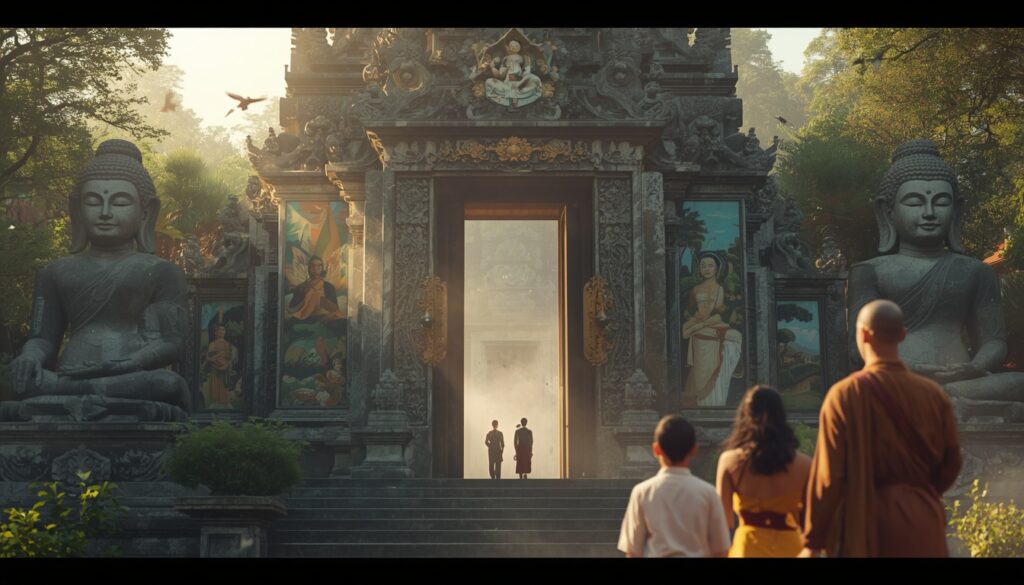
There are grand temples where architecture grabs your attention first. At Salasar, for many people, devotion does.
The town, the queues, the coconuts, the repeated “Jai Balaji,” the families travelling together and the distinctive form of Hanuman all combine into something that is difficult to describe through photographs alone.
Rajasthan Tourism calls Salasar an important place of worship for devotees of Hanuman and notes its year-round visitation and especially heavy crowds during the major Purnima fairs.
Perhaps that is why people return. Not because every visit is comfortable. Not because every queue is short. They return because faith does not always behave like a travel plan.
It is a major Lord Hanuman pilgrimage site in Salasar, Churu district, Rajasthan, particularly known for the distinctive bearded and moustached form of the Hanuman idol and its strong devotional tradition.
The Shri Hanuman Seva Samiti currently publishes darshan hours of 6:00 AM to 9:00 PM, while a separate official update gives darshan as 6:00 AM to 8:45 PM. Because these official pages differ slightly, verify the exact schedule before travelling.
The temple’s visitor tradition includes general darshan, but visitors should verify the current arrangements and any special facilities directly with the temple administration.
There is no clearly verified current VIP price published on the official sources reviewed for this article. Online claims about amounts such as ₹200–₹500 or ₹5,100 should therefore be confirmed directly before payment.
Do not assume that third-party websites offering “online VIP booking” are authorised. Check the official Salasar Balaji website and Shri Hanuman Seva Samiti first, then contact the temple if you need confirmation of a priority-darshan facility.
The biggest crowds are associated with Chaitra Purnima and Ashwin Purnima, when major fairs take place. Rajasthan Tourism says these gatherings can attract several lakh devotees.
You can choose from dharamshalas, guest houses and hotels in and around the temple town. The Shri Hanuman Seva Samiti publishes a list of accommodation contacts.
Carry identification if required for any booked service, comfortable clothing, essential medicines, water and only the belongings you genuinely need. Check current temple instructions before carrying cameras or electronic items.
If you want to keep your pilgrimage uncomplicated, this basic approach works nicely.
Arrive in Salasar the previous evening if possible. Stay somewhere within convenient reach of the temple. Wake early, have a light meal, check the current darshan timing and head toward the temple without rushing.
After darshan, you can spend time on your devotional offerings, visit relevant nearby religious places or simply sit somewhere quiet before beginning your return journey.
If you are travelling on a festival day, reverse the philosophy: plan everything much earlier. Accommodation, transport, darshan expectations and even food breaks should have a little breathing room.
That extra hour you leave in the itinerary may turn out to be the most useful hour of the entire trip.
Salasar Balaji Mandir generally remains open from early morning until late evening for devotees. Timings may vary on festivals and special occasions.
Salasar Balaji darshan allows devotees to seek blessings of Lord Hanuman. General, special, and VIP darshan options may be available depending on temple arrangements.
Photos of Salasar Balaji Mandir showcase the temple’s architecture, spiritual atmosphere, and the famous idol of Lord Hanuman. Visitors can find temple images online and through official sources.
The official Salasar Balaji Temple website provides important information about darshan, temple services, timings, and other visitor-related details.
Salasar Balaji Dham timings are planned to accommodate devotees throughout the day. Visitors should check the latest official schedule before planning their darshan.
A visit to Salasar Balaji Temple can be deeply personal. One devotee may arrive asking for strength. Another may come after a difficult year.
A family may arrive because a long-held wish finally came true. Someone else may simply come because their parents always told them, “One day, we should go to Salasar.”
All of those reasons belong there.
The practical side matters too. Check Salasar Balaji Temple timings from official sources, be cautious with unverified VIP Darshan booking claims, confirm prices before making payments, plan accommodation early during festivals and respect the instructions of temple authorities and volunteers.
Most of all, don’t measure the pilgrimage only by how quickly you reach the sanctum.
Sometimes the road, the waiting, the first glimpse of Balaji, the coconut held carefully in your hands, the family standing beside you these become the memory.
And when you finally leave Salasar, perhaps with prasad in one hand and dust from the road on your shoes, there is a strange little feeling that you haven’t really finished the journey.
You have only carried it home.
Jai Shri Balaji Maharaj.