Physical Address
304 North Cardinal St.
Dorchester Center, MA 02124
Physical Address
304 North Cardinal St.
Dorchester Center, MA 02124

There is something quietly different about reaching Sri Kalahasti Temple early in the morning. The streets may already be awake, bells drift somewhere through the air, and groups of devotees move toward the temple carrying flowers, prayers, and sometimes worries they haven’t told anybody about. It doesn’t quite feel like an ordinary sightseeing trip, and honestly, it isn’t one.
Located in Srikalahasti, Andhra Pradesh, this ancient Shiva Temple is dedicated to Lord Kalahasteeswara, a form of Lord Shiva, along with Goddess Gnana Prasunambika Devi. The temple is especially revered for its Vayu Lingam, representing the Air Element among the sacred Pancha Bhoota Sthalams. This spiritual importance has also given Srikalahasti the beautiful name Dakshina Kailasam, or the Kailasam of the South.
Knowing the Sri Kalahasti Temple timings, available darshan options, pooja schedules, ticket arrangements, and likely crowd conditions can make a visit much easier. Below is a practical guide to Sri Kalahasti Temple darshan, including opening hours, Rahu Ketu Pooja timings, sevas, dress expectations, queues, and useful tips for first-time pilgrims.
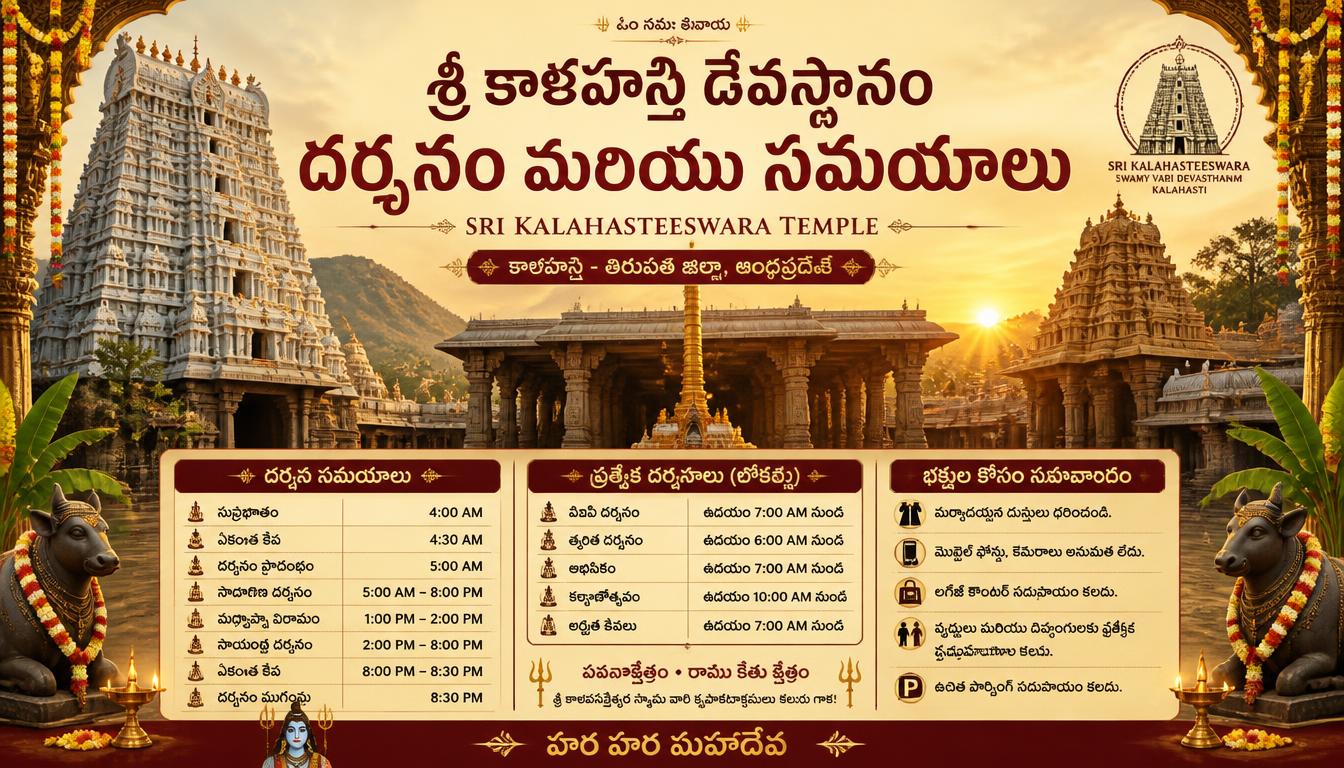
The commonly followed Sri Kalahasti Temple darshan timings run from around 5:00 AM to 9:00 PM. Darshan continues through much of the day, though access and individual ritual schedules can change depending on temple ceremonies, festivals, crowd levels, and special occasions.
For many devotees, early morning is the loveliest part of the day here. The temple feels slightly calmer, the weather is kinder, and standing before Lord Kalahasteeswara after sunrise has a peacefulness which is difficult to properly put into words.
A practical daily schedule can generally be understood like this:
These timings should be treated as planning guidance rather than a promise carved in stone. The daily temple schedule may be adjusted on Amavasya, Pournami, Mondays, festival dates, and other spiritually important days.
If your journey depends upon a particular seva or exact slot, confirming the latest schedule through the temple’s official channels or official temple counters before participating is sensible.
The usual Sri Kalahasti Temple opening time is around 5:00 AM, while the Sri Kalahasti Temple closing time is generally around 9:00 PM.
That long schedule gives pilgrims a fair amount of flexibility, but choosing a random hour isn’t always the best plan. A quiet weekday morning and an Amavasya afternoon can feel like two completely different temples when you look at the queue.
The morning darshan period is particularly attractive for devotees who prefer cooler weather and relatively peaceful surroundings. Arriving close to opening time can also leave enough of the day for a pooja or nearby visit afterward.
Evening darshan carries another mood altogether. Lamps, Harathi, temple sounds, and the gradually darkening sky create an atmosphere that feels less hurried even when plenty of devotees are around.
Remember that ritual requirements can temporarily affect access to certain temple areas. So, when searching for Sri Kalahasti Temple timings today, verify current information rather than relying completely on an old timetable saved months ago.
Visitors can usually choose among different forms of Sri Kalahasti darshan, ranging from Free Darshan to paid priority arrangements. The exact availability and ticket structure may be revised by the Sri Kalahasteeswara Swamy Vari Devasthanam, especially during busy periods.
Free Darshan is the regular option for pilgrims who don’t mind joining the standard darshan queue. It doesn’t require paying for faster entry, though waiting can naturally become longer during weekends and auspicious dates.
A Special Entrance Darshan, sometimes associated with a ₹50 Special Entrance category, provides a separate or comparatively quicker queue arrangement when offered.
Another familiar option is ₹200 Seeghra Darsanam or Seeghra Darsanam, intended to shorten the normal waiting process. This can be useful when visiting with limited time, although a ticket should never be understood as a guarantee of instant entry.
Other arrangements may include Seva Darshan, NRI Darshan, VIP Darshan, or Antharalaya Darshanam, depending upon current Devasthanam rules and eligibility.
Before purchasing a special darshan ticket, confirm the current darshan ticket price at an authorized darshan counter or official booking source. Avoid depending on unofficial agents simply because somebody near the temple promises a magical five-minute entry.
For devotees without a strict schedule, Sri Kalahasti Temple free darshan timings make regular worship quite accessible throughout much of the temple’s operating hours.
The trade-off is waiting.
On a normal weekday, the temple queue system may move reasonably comfortably. On a Monday, weekend, Pradosham, Amavasya, or major festival, that same corridor can fill with pilgrims surprisingly quick.
Srikalahasti Seeghra Darsanam is therefore useful for visitors wanting a faster route. The priority queue generally reduces waiting compared with ordinary entry, but crowd conditions still matter.
Even a ticketed queue can become busy on spiritually significant dates. Keep a little buffer in your itinerary instead of scheduling your train, pooja, darshan, meal, and return journey with barely ten minutes between everything.
That tiny bit of flexibility saves alot of unnecessary tension.
For many pilgrims, Sri Kalahasti Rahu Ketu Pooja is as important as the main darshan itself. Srikalahasti has become particularly well known for rituals associated with Rahu–Ketu dosha, Naga Dosha, Sarpa Dosha, and traditional beliefs surrounding difficult planetary positions.
The commonly cited Rahu Ketu Pooja timings extend from approximately 6:00 AM to 5:00 PM, with rituals conducted in batches during the day.
Devotees sometimes prefer performing the ritual during Rahu Kalam, although the temple conducts the pooja across a much broader daily period. Some visitors deliberately choose Amavasya, Pournami, or another astrologically meaningful day, which naturally brings larger crowds.
The ritual generally takes place within designated areas or a Rahu Ketu Mandapam, rather than being performed directly beside the main Shiva Lingam.
If this pooja is the central purpose of your journey, reach the temple well before your preferred period. Buying a ticket and finding the correct mandapam can itself take time when thousands of people seem to have had exactly the same idea that morning.
Rahu Ketu Pooja tickets may be offered in different categories, sometimes described as General Ticket, Special Ticket, and Deluxe Ticket arrangements. Differences may involve seating location, ritual setting, assistance, or other temple-defined benefits.
Because Rahu Ketu Pooja cost and categories can change, visitors should verify the current Rahu Ketu Pooja price before travelling. The safest approach is to rely on authorized booking facilities and temple counters.
Depending upon the current arrangement, priest assistance or a more guided ritual may accompany certain categories. Instructions are normally provided during the ceremony, so first-time pilgrims shouldn’t feel like they must already know every mantra and movement.
For Rahu Ketu Pooja booking, avoid assuming every website displaying a payment button is an official temple service. Check the authorized source carefully, especially before paying a large amount.
After completing the pooja, devotees may proceed for Rahu Ketu Pooja darshan according to the temple’s prevailing system.
Beyond regular darshan and Rahu–Ketu worship, Sri Kalahasti Temple sevas and poojas include several rituals connected with Shiva worship.
Abhishekam is among the most meaningful. In Hindu worship, Abhishekam involves the ceremonial sacred bath of the deity, and offerings such as water or milk abhishekam may form part of specific traditions and temple-approved rituals.
Rudrabhishekam carries particular significance for Shiva devotees. Chanting associated with Lord Rudra accompanies the worship, creating one of those moments where the temple seems louder and quieter at the same time. Strange description maybe, but anybody who has sat through a deeply devotional chant knows the feeling.
Other temple sevas can include Archana, or Name Recitation, Somavara Abhishekam, Naga Pratishta, Pradosha Pooja, Suprabhata Seva, and evening Harathi.
Exact abhishekam timings, availability, participation rules, and ticket requirements should be confirmed at the temple, since individual Sevas and Poojas don’t necessarily operate on an identical timetable every day.
The period from roughly 6:00 AM to 9:00 AM is important for various morning poojas and Abhishekam activities. Early arrival can therefore work particularly well for devotees who want worship and darshan in one visit.
The day begins with devotional activity such as Suprabhata Seva, followed by the temple’s scheduled rituals. The precise sequence matters more to temple administration than to the average visitor, but knowing the broad timetable helps enormously.
Evening worship generally gathers momentum from around 6:00 PM to 8:30 PM, including evening pooja and evening Harathi.
Morning feels fresh and purposeful. Evening feels warmer, slower and almost cinematic—but not in the touristy sense. Oil lamps don’t really care about your camera angle.
For a relatively peaceful darshan, early weekday mornings are usually the smartest choice. Arriving around opening time gives you cooler temperatures and may help reduce your temple waiting time.
A regular Tuesday-to-Friday visit may be easier than a Monday because Monday is traditionally associated with Lord Shiva. Weekend darshan can also draw families and pilgrims travelling from nearby cities.
The best time for darshan at Sri Kalahasti therefore depends on what you value. If shorter queues matter most, pick a non-festival weekday and arrive early. If spiritual observance matters more than convenience, an auspicious day may be worth the additional crowd.
Try not to measure a sacred visit entirely by how quickly you entered and left, though. Sometimes twenty quiet minutes after darshan become more memorable than saving forty minutes in a queue.
Monday holds particular significance for Shiva worship, and more devotees may visit on this day.
Amavasya, meaning the New Moon, is especially significant for many people visiting for Rahu–Ketu-related worship and certain traditional observances. Pournami, or the full moon, is another spiritually meaningful lunar date.
Pradosham is closely connected with Lord Shiva worship and attracts devotees for special prayers. Similarly, Karthika Month carries deep importance in the Shiva tradition, with lamps and devotional observances becoming prominent during celebrations such as Karthika Deepotsavam.
The biggest occasion is naturally Maha Shivaratri. The temple can become exceptionally busy as enormous numbers of devotees arrive to worship Lord Shiva.
Other periods such as Pitru Paksha, Mahalaya Amavasya, Bhadrapada Masam, Navaratri, and Vijaya Dashami may also influence pilgrim movement and ritual activity.
If visiting on major festival days, assume your darshan waiting time will be considerably longer than on an ordinary weekday.
Srikalahasti isn’t famous only because people perform Rahu–Ketu rituals here. Its identity reaches much deeper.
The presiding deity, Sri Kalahasteeswara Swamy, represents Lord Shiva in the form associated with Vayu. The Vayu Lingam makes the shrine one of the revered Pancha Bhoota Sthalams, where Shiva is worshipped through manifestations connected with nature’s fundamental elements.
Here, that element is air.
You cannot hold air in your palm, yet you notice immediately when it disappears. There is something rather beautiful about worship centered around something invisible but absolutely necessary for life.
The temple also honours Gnana Prasunambika Devi, and generations of devotees have come here seeking blessings, spiritual clarity, relief from karmic troubles, and ultimately liberation.
This combination of mythology, ritual and living devotion explains why Srikalahasti remains much more than another historic monument in South India.
Following the Sri Kalahasti Temple dress code is one simple way of showing respect for the sacred environment.
Traditional or modest clothing is recommended. Men may choose a Dhoti, shirt, or Kurta-Pajama, while women commonly wear a Saree, Salwar-Kameez, or other appropriate traditional clothing.
Whatever you wear, choose something comfortable enough for walking and potentially standing in queues. A beautiful outfit becomes considerably less beautiful after two hours if you can’t comfortably move in it.
Visitors should also respect temple entry guidelines regarding shoes, bags, leather items, photography, and electronic devices.
Mobile phone restrictions and camera restrictions may apply in temple areas, particularly near the sanctum. Follow posted instructions and directions from temple volunteers rather than arguing that you only wanted “one quick photo.”
Good darshan etiquette is fairly simple: respect the deity, the space, temple staff, and the other pilgrims standing beside you.
Maintain temple silence where requested and avoid pushing through the queue. During crowded periods everybody wants darshan, including the elderly person who may be standing behind you for much longer than you realised.
Follow all sanctum rules, photography restrictions, and directions concerning personal belongings. Help maintain temple cleanliness by using proper disposal facilities and avoiding litter.
Photography should never interfere with worship. In restricted areas, keep the phone away entirely.
Most importantly, don’t let the race to reach the deity turn devotion into competition. A queue moves better when everybody remembers they’re sharing the same sacred space.
There is no single reliable answer to the Sri Kalahasti Temple queue waiting time because it can change dramatically.
During ordinary weekdays darshan, queues may be relatively manageable. Weekend darshan generally sees increased visitor numbers, while festival darshan can involve substantial waits.
Monday, Amavasya, Pradosham, Karthika dates, and Maha Shivaratri deserve extra planning.
Your chosen entry category also matters. Free Darshan normally involves more waiting than Special Darshan or Seeghra entry when those faster options are operational.
Arrive with water where permitted, eat appropriately beforehand, and don’t create a return itinerary with zero margin. Temples don’t run according to your railway ticket, unfortunately.
Families travelling with elderly devotees should ask at official counters about the current arrangements for senior citizen darshan.
Special provisions may also sometimes exist for differently-abled devotees and mothers with infants, subject to current temple policies. These arrangements can change, so never assume priority access simply from something written in an old travel post.
If someone in your family struggles with extended standing, speak with temple staff before entering a long queue.
Facilities such as drinking water, resting areas, a cloakroom, and assistance from temple volunteers can make the journey easier, but availability and location should be checked upon arrival.
For visitors searching how to book Sri Kalahasti Temple darshan, first decide what you actually require: ordinary darshan, faster entry, a specific seva, or Rahu–Ketu Pooja.
Regular general darshan may not require advance reservation in the same way as certain paid services. Tickets for specific arrangements can be available through official booking facilities or authorized temple counters.
When looking for Sri Kalahasti Temple online booking, make sure you’re using an official or authorized platform before entering personal or payment details.
For Sri Kalahasti Temple ticket booking, keep confirmation details accessible and check reporting instructions carefully. A ticket for a pooja may have conditions different from an ordinary darshan ticket.
It sounds obvious, but many travel headaches begin with people buying the right ticket and reading absolutely none of it.
A little temple travel planning makes the first visit surprisingly easier.
Try arriving early, particularly if you plan to combine Rahu Ketu Pooja, main darshan, and another seva. Check your ticket category first rather than joining whichever queue looks most convincing.
Carry minimal belongings. Use the authorized cloakroom where necessary, leave prohibited items outside designated areas, and ask staff when you’re unsure about an entrance.
After darshan, devotees may visit the prasadam counter and spend a few unhurried minutes within permitted temple areas instead of rushing straight toward the exit.
For first-time pilgrims, keeping the schedule loose is genuinely useful. A temple visit feels much nicer when every unexpected 20-minute delay doesn’t become a personal emergency.
Read more: https://templetimingsdaily.com/car-dashboard-accessories/
Srikalahasti Railway Station provides convenient rail access for many visitors, and the temple can be reached from the station using local transport.
The temple is also frequently combined with a pilgrimage to Tirupati and the famous Balaji Temple. Because Srikalahasti lies within practical travelling distance of Tirupati, devotees often include both destinations in one itinerary.
Around the temple area, the Swarnamukhi River carries religious and geographical significance. The Swarnamukhi River Bathing Ghats have traditionally been associated with pilgrim activities and ritual practices.
Visitors approaching the temple will also encounter the striking East Gopuram, one of the architectural elements that immediately gives the sacred complex its unmistakable presence.
If sufficient time remains after darshan, pilgrims may explore a few nearby places connected with the Srikalahasti journey.
The Bhakta Kannappa Hill Shrine recalls the extraordinary devotion of Kannappa, remembered in Shaiva tradition for his unconditional devotion to Lord Shiva.
The Swarnamukhi River surroundings are another meaningful part of the landscape, particularly for visitors interested in the temple’s broader sacred geography.
Veyilingala Kona Waterfalls offers a contrasting natural experience for travellers who have additional time, though seasonal conditions and local access should be checked before planning a trip.
Still, if your primary purpose is temple worship, don’t pack the itinerary so tightly that darshan itself becomes merely another box to tick.
A smooth Sri Kalahasti Temple visit usually comes down to a handful of simple habits:
And perhaps one more thing: don’t spend the entire visit worrying about whether you’re doing the visit perfectly. Be prepared, yes, but leave a little room for simply being there.
Srikalahasti Temple is generally open from early morning until evening, allowing devotees to attend darshan, poojas, and other sacred rituals throughout the day.
Sri Kalahasti Temple timings usually begin around 5:00 AM and continue until about 9:00 PM, though schedules may vary on festivals and special days.
Srikalahasti is a famous pilgrimage town in Andhra Pradesh, best known for the ancient Sri Kalahasteeswara Temple dedicated to Lord Shiva.
Srikalahasti Temple darshan timings generally run from around 5:00 AM to 9:00 PM, with certain periods reserved for poojas and temple rituals.
Kalahasti timings generally allow devotees to visit from early morning to late evening, but checking the latest schedule before visiting is recommended.
A visit to Sri Kalahasti Temple can begin as a timetable—5:00 AM opening, pooja at this hour, darshan at another—and slowly turn into something much less measurable. Somewhere between the queue, ringing bells, old stone corridors and a brief glimpse of the deity, the clock tends to matter a little less.
Understanding Sri Kalahasti Temple darshan timings, Free Darshan, Seeghra Darsanam, Rahu Ketu Pooja timings, Abhishekam, ticket arrangements, the temple dress code, and expected waiting time helps remove unnecessary confusion from the journey. Early weekday mornings are generally preferable for pilgrims seeking a calmer experience, while Amavasya, Monday, Pradosham, Karthika Month, and Maha Shivaratri bring a more intense devotional atmosphere along with larger crowds.
Above everything, remember what draws people to this place generation after generation. The sacred Vayu Lingam represents something nobody can see yet everybody needs with every breath. Maybe that is part of Srikalahasti’s quiet lesson too: some of the most important things we carry away from a pilgrimage aren’t things anybody else can see.
Plan the timings, check current temple information, respect the traditions—and once you finally stand before Lord Kalahasteeswara, allow the schedule to become silent for a moment.
I kept the supplied timing and ticket information appropriately qualified because temple schedules, ticket categories, prices, and access rules can change.