Physical Address
304 North Cardinal St.
Dorchester Center, MA 02124
Physical Address
304 North Cardinal St.
Dorchester Center, MA 02124

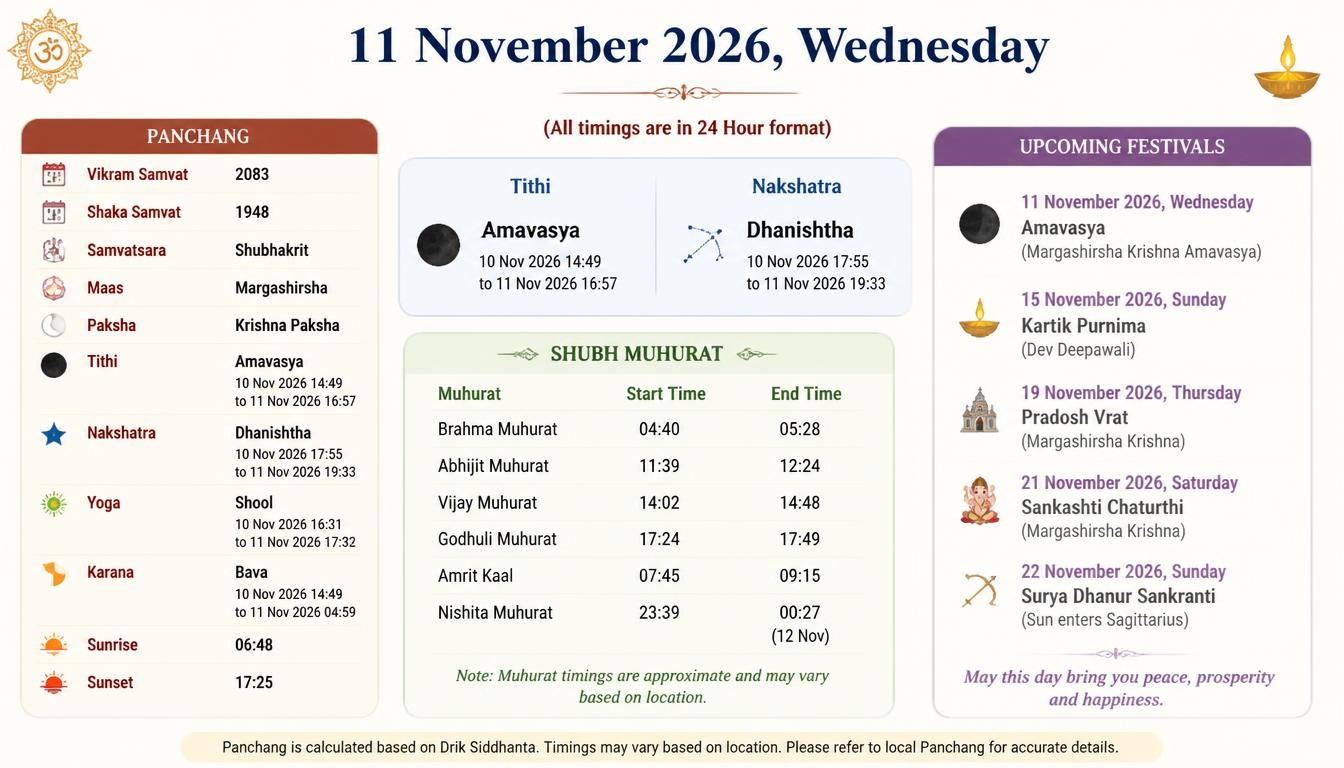
11 November 2026 falls on a Wednesday, bringing an interesting combination of Hindu calendar observances, traditional astrological timings, and preparations for several important November festivals. According to the Hindu calendar, this date falls during Kartik Shukla Dwitiya, a spiritually significant period associated with devotion, family relationships, and post-Diwali celebrations.
If you are checking Panchang for 11 November 2026 to understand the day’s tithi, nakshatra, yoga, karana, sunrise, sunset, or auspicious timings, this guide brings the important details together. It also explains the meaning of the day’s planetary positions, religious significance, and upcoming festivals.
One important date clarification: 11 November 2026 has already passed, as the current date is 19 November 2026. The information below is presented as a calendar reference for that particular Wednesday, rather than as today’s live Panchang.
The timings supplied for this date use Hyderabad, India, as the reference location and Indian Standard Time (IST). People checking the same date from Lahore or another city should use locally calculated timings because sunrise and sunset affect several Panchang periods.
Writing
11 November 2026 is an important date in the Hindu calendar 2026, particularly because it is associated with Bhai Dooj, also known as Bhaiya Dooj, Bhau Beej, or Yam Dwitiya.
The day falls in the Kartik month during Shukla Paksha. It is traditionally connected with the bond between brothers and sisters, prayers for family well-being, and the worship of Yama, the Hindu god associated with death and dharma.
Here are the key calendar details:
| Calendar element | Details |
|---|---|
| Date | 11 November 2026 |
| Day | Wednesday (Budhavar) |
| Hindu month | Kartik |
| Paksha | Shukla Paksha |
| Tithi | Dwitiya until 3:53 PM |
| Next Tithi | Shukla Tritiya |
| Nakshatra | Anuradha until 11:37 AM |
| Next Nakshatra | Jyeshtha |
| Yoga | Atiganda, followed by Sukarma |
| Karana | Kaulava, followed by Taitila |
| Sun sign | Tula (Libra) |
| Moon sign | Vrishchika (Scorpio) |
| Ayana | Dakshinayana |
These details describe the five main components of the Panchang, traditionally called the Pancha Anga. Together, they help people understand the character of a particular day according to Vedic astrology.
The date is especially relevant for families observing Bhai Dooj and those following the religious traditions of the Kartik Shukla fortnight.
A daily Panchang is more than a calendar showing dates and festivals. It is a traditional Hindu almanac that explains the movement of celestial bodies and divides time into meaningful astrological periods.
The five elements are Tithi, Nakshatra, Yoga, Karana, and Vara. Let’s understand what each one indicates on this Wednesday.
The Tithi on 11 November 2026 is Shukla Paksha Dwitiya, which continues until approximately 3:53 PM. After that, Shukla Tritiya begins.
Dwitiya is the second lunar day of the waxing Moon. It falls after Pratipada and represents the early development of the bright lunar fortnight.
This particular Dwitiya is associated with Bhai Dooj, making it significant for traditional brother-sister celebrations.
The Moon remains in Anuradha Nakshatra until approximately 11:37 AM, after which Jyeshtha Nakshatra begins.
Anuradha is the seventeenth of the 27 nakshatras in Vedic astrology. It is associated with Mitra, a deity connected with friendship, harmony, cooperation, and relationships.
People born under Anuradha are traditionally associated with qualities such as loyalty, determination, and the ability to maintain meaningful connections.
Jyeshtha follows Anuradha and is traditionally associated with responsibility, authority, protection, and maturity.
An important calendar-reading detail deserves attention: some calendar information may incorrectly display Pūrva Bhādrapada as the day’s nakshatra. This conflicts with the detailed timing of Anuradha followed by Jyeshtha. For the Hyderabad calculation used here, Anuradha and Jyeshtha are the consistent entries.
The Yoga is Atiganda, followed by Sukarma.
In Vedic astrology, Yoga is calculated using the combined longitudinal positions of the Sun and Moon. It is one of the five essential Panchang elements.
Atiganda is traditionally considered a challenging yoga, encouraging caution and thoughtful decisions. Sukarma, which follows it, has a more favourable traditional association with constructive effort and meaningful activities.
These interpretations are part of traditional astrology rather than scientifically established predictions.
Kaulava Karana continues until approximately 3:53 PM, followed by Taitila Karana.
A Karana represents half of a lunar Tithi. There are eleven recognised Karanas in the traditional Hindu calendar.
Kaulava and Taitila are both relevant when astrologers examine the suitability of particular activities and calculate an auspicious muhurat.
The weekday is Wednesday, traditionally known as Budhavar.
Wednesday is associated with Mercury, or Budh, in Vedic astrology. Mercury represents communication, intelligence, learning, business, mathematics, and analytical thinking.
Devotees may offer prayers to Lord Budh and seek blessings for wisdom, clear communication, education, and professional progress.
One of the most important observances associated with this date is Bhai Dooj 2026.
Also called Bhaiya Dooj, Bhau Beej, and Yama Dwitiya, this festival celebrates the loving relationship between brothers and sisters. It is observed during Kartik Shukla Dwitiya and forms an important part of the post-Diwali festival season.
On this occasion, sisters traditionally apply a tilak to their brothers’ foreheads and pray for their long lives, happiness, and prosperity.
Brothers, in return, express affection and offer gifts or blessings to their sisters. The celebration may be simple in some households, while other families organise a special meal and a larger family gathering.
The religious story associated with Bhai Dooj centres on Yama and his sister Yamuna.
According to a popular traditional account, Yamuna lovingly invited her brother Yama to visit her home. When he accepted the invitation, she welcomed him with affection, prepared a meal, and performed a ceremonial tilak.
Yama was pleased with her hospitality and offered her a blessing. The occasion became associated with prayers for the well-being and longevity of brothers.
This is why Bhai Dooj is also called Yam Dwitiya.
The story carries a simple but beautiful message: family affection deserves attention, and relationships become stronger when people make time for each other.
For Hyderabad, the Bhai Dooj observance is associated with the afternoon Aparahna period.
The exact Bhai Dooj tika muhurat should be checked against the local Panchang, as regional calculations and observance traditions can differ.
Bhai Dooj is also associated with Chitragupta Puja in several Hindu communities.
Chitragupta is traditionally regarded as the divine record-keeper who maintains accounts of human actions. He is closely associated with Yama.
During the worship, devotees may offer prayers to Chitragupta and seek blessings for wisdom, honesty, discipline, and success.
The Kalam-Dawat Puja tradition is particularly meaningful for people involved in education, writing, accounting, and business. Pens, inkpots, books, and writing materials may be placed before the deity as symbols of knowledge and responsible work.
A shubh muhurat refers to an auspicious period selected for beginning an activity according to traditional Hindu astrology.
People often consult the Panchang before planning religious ceremonies, purchases, business activities, travel, and family functions.
The following timings are supplied for Hyderabad, India.
| Muhurat | Timing |
|---|---|
| Brahma Muhurat | 4:41 AM – 5:29 AM |
| Abhijit Muhurat | 11:37 AM – 12:22 PM |
| Vijay Muhurat | 1:54 PM – 2:39 PM |
| Godhuli Muhurat | 5:42 PM – 6:06 PM |
| Pratah Sandhya | Morning twilight period |
| Sayam Sandhya | Evening twilight period |
Brahma Muhurat occurs in the early morning, traditionally considered a peaceful period for meditation, prayer, yoga, and spiritual study.
Many devotees use this time for mantra jaap, reading sacred texts, and beginning the day with a calm mind.
Abhijit Muhurat is a traditionally auspicious midday period. It is often considered useful when selecting a suitable time for certain important activities.
However, it should not automatically be treated as suitable for every ceremony. Other Panchang factors, including Rahu Kaal and the relevant Tithi, should also be examined.
Vijay Muhurat is traditionally associated with success, determination, and overcoming difficulties.
Some people consult this period before starting important tasks or making significant decisions.
Godhuli Muhurat occurs around sunset. The word Godhuli refers to the dust raised by cattle returning home in the evening.
It is traditionally considered a peaceful time for lighting a diya, offering prayers, and performing evening rituals.
Amrit Siddhi Yoga and Sarvartha Siddhi Yoga are recognised auspicious combinations in Hindu astrology.
Amrit Siddhi is traditionally associated with favourable outcomes, while Sarvartha Siddhi is interpreted as a combination supporting success in various undertakings.
Their presence and exact duration must be confirmed using the complete local Panchang. They should not be assumed solely from the date.
Along with favourable periods, the Panchang also identifies certain time windows traditionally considered less suitable for beginning important activities.
These are commonly known as Ashubh Muhurat.
| Inauspicious period | Hyderabad timing |
|---|---|
| Rahu Kaal | 12:00 PM – 1:25 PM |
| Yamaganda | 7:43 AM – 9:08 AM |
| Gulika Kaal | 10:34 AM – 12:00 PM |
| Durmuhurat | 10:51 AM – 11:37 AM |
| Durmuhurat | 1:08 PM – 1:54 PM |
Rahu Kaal is a daily period associated with Rahu. Traditional astrology recommends avoiding the commencement of particularly important new activities during this window.
For this date, Rahu Kaal is approximately 12:00 PM to 1:25 PM in Hyderabad.
Yamaganda is another traditionally inauspicious period. It is associated with Yama and is generally avoided when selecting a time to begin important undertakings.
Gulika Kaal is associated with Gulika, a subsidiary astrological influence traditionally considered when choosing auspicious timings.
Durmuhurat refers to a period considered unfavourable for certain important activities.
There are two listed Durmuhurat windows on this date, so people consulting the Panchang for a ceremony should take these periods into consideration.
Remember, these traditional time classifications are not guarantees of success or failure. They are part of a religious and astrological time-selection system.
Sunrise and sunset are particularly important in Hindu calendar calculations because the traditional Panchang day is generally reckoned from one sunrise to the next.
For Hyderabad, the approximate astronomical timings are:
| Sun and Moon details | Time |
|---|---|
| Sunrise | 6:17 AM (approximately) |
| Sunset | 5:42 PM (approximately) |
| Moonrise | 8:00 AM (approximately) |
| Moonset | 7:14 PM (approximately) |
| Dinamana | Approximately 11 hours 24 minutes |
The Sun is in Tula Rashi (Libra), while the Moon is in Vrishchika Rashi (Scorpio) according to the supplied Panchang details.
These positions are relevant to traditional Vedic astrology and are used alongside the Tithi, Nakshatra, Yoga, and Karana.
For people checking the calendar from Lahore, Pakistan, the local sunrise and sunset are different. Therefore, Hyderabad’s Rahu Kaal, Abhijit Muhurat, and other location-sensitive timings should not be copied directly.
Several deities and spiritual figures are associated with the religious context of 11 November.
Lord Krishna is worshipped by devotees seeking wisdom, protection, peace, and spiritual guidance.
A traditional mantra associated with Krishna devotion is:
Krishnaya Vasudevaya Haraye Paramatmane
Devotees may chant this mantra 11 times with concentration and devotion.
The practice can be accompanied by lighting a small ghee diya and offering flowers or prayers.
Since the date falls on Wednesday, worship of Lord Budh is also relevant.
Mercury is traditionally associated with intelligence, communication, trade, and learning. Devotees may pray for better judgement, academic progress, and success in professional activities.
Yama and Chitragupta are particularly relevant because of the Bhai Dooj and Yam Dwitiya observances.
Their traditional stories remind devotees of family relationships, moral responsibility, truthfulness, and the importance of good actions.
November is an especially significant month in the Hindu religious calendar because it contains several festivals connected with Kartik Shukla Paksha.
After 11 November, devotees can look forward to various celebrations and observances.
Here are some important upcoming occasions in the November 2026 calendar:
| Festival or observance | November 2026 date |
|---|---|
| Nagula Chavithi | 13 November |
| Chhath Puja (Surya Shashthi) | 15 November |
| Vrischika Sankranti | 16 November |
| Dev Uthani Ekadashi | 20 November |
| Tulsi Vivah | 21 November |
| Kartik Purnima | 24 November |
Festival dates and regional observances can differ depending on the location and calendar tradition.
Nagula Chavithi is an important traditional observance in parts of South India, particularly Andhra Pradesh.
Devotees worship serpent deities and offer prayers for family well-being, protection, and prosperity.
Chhath Puja, also called Surya Shashthi, is dedicated to the worship of the Sun God.
Devotees observe fasting, offer arghya to the setting and rising Sun, and pray for health, happiness, and the welfare of their families.
It is especially popular in Bihar, Jharkhand, Uttar Pradesh, and neighbouring regions.
Vrischika Sankranti marks the Sun’s transition into Vrischika Rashi (Scorpio).
It is observed through regional religious customs, prayers, and charitable activities.
Dev Uthani Ekadashi, also known as Prabodhini Ekadashi, is an important observance during Kartik Shukla Paksha.
According to Hindu tradition, Lord Vishnu awakens from his cosmic rest on this occasion.
It also marks the beginning of an important period for traditional Hindu marriage ceremonies and other auspicious activities.
Tulsi Vivah symbolically celebrates the marriage of the sacred Tulsi plant with Lord Vishnu, often represented by Shaligram.
Families perform the ceremony with devotion and traditional rituals. In many communities, it also marks the beginning of the wedding season.
Kartik Purnima is one of the most spiritually significant full-moon days in the Hindu calendar.
Devotees take holy baths, light lamps, perform charity, and offer prayers. In several places, the festival is celebrated as Dev Deepawali.
If you are new to Hindu astrology, reading a Panchang can initially seem a little confusing. There are Sanskrit terms, astronomical calculations, and several different time periods to understand.
However, learning the five basic elements makes the process much easier.
This is essentially how to read a Panchang without getting lost in complicated astrological terminology.
A common question is why two websites sometimes show slightly different timings for the same date.
The answer is usually geographical location, calculation method, or rounding.
Sunrise, sunset, Moonrise, and Moonset depend on geographical coordinates. A Panchang calculated for Hyderabad may not give the same results as one calculated for Lahore, Delhi, Mumbai, or Kathmandu.
Other important factors include:
For accurate personal muhurat selection, it is sensible to consult a local astrologer or purohit who can calculate the relevant timings for the actual ceremony location.
11 November 2026 is a Wednesday, traditionally known as Budhavar.
Bhai Dooj, also known as Bhaiya Dooj, Bhau Beej, and Yam Dwitiya, is associated with this date in the Hyderabad and Lahore calendars.
The Tithi is Shukla Paksha Dwitiya until approximately 3:53 PM, followed by Shukla Tritiya.
Anuradha Nakshatra continues until approximately 11:37 AM, followed by Jyeshtha Nakshatra.
For Hyderabad, Rahu Kaal is approximately 12:00 PM to 1:25 PM.
The supplied Hyderabad Abhijit Muhurat is 11:37 AM to 12:22 PM.
The date alone is not enough to determine whether a marriage muhurat is suitable. A complete assessment should consider the Tithi, Nakshatra, planetary positions, local Panchang, and the relevant traditional marriage criteria.
A suitable time for Griha Pravesh or Naamkaran should be determined through a complete muhurat calculation. The presence of an Abhijit Muhurat does not automatically make every ceremony appropriate.
You can consult established calendar services such as Drik Panchang and compare the date-specific calculations with a local Hindu almanac. For important ceremonies, a qualified purohit or astrologer can provide additional guidance.
Read ARticul: https://templetimingsdaily.com/karthika/
11 November 2026 is a meaningful Wednesday in the Kartik month, combining the religious importance of Bhai Dooj with the traditional Panchang elements of Shukla Dwitiya, Anuradha Nakshatra, Atiganda Yoga, and Kaulava Karana.
The day also provides an opportunity to reflect on family relationships, devotion, gratitude, and the importance of living with honesty and kindness.
Whether you are researching the Hindu calendar 2026, checking the Bhai Dooj date and time, understanding Rahu Kaal, or looking ahead to the upcoming November festivals, the Panchang offers a traditional framework for understanding the day.
The most useful approach is to remember that Panchang timings are location-specific. Always check the local sunrise, sunset, and muhurat before planning an important religious ceremony.
May the spirit of Kartik bring peace to your home, happiness to your family, and wisdom to your decisions. And may every festival become an opportunity to strengthen the bonds that make life truly beautiful.