Physical Address
304 North Cardinal St.
Dorchester Center, MA 02124
Physical Address
304 North Cardinal St.
Dorchester Center, MA 02124

There are some festivals that arrive with noise, colour and crowds, and then there are festivals that somehow make people look inward even while the streets are glowing. Dussehra 2026 is one of those days.
The sound of drums, the sight of a towering Ravana effigy, prayers in temples and the familiar stories of Lord Rama make the festival feel both grand and strangely personal.
In 2026, Dussehra falls on Tuesday, October 20 in India. It is also known as Vijayadashami or Dasara and is observed on the Dashami day of the bright half of Ashvin. Multiple calendar sources confirm October 20 as the main Dussehra date for 2026.
But Dussehra is not simply a date to circle on a calendar. It carries stories about courage, duty, devotion and the eternal struggle between dharma and adharma. For some families, it is about Rama’s victory over Ravana.
For others, it is connected with Goddess Durga’s victory over Mahishasura. And for many, it becomes a quiet reminder that our own inner battles deserve attention too.
Dussehra 2026 will be celebrated on Tuesday, October 20, 2026. The festival is also called Vijayadashami, with the name referring to the victorious tenth day.
According to the Hindu lunar calendar, Vijayadashami occurs on Dashami Tithi during Shukla Paksha in the month of Ashwin. The exact Puja timings can vary according to location because Hindu religious timings depend on the local sunrise and Panchang calculations.
For example, Drik Panchang lists Vijaya Muhurta for October 20, 2026, with the exact window changing slightly from one Indian city to another. It also gives the Dashami Tithi as beginning on October 20 and ending on October 21.
So, if you’re planning a Dussehra Puja, temple visit or other religious observance, checking the Panchang for your own city is better than blindly copying a time from another location.
Dussehra is a major Hindu festival traditionally associated with the victory of good over evil. The word Vijayadashami itself carries the idea of victory on the tenth day, which gives the celebration its deeply hopeful character.
In the Ramayana tradition, the festival commemorates Lord Rama’s victory over Ravana, following the long conflict that began after Ravana abducted Sita. Rama’s victory is remembered not merely as the defeat of one powerful king, but as the restoration of righteousness.
At the same time, in traditions connected with Goddess Durga, Vijayadashami marks the triumph of Durga over Mahishasura, the buffalo demon. This makes the festival especially interesting because one day can hold multiple sacred stories, each carrying its own cultural meaning.
That is probably one reason Dussehra feels different from an ordinary celebration. It doesn’t tell just one story.
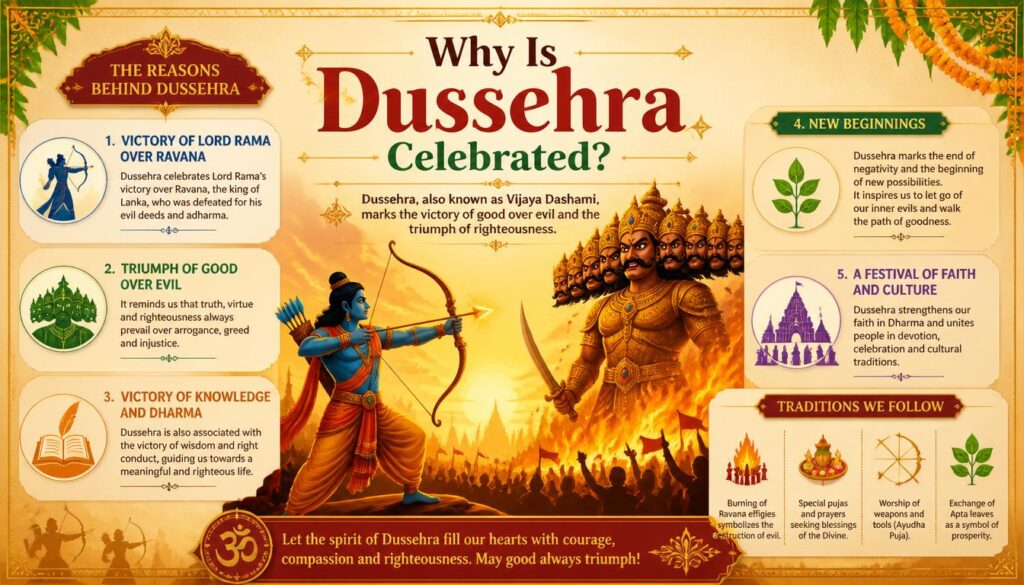
The central message behind Dussehra celebrations is the triumph of good over evil and the victory of dharma over adharma.
The story of Rama teaches the value of duty, courage, loyalty and righteousness. Ravana, despite being highly learned and extraordinarily powerful, is remembered for allowing pride, desire and ego to overcome wisdom.
His ten heads are sometimes interpreted symbolically as representing negative tendencies that human beings must learn to control.
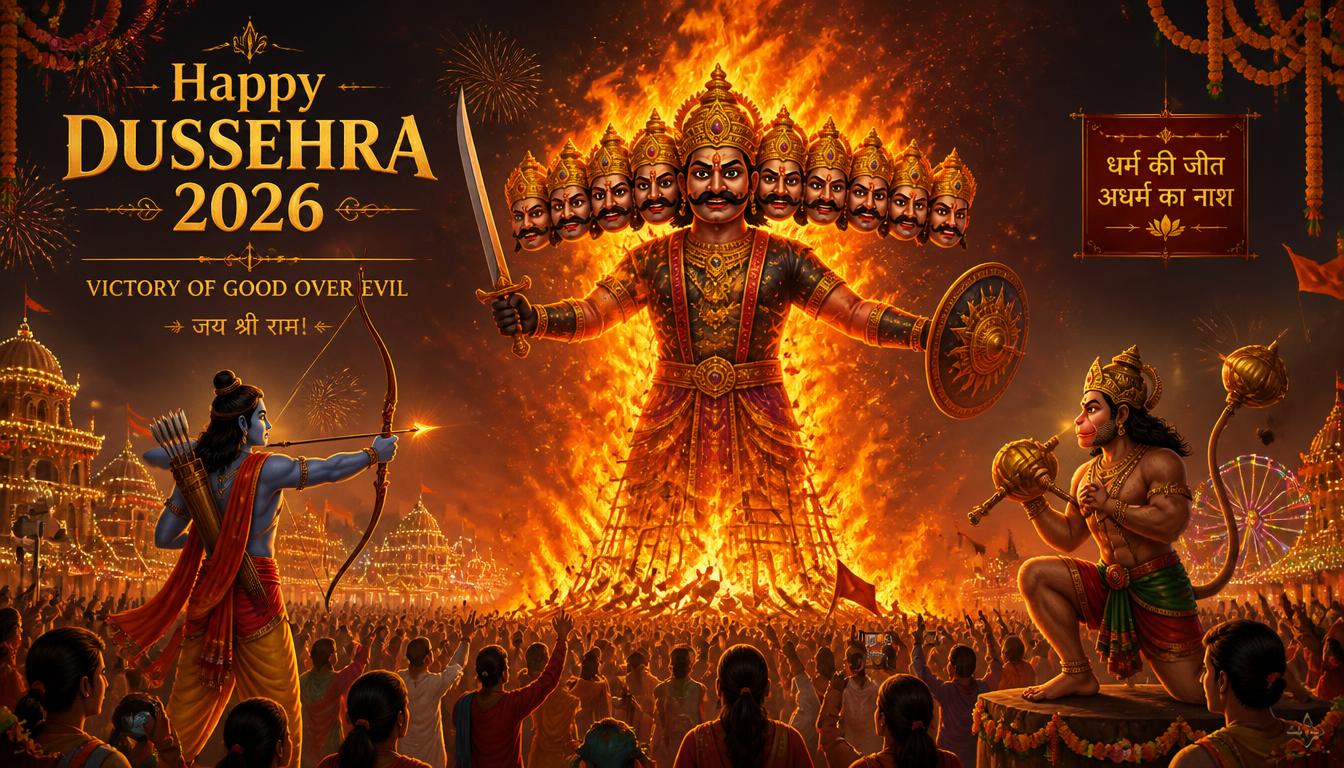
This makes the Ravana Dahan tradition more than a dramatic public show. When the huge effigy catches fire, people are watching a symbolic destruction of evil, arrogance and destructive desires.
And honestly, thats where the festival gets a little uncomfortable in a useful way. It is easy to point at Ravana and call him evil. It is harder to ask which small version of pride or anger we are carrying around ourselves.
The Ramayana provides the most widely recognized narrative behind Dussehra. Lord Rama, regarded in Vaishnava tradition as an avatar of Vishnu, spent fourteen years in exile before the events that led to his confrontation with Ravana.
During the exile, Sita was abducted by Ravana, the powerful ruler of Lanka. Rama, together with Lakshmana, eventually formed an alliance with Hanuman and the Vanara Army.
The resulting journey became one of the most enduring stories in Hindu mythology.
Rama’s army crossed toward Lanka, the conflict reached its climax, and Ravana was ultimately defeated. His fall is remembered on Vijayadashami as the victory of righteousness over arrogance and injustice.
The story has been retold through scripture, theatre, family storytelling, television, dance and Ramlila performances for generations. Somehow the old story keeps finding new audiences.
The burning of the Ravana effigy is one of the most recognizable traditions associated with Dussehra.
In cities and towns, enormous effigies of Ravana, often accompanied by Kumbhakarna and Meghnad, are displayed before being set ablaze.
Crowds gather to watch the spectacle, children point at the fireworks, and for a few moments the whole atmosphere becomes wonderfully chaotic.
But behind the fireworks is a symbolic message.
Ravana Dahan represents the destruction of evil, arrogance, ego and destructive tendencies. Ravana is often portrayed with ten heads, and these have been interpreted in different traditions as symbolic of negative human qualities.
So the burning is not meant simply to say, “Ravana was bad.” Its deeper lesson is that intelligence and power mean very little when they are controlled by arrogance.
The connection between Dussehra and Goddess Durga adds another powerful dimension to Vijayadashami.
According to the Devi Mahatmya tradition, Durga battles Mahishasura, the buffalo demon, and ultimately defeats him. Her victory represents the triumph of divine Shakti, or sacred feminine power, over destructive forces.
This is especially significant in communities where the Shakta tradition has a strong presence.
The final days of Navratri naturally lead into Vijayadashami in many regional traditions. In this sense, Dussehra can be understood as a celebration of victory after a period of spiritual preparation, prayer and devotion.
The stories differ in focus, but the emotional destination is remarkably similar: evil does not get the final word.
Navratri means nine nights and is devoted in many traditions to different manifestations of divine feminine energy. Vijayadashami arrives on the tenth day, giving the festival cycle a natural sense of completion.
The relationship between Navratri and Dussehra is expressed differently across India. Some regions focus strongly on Durga Puja, while others emphasize the Ramayana, Rama and Ravana.
This regional variety isn’t a contradiction. It is one of the beautiful things about Indian festivals. One celebration can wear different clothes in different places and still carry a familiar heartbeat.
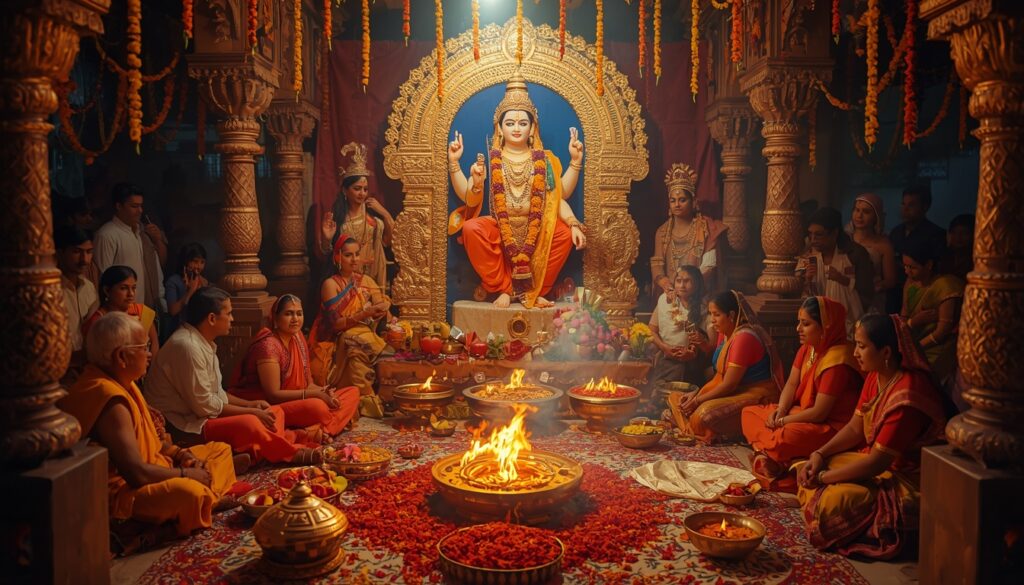
The exact practices vary by family, community and region, but several Dussehra rituals are traditionally associated with Vijayadashami.
Families may clean their homes, prepare a small worship area, wear traditional clothes and offer flowers, incense, fruits, coconut, kumkum and turmeric during prayer.
For many people, the point isn’t the size of the ritual. A small prayer performed sincerely can carry more emotional weight than a room full of decorations.
Shami Puja is an important Vijayadashami tradition in several communities. The Shami tree has associations with the Pandavas and their hidden weapons during their period of incognito exile in the Mahabharata tradition.
Shami leaves may also be exchanged as auspicious symbols of goodwill and prosperity.
Aparajita Puja involves the worship of Goddess Aparajita, whose name means the undefeated or unconquered one.
The practice is associated with victory and divine protection, and traditional observances are generally connected with the Aparahna period of Vijayadashami.
In several parts of India, Ayudha Puja is an important part of the broader Dussehra season. Tools, machinery, vehicles, books and professional instruments may be cleaned and worshipped.
A mechanic may honour his tools. A musician may honour an instrument. A student may place books before the deity.
There is something rather beautiful about that idea: work itself can become a thing worthy of gratitude.
India doesn’t celebrate Dussehra in just one style. The same festival changes dramatically as you travel from one state to another.
Read more: https://templetimingsdaily.com/the-craziest-south-african-nightlife/
Mysuru Dasara is famous for its royal heritage, illuminated surroundings, cultural programmes and the celebrated Jumbo Savari procession.
The connection with Mysuru Palace, elephants, music and ceremonial processions gives the festival an especially majestic character. It feels less like watching a single event and more like stepping into a living historical tradition.
Kullu Dussehra has its own distinctive character. Celebrations in Kullu, Himachal Pradesh, are closely associated with local deities, processions and gatherings around Dhalpur Maidan.
Instead of simply copying the Ravana-burning model found elsewhere, the local tradition has developed around its own religious and cultural practices.
The Ramnagar Ramlila tradition near Varanasi is renowned for its elaborate enactment of the Ramayana.
Here, the story isn’t compressed into one evening. Performances unfold as a larger theatrical and devotional experience, allowing audiences to follow Rama’s journey in much greater detail.
In Delhi, large public Ramlila performances and Ravana effigies attract huge crowds. Places associated with Ramlila celebrations can become packed with families, food stalls, performers and children waiting impatiently for the dramatic finale.
For a child, that giant Ravana can look almost frighteningly real. Then the fireworks start, and suddenly it is a lesson in mythology wrapped inside a festival night.
In parts of South India, Kolu or Golu involves arranging decorative dolls and figurines during the Navratri period.
The practice creates a distinctly domestic and artistic form of celebration, with families inviting guests, sharing food and participating in devotional traditions before Vijayadashami.
The deepest meaning of Dussehra may have less to do with an effigy outside and more to do with what happens inside us.
The festival encourages reflection on qualities such as ego, greed, anger, jealousy, pride and injustice. These are sometimes described as inner enemies because they can quietly damage relationships and judgment.
The victory of Rama can therefore become a metaphor for choosing dharma when doing the right thing is difficult.
Likewise, the victory of Durga can remind devotees of courage, Shakti, resilience and the strength required to confront destructive forces.
Dussehra asks a surprisingly simple question: what needs to be defeated within us before we can genuinely celebrate victory?
Different families follow different devotional practices during the festival. Some may recite the Hanuman Chalisa, while others turn to Sri Ram Chalisa, Rama Raksha Stotram, Durga Kavacham, Devi Mahatmya or Chandi Path according to their tradition.
Some devotees may also read portions of the Sundara Kanda, especially because of its association with Hanuman’s devotion, courage and service to Rama.
There is no need to treat these practices like a checklist. Religious observance is deeply personal, and the appropriate mantra or prayer can depend on family tradition, regional custom and one’s own spiritual practice.
Dussehra is also associated with auspicious beginnings.
People may choose Vijayadashami for starting a new business, beginning studies, purchasing something important, initiating a professional project or embarking on a new journey.
This idea makes sense symbolically. If Dussehra represents victory, then beginning something meaningful on a day associated with victory feels naturally hopeful.
Still, an auspicious day doesn’t do the work for us. The blessing may open the door, but we still have to walk through it.
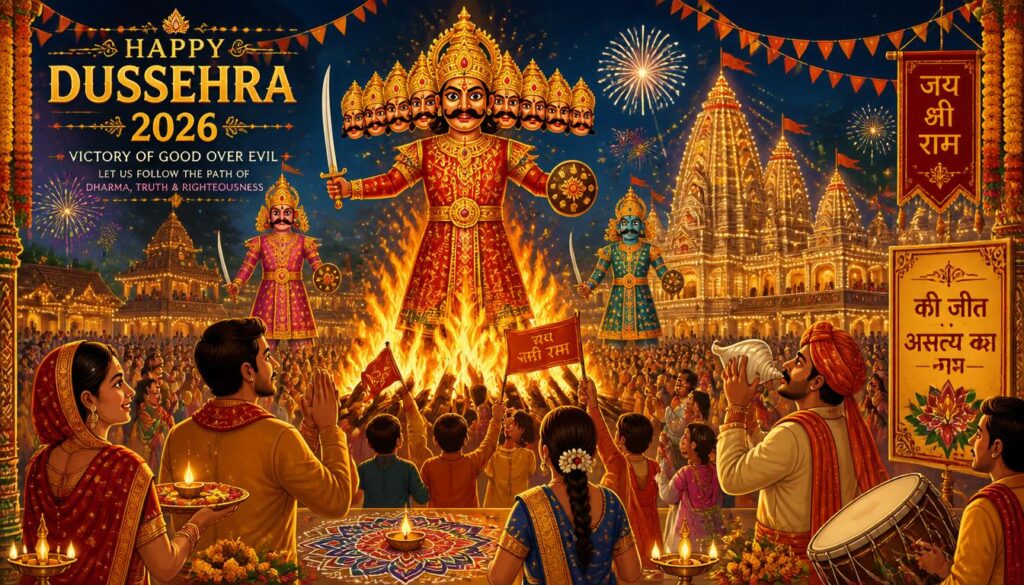
You don’t need to attend the biggest event in your city to make Dussehra 2026 meaningful.
You could begin the day with a simple prayer, visit a temple, read a passage from the Ramayana, participate in a local Ramlila, spend time with family or contribute food or money to someone who needs support.
If your family follows Ayudha Puja, clean and respectfully arrange the tools or objects connected with your livelihood. If you observe Shami Puja or Aparajita Puja, follow your family’s traditional method or seek guidance from a knowledgeable priest.
And perhaps make one private resolution too.
Choose one habit you genuinely want to defeat.
Not ten. Just one.
That makes the symbolism surprisingly practical.
If you’re sending Dussehra wishes in 2026, try making them more personal than a generic “Happy Dussehra.”
You might wish someone courage for a difficult phase, success in a new business, peace within their family or strength to overcome a personal challenge. A short message connected to the actual meaning of the festival can feel much warmer.
For example:
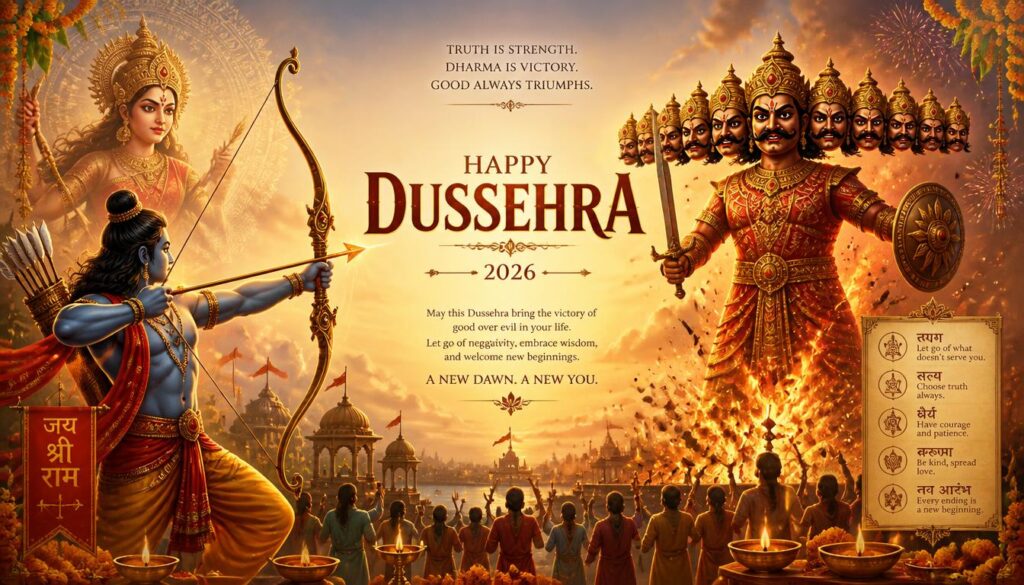
The stories surrounding Dussehra are ancient, but their emotional questions aren’t ancient at all.
People still struggle with pride. Families still need forgiveness. Communities still need cooperation. Businesses still need honesty. Young people still need courage when their future feels uncertain.
That is why Dussehra history continues to matter.
The festival doesn’t merely tell us that good once defeated evil. It invites us to believe that courage, righteousness, devotion and compassion can still defeat destructive tendencies today.
And maybe that is why the festival keeps returning every year. We forget. We remember. We forget again. The calendar brings the lesson back to our doorstep.
Dussehra 2026 is on Tuesday, October 20, 2026 in India. It is also known as Vijayadashami or Dasara.
Dussehra symbolizes the victory of good over evil and is associated with Lord Rama’s victory over Ravana and Goddess Durga’s victory over Mahishasura.
Ravana Dahan symbolizes the destruction of evil, arrogance, ego and other negative qualities represented through the story of Ravana.
Yes. Dussehra, Vijayadashami and Dasara are commonly used names for the festival, although regional traditions and celebrations can differ.
Ayudha Puja is a tradition in which tools, vehicles, machinery, books or professional instruments are cleaned and worshipped as a gesture of gratitude for work and livelihood.
Shami Puja is a Vijayadashami ritual associated with the Shami tree and traditions concerning the Pandavas. It is observed as an auspicious practice in several communities.
Celebrations vary widely, from Ramlila and Ravana Dahan in North India to Mysuru Dasara, Kullu Dussehra, Durga-related celebrations and South Indian Kolu/Golu traditions.
Dussehra 2026 arrives on October 20 with stories that have survived centuries, but its message still feels remarkably close to everyday life.
It speaks about Rama, Ravana, Durga and Mahishasura, yes. But beneath those names are ideas that almost everyone understands: courage against fear, truth against deception, humility against pride and hope against despair.
When the Ravana effigy burns, the flames rise for only a few minutes. The lesson, ideally, should last much longer.
So this Vijayadashami, celebrate the prayers, the sweets, the family gatherings and the colourful traditions. Watch the Ramlila. Visit the temple. Share your Dussehra wishes. Enjoy the fireworks if they are part of your local celebration.
But perhaps take one quiet moment afterward.
Ask yourself what you want this Dussehra to defeat within you.
Because the most meaningful victory may not be happening somewhere under a sky full of fireworks. It might be happening quietly, inside a person who has finally decided to choose the better path.