Physical Address
304 North Cardinal St.
Dorchester Center, MA 02124
Physical Address
304 North Cardinal St.
Dorchester Center, MA 02124

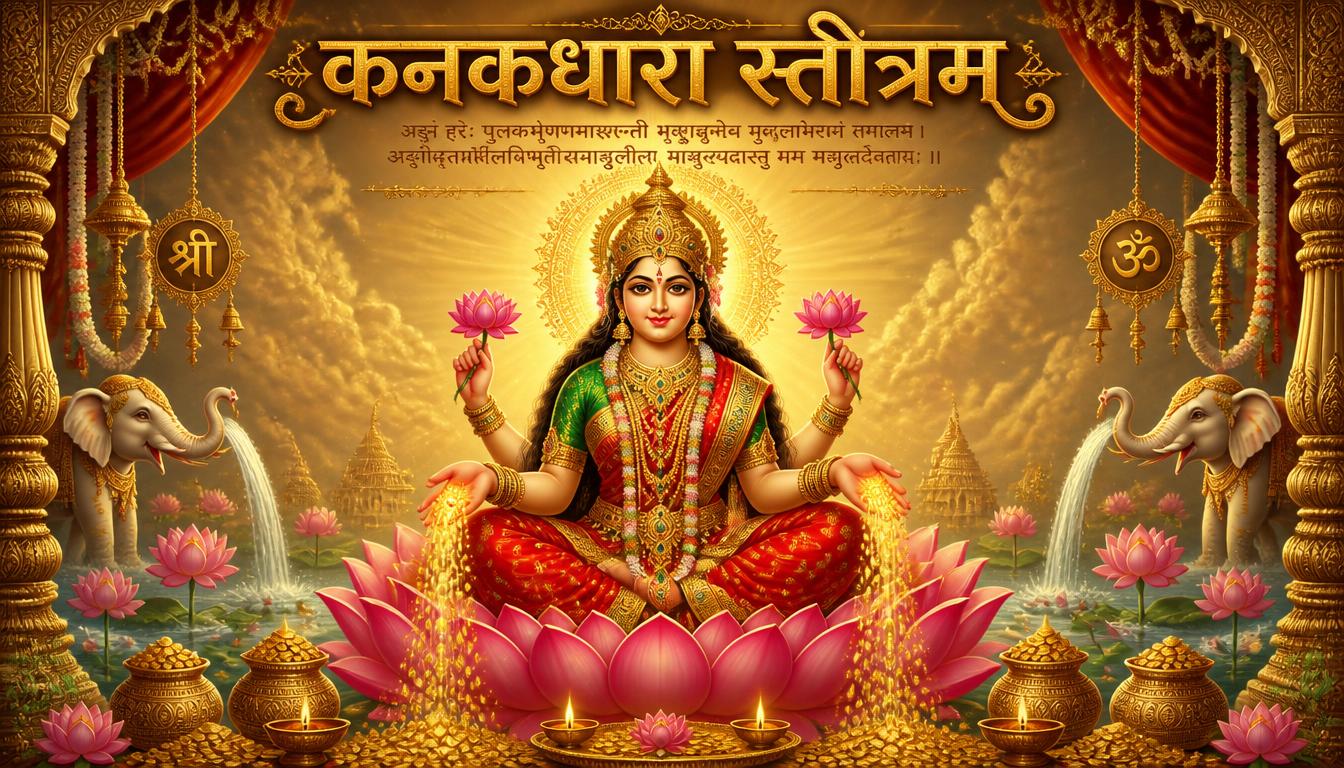
Sometimes a prayer does not arrive with a loud voice. It quietly sits beside a small lamp, folds its hands, and asks the divine for a little mercy. Kanakadhara Stotram in Hindi carries something of that feeling. It is a famous devotional hymn dedicated to Goddess Lakshmi, associated with compassion, prosperity, auspiciousness, and divine grace.
The story connected with this stotram is especially touching. It tells of young Adi Shankaracharya, a poor woman, a single dry amla fruit, and a prayer offered with such compassion that the story eventually became associated with a shower of golden amlas.
That is why the Kanakadhara Stotram is not simply about asking for wealth. Its deeper message touches generosity, karma, kindness, devotion, and the mysterious way compassion can change the meaning of even the smallest offering.
The Kanakadhara Stotram is a well-known Sanskrit hymn traditionally attributed to Adi Shankaracharya and devoted to Goddess Lakshmi. The verses praise her beauty, divine qualities, compassion, and gracious glance upon devotees.
The word “Kanakadhara” is generally understood through two Sanskrit terms: “kanaka,” meaning gold, and “dhara,” meaning a stream or flow. The name is strongly connected with the traditional story in which golden amlas are said to have fallen upon the home of a poor woman.
But there is more here than a story about gold. Goddess Lakshmi represents not only material prosperity but also happiness, abundance, auspiciousness, grace, beauty, and well-being.
For people who do not understand Sanskrit easily, reading Kanakadhara Stotram in Hindi can make the devotional meaning much easier to grasp. The original verses have a poetic richness, but their emotional message becomes clearer when explained in a familiar language.
A person may recite a Sanskrit verse correctly and still wonder what it actually means. Hindi explanations can bridge that little gap between pronunciation and understanding, which is often where devotion starts becoming personal.
The Kanakadhara Stotram meaning in Hindi can also help readers understand why Lakshmi is described through flowers, jewels, the ocean, lotus eyes, divine ornaments, and her compassionate glance.
The Kanakadhara Stotram origin story is traditionally associated with the childhood of Adi Shankaracharya. According to the popular account, young Shankaracharya was studying in a gurukul and would go from house to house seeking bhiksha.
One day, he reached the home of a very poor woman. She had almost nothing to offer. Her circumstances were so difficult that even giving food to a young Brahmachari was not an easy thing.
Still, she did not want the visitor to leave empty-handed.
After searching through her home, she found a single dry amla fruit and offered it to him. The offering itself was tiny, almost painfully tiny, but the intention behind it was enormous.
Shankaracharya was moved by her generosity. He prayed to Goddess Lakshmi, asking her to show compassion toward the woman.
According to the traditional story, Goddess Lakshmi responded to the prayer, and a shower of golden amlas fell upon the woman’s home. This is the famous image of the golden shower that gave the hymn its distinctive identity.
Whether one reads this story literally, devotionally, or symbolically, its central lesson remains remarkably simple: generosity is not measured by the size of the gift.
Adi Shankaracharya holds an important place in Indian spiritual history and is traditionally associated with numerous philosophical and devotional works.
The Kanakadhara Stotram is particularly interesting because it brings together devotional praise and profound spiritual imagery. Shankaracharya does not simply describe Lakshmi as a giver of money. He praises her divine beauty, compassion, power, and auspicious presence.
The hymn addresses Lakshmi through several beautiful names and descriptions, including Narayana Vallabha, Hari Vallabha, Kamala, Kamaleekshana, Bhrigunandana, and other sacred epithets.
Each name adds another little window through which the devotee can contemplate the goddess.
The image of Goddess Lakshmi in the hymn is filled with symbolism. She is associated with the lotus, divine ornaments, beauty, grace, and the presence of Lord Vishnu.
Names such as Narayana Vallabha and Hari Vallabha emphasize her relationship with Lord Vishnu. Other names such as Kamala and Kamaleekshana connect her with the lotus and lotus-like eyes.
The lotus itself carries an important spiritual image. It grows in muddy water but rises above it beautifully. In that sense, it can represent purity and grace existing within the ordinary messiness of worldly life.
The hymn therefore becomes much more than a request for financial prosperity. It becomes a meditation on divine beauty, purity, abundance, and compassion.
The Kanakadhara Stotram shlokas and meaning are best understood together rather than treating the Sanskrit words as isolated phrases.
Many verses use rich poetic images involving lotus flowers, ornaments, divine radiance, the ocean, and the compassionate glance of Lakshmi. These descriptions are meant to create a devotional picture in the mind of the person reciting the hymn.
The phrase Lakshmi Kataksha, or the gracious glance of Lakshmi, is especially important. The divine glance represents mercy and blessing rather than merely physical sight.
For a devotee, being noticed by the goddess becomes a poetic way of expressing hope for divine compassion.
The story of the golden amlas is perhaps the most memorable part of the Kanakadhara tradition.
At first glance, it appears to be a story about a poor woman receiving gold. But its emotional center lies somewhere else.
The woman had very little, yet she gave what she had.
That small dry amla becomes meaningful because it represents selfless giving. It is not the material value of the offering that makes the story powerful. It is the heart behind it.
This is why the golden amla can be understood as a symbol of transformation. Something ordinary becomes extraordinary when it is offered with genuine compassion and faith.
One of the deeper ideas connected with the story is the relationship between karma and divine grace.
Traditional interpretations sometimes connect the woman’s difficult circumstances with Prarabdha Karma, or the portion of past karma believed to influence one’s present life.
The story raises a fascinating spiritual question: can divine grace transform what appears to be fixed?
Different Hindu philosophical traditions may approach this question differently. The important point for a reader is not to turn the story into a simple formula where chanting automatically cancels every difficulty.
Instead, the story can encourage reflection on karma, compassion, devotion, and grace.
It also reminds us that our own actions still matter. Prayer and spiritual practice do not remove the importance of kindness, effort, responsibility, and ethical living.
The golden stream in Kanakadhara symbolism naturally represents abundance and prosperity. Yet prosperity can have a broader meaning than money sitting in a bank account.
Health, peace, loving relationships, meaningful work, contentment, generosity, and spiritual awareness can all be understood as forms of abundance.
This broader interpretation makes the hymn relevant even to people who are not simply seeking financial success.
The golden stream becomes a poetic image of life becoming more hopeful, more generous, and more auspicious.
A person wishing to perform Kanakadhara Stotram recitation can begin by choosing a clean and peaceful place. A lamp, flowers, incense, and a simple offering may be used according to personal tradition.
There is no need to turn the practice into something unnecessarily complicated. Sit comfortably, calm the mind, and try to understand what you are reciting.
If the Sanskrit verses feel difficult, read a Hindi translation of Kanakadhara Stotram first. Understanding the meaning can make the actual recitation feel much more connected.
Most importantly, the stotram should not be treated as a guaranteed financial shortcut. Devotional practice can provide spiritual comfort and inspiration, while practical life still requires work, planning, responsibility, and wise decisions.
One beautiful feature of the hymn is its use of different names for Lakshmi. These names are not merely decorative words. They describe different qualities and relationships associated with the goddess.
Kamala, Kamaleekshana, Narayana Vallabha, Hari Vallabha, Bhrigunandana, and other names evoke different aspects of her divine identity.
She is connected with the lotus, the ocean, Vishnu, beauty, prosperity, and compassion.
Reading these names slowly can change the experience of the hymn. Instead of seeing a long list of unfamiliar Sanskrit words, the reader begins to see a collection of descriptions forming one larger spiritual portrait.
Devotion does not always require elaborate rituals. Sometimes it begins with a few quiet minutes, a lamp, a prayer, and a mind that is finally willing to slow down.
Mahalakshmi worship traditionally emphasizes auspiciousness, gratitude, purity, generosity, and devotion. The Kanakadhara Stotram fits naturally into this devotional atmosphere.
When someone offers a Mahalakshmi prayer, the intention does not have to be limited to asking for money. One may pray for peace within the family, wisdom in difficult decisions, protection from unnecessary hardship, and the ability to share one’s blessings with others.
That makes the prayer feel less like a transaction and more like a relationship.
Manas Puja, or mental worship, refers to worship performed through visualization and inner devotion. Instead of relying entirely on physical objects, the practitioner creates a sacred image within the mind.
While reciting the Kanakadhara Stotram, a devotee may visualize Goddess Lakshmi seated upon a lotus, surrounded by divine light, and looking upon devotees with compassion.
This type of inner worship can make the recitation more meditative.
It is not necessary to turn a simple devotional practice into complicated Tantra Sadhana. For an ordinary devotee, sincere prayer, understanding, concentration, and good conduct can already give the practice meaningful depth.
The spiritual significance of Kanakadhara Stotram comes from the combination of devotion, compassion, and symbolic imagery.
The hymn praises Lakshmi, but the story behind it also praises the heart of the poor woman who gave something despite having almost nothing.
That contrast is powerful.
One person has almost no material wealth but possesses generosity. Another, according to the story, possesses divine grace. When the two meet, the result becomes the famous Kanakadhara story.
Perhaps that is why the tale has survived so strongly. It does not only say, “Ask the goddess for wealth.” It quietly asks another question: What are you willing to give when you have very little?
The message of the hymn can still be applied to ordinary modern life.
We often assume that we need to become wealthy before we can help someone. The story of the dry amla suggests another possibility: generosity can begin before abundance arrives.
A meal shared with someone hungry, a small donation, helping an elderly person, supporting someone who is struggling, or simply offering genuine kindness can all become expressions of the same spirit.
In that sense, divine grace and abundance are not only things to receive. They can also become things we pass forward.
The story, symbolism, and devotional meaning of the hymn offer several memorable lessons:
The Kanakadhara Stotram is traditionally attributed to Adi Shankaracharya. Its famous origin story connects the hymn with his compassionate prayer for a poor woman who offered him a dry amla.
“Kanaka” means gold, while “dhara” means a stream or flow. The name is traditionally associated with the story of golden amlas showering upon the poor woman’s home after Shankaracharya prayed to Goddess Lakshmi.
No. Although prosperity is an important theme, the hymn also concerns divine grace, compassion, auspiciousness, devotion, generosity, and spiritual abundance.
The hymn is dedicated primarily to Goddess Lakshmi, who is praised through numerous sacred names and descriptions.
Yes. Reading the original Sanskrit verses along with a Hindi translation and meaning can help readers understand the devotional message more clearly.
According to the traditional story, a poor woman had almost nothing but still gave a dry amla to young Shankaracharya as bhiksha. Moved by her generosity, he prayed to Goddess Lakshmi, and the story says that golden amlas showered upon her home.
It would be inappropriate to promise a guaranteed financial result from chanting any devotional hymn. The stotram has religious and spiritual significance, while financial well-being also depends on practical actions, work, decisions, and circumstances.
Kanakadhara Stotram is a sacred hymn dedicated to Goddess Lakshmi, traditionally recited to seek her blessings, divine grace, peace, and prosperity.
Kanakadhara Stotram in Hindi includes the original Sanskrit verses along with their Hindi meanings, helping devotees understand the spiritual significance of this powerful hymn.
Kanakdhara Strot Hindi Mein explains the verses of the hymn in simple language, making it easier for devotees to learn about Goddess Lakshmi and her divine blessings.
Kanakdhara Strot is a devotional hymn composed by Adi Shankaracharya in praise of Goddess Lakshmi, traditionally associated with a story of compassion, generosity, and divine grace.
Kanak Dhara Strot is revered as a prayer to Goddess Lakshmi that reflects the importance of devotion, selfless giving, and spiritual prosperity.
Read more: https://templetimingsdaily.com/kali-mata/
If you want to study the hymn rather than simply recite it, begin with the original Sanskrit verse and then read its Kanakadhara Stotram Hindi meaning.
Pay attention to three things: the name of Lakshmi being used, the imagery in the verse, and the kind of divine quality being praised.
For example, lotus imagery can invite reflection on purity and beauty. The ocean can suggest vastness and divine origin. Gold can represent abundance, while the compassionate glance of Lakshmi can represent grace.
Suddenly, the verses stop looking like difficult Sanskrit lines and start becoming a connected spiritual story.
Before beginning the recitation, take a moment to think about something for which you are genuinely grateful. It does not need to be dramatic.
Maybe it is your family, a meal, a safe home, a second chance, or simply another morning.
Then remember the story of the poor woman and the single dry amla.
That small pause can change the emotional meaning of the prayer. Instead of approaching the stotram only with the question, “What can I receive?” you may also approach it with, “What can I give?”
That little change of perspective is perhaps one of the most beautiful lessons hidden inside the Kanakadhara tradition.
Kanakadhara Stotram in Hindi is more than a translated devotional text. It brings together the praise of Goddess Lakshmi, the traditional story of Adi Shankaracharya, the image of golden amlas, and deeper ideas about compassion, karma, generosity, and divine grace.
The story reminds us that abundance does not always begin with having more. Sometimes it begins with sharing the little that we already have.
The dry amla offered by a poor woman became, in the traditional story, the beginning of a golden shower. Whether understood as sacred history, spiritual symbolism, or devotional poetry, its message remains wonderfully human.
May the spirit of Mahalakshmi, compassion, generosity, gratitude, and auspiciousness bring light into every home. And perhaps, when we ask for blessings, we can remember to become a small blessing in someone else’s life too.
Add the Hindi text and translationsReduce repeated explanations of the story