Physical Address
304 North Cardinal St.
Dorchester Center, MA 02124
Physical Address
304 North Cardinal St.
Dorchester Center, MA 02124

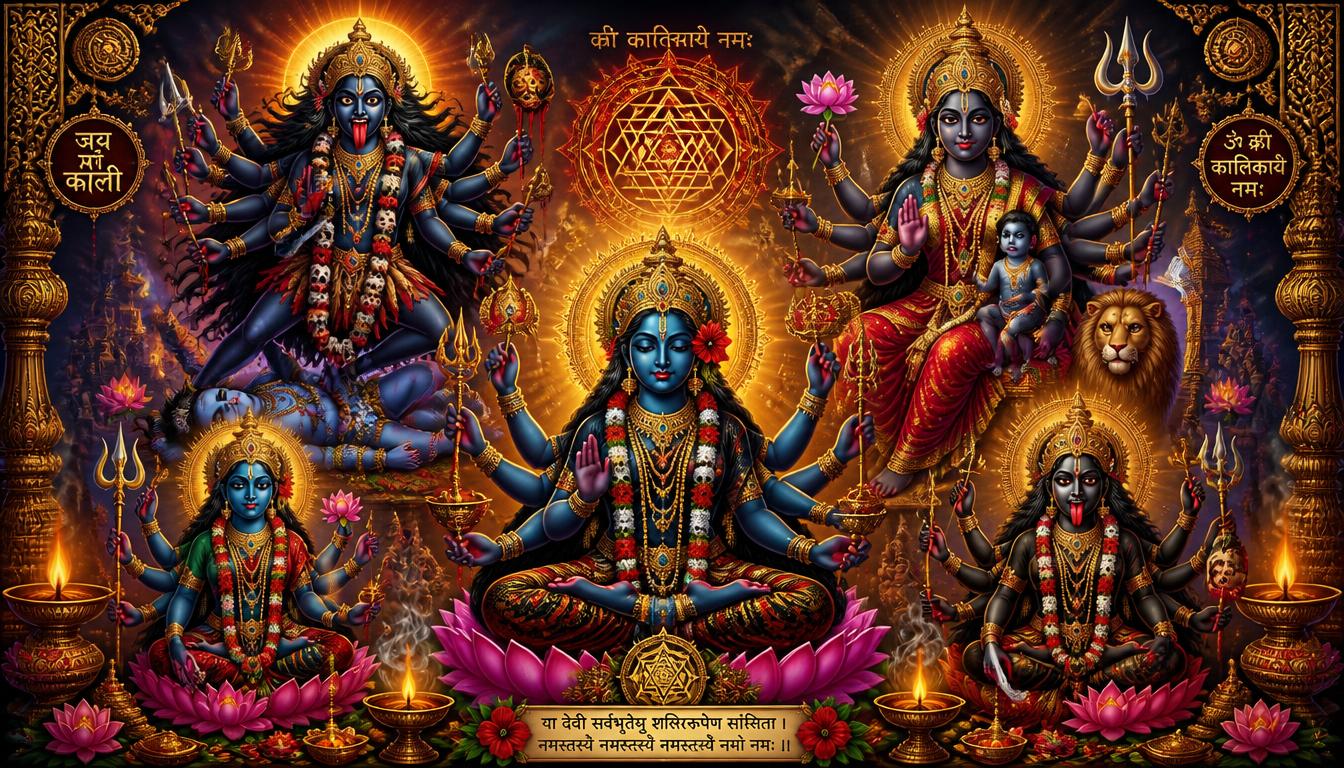
When people first encounter Kali Mata, the image can feel intense. Her dark complexion, wild hair, three eyes, garland of skulls, and outstretched tongue seem almost frightening at first glance. But behind that fierce appearance is a much deeper idea: Kali Mata represents the power that destroys what must end so that something new can begin.
In Hinduism, Goddess Kali is closely connected with Shakti, the divine feminine energy that moves through creation, preservation, destruction, and transformation. She is not simply a goddess of destruction, as the word is sometimes understood. She can also represent protection, liberation, courage, spiritual awakening, and the ending of ignorance.
The phrase different forms of Kali Mata is used in several ways. In popular Hindu understanding, Kali has numerous manifestations and regional forms. In Shakta and Tantric traditions, she is also closely associated with the Mahavidyas, the ten great wisdom goddesses. However, the ten Mahavidyas are not merely ten costume changes of Kali; different traditions explain their relationship in different ways.
Understanding these forms means looking beyond the frightening imagery and seeing the symbolism underneath it. Kali’s fierceness, strangely enough, can be understood as a fierce kind of compassion.
Kali Mata, also called Maa Kali, Kali Maa, or Goddess Kali, is one of the most powerful forms of the Hindu divine feminine. Her name is connected with kala, a Sanskrit word associated with time, and this gives an important clue to her spiritual meaning.
Time consumes everything. Kings disappear, bodies age, empires fall, and even mountains eventually change. Kali, as the goddess of time and transformation, represents this unavoidable truth.
Yet Kali is not only about endings. Her symbolism points toward rebirth, freedom and transformation too. When something false or destructive is removed, there is space for something more truthful to emerge.
This is why devotees may approach Maa Kali as a protective goddess rather than simply a terrifying deity. Her fierce nature is directed against evil, ignorance, fear and forces that disturb the balance of life.
The familiar image of Kali is filled with symbolism. Her dark complexion can represent the limitless and unmanifest nature of reality, while her three eyes are often connected with the past, present and future.
Her garland of skulls is a powerful reminder of mortality. The severed head can symbolize the destruction of ego, while the sword represents the cutting away of ignorance and illusion.
Then there is her famous tongue, extended outward. Different traditions and stories explain this image in different ways. One well-known interpretation connects it with the moment when Kali realizes she has stepped upon Lord Shiva during her furious dance.
Her appearance can therefore seem violent on the surface, but the symbolism is much more layered than that. Kali’s imagery asks a difficult question: what happens when the things we cling to must finally be surrendered?
Kali is often discussed alongside Goddess Durga, and the relationship between them is important in Hindu mythology. Both are associated with Shakti, divine feminine power, and both can appear in stories where divine power is needed to defeat destructive forces.
Durga is commonly portrayed as a warrior goddess riding a lion or tiger, carrying weapons given by various gods. Kali, by contrast, often appears in a much more wild and uncompromising form.
This difference doesn’t necessarily mean they are completely separate powers. In many Shakta traditions, different Hindu goddesses are understood as manifestations of one supreme feminine reality.
So, when people speak about Kali and Durga, they are often discussing two expressions of the same enormous spiritual principle: divine power responding to different circumstances.
One of the best-known episodes involving Kali concerns the demon Raktabija. His unusual power made him exceptionally difficult to defeat.
According to the story, every drop of Raktabija’s blood that touched the ground produced another demon like him. A normal battle therefore made the problem worse, which is rather an inconvenient situation for any army.
Kali was brought forth in her terrifying form to stop this multiplication. She drank the blood of Raktabija before it could fall to the earth, preventing new versions of the demon from appearing.
This story is central to understanding Kali mythology. Her destructive appearance is not destruction without purpose. It is a response to a force that ordinary methods could not overcome.
The Kali and Raktabija story can also be read symbolically. Some spiritual interpretations see Raktabija as representing destructive patterns that reproduce themselves whenever they are fed. Kali’s role becomes the interruption of that endless cycle.
There is no single universally accepted list of every form of Kali Mata across all Hindu traditions. Different scriptures, temples, Tantric lineages and regional traditions describe different manifestations.
Some traditions speak of specific forms of Kali, while others place Kali within the broader framework of the ten Mahavidyas.
This distinction matters because calling every Mahavidya simply “a form of Kali” can flatten a very rich religious tradition. The goddesses have their own identities, symbolism and stories, even when their traditions connect them with Kali or the supreme Shakti.
The following ten goddesses are known as the Dash Mahavidya, or ten great wisdom goddesses.
Kali stands at the beginning of the Mahavidya tradition in many presentations. She represents time, transformation, destruction of ignorance, fearlessness and liberation.
Her dark form can symbolize the infinite reality from which everything emerges and into which everything eventually returns. She does not politely negotiate with the ego, which is probably one reason her imagery feels so powerful.
The sword, skull and fierce expression all reinforce the idea of cutting through attachment and illusion.
For devotees, Kali Mata significance can therefore extend far beyond destruction. She can represent the courage required to face reality without hiding behind comfortable illusions.
Tara, often called Maa Tara, is another major figure among the Mahavidya goddesses. She is commonly associated with compassion, protection, guidance and the ability to help beings cross difficult situations.
Her blue complexion is an important part of her imagery. In certain traditions, stories connect Tara with Samudra Manthan, the cosmic churning of the ocean, and with saving or healing Shiva.
Tara’s energy can feel gentler than Kali’s, although she too carries enormous spiritual power. She is often understood as a mother who guides beings through danger rather than leaving them alone in it.
Tripura Sundari, also known as Shodashi, represents beauty, grace, harmony and spiritual fullness. Her name is associated with the beauty of the three worlds.
Unlike the frightening imagery associated with Kali, Tripura Sundari is commonly portrayed with a more graceful appearance. She carries a sugarcane bow, flower arrows, a noose and a goad.
Her sacred abode is traditionally associated with Manidvipa, an exalted realm in Shakta theology.
Her place among the ten Mahavidyas demonstrates something fascinating about divine feminine symbolism: spirituality isn’t represented only through fearsome destruction. Beauty, attraction, harmony and desire can also become pathways toward divine knowledge.
Bhuvaneshwari is traditionally associated with the universe itself. Her name is connected with the ruler or sovereign of the worlds.
She represents expansive cosmic power, space and the nurturing dimension of Shakti. Her imagery often emphasizes a majestic, motherly presence rather than the terrifying appearance of Kali.
In this sense, Bhuvaneshwari can be contemplated as the divine reality that contains everything. Nothing is outside the cosmic field she represents.
Her symbolism reminds devotees that the divine feminine can be both immensely powerful and profoundly nurturing at the same time.
Bhairavi, sometimes described as the female counterpart or feminine power of Bhairava, is associated with fierceness, discipline, fearlessness and transformation.
Her name itself carries an intense quality. She is not the sort of divine figure associated with avoiding difficult truths.
Goddess Bhairavi can symbolize the spiritual courage needed to confront fear and move beyond limitations. Her energy is often understood as transformative rather than merely destructive.
Like Kali, Bhairavi demonstrates that fierceness in Hindu goddess symbolism does not automatically mean cruelty. It can represent a force that protects what is sacred by confronting what threatens it.
Chhinnamasta is perhaps one of the most visually startling among the Mahavidyas. Her imagery includes a severed head and streams of blood, making her symbolism difficult to misunderstand at first glance.
But the symbolism is deeply connected with self-sacrifice, life, death and rebirth.
Traditional imagery commonly includes her attendants Jaya and Vijaya. The goddess represents the paradox of giving and receiving, destruction and nourishment, death and continuing life.
Her severed head can be interpreted in relation to the transcendence of ordinary ego and attachment. It is an intense spiritual image, certainly, but its purpose is contemplation rather than simple shock value.
Dhumavati has one of the most unusual identities among the Mahavidyas. She is traditionally portrayed as an elderly, widowed goddess, often associated with smoke, hardship, solitude and the difficult dimensions of existence.
Her appearance is deliberately unlike conventional images of youthful divine beauty. That is part of her meaning.
Dhumavati can symbolize what remains after worldly attachments have been stripped away. Her associations with solitude, introspection and wisdom make her especially significant in traditions that explore impermanence.
The goddess reminds devotees that spiritual insight does not always arrive wearing beautiful clothes and carrying flowers. Sometimes wisdom arrives through loss, silence and uncomfortable truths.
Bagalamukhi, also called Pitambara in some traditions, is associated with the power to restrain, silence or immobilize hostile forces.
Her imagery often includes yellow attire, a golden or yellow complexion and a mace. Traditional depictions may show her controlling an enemy by holding the tongue.
This symbolism is connected with the power of speech, conflict and the ability to stop harmful activity.
Some traditions associate her mythology with Madanasura, whose destructive power was eventually brought under control. Her symbolism therefore focuses less on destruction and more on restraint.
Matangi, sometimes called Syamala, is associated with knowledge, music, speech, creativity and unconventional forms of spiritual wisdom.
She is frequently depicted with a veena, connecting her imagery with music and artistic expression. Her green or emerald-like complexion and royal imagery give her a distinctive appearance among the Mahavidyas.
Matangi demonstrates that divine wisdom can appear through art, language and creative expression too.
Her presence in the Mahavidya tradition expands the meaning of spiritual power. Not every form of Shakti needs to carry a sword; sometimes the power of the spoken word can change a person’s entire world.
Kamalatmika, often known as Kamala, is commonly regarded as the tenth Mahavidya. She is strongly associated with prosperity, beauty, abundance, fertility and spiritual blessings.
Her lotus symbolism connects her with purity, beauty and prosperity. In many ways, her imagery resembles aspects associated with Lakshmi, and she is sometimes described as a Tantric Lakshmi.
Kamala shows another side of the divine feminine: nourishment, abundance and grace.
Her inclusion among the Mahavidyas creates a remarkable range. The tradition moves from Kali’s fierce confrontation with time and mortality to Kamala’s association with prosperity and flourishing life.
This is an important question, especially for anyone researching the 10 forms of Kali.
In many Shakta traditions, the ten Mahavidyas are understood as manifestations of the supreme Goddess or expressions of Shakti. Some traditions closely connect them with Kali, while others emphasize their individual identities.
Therefore, saying “the ten Mahavidyas are ten forms of Kali” can be useful as a simplified explanation, but it isn’t the only theological interpretation.
A more accurate description is that the Mahavidyas are ten great wisdom manifestations of the divine feminine, and Kali is the first or central figure in many traditional presentations.
This distinction gives each goddess room to be understood on her own terms while still showing the underlying unity of Shakti.
The Kali symbolism is perhaps more important than the visual appearance itself.
Her dark complexion can represent the infinite, formless reality. Her three eyes connect with time and perception. Her sword cuts through ignorance, while the severed head represents the destruction of ego.
The garland of skulls points toward mortality, reminding humanity that physical existence is temporary. Her loose hair and wild appearance can represent a freedom that has moved beyond conventional social restraints.
And then comes Kali and Shiva.
In a famous image, Kali stands upon Shiva. One interpretation connects this with her furious dance of destruction, when Shiva intervenes by lying in her path. When she realizes she has stepped on him, her tongue extends in shock or embarrassment.
The scene can also symbolize the relationship between dynamic Shakti and still consciousness. Different philosophical traditions interpret this relationship in their own ways, so the image should not be reduced to one simple meaning.
People sometimes see the frightening imagery of Kali and assume that she represents evil or violence. That is a misunderstanding of her traditional role.
In many Hindu traditions, Kali is a destroyer of evil precisely because she protects devotees from destructive forces.
Her fierce form represents the willingness to confront what cannot be defeated through softness alone. Fear, ignorance, ego and destructive forces are not always removed gently.
This is why devotees may pray to Maa Kali for protection from fear, courage, spiritual strength and freedom from negative influences.
Her fierceness is therefore not the opposite of compassion. In many interpretations, fierceness becomes one expression of compassion.
When all these forms are viewed together, a fascinating pattern appears.
Kali represents time and transformation. Tara offers compassionate guidance. Tripura Sundari represents beauty and harmony. Bhuvaneshwari expresses cosmic space. Bhairavi brings fierce protection. Chhinnamasta explores sacrifice and life-death-rebirth.
Dhumavati confronts solitude and impermanence. Bagalamukhi represents restraint. Matangi reveals wisdom through speech and art. Kamala expresses abundance and grace.
These aren’t random characters placed into a spiritual catalogue. Together, they provide a broad language for understanding the divine feminine energy.
The tradition acknowledges that existence itself has many faces. There is beauty and ugliness, birth and death, abundance and poverty, solitude and relationship, silence and speech, destruction and creation.
The divine feminine can therefore contain contradictions without needing to erase them.
For many devotees, studying Kali Mata forms is not only an academic exercise. It can become a deeply personal spiritual practice.
One person may connect with Kali because they are trying to overcome fear. Another may feel drawn to Tara because they need compassion and protection. Someone going through profound change may find meaning in Kali’s association with transformation.
This personal dimension is important because Hindu devotional traditions have never been only about memorizing lists of divine names. Stories, images, prayers, festivals, temples and family traditions all create different ways of approaching the sacred.
A grandmother might explain Kali through a story told during childhood. A priest might discuss her through scripture and ritual. A scholar may approach her through theology and symbolism. A devotee may simply call her “Maa” and feel that the relationship needs no complicated explanation.
All these approaches can coexist.
Kali worship varies considerably according to region and tradition. Some forms of worship are deeply devotional and family-centered, while others belong to specialized Tantric practices that require proper guidance.
Kali is especially prominent in eastern India, including Bengal, where Kali Puja is an important religious observance. Temples and traditions dedicated to Kali can also be found throughout India and beyond.
The details of worship differ, so it is wise not to assume that one regional practice represents every Kali tradition.
At the heart of devotional approaches, however, is often a desire for protection, courage, transformation and connection with the divine feminine.
The easiest way to understand Goddess Kali is to stop viewing her imagery as a literal portrait of violence.
Instead, ask what each symbol is trying to communicate.
Why is there a sword? What does the skull represent? Why is time associated with Kali? Why does she stand over Shiva? Why does her appearance challenge ordinary ideas of beauty?
These questions open the door to Kali spiritual meaning.
Her imagery is intentionally dramatic because the truths she represents are dramatic too. Death is real. Change is unavoidable. Ego can become destructive. Fear can control human beings. Sometimes transformation requires letting go.
Kali turns those uncomfortable truths into a divine image that can be confronted rather than hidden from.
Maa Kali is a powerful Hindu goddess associated with time, transformation, and the destruction of evil. She represents fierce protection and divine feminine energy.
Kali Mata is revered as a fearless form of Shakti who destroys negativity and restores balance. Her fierce appearance symbolizes strength, protection, and spiritual transformation.
Kali Maa represents a powerful yet protective motherly force in Hindu tradition. Devotees worship her for courage, protection, and freedom from fear and negativity.
Ma Kali symbolizes the victory of divine power over evil, ignorance, and illusion. Her stories teach the importance of embracing change and overcoming inner fears.
Mata Kali is known for her fierce form, immense power, and role as a protector against destructive forces. She embodies transformation, courage, and the triumph of good over evil.
Read more: https://templetimingsdaily.com/guru-purnima-2026-2/
The different forms of Kali Mata reveal a remarkable dimension of Hindu goddess traditions. Kali is fierce, but she is not simply destructive. She represents time, transformation, protection, liberation and the power to confront darkness.
Through the broader Dash Mahavidya tradition, the divine feminine takes many expressions: Kali, Tara, Tripura Sundari, Bhuvaneshwari, Bhairavi, Chhinnamasta, Dhumavati, Bagalamukhi, Matangi and Kamala. Each carries distinctive symbolism, stories and spiritual associations.
The important thing is not to force all these goddesses into one narrow definition. Their differences are part of what makes the tradition so rich.
Kali teaches that endings can become beginnings. Tara reminds us that compassion can carry us through difficult waters. Tripura Sundari reveals beauty as a spiritual force, while Dhumavati asks us to find wisdom even in uncomfortable seasons of life.
And perhaps that is the most beautiful lesson hidden inside Maa Kali’s fierce face: transformation doesn’t always look gentle while it is happening.
Sometimes the old must fall away completely.
Sometimes fear has to be faced directly.
And sometimes, after the darkness has finished its work, there is a new kind of freedom waiting on the other side.