Physical Address
304 North Cardinal St.
Dorchester Center, MA 02124
Physical Address
304 North Cardinal St.
Dorchester Center, MA 02124

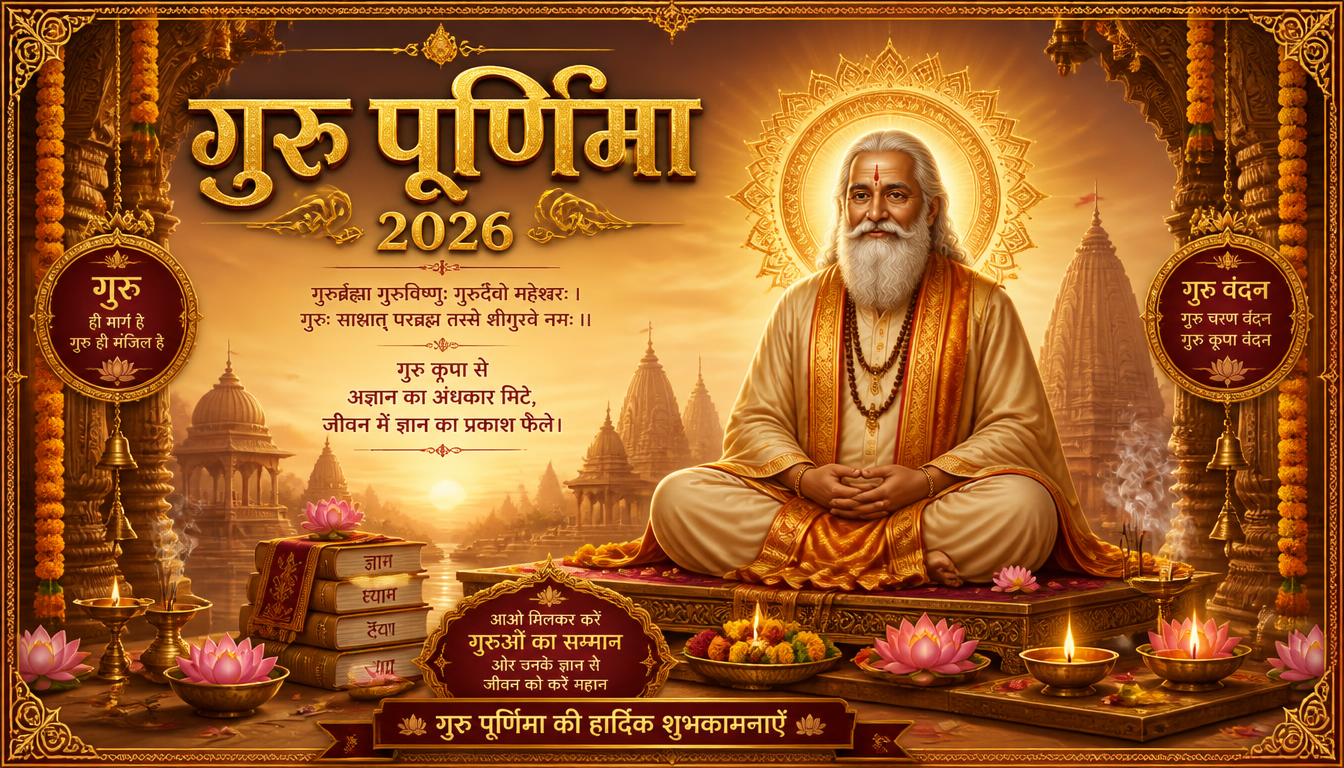
Some teachers give us lessons written on a board, while others quietly change the direction of our whole life without ever calling it a lesson. Maybe it was a school teacher who noticed a talent nobody else saw, a parent whose advice stayed in your head for years, or a spiritual guide who helped you understand yourself when everything felt a little messy. Guru Purnima is a day for remembering those people.
Observed on the full moon day of Ashadha, this ancient festival celebrates teachers, gurus, mentors, and the priceless gift of knowledge. It is rooted deeply in Indian spiritual culture, yet its central idea feels surprisingly universal: nobody learns everything alone.
Guru Purnima 2026 carries traditions connected with Sage Ved Vyasa, the Guru-Shishya Parampara, Lord Shiva, Buddhist teachings, Jain tradition, prayer, meditation, and service. At the same time, the festival can be beautifully simple. Sometimes saying, “Thank you for showing me the way,” is itself a kind of puja.
Here is a complete look at the Guru Purnima 2026 date, history, spiritual significance, traditions, rituals, and the different ways people may observe this meaningful day.
Guru Purnima 2026 falls on Wednesday, July 29, 2026. The festival is celebrated during the Purnima, or full moon, of Ashadha, a month in the Hindu lunar calendar.
The day is therefore also known as Ashadha Purnima. Unlike festivals fixed to a Gregorian calendar date every year, its date shifts because the observance follows the lunar cycle. The moon, basically, gets a vote here.
According to the traditional timing commonly given for the observance, the Purnima Tithi begins on July 28, 2026, at 6:18 PM and ends on July 29, 2026, at 8:05 PM. Exact local Tithi and Muhurat timings can vary slightly by location and panchang calculation, so devotees planning a specific puja should check a trusted local calendar.
The key details are:
The full moon of Ashadha has been associated for generations with contemplation, learning, devotion, and the relationship between teacher and disciple. That makes the festival more than another date circled on a calendar; it is meant to be lived a little.
The word “Guru” carries a richer meaning than the English word “teacher” sometimes suggests. In traditional interpretation, a Guru is understood as someone who removes darkness or ignorance and leads another person toward knowledge.
That darkness need not mean something dramatic. Confusion is darkness. Ego can be darkness too. Not knowing which direction to walk, even while walking very fast, is probably one of its most familiar forms.
Purnima means the full moon day. Thus, Guru Purnima meaning is closely associated with honoring the person or principle that brings the light of knowledge into life.
The festival celebrates the victory of wisdom over ignorance, but wisdom here is not merely academic intelligence. It may include spiritual knowledge, discipline, compassion, self-awareness, humility, and an understanding of one’s dharma.
This is why a Guru can be a spiritual teacher, an academic teacher, a mentor, or someone whose guidance fundamentally shapes another person’s growth.
Any discussion of Guru Purnima history quickly arrives at one towering figure: Sage Ved Vyasa.
The festival is traditionally known as Vyasa Purnima, reflecting the immense reverence given to Ved Vyasa in Hindu tradition. He is regarded as one of ancient India’s most influential sages and teachers, with an extraordinary place in the preservation and organization of sacred knowledge.
Tradition credits Ved Vyasa with arranging Vedic knowledge into the four Vedas: the Rig Veda, Sama Veda, Yajur Veda, and Atharva Veda. He is also traditionally associated with the Mahabharata and numerous Puranas.
Whether one approaches these accounts through faith, history, literature, or philosophy, Vyasa’s influence on Indian intellectual and religious tradition is hard to squeeze into a few sentences. His name became almost inseparable from the transmission of sacred learning.
That is one reason Ved Vyasa Guru Purnima carries such importance. Devotees remember not simply an individual scholar, but the idea that knowledge has to be preserved, taught, questioned, understood, and then passed forward.
The observance is consequently linked to the ancient Guru-Shishya Parampara, the teacher-disciple lineage through which learning traveled across generations.
Imagine knowledge as a lamp moving from hand to hand. Nobody needs to extinguish their own flame to light somebody else’s. Guru Purnima celebrates that lovely little paradox.
Long before online courses, classrooms with projectors, or a search box capable of answering almost anything, much Indian learning developed through the Guru-Shishya Parampara.
A disciple often learned through sustained contact with a Guru, combining instruction with observation, practice, discipline, and service. Education wasn’t always separated neatly into “lesson time” and “real life.” The two could sit at the same table.
The sacred bond between Guru and disciple was therefore based on more than information transfer. Trust, commitment, humility, responsibility, and character mattered deeply.
Guru Purnima became a natural occasion for expressing gratitude to teachers and renewing one’s commitment to learning.
Even today, this idea remains surprisingly relevant. We may have information everywhere, but information and guidance aren’t quite twins. A mentor can sometimes identify the question we should be asking before we even know how to phrase it.
The simplest answer to why Guru Purnima is celebrated is gratitude.
People honor those who have guided them intellectually, morally, artistically, professionally, or spiritually. The festival acknowledges a truth we sometimes forget once success arrives: there were hands holding the ladder.
For spiritual seekers, the day may involve seeking the blessings of the Guru, meditation, prayer, contemplation, and renewed commitment to a chosen path.
For students, it can become a day of teacher appreciation and mentor appreciation. In schools, universities, and academic institutions, students may offer flowers, cards, respectful messages, or tributes to their teachers and professors.
For artists, the Guru may be the person who taught the first difficult note, dance posture, brushstroke, or rhythm. The tradition remains especially meaningful in Indian classical dance and Indian classical music, where the relationship between student and artistic mentor can continue for decades.
So, the festival is religious for many people, cultural for others, and deeply personal for plenty more.
The significance of Guru Purnima in Hinduism is closely tied to the belief that spiritual knowledge requires guidance. Sacred scriptures repeatedly place importance on teachers capable of leading seekers toward deeper understanding.
A Guru is therefore not merely admired for knowing things. The Guru’s purpose is to awaken understanding in the disciple.
This explains the symbolism behind the phrase dispeller of ignorance. The Guru helps remove ego, doubt, confusion, and false understanding so that genuine insight can grow.
Many devotees spend the festival performing Guru Puja, reading spiritual texts, practicing meditation, chanting sacred mantras, or offering Seva, meaning selfless service.
Others may study the Guru Gita, visit an ashram or matha, or simply sit quietly and remember the guidance they have received. Not every spiritual moment needs bells and crowds; sometimes silence does the job better.
Another important strand of the festival appears in the yogic tradition, where Lord Shiva is revered as Adi Guru Shiva, or the first Guru.
In this tradition, Shiva as Adiyogi is associated with the transmission of profound yogic knowledge to the Saptarishis, the Seven Sages.
These sages are traditionally understood as carriers of ancient wisdom who transmitted teachings onward to humanity. The story gives Guru Purnima another beautiful layer: knowledge doesn’t belong to the one who receives it first.
It moves.
The association of Guru Purnima and Lord Shiva therefore emphasizes the beginning of a teacher-disciple lineage and the transmission of yogic teachings from Guru to student.
For practitioners of Yoga, the day may become an opportunity to reflect not only on physical practice but also on the larger philosophical and spiritual tradition from which yoga developed.
Guru Purnima in Buddhism carries an important connection with Gautama Buddha.
According to Buddhist tradition, after attaining enlightenment, Lord Buddha delivered his first sermon at Sarnath, near Varanasi in present-day Uttar Pradesh. This event is traditionally associated with Ashadha Purnima and is commemorated by Buddhists as an enormously significant moment.
At Sarnath, Buddha taught the principles represented by the Four Noble Truths and set his teaching tradition into motion.
The significance here fits beautifully with the broader spirit of Guru Purnima. Knowledge becomes transformative when it is shared.
Buddhist observances may include meditation, reflection on the Buddha’s teachings, charitable acts, and study of the Dharma. Though theological interpretations differ between traditions, the common thread of spiritual wisdom and learning remains strong.
Guru Purnima in Jainism also holds significance through the teacher-disciple tradition.
In Jain accounts associated with this observance, Lord Mahavira and his chief disciple Gautama Swami hold an important place. The relationship reflects the central value placed upon spiritual instruction and disciplined learning within the Jain tradition.
Jain teachers, monks, and spiritual guides are respected for helping practitioners understand and follow principles of ethical and spiritual development.
The festival thus becomes another occasion to appreciate the teacher-student bond as something capable of changing one’s inner life, not merely increasing what one knows.
Different traditions tell different stories, of course, but they meet at one interesting doorway: wisdom matters, and so do the people who help us reach it.
There isn’t one single way to observe Guru Purnima traditions. Practices differ according to region, family custom, spiritual lineage, and personal belief.
Still, several traditional Guru Purnima rituals are widely recognized.
Guru Puja is one of the central practices. Devotees may worship or respectfully honor their spiritual teacher, remembering the Guru’s teachings and asking for continued guidance.
Flowers, fruits, incense, lamps, and other ritual offerings may be presented. For some disciples, the most meaningful offering isn’t expensive at all; it’s a sincere promise to actually practice what they’ve been taught.
During Paduka Puja, devotees ceremonially honor the Guru’s sandals, known as Paduka, or symbolically worship the Guru’s feet.
In Indian spiritual culture, touching or bowing at a respected elder’s or Guru’s feet can represent humility and reverence.
During the worship of Guru Paduka, water, milk, flowers, or rose petals may be used according to a particular tradition. In some rituals, consecrated liquid may be received as Charnamrit.
Many devotees spend additional time in meditation and Mantra Jaap on Guru Purnima.
The point isn’t to break some personal chanting speed record. Repetition is intended to steady attention, deepen devotion, and turn awareness inward.
Some practitioners chant a Guru Purnima mantra, recite prayers, or engage in chanting the Guru Gita.
Guru Purnima fasting is practiced by some devotees as an act of discipline and purification.
The exact form can vary considerably. Some observe a complete fast, while others eat fruits or simple sattvic foods. Individual health requirements should always matter more than copying somebody else’s fasting routine.
Dakshina traditionally refers to an offering made to a Guru as an expression of gratitude.
Historically and spiritually, offering Dakshina to the Guru is not supposed to function like paying a bill for wisdom. Its deeper symbolism is gratitude, respect, and recognition of what has been received.
Today, Dakshina might take the form of money, useful gifts, charitable support, or another meaningful offering appropriate to the teacher and tradition.
Seva, or selfless service, is another powerful way of marking the festival.
A disciple may volunteer at an ashram, help organize a spiritual gathering, serve food, assist elderly people, donate to a charitable cause, or perform another useful act without expecting praise.
This turns gratitude into action, which is perhaps where gratitude looks its best.
After worship, Prasad distribution may take place among devotees. Some communities also organize a Bhandara, or community feast.
Sharing food makes the celebration communal rather than purely individual. People pray together, serve together, eat together, and the boundary between devotion and everyday kindness becomes wonderfully thin.
Modern Guru Purnima celebrations can look very different depending on where you happen to be.
At an ashram or spiritual center, the day may begin early with prayers, Guru Puja, devotional singing, scripture reading, meditation, discourses, and service.
In schools and universities, students may honor teachers, professors, and scholars through speeches, flowers, handwritten notes, cultural programs, or simple messages of appreciation.
Students of music and dance may arrange recitals or performances dedicated to their artistic mentors. In such settings, the performance itself becomes a kind of thank-you letter written with movement or sound.
Families may also remember parents, grandparents, elders, and others who served as teachers in life.
And increasingly, distance doesn’t stop the tradition. A student living on another continent can make a video call, send a heartfelt message, or write to an old teacher after years of silence. A screen may not feel very ancient, but gratitude doesn’t seem particularly offended by technology.
The Guru Purnima full moon adds another layer of symbolism to the celebration.
A full moon has long been associated in Indian traditions with completeness, illumination, reflection, and heightened spiritual practice. On Guru Purnima, that imagery fits naturally with the idea of a teacher bringing clarity into the student’s life.
The Guru does not necessarily create wisdom from nothing. A good teacher often helps uncover what the student was unable to see clearly.
That is why the spiritual significance of the full moon works so well here: illumination replaces obscurity.
The outer moon shines brightly, while the inner work asks a quieter question—what still needs light inside me?
In Vedic astrology, the Sanskrit word “Guru” is also associated with Jupiter, known as Brihaspati or Guru Graha.
Brihaspati is traditionally described as Deva Guru, the teacher of the gods, and is connected astrologically with wisdom, learning, spirituality, prosperity, ethics, and higher knowledge.
Because of this symbolism, some people also connect Guru Purnima with seeking Jupiter’s blessings.
In Hindu astrology, a person’s Jupiter placement is traditionally interpreted in relation to knowledge, teachers, belief, growth, generosity, and fortune. Jupiter is generally considered a beneficent planet, although astrological interpretations depend on the full birth chart.
The connection between Guru Purnima and Jupiter is ultimately symbolic as well as astrological: both celebrate expansion through wisdom rather than simply accumulation.
A mind can own a lot of facts and still be rather cramped inside. Wisdom, ideally, gives it more room.
A meaningful celebration doesn’t require elaborate arrangements. If you want to observe Guru Purnima 2026, begin with the person or teaching that genuinely changed something in you.
Perhaps the last point is the hardest one.
Thanking a teacher is lovely. Living the lesson can be the bigger thank-you.
Guru Purnima does not need to remain limited to formal spiritual relationships.
An academic teacher can change a student’s life through patience, encouragement, discipline, or a single unexpected sentence. Professional mentors can do something similar by offering guidance when a younger person has ability but absolutely no map.
This makes Guru Purnima teacher appreciation relevant even for people who don’t follow a particular spiritual lineage.
A handwritten letter can be especially meaningful. Instead of simply writing “Happy Guru Purnima,” mention one lesson you still remember.
You might recall the teacher who encouraged you after a poor exam result, the mentor who gave you your first opportunity, or the professor who made a frightening subject suddenly make sense.
Specific gratitude has a heartbeat. Generic gratitude sometimes only has punctuation.
People searching for gifts for Guru Purnima should remember that the spirit of the festival favors meaning over extravagance.
Books can be appropriate for teachers who love reading. Flowers, plants, handwritten notes, devotional items, or useful objects connected with a mentor’s interests can also make thoughtful gifts.
For a spiritual Guru, however, customs regarding gifts and Dakshina may vary between traditions. Following the norms of the particular lineage is more respectful than assuming one practice fits everybody.
Another meaningful option is charity. Donating educational materials to students, feeding people, supporting an institution, or sponsoring learning in your teacher’s honor can transform appreciation into something that keeps moving outward.
That’s rather fitting for a festival built around transmitted knowledge.
The world of 2026 has information arriving faster than almost anyone can comfortably digest. Answers appear in seconds. Tutorials exist for nearly everything.
Yet the importance of a Guru in life hasn’t disappeared.
A real teacher does something information alone cannot always accomplish. They understand context. They notice mistakes. They challenge assumptions. They can tell us, occasionally and annoyingly, that the problem isn’t the question but the way we’re looking at it.
Guru Purnima reminds us that knowledge, humility, and gratitude belong together.
It also reminds teachers of their responsibility. Respect in the teacher-disciple relationship should never excuse manipulation, exploitation, or blind obedience. Genuine guidance should support learning, ethical conduct, discernment, and growth.
A healthy tradition of mentorship isn’t built by making the student smaller. The finest teachers somehow make their students capable of standing taller on their own.
On July 29, find ten quiet minutes.
Think of three people who taught you something that genuinely stayed. One might be a formal teacher, another a family member, and the third somebody you never expected to learn from.
Write down what each person taught you.
Then ask yourself one question: “Am I living any differently because I learned it?”
If the answer is yes, gratitude becomes obvious. If the answer is no, perhaps Guru Purnima 2026 is a fine day to begin.
You can also send one of those people a message. Teachers rarely get to see every place their lessons eventually travel. Telling them can be a small gift with a surprisingly long echo.
Guru Purnima 2026 will be celebrated on July 29, 2026. It is a sacred occasion for honoring spiritual gurus, teachers, and mentors.
The Guru Purnima 2026 date is Wednesday, July 29, 2026. The festival falls on the full moon day of the Hindu month of Ashadha.
Guru Purnima 2026 is on Wednesday, July 29. Devotees celebrate the day by expressing gratitude and respect toward their gurus and teachers.
Guru Purnima date 2026 is July 29. The occasion is also known as Vyasa Purnima and holds great spiritual importance in Indian traditions.
The 2026 Guru Purnima date is July 29, Wednesday. It marks Ashadha Purnima and celebrates the sacred relationship between a guru and disciple.
Read Articul: https://templetimingsdaily.com/the-egyptian-god-family-tree-2/
Guru Purnima 2026, observed on Wednesday, July 29, 2026, is much more than a traditional full moon festival. It is a celebration of the mysterious human chain through which wisdom travels from Sage Ved Vyasa and the ancient Guru-Shishya tradition to spiritual masters, Buddhist and Jain teachers, school professors, artistic mentors, parents, and everyday guides.
Its history connects with Vyasa Purnima, the Vedas, the yogic tradition of Adi Guru Shiva and the Saptarishis, Gautama Buddha’s teachings, and the Jain teacher-disciple heritage associated with Lord Mahavira and Gautama Swami.
Its rituals from Guru Puja and Paduka Puja to fasting, Dakshina, meditation, mantra chanting, Seva, Prasad, and Bhandara turn gratitude into something visible.
But underneath every ritual sits one beautifully uncomplicated thought: somebody helped us know what we once didn’t know.
Maybe they taught a sacred scripture. Maybe mathematics. Maybe music. Maybe they simply taught us not to quit on a terrible Tuesday.
On this full moon day of Ashadha, honor the teachers who brought a little more light into your world. Thank them where you can, remember them where you cannot, and carry their best lessons forward.
Because the finest tribute to a Guru isn’t merely remembering the light they gave us. It’s becoming wise enough, and kind enough, to pass some of it on.