Physical Address
304 North Cardinal St.
Dorchester Center, MA 02124
Physical Address
304 North Cardinal St.
Dorchester Center, MA 02124

There are some festivals you attend, and then there are festivals that seem to gather you back into yourself. Durga Puja is very much the second kind.
It arrives with the smell of shiuli flowers, the first restless beats of the dhak, new clothes waiting in cupboards, and that strange happiness of meeting people you have not seen properly all year.
For many Bengali families, it is less like a date on the calendar and more like someone beloved coming home again, which is why the emotion around the festival can be so difficult to explain.
Durga Puja 2026 will once again bring together prayer, craftsmanship, food, music and community celebration, especially across West Bengal, Kolkata, Bangladesh, Assam and Bengali communities around the world.
UNESCO describes Durga Puja in Kolkata as an important expression of religion, art and community life, and it was inscribed on the Representative List of the Intangible Cultural Heritage of Humanity in 2021. UNESCO+1
And perhaps thats the loveliest thing about Puja: devotion does not arrive alone. It brings artists, artisans, priests, drummers, cooks, children, grandparents, photographers, volunteers and curious visitors along with it.
If you are searching for when is Durga Puja 2026, the most useful dates to remember for the Kolkata/Bengal observance are October 17 to October 21, 2026, covering Maha Shashthi through Vijayadashami. Mahalaya 2026 falls on October 10, preceding the main Puja period.
Some calendars count preparatory rituals from October 16, so small differences in presentation are normal when comparing calendars. Drik Panchang+2
The five principal days are traditionally understood as Shashthi, Saptami, Ashtami, Navami and Vijayadashami. In 2026, the commonly observed sequence in Kolkata is Shashthi on October 17, Saptami on October 18, Ashtami on October 19, Navami on October 20 and Vijayadashami on October 21.
Exact ritual timings depend on local panchang calculations, so anyone performing formal worship should check a local almanac rather than relying only on a generic internet calendar. Drik Panchang+1
Mahalaya deserves its own little place in the heart. It traditionally marks the transition toward Devi Paksha and is associated with Tarpan, prayers for ancestors, and the stirring anticipation of the Goddess’s arrival.
In Bengal, the morning atmosphere surrounding Mahishasura Mardini has become almost inseparable from the emotional beginning of Puja, even though the principal five-day celebration comes later. It has a way of making an ordinary morning suddenly feel ceremonial, somehow.
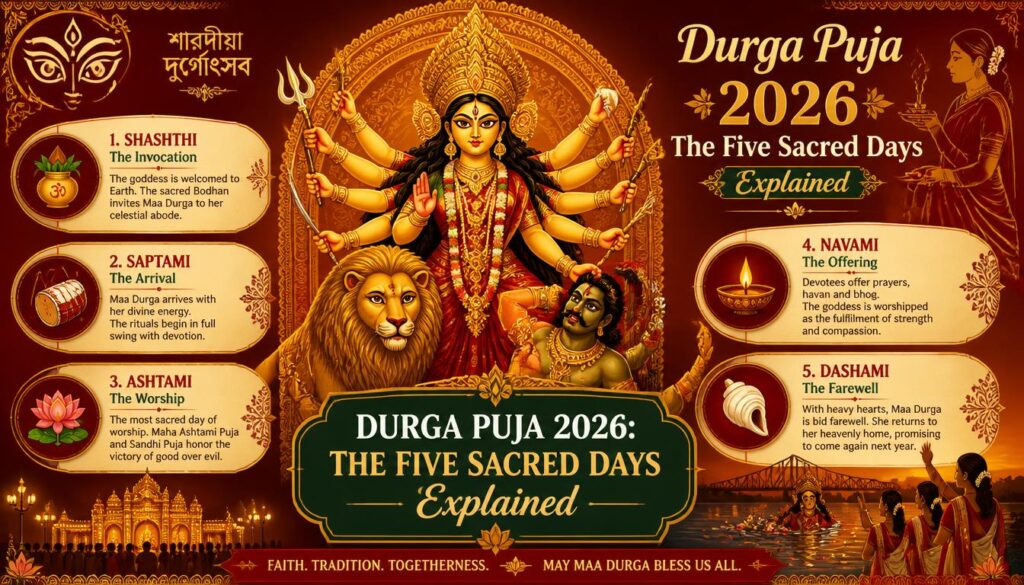
Each day carries its own mood and ritual vocabulary. You don’t have to know every Sanskrit term to enjoy the festival, but understanding a few of them changes the experience considerably.
Maha Shashthi is closely associated with Bodhan, the ritual awakening or invocation of Goddess Durga, along with Amantran and Adhivas in many Bengali traditions. It is the moment when anticipation becomes celebration, and the idol feels less like an artwork sitting inside a pandal and more like the centre of a living sacred space.
In some traditions, Chakshu Daan, literally the giving of eyes, is connected with bringing the image into ritual life. The details vary by tradition and priestly practice, but the larger idea remains beautiful: the Goddess is being welcomed, not merely displayed.
Maha Saptami introduces one of the festival’s most recognisable rituals, Nabapatrika Snan. A bundle of nine plants, associated with different symbolic forms and traditionally including banana, turmeric and other plants, is ritually bathed and worshipped.
It is easy to miss the deeper message here while rushing from one pandal to another: Durga Puja isn’t only about a magnificent idol. It also contains an old relationship with land, plants, rivers, agriculture and the natural world. The green leaves standing beside the Goddess quietly tell that story.
For many devotees, Maha Ashtami is the emotional centre of the festival. People arrive early for Pushpanjali, holding flowers in their hands while priests recite sacred mantras.
Children who were barely awake a few minutes earlier suddenly become very serious when the flowers are offered, though they usually return to mischief immediately afterward.
Sandhi Puja marks the transition between Ashtami and Navami and has a particularly powerful ritual significance. Traditional observances may involve 108 lamps and 108 lotus flowers, although exact practices differ among communities.
The symbolism connects the fierce protective aspect of Devi with the destruction of Mahishasura and the victory of divine power over destructive forces.
Maha Navami carries a slightly different emotional texture because everyone knows, somewhere in the background, that the farewell is approaching. Havan or homa, offerings into sacred fire, and other forms of worship are performed according to local custom.
The festival may also include Kumari Puja, in which a young girl is ritually honoured as an embodiment of the Divine Feminine.
This is one reason the festival’s understanding of feminine divinity can feel particularly immediate: the sacred is not imagined as something impossibly distant.
It can be honoured in a child, in a mother, in an artist, in a worker, in a woman standing quietly in a crowded pandal.
Then comes Vijayadashami, and suddenly the laughter has a small shadow behind it. In Bengal, Sindoor Khela, greetings among families and the emotional rituals of farewell lead toward Visarjan, when the Durga idol is carried in procession for immersion.
The drums become louder, conch shells sound, people dance, and yet there is an unmistakable sadness. The phrase “Asche bochor abar hobe”, meaning that it will happen again next year, captures the feeling perfectly. The farewell isn’t really an ending; it is a promise to return.
At its heart, the Durga Puja festival celebrates the triumph of Goddess Durga over Mahishasura, the buffalo demon. The myth is often understood as a dramatic expression of good versus evil, but reducing it to that single sentence misses much of its spiritual richness.
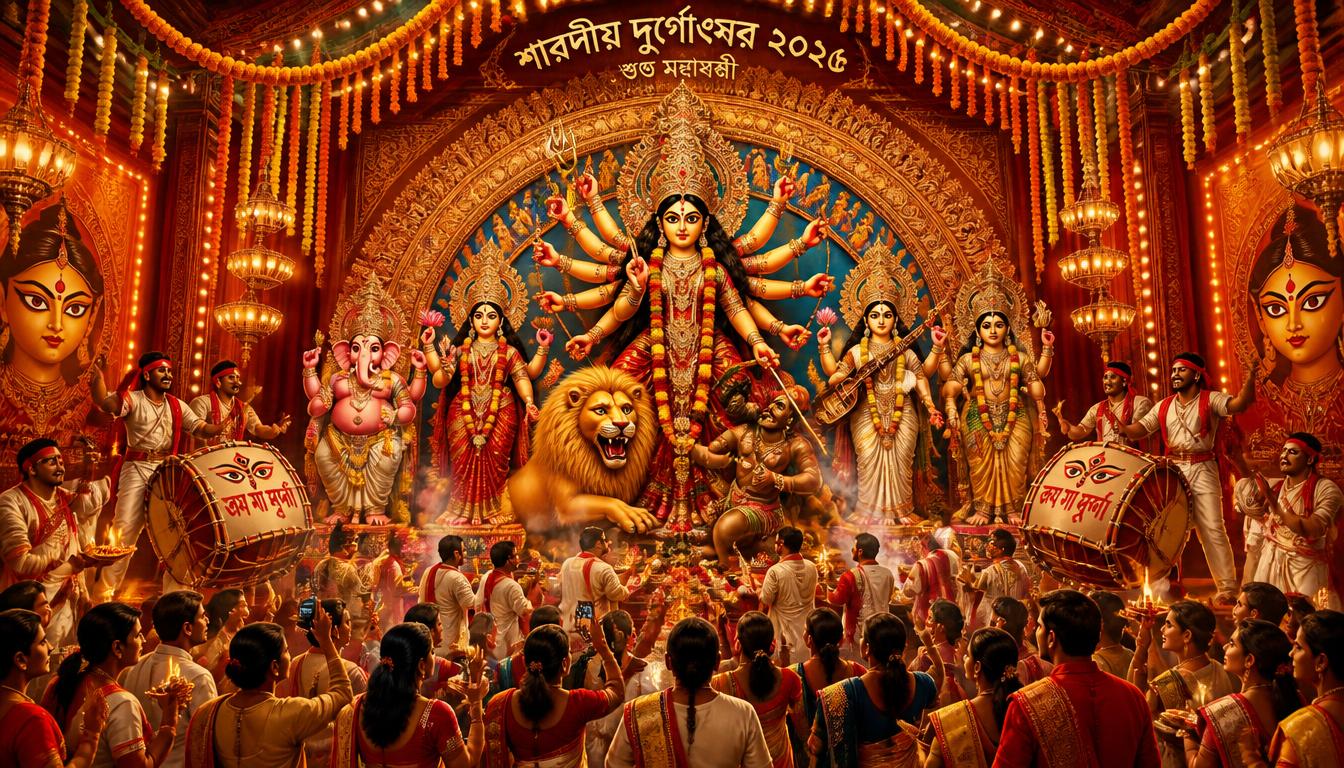
Durga represents Shakti, divine feminine power. She is warrior, mother, protector and supreme energy at once. The many arms of the traditional ten-armed Durga, or Dashabhuja, suggest an ability to confront multiple forms of disorder simultaneously, while the lion represents courage and strength.
The myth can also be read inwardly. Mahishasura need not live only in an ancient story; arrogance, greed, anger, fear and uncontrolled desire can become our own little demons. A meaningful Durga Puja celebration therefore offers an opportunity for spiritual renewal: what do we need to defeat within ourselves this year?
A traditional Durga pratima is far more than a decorative centrepiece. The Goddess is usually shown with her children , Saraswati, Kartikeya and Ganesha creating a family tableau that makes the divine strangely familiar.
Her lion, her weapons and the defeated Mahishasura each carry symbolic meaning. The trident, discus, bow, arrows and other divine weapons represent different forms of power granted by the gods. The lotus suggests purity and auspiciousness, while the accompanying deities bring associations of prosperity, knowledge, courage and wisdom.
The artistic process is equally fascinating. In Kolkata, artisans in places such as Kumortuli spend months shaping clay figures before the festival begins. UNESCO notes that traditional workshops create images of Durga and her family using unfired clay, including clay associated with the Ganga. UNESCO ICH
So when someone says, “It’s only an idol,” they are missing the rather enormous story behind it. It is craft, theology, inherited skill and community memory sitting together in one frame.
The best festival wishes don’t sound like they were copied from a calendar. They should feel like something you would actually say to your mother, brother, friend or that cousin who appears once a year and somehow still knows all your childhood secrets.
Friendship has its own version of Puja: late-night pandal hopping, arguing about which idol is best, eating too many sweets and promising that next year everyone will meet earlier. They rarely meet earlier, of course.
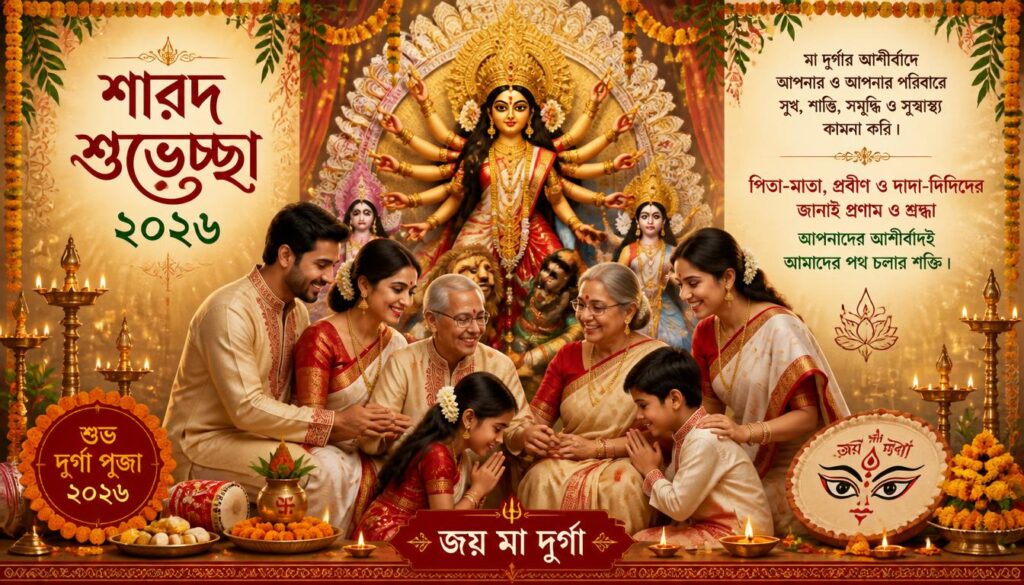
Some festival greetings carry extra weight when spoken to elders. A simple “Happy Puja” can contain years of inherited tradition, memories of homes that no longer exist and recipes nobody has quite managed to reproduce.
Festival messages at work need a slightly lighter touch. They should be warm without suddenly sounding like you have become a Sanskrit scholar overnight.
Sometimes a normal greeting feels too ordinary for a festival this visually dramatic. These work nicely as captions, status updates or short posts, with a little poetry rather than corporate-card energy.
It would be slightly dishonest to write about Puja without talking about food. Bhog is an important part of many celebrations, and dishes can include khichuri, labra, rice, lentils, vegetables, chutney, sweets and mishti doi, depending on the community and household.
Food during Puja does something unusual: it turns strangers into people sharing the same table. A volunteer serving khichuri may not know the person holding the plate, yet for a few minutes they are part of the same little community. Thats social warmth in its most uncomplicated form.
Traditional Prasad is not simply “festival food.” Offerings are connected to worship and then shared among devotees. Recipes and menus vary enormously, so there is no single universal Durga Puja bhog menu that every Bengali household follows.
One of the defining features of modern Bengali Durga Puja is the pandal. These temporary structures can be modest neighbourhood spaces or astonishing architectural installations inspired by temples, historical buildings, contemporary art and social themes.
Pandal hopping has become almost a cultural activity in its own right. In Kolkata, people plan routes, compare artistic interpretations and wander through the city late into the night.
UNESCO specifically highlights the festival’s large-scale installations and pavilions, along with the participation of families, artists, craftspeople, organisers and visitors. UNESCO ICH
There is something democratic about the whole thing. A magnificent installation might attract thousands, but next door a small community pandal can be equally meaningful to the people who built it. Not every beautiful Puja needs to be famous, thankfully.
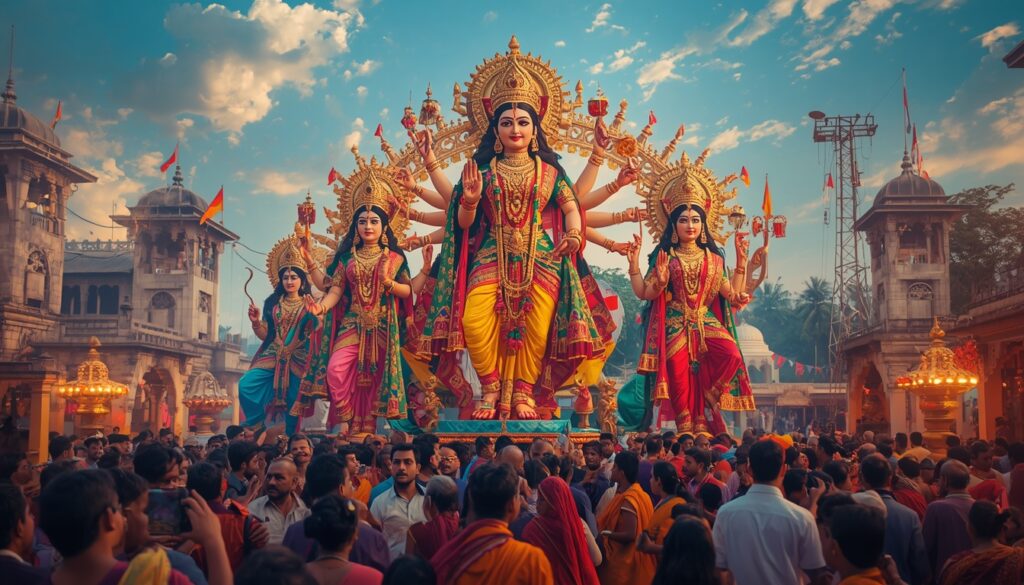
Although West Bengal remains strongly associated with the festival, Durga Puja is not confined to Kolkata. Celebrations take place across India, including in Assam, Delhi, Mumbai and other cities, as well as in Bangladesh and among the Bengali diaspora worldwide.
This global spread has created interesting variations. A community in London may hold Puja in a rented hall; a group in New York may combine worship with cultural performances; families elsewhere may celebrate on a smaller scale because of work, distance or limited resources.
UNESCO also notes that Durga Puja is practiced beyond Kolkata among Bengali communities and that its transmission involves families, art centres and traditional media. UNESCO
The form may change, but the emotional centre often doesn’t. People still want to gather, remember where they came from and make room for the next generation.
The philosophical heart of the festival is Shakti, the divine feminine power that sustains and transforms existence. In Shakta philosophy, Devi is not merely a secondary figure in a larger divine story; the feminine divine can be understood as ultimate reality itself.
That makes the festival especially rich when viewed beyond spectacle. Durga Puja significance can include the search for courage, the defeat of ego, the cleansing of anger and greed, and the desire to live with greater awareness.
The Goddess carries weapons, but the deeper lesson isn’t simply “be stronger.” It is that strength must be guided by righteousness, compassion and discernment. Otherwise power becomes another form of Mahishasura, which is a lesson worth remembering outside festival season too.
Another fascinating thread is Akalbodhan, the untimely or unusual invocation of Goddess Durga traditionally associated with Rama’s worship before his battle with Ravana in the Ramayana tradition.
The story connects two major ideas of victory: Rama’s struggle against Ravana and Durga’s victory over Mahishasura. In both cases, righteousness requires courage, preparation and divine support.
Whether one approaches the story devotionally, symbolically or culturally, it adds another layer to the festival. Puja becomes not only a celebration of what has already been won, but a reminder that difficult battles often require us to awaken strengths we have left sleeping.
A memorable festival wish usually contains one detail that could not have been written for just anybody. Start with the relationship: “To my grandmother,” “To my childhood friend,” or “To our whole team.”
Then add a shared memory. Perhaps you always visit the same neighbourhood pandal, eat bhog together, listen to Mahishasura Mardini on Mahalaya morning or meet relatives only during Puja. One real detail can make a five-line message feel more valuable than fifty generic blessings.
Finally, choose one hope for the coming year. It might be health, courage, peace, success, family unity or simply more time together. Keep it sincere; you don’t need twelve Sanskrit words and a philosophical lecture to make someone feel remembered.
A WhatsApp message is easy, but sometimes the medium can make the greeting more memorable.
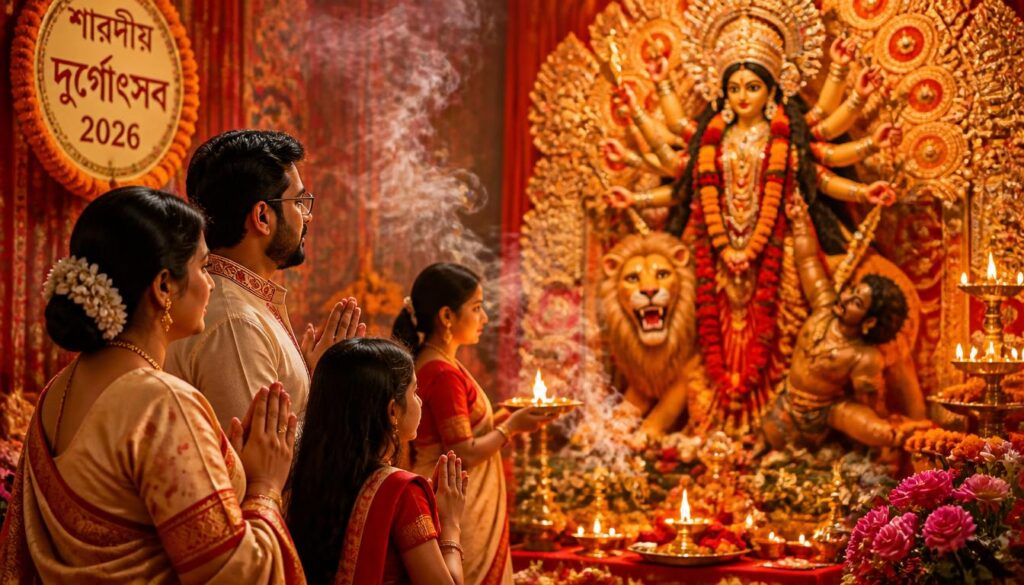
The most meaningful how to celebrate Durga Puja guide doesn’t have to begin with “visit ten pandals.” Celebration can be devotional, cultural, artistic, social or wonderfully simple.
Attend a local Puja, offer flowers if that is part of your tradition, share Prasad, listen to devotional music, learn about the artisans who created the idol, support community organisations, or simply spend time with family. If you are visiting a large celebration, be considerate around crowds and remember that the people managing the pandal are often volunteers giving up their own festival time.
Sustainability is worth thinking about too. UNESCO’s documentation of the festival specifically discusses safeguarding measures involving crowd management and environmental concerns. UNESCO ICH A beautiful Puja should ideally leave behind memories, not a mountain of avoidable waste.
Durga Puja 2026 will be celebrated from October 22 to October 26, 2026, with Vijayadashami falling on October 26.
The 2026 Durga Puja festival will take place in October 2026, with devotees celebrating Goddess Durga through rituals, prayers, cultural events, and pandal celebrations.
Durga Puja 2026 begins on October 22 (Saptami) and concludes on October 26 (Vijayadashami).
The main Durga Puja dates in 2026 are October 22 (Saptami), October 23 (Ashtami), October 24 (Navami), and October 26 (Vijayadashami).
Durga Puja in 2026 will be observed from October 22 to October 26, with the festival concluding on Vijayadashami.
Read more; https://templetimingsdaily.com/mahakaleshwar-jyotirlinga-timings-today/
Durga Puja 2026 will eventually end. The lights will come down, the pandals will disappear, the drums will become quiet and the idols will return to the water. That impermanence is not a flaw in the celebration; it is part of its meaning.
The Goddess arrives, is worshipped, loved, celebrated and finally bid farewell. In that rhythm there is a gentle lesson about life itself: welcome what is precious, appreciate it while it is here, and learn to let go without believing that letting go means forgetting.
From Mahalaya and Bodhan to Pushpanjali, Sandhi Puja, Kumari Puja, Bhog, Sindoor Khela and Visarjan, every part of the festival carries a different shade of devotion. Together they create something larger than a religious ceremony—a living expression of Bengali heritage, community spirit, artistic creativity and Shakti. UNESCO’s 2021 inscription recognises precisely this wider cultural character of Durga Puja in Kolkata. UUNESCO+1
So this year, when the first dhak beats begin and someone says, “Maa eshe gechhe”—Maa has arrived—pause for a second. Look around. The festival isn’t only happening in the idol, the pandal or the calendar date. It is happening in the reunion of families, the work of artisans, the sharing of food, the whispered prayers and even in that friend who insists on visiting one final pandal at midnight.
May Goddess Durga bring courage where there is fear, wisdom where there is confusion, prosperity where there is hardship and peace where hearts have grown tired. May every home celebrating Durga Puja 2026 find its own reason to smile, and may every farewell carry the quiet promise of returning again.
Shubho Durga Puja. Shubho Sharadiya. Asche bochor abar hobe.
If you’d like, I can also turn this into a more SEO-focused 2,500–3,000 word version, add an FAQ section with schema-friendly questions, or create a separate collection of 100+ Durga Puja 2026 wishes, captions and WhatsApp messages.