Physical Address
304 North Cardinal St.
Dorchester Center, MA 02124
Physical Address
304 North Cardinal St.
Dorchester Center, MA 02124

Some festivals arrive with drums, bright lights, crowded streets, and enough sweets to make every diet quietly disappear. Guru Purnima arrives differently. It feels more like a thoughtful knock on the heart—a day asking us to remember the people who taught us how to see a little clearer.
Celebrated on the full moon of the Ashadha month, Guru Purnima is dedicated to Gurus, teachers, mentors, and guides. In 2026, the observance carries the same timeless message it has carried for generations: knowledge matters, but so does remembering the person who helped us discover it.
The festival has deep roots in Indian culture and is observed in different ways within Hinduism, Buddhism, Jainism, yoga communities, schools, artistic traditions, and spiritual institutions. A Guru may be a spiritual teacher, an academic teacher, a parent, an artistic mentor, or simply someone whose guidance changed the direction of your life.
So, when exactly is Guru Purnima 2026, why is it celebrated, and what traditions surround it? Here’s the story, with all its moonlight, gratitude, history, and a few beautifully human details.
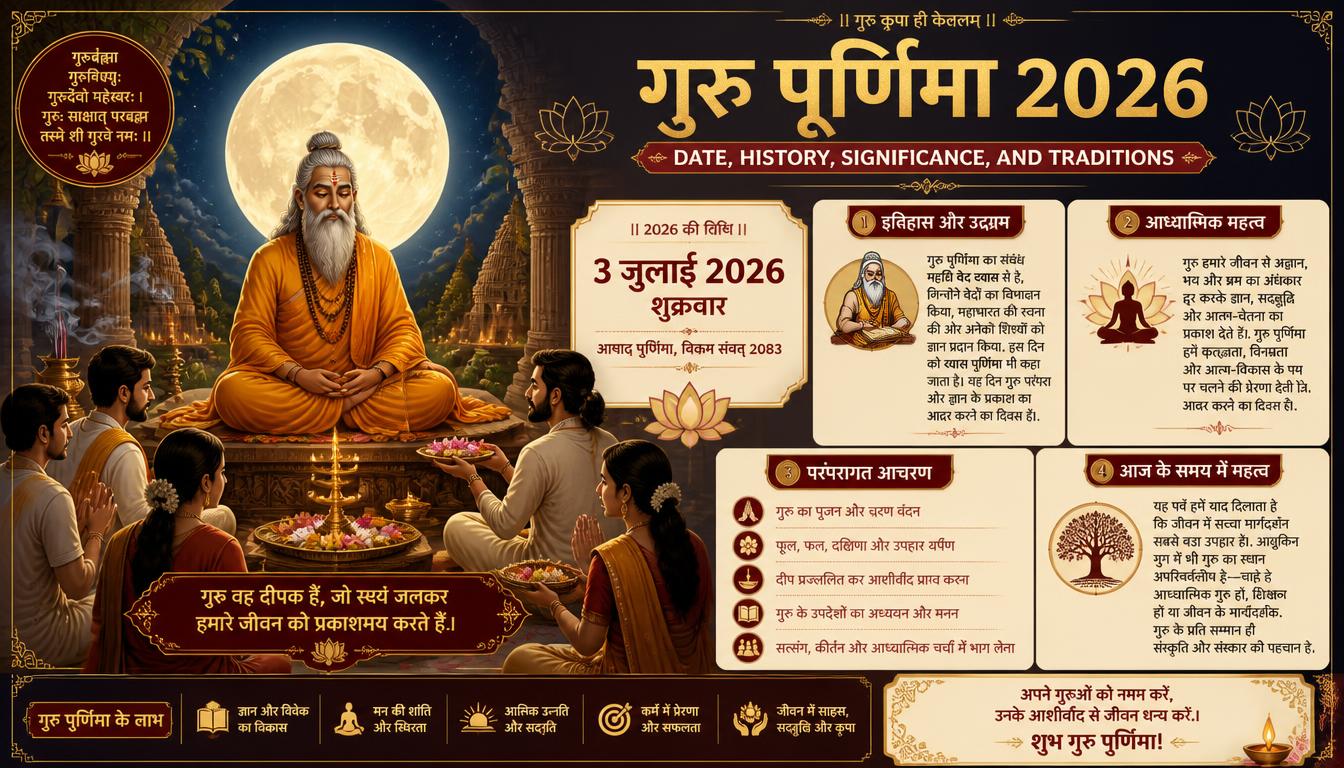
Guru Purnima 2026 falls on Wednesday, July 29, 2026. The sacred observance takes place on the Purnima Tithi, or full-moon lunar day, during the Hindu month of Ashadha. For this reason, the festival is also associated with Ashadha Purnima.
According to commonly cited Hindu calendar timings, the Purnima Tithi is expected to begin on July 28, 2026, at 6:18 PM and end on July 29, 2026, at 8:05 PM. Local Panchang calculations can vary slightly by location, though, so people performing a time-specific Guru Puja should check their regional calendar.
For a quick look:
The date changes on the Gregorian calendar each year because the festival follows the Hindu lunar calendar, not a fixed Western-calendar date. The moon, basically, gets the final say here.
The Guru Purnima meaning becomes clearer when we look at the traditional interpretation of the word “Guru.” In Sanskrit explanations, Gu is associated with darkness or ignorance, while Ru is interpreted as its remover. Thus, a Guru is commonly understood as one who removes the darkness of ignorance through knowledge and insight.
That idea goes considerably deeper than ordinary classroom teaching. A genuine Guru does not simply fill an empty notebook with information; the teacher helps the student understand what to do with what they know.
“Purnima” refers to the full moon day. Symbolically, the luminous moon fits the festival almost perfectly—the movement from darkness toward light mirrors the movement from ignorance toward wisdom.
This is why the festival celebrates the teacher-student relationship in such a profound way. It acknowledges that nearly every meaningful journey of learning contains someone who pointed toward a road we couldn’t yet see ourselves.
At the heart of Guru Purnima 2026 lies the ancient Guru-Shishya Parampara, or Guru-disciple tradition. This relationship has shaped spiritual, philosophical, musical, artistic, and educational traditions across India for centuries.
Historically, learning was often much more personal than simply attending a lecture. A disciple could spend years studying under a Guru, absorbing not only formal lessons but discipline, values, practice, observation, and a particular way of understanding life.
That closeness created a sacred relationship between teacher and disciple. Knowledge wasn’t treated merely as information to possess. It carried responsibility.
The tradition remains visible today in Indian classical dance, Indian classical music, yoga lineages, spiritual institutions, and traditional arts. Students may honor their teachers through performances, recitals, flowers, respectful greetings, or quiet expressions of gratitude.
Modern classrooms look rather different, obviously. Yet the basic emotion survives. A professor who encouraged a struggling student, a mentor who opened a career door, or an elder who taught someone patience can occupy that Guru-like place in a person’s memory.
The history of Guru Purnima is closely connected with Sage Ved Vyasa, one of the most revered sages in Hindu tradition. This association is so strong that Guru Purnima is widely called Vyasa Purnima.
Ved Vyasa holds an extraordinary position in India’s sacred and literary tradition. He is traditionally credited with arranging the Vedas into four divisions: the Rig Veda, Sama Veda, Yajur Veda, and Atharva Veda.
Tradition also associates him with the Mahabharata and important bodies of sacred literature including the Puranas. His contribution made him an enduring symbol of scholarship, sacred teaching, and preservation of ancient knowledge.
Guru Purnima therefore became an occasion not merely to remember one historical teacher, but to honor the entire lineage through which knowledge moves from one generation to another.
There’s something quietly beautiful about that. Books preserve words, yes, but teachers keep those words alive enough to matter.
Another important stream comes from the Yogic tradition, where Lord Shiva is revered as Adi Guru, meaning the first Guru.
According to yogic tradition, Shiva transmitted profound knowledge of yoga to the Saptarishis, or Seven Sages. These sages are then associated with carrying that knowledge outward, creating lineages of teaching and spiritual practice.
Within this understanding, Guru Purnima remembers the beginning of the transmission of transformative knowledge from teacher to seeker. It gives the festival an almost cosmic scale—the Guru is not merely someone who explains things but one who awakens perception.
For yoga practitioners and spiritual seekers, the day may therefore include meditation, contemplation, mantra practice, and reflection on their spiritual lineage.
The outer rituals can be simple. The inner question is harder: Am I actually becoming wiser from what I have been taught? That’s where the festival gets rather personal.
Guru Purnima and Buddha share another historically significant connection. In Buddhist tradition, the Ashadha full moon is associated with Lord Buddha delivering his first sermon after attaining enlightenment.
This teaching was delivered at Sarnath, near present-day Varanasi in Uttar Pradesh, to his first group of disciples. The discourse is traditionally associated with the teaching of the Four Noble Truths and the beginning of the Buddhist Sangha’s teaching tradition.
For Buddhist communities, this lunar occasion is therefore deeply connected with teaching, Dharma, discipline, meditation, and spiritual understanding.
Observances may involve listening to teachings, meditating, studying Buddhist texts, offering respect to teachers, and renewing one’s dedication to the spiritual path.
The outward language differs from one tradition to another, but the thread feels familiar: wisdom received should eventually become wisdom lived.
Guru Purnima Jain tradition adds another meaningful layer to the festival’s wider cultural story.
Within Jain accounts associated with this period, Lord Mahavira, the 24th Tirthankara, is connected with accepting Gautama Swami as his principal disciple. The occasion consequently carries significance for the relationship between spiritual master and disciple.
Jain observances emphasize reverence toward spiritual teachers, disciplined learning, introspection, and the pursuit of liberation through right understanding and conduct.
This is one reason Guru Purnima cannot be squeezed into one narrow definition. Different religious communities have their own histories and theological meanings, while the larger cultural theme of honoring teachers remains remarkably recognizable.
The significance of Guru Purnima is not limited to ancient scriptures or monasteries. At its simplest, the festival teaches gratitude.
Most people can remember somebody who changed how they think. Perhaps it was the teacher who stayed ten minutes after class. Maybe it was a grandfather explaining life without ever calling it a lesson. Maybe it was a mentor who said, “Try again,” when quitting would’ve been much easier.
Guru Purnima asks us to notice those invisible debts.
Its spiritual significance centers on the victory of wisdom over ignorance, the removal of doubt, and movement toward spiritual enlightenment. In many traditions, a Guru’s role is to guide the disciple toward deeper self-awareness rather than create dependence.
The occasion also encourages humility. The more we learn, strangely enough, the bigger the territory of what we don’t know starts looking.
That realization is not weakness. It is often where meaningful learning, personal evolution, and mental maturation begin.
Guru Purnima traditions differ across regions, families, ashrams, schools, and spiritual lineages. There is no single ritual performed identically by everybody.
One of the central practices is Guru Puja, a ceremonial expression of reverence toward one’s Guru. Devotees may offer flowers, fruit, sweets, incense, or other simple offerings.
Some traditions perform Paduka Puja, in which the Guru Paduka, or symbolic sandals representing the Guru’s feet, are respectfully worshipped. Touching or bowing near a Guru’s feet in Indian tradition can represent humility and reverence rather than ordinary social hierarchy.
Mantra chanting or Mantra Jaap is another common practice. Devotees may chant prayers associated with their spiritual lineage or verses honoring the Guru.
Meditation, scriptural reading, fasting, and devotional singing are also widely practiced. In some places, the day begins almost silently; elsewhere, an ashram can become wonderfully busy with prayers, flowers, visitors, and food being prepared in giant pots.
Different spaces, same gratitude.
During Guru Purnima Puja, disciples traditionally seek their teacher’s blessings and express appreciation for guidance received throughout the year.
In certain lineages, Paduka Puja carries special symbolic importance. The Guru’s sandals represent the spiritual path and the teacher’s presence, even when the teacher is physically absent.
Some rituals may involve water used ceremonially in worship, sometimes regarded as Charnamrit according to the particular tradition. Such practices are connected with ideas of purification, surrender, and divine grace.
However, Guru Purnima doesn’t require elaborate ritual for gratitude to be genuine. A sincere visit, respectful message, phone call, or handwritten card to a former teacher may carry more emotional weight than an expensive offering.
A teacher rarely forgets the student who returns years later just to say, “Your lesson stayed with me.” Funny how five words can repay something money can’t.
The tradition of Dakshina involves giving an offering to one’s Guru as an expression of gratitude. Historically and culturally, its form has varied greatly.
Modern Dakshina might involve a traditional gift, donation, support for an educational or spiritual institution, or something personally meaningful. The value isn’t supposed to live only in the price tag.
Seva, meaning selfless service, is another powerful way of observing the day. People may volunteer at an ashram, assist teachers, help prepare meals, clean shared spaces, donate educational materials, or serve those in need.
Many communities organize Bhandara, or a community feast, where food is prepared and shared with devotees and visitors. Prasad distribution may also form part of the celebration.
In a lovely way, this shifts gratitude from a feeling into an action. Instead of merely saying that knowledge made us better, Seva asks us to prove it a little.
Guru Purnima isn’t confined to temples, monasteries, ashrams, or mathas. Schools, colleges, universities, and other academic institutions may also recognize the occasion as a celebration of teachers and mentors.
Students can offer cards, flowers, speeches, poems, or small tributes to their teachers, professors, and scholars. Some institutions organize cultural programs discussing the importance of education, mentorship, and respect for teachers.
These celebrations give the festival a contemporary meaning. A science professor doesn’t need to become a spiritual Guru for their guidance to deserve gratitude.
Similarly, coaches, research supervisors, workplace mentors, writers, craftspeople, and artistic mentors can influence someone’s development for decades.
Guru Purnima expands the word “teacher” until it becomes big enough for all those people.
The teacher-disciple relationship has particular significance within Indian classical music and Indian classical dance.
Traditional artistic learning often involves years of close guidance. Students don’t merely memorize notes, rhythms, gestures, or movements; they learn interpretation, discipline, patience, and the subtle character of an art form.
On Guru Purnima, some students visit their Gurus, offer flowers, perform recitals, or participate in devotional singing. A performance can itself become an offering.
For an artist, this relationship can be unusually emotional. A tiny correction made by a teacher years earlier may still appear in every performance the student gives.
That is another kind of immortality, really.
The word “Guru” also has an astrological dimension. In Vedic astrology, Jupiter, known as Brihaspati, is commonly associated with wisdom, teachers, learning, expansion, spirituality, and prosperity.
Brihaspati is traditionally described as the divine teacher or teacher of the gods. Because of this symbolism, discussions of Guru Purnima and Jupiter sometimes connect the festival with qualities represented by the Guru planet.
A favorable Jupiter placement, within astrological belief, is associated with knowledge, judgment, education, optimism, dharma, and spiritual inclination. Some devotees use Guru Purnima for prayer and reflection related to these qualities.
It is worth distinguishing religious devotion from astrological interpretation, though. Not every person celebrating Guru Purnima follows Indian Vedic astrology, and the festival’s significance does not depend on accepting astrological claims.
Still, symbolically, Jupiter’s association with growth and wisdom fits the day’s central idea rather neatly.
Why a full moon?
Across many Indian spiritual traditions, lunar days carry ritual and contemplative significance. Purnima represents fullness, illumination, and completion, making it a natural symbolic setting for a celebration devoted to knowledge.
The bright moon becomes an image for divine knowledge illuminating ignorance. Yet the symbolism contains another subtle lesson—the moon does not generate its own light; it reflects light.
A student can be understood similarly. We receive knowledge, reflect upon it, transform through it, and eventually pass something useful to another person.
Teacher becomes student, student eventually becomes teacher. And the circle keeps moving, quietly, generation after generation.
You don’t need an elaborate ceremony to participate in the Guru Purnima celebration. What matters most is thoughtful appreciation and respect.
The final idea may be the most fitting. Knowledge honors its source beautifully when it continues travelling.
People often wonder about Guru Purnima gifts, especially when they want something more personal than the usual flowers or sweets.
There is no universal perfect gift. A spiritual teacher may appreciate an offering connected with their tradition, while an academic mentor might treasure a thoughtful letter explaining how their teaching affected your life.
Flowers, fruit, sweets, books, cards, or charitable donations can all be suitable depending on the relationship. Some disciples choose spiritual offerings or contribute toward their Guru’s institution.
But one gift sits above the rest: applying the lesson.
If a teacher taught patience and we remain needlessly cruel, the bouquet looks a bit lonely. If they taught discipline and we practice it, their teaching is still breathing.
Generic greetings are easy. Personal gratitude requires one extra minute, and that minute makes all the difference.
Mention one specific lesson your teacher gave you. Recall a moment when their guidance helped you make a difficult decision. Tell them what changed because they were there.
Instead of simply writing “Happy Guru Purnima,” you might explain that their encouragement helped you continue studying, choose a career, develop confidence, understand a spiritual practice, or survive a difficult season of learning.
Don’t worry too much about making the words fancy. Teachers have spent enough time correcting fancy words anyway.
Sincerity usually wins.
We live in an age where information arrives faster than we can drink morning tea. Search engines can answer questions, videos can demonstrate skills, and digital tools can explain difficult concepts almost instantly.
Yet information and wisdom remain different things.
A mentor helps us understand context. A teacher notices mistakes we cannot notice ourselves. A Guru, in the spiritual sense, may challenge the ego, doubt, assumptions, and habits that stand between a seeker and deeper understanding.
That makes Guru Purnima unexpectedly modern.
The festival reminds us that learning isn’t merely collecting answers. It involves discernment, practice, humility, and occasionally having somebody tell us the uncomfortable thing we needed to hear.
Technology can carry knowledge farther than ancient teachers could’ve imagined. But gratitude toward those who guide our journey of learning remains wonderfully human.
Guru Purnima 2026 will be observed on July 29, honoring spiritual gurus, teachers, and mentors for their wisdom, guidance, and valuable teachings.
Guru Purnima 2026, observed on Wednesday, July 29, 2026, is much more than another date on the religious calendar. From Ved Vyasa and Vyasa Purnima to Lord Shiva as Adi Guru, from Lord Buddha at Sarnath to Jain teacher-disciple traditions, the festival carries centuries of reflection on how wisdom travels from one life into another.
Its rituals—Guru Puja, Paduka Puja, mantra chanting, meditation, Dakshina, Seva, Prasad distribution, and community gatherings—give physical form to something deeply internal: gratitude.
But perhaps the most meaningful Guru Purnima tradition requires no ritual object at all.
Remember the person who helped remove a little darkness from your path. Call them. Visit them. Write to them. Live one of their lessons properly.
Because a Guru’s greatest legacy isn’t a flower placed at their feet for one day. It is knowledge that continues walking through the world in the life of a student.
And beneath the bright Ashadha Purnima moon, that feels like a beautiful reason to say thank you.