Physical Address
304 North Cardinal St.
Dorchester Center, MA 02124
Physical Address
304 North Cardinal St.
Dorchester Center, MA 02124

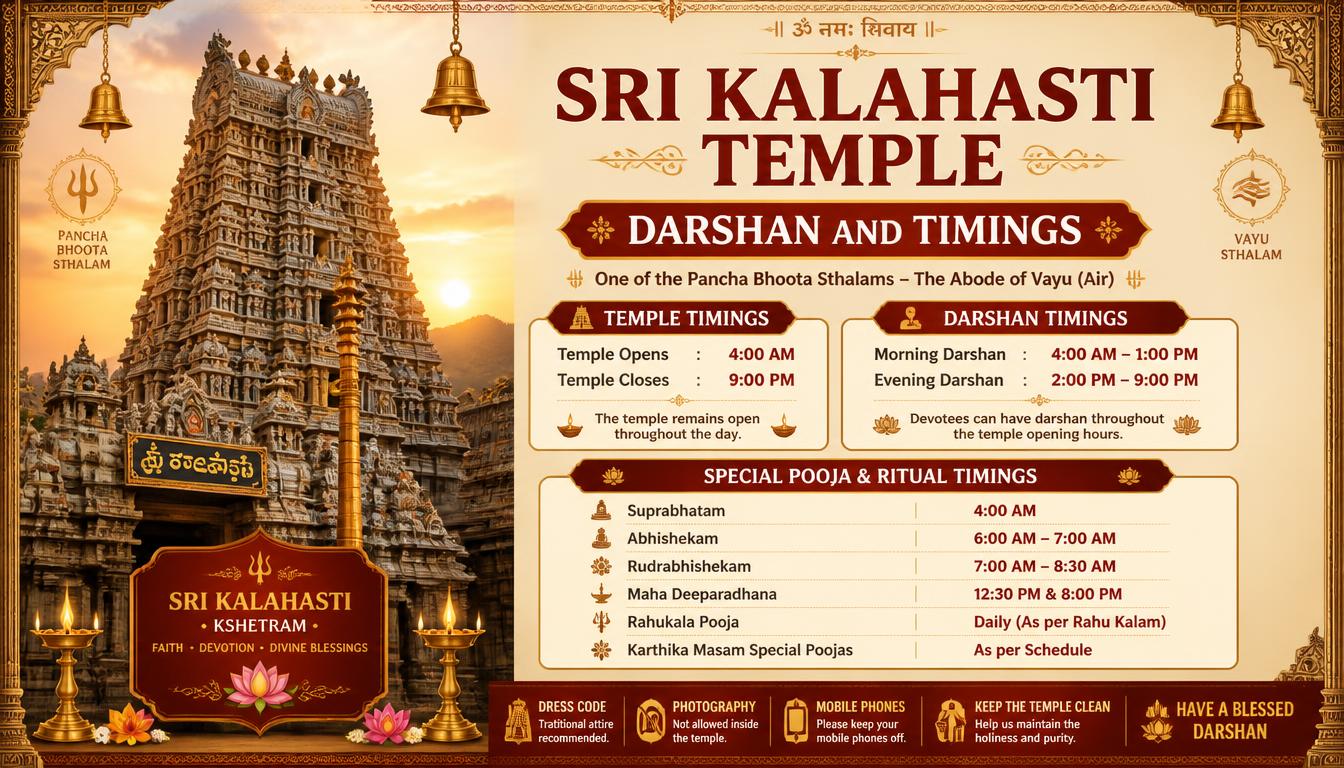
There are temples you visit, offer a prayer, and quietly leave. Then there are places where the atmosphere itself seems to slow your footsteps. Sri Kalahasti Temple belongs to the second kind. Standing close to the Swarnamukhi River, this ancient Shiva temple draws pilgrims who come for darshan, traditional rituals, and the deeply associated Rahu Ketu Pooja.
Also known as Sri Kalahasteeswara Temple and Sri Kalahasteeswara Swamy Temple, the shrine is dedicated to Lord Kalahasteeswara, a form of Lord Shiva. The temple is especially famous for the Vayu Lingam, representing the Air Element among the sacred Pancha Bhoota Sthalams. That spiritual importance has also earned Srikalahasti the name Dakshina Kailasam, or the “Kailasam of the South.”
For a first-time pilgrim, though, devotion is only one part of planning. You also need to know when the doors open, how long darshan may take, which queue to choose, what to wear, and how pooja schedules can affect your visit. This guide covers the essential Sri Kalahasti Temple Darshan, timings, tickets, queues, rituals, dress expectations, and practical visitor information in one place.
The commonly followed Sri Kalahasti Temple timings are approximately 5:00 AM – 9:00 PM. The temple generally remains accessible through much of the day, although actual darshan movement can pause briefly when important rituals or poojas are being performed.
| Temple Activity | Approximate Timing |
|---|---|
| Temple opening time | 5:00 AM |
| Morning Darshan | From around 5:00 AM |
| Morning Poojas / Abhishekam | Mainly morning hours |
| General Darshan | Available through most of the day |
| Rahu Ketu Pooja | Commonly offered during daytime hours |
| Evening Darshan | Continues into the evening |
| Temple closing time | Around 9:00 PM |
These are useful planning hours rather than a promise that every queue or ritual operates continuously. Daily temple timings may be adjusted during festivals, special sevas, temple ceremonies, or unusually heavy crowds, so checking the latest Devasthanam information before a long journey is a smart idea.
Unlike some temples with a long and clearly defined temple lunch break, Srikalahasti is generally known for broad daytime access. Still, short ritual pauses can happen. In temple life, the clock sometimes follows worship rather than the other way round.
For many pilgrims, morning darshan is the loveliest choice. The surroundings feel calmer, the heat is usually less tiring, and arriving early can help you avoid the larger groups that gradually appear later.
The Sri Kalahasti Darshan timings extend into the evening as well. Evening hours can feel wonderfully atmospheric, especially around Harathi and other worship activities, though crowds can rise on important days.
If your only aim is a relatively peaceful darshan, try reaching near opening hours on an ordinary weekday. If you also intend to perform Rahu Ketu Pooja, plan your arrival around the pooja schedule instead of thinking only about general darshan.
There is no single perfect hour for everybody. A family travelling with children, an elderly pilgrim, and someone visiting specifically for a ritual all need a slightly different plan, thats worth remembering.
The central deity is Kalahasteeswara Swamy, worshipped in the form of the sacred Shiva Lingam associated with Vayu, or air. This makes the temple one of the celebrated Pancha Bhoota Sthalams, where Lord Shiva is associated with the five fundamental elements.
The shrine of Goddess Gnana Prasunambika Devi is another important part of worship here. Devotees often seek the blessings of both Lord Kalahasteeswara and the Goddess during their pilgrimage.
Srikalahasti is also inseparable from the story of Bhakta Kannappa, whose extraordinary devotion to Shiva remains one of the most powerful legends connected with the region. The nearby Bhakta Kannappa Hill Shrine recalls Kannappa’s sacrifice and makes his story feel less like an old tale and more like something still breathing around the temple town.
This combination of mythology, elemental worship and living ritual tradition is why Srikalahasti is much more than another stop near Tirupati.
Pilgrims generally have different darshan options depending on current temple arrangements. These can include Free Darshan, paid or Special Darshan, and faster queue arrangements such as Seeghra Darsanam.
Free Darshan is the standard choice for devotees who don’t mind spending additional time in the free darshan queue. On quieter weekdays, it may move comfortably; on festivals and auspicious days, patience becomes part of the pilgrimage.
Paid special entrance or Seeghra Darshan arrangements are designed to reduce waiting compared with the normal queue. Ticket categories and prices can change, though, so don’t assume an old ₹50 or ₹200 ticket mentioned on a blog is still available at exactly the same rate.
Depending on current Devasthanam provisions, categories such as Seva Darshan, NRI Darshan, VIP Darshan, or Antharalaya Darshanam may also have specific eligibility or procedures. These should never be confused with guaranteed everyday walk-in options.
The safest approach is simple: verify the current darshan ticket price, eligibility, and availability through authorised temple channels or the official darshan counter before paying anybody.
“How long does Srikalahasti darshan take?” sounds like a simple question until a festival morning answers it for you.
The darshan waiting time depends heavily on the day, season, queue category and religious calendar. On quieter weekdays, movement may be fairly smooth. Weekends, Mondays, Amavasya, Pournami, Pradosham days and major festivals can bring substantially heavy crowds and longer queues.
The temple uses separate queue arrangements to manage devotees. A standard queue serves regular pilgrims while a special darshan queue or other priority arrangement may operate according to the ticket category available that day.
Families should keep some flexibility in their schedule. Water, comfortable clothing and patience matter more than trying to calculate darshan down to the exact minute.
During peak periods, follow announcements and instructions from temple volunteers. Queue arrangements can change to handle crowd flow, and arguing with a barricade rarely makes it move faster.
One of the biggest reasons pilgrims specifically choose Srikalahasti is the famous Rahu Ketu Pooja. It is traditionally performed by devotees seeking spiritual relief from issues associated with Rahu–Ketu dosha, Naga dosha, Sarpa Dosha, planetary difficulties, or other astrologically interpreted obstacles.
The ritual is normally conducted in a designated mandapam, where devotees receive instructions for the procedure. Depending on the arrangement, priest assistance and guidance are provided so even a first-time visitor can follow the ritual without feeling completely lost.
Commonly referenced Rahu Ketu Pooja timings extend through much of the daytime, often roughly 6:00 AM – 5:00 PM, but timings and available sessions can vary. Pilgrims should confirm the day’s schedule before arriving, particularly on auspicious dates.
Different pooja seat types or ticket categories may also be offered. Rather than relying on outdated descriptions such as “General Pooja Ticket,” “Special Pooja Ticket,” or “Deluxe Pooja Ticket,” check which categories are actually being sold for your visit.
The Rahu Ketu Pooja ticket price may differ according to the selected ritual arrangement. Purchase Rahu Ketu Pooja tickets only from authorised sources or official temple counters.
Some devotees deliberately consider Rahu Kalam while planning the ritual. Others choose a convenient available session according to travel and crowd conditions.
Because Rahu Kalam changes according to the weekday and local timing calculations, don’t use one fixed time copied from another date. If performing the ritual at a particular auspicious period is important to you, verify the relevant day’s schedule locally.
It is also useful to separate Rahu Ketu Pooja Darshan planning from ordinary temple darshan. Give yourself enough time for ticket purchase, instructions, the guided ritual, movement between areas, and subsequent worship.
Trying to squeeze everything into a forty-minute stop can turn a spiritual visit into an airport connection, which is probably not the mood anyone came for.
Beyond darshan and Rahu Ketu worship, the temple follows a rich cycle of daily poojas and daily sevas.
Devotees may encounter or enquire about rituals such as Suprabhata Seva, Abhishekam, Rudrabhishekam, Archana, Naga Pratishta, Somavara Abhishekam, Pradosha Pooja, Naivedyam, and evening Harathi.
During Archana, devotional name recitation and prayers may form part of the worship. Abhishekam is a sacred ceremonial offering associated with Shiva worship, while Pradosham carries special importance for many devotees of Lord Shiva.
Availability, seva tickets, participation rules and timings are not necessarily identical every day. Some ceremonies follow the lunar calendar, while others may have specific weekday or festival schedules.
If a particular seva is the main purpose of your journey, confirm its schedule first and build your darshan around it. This tiny bit of planning can save several confused hours after arrival.
Pilgrims often search for Sri Kalahasti Temple online booking, especially when planning from another state or country.
Online facilities may be available for selected services, while other darshan tickets, poojas, or sevas may require purchase through official temple counters. Services and booking systems can change, so use only the current official Devasthanam booking channel when available.
Avoid agents or unofficial pages promising guaranteed VIP Darshan, immediate entry, or special access to the inner sanctum. A professional-looking page isn’t automatically an authorised booking service.
For darshan online booking, pooja online booking, or seva online booking, verify that you’re using an official Devasthanam source before making payment. Keep your booking confirmation and identification accessible on the day of your visit.
For Free Darshan, advance booking may not always be necessary or available in the same way as ticketed services.
Respectful clothing makes temple entry simpler and also fits the sacred atmosphere of the shrine.
Under the commonly followed Sri Kalahasti Temple dress code, traditional or modest clothing is the sensible choice. Men can wear a Dhoti, trousers with a shirt, or Kurta-Pajama. Women commonly choose a Saree, Salwar-Kameez, or another modest traditional outfit.
Very short clothing, shorts, or revealing sleeveless tops are better avoided. Rules may be enforced differently depending on the temple area or particular seva, so conservative clothing is the safest option.
Footwear must be removed before entering designated sacred areas. Follow current instructions concerning mobile phones, cameras, leather belts, and leather bags, because restrictions may apply inside the temple premises.
Use authorised cloakrooms or storage facilities where provided rather than leaving valuables unattended.
Once inside, keep your voice low near the main sanctum and follow the designated darshan path. Don’t stop abruptly in moving queues to take photographs or hold up other devotees, particularly when crowds are dense.
Maintain temple cleanliness, respect barriers, and follow staff instructions. Photography may be prohibited in sacred areas even when phones are permitted elsewhere.
Use official offerings and authorised services whenever possible. If prasadam or official prasadam is available, collect it from recognised counters rather than unknown sellers presenting themselves as temple representatives.
Most temple rules are pretty simple when reduced to one thought: behave as though the sacred space belongs equally to the person praying beside you.
For lighter crowds, an ordinary weekday morning is usually a practical choice. Arriving near the temple opening time gives you a head start before tour groups and day visitors begin filling the queues.
Mondays hold particular significance for Lord Shiva, which can also mean more devotees. Sundays and public holidays are naturally busier because more families are free to travel.
The best time for darshan at Srikalahasti therefore depends on your priority. Choose early weekdays for convenience, important religious days for atmosphere, and festival periods only when you’re comfortable with larger crowds.
Weather matters too. Hot afternoons can make queueing tiring, particularly for children and older visitors. During monsoon weather, allow extra travel time and carry only what you genuinely need.
The religious calendar strongly influences temple crowd levels.
Amavasya, or New Moon, is particularly important for many devotees performing Rahu Ketu-related worship and other traditional observances. Pournami, the Full Moon, also carries religious significance, while Pradosham is closely connected with Shiva worship.
Periods such as Pitru Paksha and Mahalaya Amavasya can attract devotees concerned with ancestral rituals, pitru rituals, or tharpanam traditions.
During these days, expect the ordinary rhythm of the temple to become busier. Reach early, avoid making tightly timed onward plans, and prepare for waiting.
The temple becomes particularly vibrant during Maha Shivaratri. Large numbers of Shiva devotees arrive, worship continues with heightened intensity, and normal expectations about queue duration pretty much disappear.
The Karthika Month and Karthika Deepotsavam are also significant, with deepa worship contributing to the devotional atmosphere. Navaratri and Vijaya Dashami can similarly influence worship schedules and crowd patterns.
During major festivals, extended temple timings or modified entry arrangements may be introduced according to Devasthanam decisions. Don’t assume ordinary 5:00 AM – 9:00 PM hours automatically apply unchanged to every festival.
Check current announcements before travelling during these periods.
Families travelling with elderly devotees, senior citizens, differently-abled devotees, or mothers with infants should avoid unnecessarily busy hours where possible.
Ask temple staff whether any current accessibility assistance or separate arrangements are available. Such facilities and eligibility can change, so it’s better to ask than assume there will be a dedicated priority line.
Carry drinking water where permitted, but travel light. Long queues become surprisingly longer when you’re carrying five bags nobody needed.
If an elderly family member has difficulty standing for extended periods, choosing quieter hours or an authorised faster darshan option, when available, can make the visit considerably more comfortable.
Srikalahasti Railway Station provides convenient rail access to the temple town. From the station, local Srikalahasti autos and other transport options can take pilgrims toward the temple area.
Srikalahasti is also frequently combined with a pilgrimage to Tirupati and the famous Balaji Temple. This makes the temple especially convenient for travellers building a broader spiritual itinerary in Andhra Pradesh.
If travelling from Tirupati, leave a reasonable buffer rather than planning your Srikalahasti visit around an exact return time. Traffic, queues, pooja sessions and festival conditions can all quietly dismantle a perfect spreadsheet.
For first-time pilgrims, arriving earlier in the day usually makes navigation easier.
The temple itself deserves enough time, but a few nearby spiritual and natural locations can complement the journey.
The Bhakta Kannappa Hill Shrine is closely associated with Kannappa’s legendary devotion to Lord Shiva. For visitors who already know the story, seeing the landscape connected with it adds another emotional layer to the pilgrimage.
The Swarnamukhi River flows near the temple, and the Swarnamukhi River Bathing Ghats have religious importance for pilgrims. Follow local safety instructions and current access conditions before entering the water.
Travellers may also hear about Veyilingala Kona Waterfalls, a natural attraction in the broader Srikalahasti area. Conditions can vary seasonally, particularly around rains, so don’t treat waterfall access as guaranteed year-round.
A first visit becomes much easier when you don’t try to improvise everything after reaching the East Gopuram.
Arrive early, confirm the day’s temple opening hours, and decide beforehand whether you need general darshan, a special darshan ticket, or Rahu Ketu worship. Purchase tickets only through authorised channels.
If performing Rahu Ketu Pooja, allow a generous time window for the entire Rahu Ketu Pooja process rather than focusing only on its advertised starting time.
Wear appropriate traditional or modest clothing, carry minimal belongings, follow the queue system, and listen for temple announcements.
Most importantly, leave some unscheduled time. A pilgrimage feels very different when you’re not checking your phone every three minutes wondering whether you’ll make the next bus.
Before travelling, these small details can make the visit considerably smoother:
A little preparation doesn’t make the journey less spiritual. Usually, it creates more room for the spiritual part because you’re no longer worrying about tickets, shoes, queues and closing hours.
Read more: https://templetimingsdaily.com/rahu-ketu-pooja-at-sri-kalahasti-temple/
The temple commonly opens around 5:00 AM and remains open until approximately 9:00 PM, with darshan available through much of the day. Rituals, festivals and special events may temporarily affect access.
The commonly followed Sri Kalahasti Temple opening time is around 5:00 AM. Early arrival is particularly useful for pilgrims hoping to avoid larger daytime crowds.
The usual temple closing time is around 9:00 PM, although festival schedules and special temple programmes can alter normal operating hours.
There is generally no fixed afternoon closing comparable to a long lunch closure, but temporary ritual pauses may occur. Confirm the current day’s schedule if you’re arriving specifically in the afternoon.
Free Darshan is generally available for devotees, although the queue can become lengthy on weekends, Mondays, festivals and auspicious lunar-calendar days.
Paid or faster Special Darshan and Seeghra Darsanam arrangements may be available according to current temple provisions. Ticket categories and prices should be verified before your visit.
The Rahu Ketu Pooja is commonly performed during daytime hours, often approximately 6:00 AM – 5:00 PM. Exact sessions can vary, so pilgrims should confirm the current schedule.
Waiting time can range considerably depending on the day, crowd and selected queue. Ordinary weekdays are usually easier, while Maha Shivaratri, Amavasya, Mondays and other busy days can involve much longer waits.
Early morning on a non-festival weekday is generally one of the best choices for pilgrims seeking shorter queues and a calmer atmosphere.
Selected temple services may have online booking facilities, while some tickets or rituals may be handled through temple counters. Always verify the latest booking method through official Devasthanam channels.
Srikalahasti Temple is generally open daily from 5:00 AM to 9:00 PM, with poojas and darshan available at scheduled times throughout the day.
Sri Kalahasti Temple timings are 5:00 AM to 9:00 PM daily. Brief ritual pauses may occur for Abhishekam, Naivedyam, and other temple ceremonies.
Srikalahasti is a sacred temple town in Andhra Pradesh, famous for the Sri Kalahasteeswara Temple, Vayu Lingam, and Rahu Ketu Pooja.
Srikalahasti Temple darshan timings are generally 5:00 AM to 9:00 PM. Visiting early in the morning can help devotees avoid longer queues on busy days.
Kalahasti Temple is usually open from 5:00 AM to 9:00 PM every day, while individual poojas and sevas follow their own scheduled timings.
A visit to Sri Kalahasti Temple is partly about timings and queues, yes, but those practical details aren’t what most pilgrims remember afterward. They remember standing before Lord Kalahasteeswara, the symbolism of the Vayu Lingam, the sound of prayers moving through old stone corridors, and perhaps that strange quiet feeling that follows a long-awaited darshan.
Knowing the Sri Kalahasti Temple Darshan timings, ticket options, Rahu Ketu Pooja timings, dress expectations and crowd patterns simply helps you reach that moment with less confusion.
Come early when possible, keep your schedule flexible, use authorised booking channels, respect the temple’s traditions, and allow the experience a little space to unfold on its own. Srikalahasti has been receiving pilgrims for generations; sometimes the best way to visit is not to rush through it, but to let the temple set the pace.