Physical Address
304 North Cardinal St.
Dorchester Center, MA 02124
Physical Address
304 North Cardinal St.
Dorchester Center, MA 02124

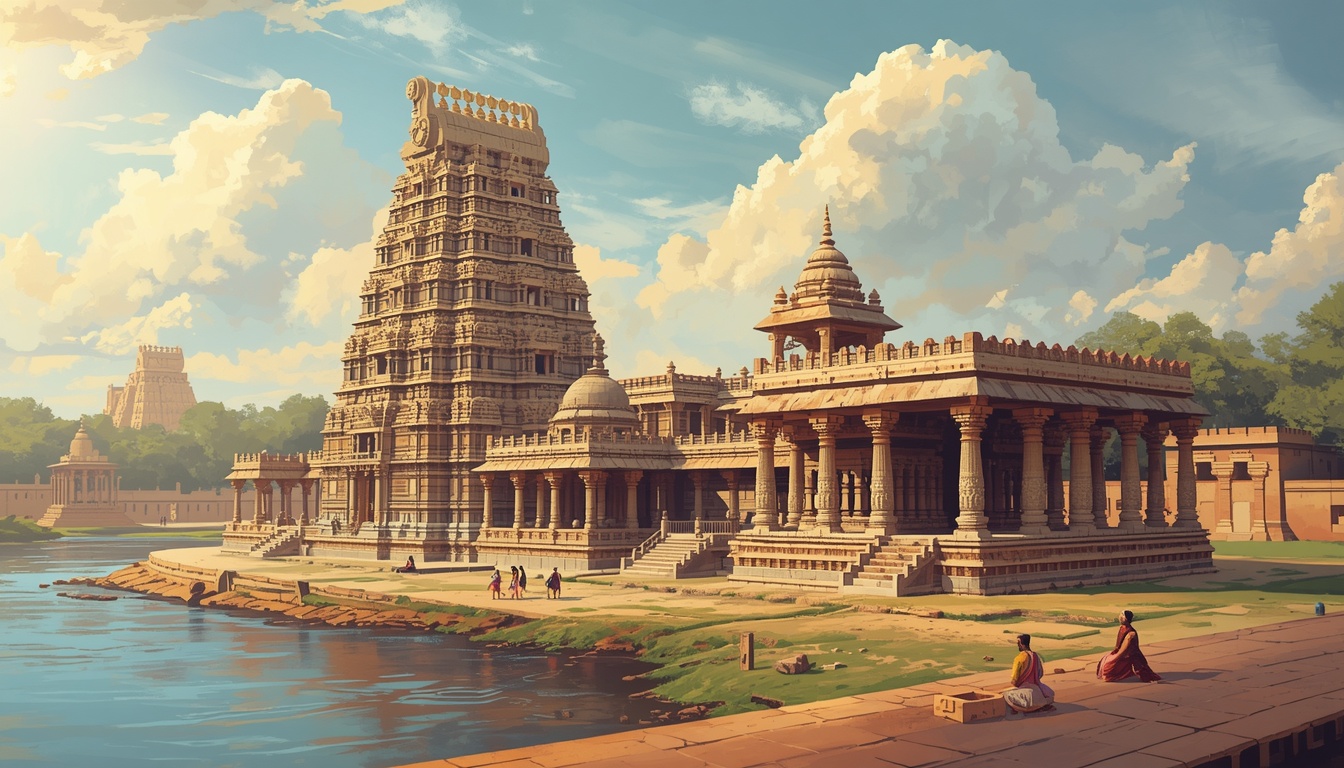
The story of Srikalahasthi Temple does not feel like the history of an ordinary monument. It feels more like several centuries, legends, kings, saints, rivers, and prayers somehow found one place to sit together.
Standing on the banks of the Swarnamukhi River in Andhra Pradesh, this ancient shrine has remained deeply connected with the worship of Lord Shiva and generations of devotees.
The Srikalahasthi Temple history is especially fascinating because mythology and documented architectural development run beside each other.
Stories speak about a spider, snake, and elephant worshipping Shiva, while historical traditions connect the temple’s development with South Indian rulers including the Pallava Dynasty, Chola Dynasty, and Vijayanagara rulers.
The temple is dedicated to Srikalahasthiswara, a manifestation of Lord Shiva, while Goddess Sri Gnanaprasunamba is worshipped alongside him.
Yet, to understand why Sri Kalahasti became such a sacred destination, we have to travel much further back than stone walls and royal inscriptions. Its story, according to sacred tradition, begins almost outside ordinary human time.
The ancient history of Srikalahasthi Temple is wrapped in Hindu sacred tradition. Different legends connect this holy place with the great Yugas Krita Yuga, Treta Yuga, Dwapara Yuga, and Kali Yuga. This gives Sri Kalahasti an identity much older in religious memory than its surviving architectural structures.
One traditional interpretation of the name “Sri-Kala-Hasti” associates it with three remarkable devotees: a spider, a snake, and an elephant. Each worshipped the Shiva Linga according to its own nature, without knowing that the others were worshipping the same deity.
The spider is traditionally associated with “Sri,” the serpent with “Kala,” and the elephant with “Hasti.” Together, their stories became inseparable from the sacred identity of Sri Kalahasti.
This legend carries a simple but rather beautiful idea: devotion does not need one fixed language.
The spider had no temple-building tools. The elephant knew no elaborate Vedic ritual. The snake couldn’t recite scriptures. Yet each offered what it naturally possessed, and their devotion became part of the Srikalahasti temple legend remembered centuries later.
The famous spider snake elephant story Srikalahasti is one of the most distinctive traditions associated with the shrine.
According to temple legend, a spider worshipped Lord Shiva by creating a web around the Linga. The web served as a tiny shelter, protecting the sacred object in the only manner the spider understood. The image is almost strangely touching—a fragile creature trying to build a roof for the divine.
A snake also worshipped the same Shiva Lingam, traditionally offering precious gems. Its worship was different from the spider’s, yet its intention was similarly devotional.
An elephant, meanwhile, is said to have brought river water in its trunk to perform a form of Abhisheka. It also offered flowers and Bilva Leaves, elements closely associated with Shiva worship.
Conflict arose because each creature interpreted the offerings of the others as interference. The elephant would clear away what it found around the Linga before making its own offerings. This eventually resulted in a dramatic confrontation.
In the religious interpretation of the story, their intense devotion ultimately brought them the grace of Lord Shiva. Their differences mattered less than the sincerity behind their worship.
This is why the Srikalahasti temple mythology isn’t merely an unusual animal legend. It represents the belief that true devotion can emerge through completely different forms.
At the spiritual centre of the temple is Srikalahasthiswara, worshipped in the form of a Shiva Linga.
Sri Kalahasti is traditionally regarded as one of the important Pancha Bhoota Sthalas associated with the five elements. The shrine is connected with Vayu, or air, giving it a particularly important place within South Indian Shaiva tradition.
The Srikalahasthiswara Linga is therefore not simply understood as another temple icon by devotees. It represents a deeper association between Shiva and the elemental forces of existence.
Within the Sanctum Sanctorum, worship has continued through generations. Rituals such as Pooja, prayer, sacred offerings, and Abhisheka form part of the devotional life surrounding the shrine.
There is an interesting contrast here. Kingdoms disappeared, political borders changed, languages evolved, and architecture was expanded. But worship inside the sacred centre continued. History outside kept moving while devotion inside, in a sense, stayed home.
No telling of Srikalahasthi Temple History feels complete without Bhaktha Kannappa, also remembered as Kannappa Nayanar.
Tradition identifies Kannappa with Thinnadu, a hunter whose devotion to Shiva did not follow conventional temple ritual. He wasn’t presented as a scholar trained in complicated scriptures. His relationship with Shiva was immediate, emotional, and almost startlingly personal.
According to the celebrated Bhakta Kannappa story, Thinnadu discovered a Shiva Lingam and began worshipping it in the way he understood best. His offerings did not necessarily follow Brahminical ritual conventions, but his devotion was considered completely sincere.
The most famous episode concerns the eyes of the Linga.
When Kannappa saw what appeared to be blood coming from one of Shiva’s eyes, he tried to heal it. Finding that his efforts were not enough, he offered his own eye. When the second eye of the Linga appeared similarly affected, he prepared to sacrifice his remaining eye as well.
There was one practical problem—once his second eye was removed, how would he know where to place it?
Tradition says Kannappa placed his foot at the spot so he would not lose it after becoming blind. Just before completing the Kannappa eye sacrifice, Shiva intervened and stopped him.
It is an intense story, even uncomfortable in its imagery, but that’s partly why it survived so powerfully. It represents Shiva devotion pushed beyond ritual performance into complete self-surrender.
Kannappa was ultimately revered among the Nayanar saints, and Kannappa Mountain remains connected with his memory. His story tells pilgrims that the worth of worship is not always measured by how polished the ritual looks from outside.
Alongside Srikalahasthiswara, Sri Gnanaprasunamba, also known as Gnanaprasunambika, occupies a central place in the sacred character of Sri Kalahasti.
She is associated with Gauri Devi and Parameshwari, representing the divine feminine power that complements Shiva. Traditions surrounding the goddess include themes of knowledge, spiritual wisdom, divine power, and transformation.
The name Gnanaprasunamba itself carries associations with knowledge and blossoming wisdom. This adds another layer to the temple: it isn’t only a place associated with Shiva’s elemental manifestation but also with divine knowledge.
Traditions further connect the goddess with Sri Chakra worship and figures such as Bharadwaja Maharishi. Ritual traditions including Shadha Puja are also associated with the sacred worship surrounding the deity.
This relationship between Shiva and Shakti gives the temple a spiritual balance. The story isn’t only about power; it’s also about wisdom, devotion and awakening.
Another important concept within the sacred geography of Sri Kalahasti is Sivanandaika Nilayamu, also rendered Sivanandaika Nilayam.
Sri Kalahasti has traditionally been praised as South Kailasam, connecting the sacred landscape symbolically with Mount Kailash, the legendary abode of Lord Shiva.
The surrounding mountains are therefore more than geographical formations in local religious imagination. Places such as Kannappa Mountain participate in a larger sacred landscape shaped by centuries of stories.
Traditions also connect the region with Lord Brahma, including accounts of a Brahma Shrine, and with sages who performed meditation and Tapasya.
The idea of South Kailasam makes Sri Kalahasti especially interesting. Pilgrimage, here, becomes a kind of sacred geography—you travel across physical land, but the stories invite you to imagine another landscape layered over it.
The Swarnamukhi River is one of the most important natural features associated with Srikalahasthi.
In sacred tradition it is connected with names and ideas such as Divya Ganga and Suwarnamukhari Sravanthi. Its presence beside the temple strengthens the relationship between landscape, pilgrimage, purification, and worship.
Stories connect Agastya Maharishi, also referred to as Agastya Maha Muni, with the sacred geography of the region. The river is similarly associated in religious narratives with Ganga Devi and divine grace.
The Swarnamukhi River religious significance becomes especially meaningful because Indian temple traditions rarely treat landscape as mere scenery. Rivers can become participants in sacred history, mountains can become dwelling places, and caves may turn into spaces of meditation.
Traditions concerning Pushkaralu, Magha Masam, sacred bathing, prayer and pilgrimage add further layers to the river’s identity.
For pilgrims visiting Sri Kalahasti, therefore, the temple and river shouldn’t really be separated in imagination. One is architecture shaped by human hands; the other is a natural presence flowing beside centuries of worship.
When we move from sacred legends toward architectural history, South India’s great dynasties become important.
The early structural development of the temple is commonly associated with the Pallava Dynasty. The Pallava Kings were major patrons of religious architecture in southern India, and their era helped establish architectural traditions that influenced temples far beyond their own political lifetime.
Elements of Pallava architecture form part of the broader historical discussion surrounding Sri Kalahasti’s development.
The temple visible to later generations, however, wasn’t created during one reign or according to one blueprint. Like many ancient Indian temples, it developed through multiple stages.
Different rulers repaired, enlarged, decorated, endowed, or reconstructed parts of the sacred complex. That is one reason reading its architecture can feel like reading several historical chapters written in stone.
The Chola Dynasty occupies another important position in the history of Sri Kalahasti Temple.
The Cholas were among the most influential temple builders and patrons in South Indian history. Their architectural legacy is particularly famous for monumental Shiva temples, detailed sculpture, carefully planned sacred spaces, and extensive religious patronage.
Sri Kalahasti experienced important development under Chola Kings, with Kulottunga Chola frequently appearing in historical traditions concerning the temple.
During the medieval period, additions and improvements helped transform the shrine into a larger religious complex.
The interaction of Pallava Chola history of Srikalahasti Temple is therefore better understood as gradual development rather than a single construction event.
If someone asks, “Who built Srikalahasthi Temple?” the most accurate broad answer is that the temple evolved over centuries under multiple patrons rather than being entirely constructed by one ruler.
That small distinction matters quite alot. Ancient temples are sometimes described as though one king woke up, ordered a gigantic structure, and completed everything in a single reign. Real architectural history is usually messier—and more interesting.
The Vijayanagara period brought another major phase in the history and architectural development of Sri Kalahasti.
Sri Krishna Devaraya, one of the most celebrated rulers of the Vijayanagara Empire, is strongly associated with temple patronage across South India. His reign left architectural and inscriptional traces at numerous religious centres.
At Sri Kalahasti, traditions associate Sri Krishna Devarayalu with important construction and patronage. The year 1529 AD also appears in historical accounts connected with architectural additions associated with this period.
The temple’s imposing structures, halls and gateways reflect how royal patronage could dramatically change the scale of an already ancient sacred site.
The Vijayanagara contribution did not erase earlier architecture. Instead, it became another layer placed beside and around older ones.
That’s part of the charm of South Indian temple architecture: a visitor may walk only a few minutes physically while crossing centuries historically.
The Srikalahasthi Temple architecture is one of the strongest physical witnesses to its long history.
Its complex includes monumental gateways, halls, shrines, sculptural details, porches, walls and sacred interior spaces. Terms such as Temple Gopuram, Southern Gopuram, Bikshala Gopuram, Mandapam, Royal Hall, and Sanctum Sanctorum occur in descriptions and traditions surrounding the temple complex.
A gopuram is not merely an entrance gate in the everyday sense. In major South Indian temples, it can become a towering visual announcement that you are entering sacred space.
The temple’s architecture reflects changes that unfolded under different rulers and periods. Influences associated with Pallava Style, Chola architecture, and later royal patronage contribute to its historical richness.
Various temple sculptures also carry religious imagery and artistic details. They remind visitors that before printed books became common, architecture itself could communicate stories.
A wall could teach. A sculpture could preserve mythology. A Mandapam could hold worshippers, music, ceremonies, conversations and generations of footsteps.
Stone wasn’t silent here, basically.
The sacred environment associated with Sri Kalahasti extends beyond its principal sanctum.
Traditional descriptions mention places such as Hyma Cave, Girija Cave, Bhairava Cave, and Gopara Cave, adding another dimension to the spiritual geography surrounding the temple.
Caves naturally carry strong associations with meditation and ascetic practice within Hindu traditions. Their quiet, enclosed environment has long made them symbolic spaces for withdrawal from ordinary distractions.
Other sacred structures and traditions include the Bhuvaneshwari Devi Peetham, shrines connected with Lord Brahma, and places associated with sages and divine personalities.
Taken together, these spaces show why Sri Kalahasti shouldn’t be understood merely as one building containing one shrine. Historically and spiritually, it is better imagined as a sacred landscape.
Tradition also connects Adi Shankara Charya with Sri Kalahasti.
Over centuries, saints, philosophers, poets and devotees helped establish the reputation of the temple beyond its immediate region. Shaiva devotional traditions associated with figures such as Appar, Thirugnana Sambandar, Sunder, and Manikya Wachakkar belong to the broader devotional environment in which South Indian Shiva shrines gained enormous religious importance.
The Nayanars were particularly significant in the development of Tamil Shaiva devotion. Their hymns and stories emphasized an intensely personal relationship with Shiva.
Kannappa fits beautifully—if dramatically—into this world of devotion.
Rather than presenting spirituality as something available only to scholars or kings, these traditions repeatedly place ordinary devotees, wandering saints, hunters, and people from different social backgrounds close to the divine.
The Srikalahasti temple ancient history stretches across so many traditions that placing everything on one perfectly straight timeline isn’t possible.
Sacred narratives take the shrine back into mythological ages. Architectural evidence and historical traditions then bring us into periods associated with the Pallava Dynasty, Chola Dynasty, medieval South Indian rulers and the Vijayanagara Empire.
Later histories also mention connections with rulers and administrators such as Yadava Narasimha, Veera Narasimha Rayalas, Akkanna, and Madananna, among others.
The wider political environment of South India, including interactions involving different kingdoms and the Golconda Kingdom, influenced the historical world surrounding temples and their patronage.
Across the 9th Century, 12th Century AD, 16th Century, and later centuries, the complex continued to acquire historical layers.
This explains why asking “when was Srikalahasthi Temple built?” does not produce one satisfying date.
The shrine’s sacred origins belong to mythology, while the physical complex grew through several historical periods. Both stories are important, provided we don’t confuse religious tradition with precisely dated architectural evidence.
The Srikalahasthi Temple historical significance comes from the unusual way religion, architecture, literature, royal patronage and geography overlap here.
It is an ancient Shiva temple in Andhra Pradesh, but that description barely opens the door.
Its legends preserve stories of radical devotion. Its architecture preserves evidence of changing dynasties. Its location beside the Swarnamukhi sacred river connects human construction with the natural landscape.
Its deities—Srikalahasthiswara and Sri Gnanaprasunamba—give the temple a strong Shaiva and Shakti identity. Its association with South Kailasam places the region within a larger sacred imagination connected with Kailasam.
Then there is Kannappa.
His story alone has carried the name of Sri Kalahasti into devotional literature and popular memory far beyond the temple walls. The Kannappa Nayanar history reminds devotees that ritual correctness and genuine surrender are not necessarily the same thing.
A historic temple survives not simply because its walls remain standing. It survives because people continue walking through them.
At Sri Kalahasti, Shiva Linga worship, Shiva Abhishekam, prayer, Pooja, Bilva leaves worship, meditation and other sacred practices continue the devotional identity built across generations.
Modern pilgrims may also encounter organized forms of Darshanam, Temple Seva, Pratyaksha Seva, and Paroksha Seva associated with temple worship.
This living character separates an active temple from an archaeological monument.
Visitors aren’t merely observing history behind glass. They are entering a place where bells ring, offerings are made, prayers are whispered, and traditions continue to be practiced. Yesterday hasn’t completely left the building, you could say.
One of the best ways to appreciate the story behind Srikalahasthi Temple is to allow history and mythology to remain related without treating them as identical.
Stories involving the spider, snake and elephant belong primarily to sacred tradition. The Bhaktha Kannappa narrative similarly comes through devotional tradition and literature.
Stories involving Agastya Maha Muni, Lord Brahma, Ganga Devi, Gauri Devi, and events associated with ancient Yugas belong to the temple’s religious worldview.
By comparison, dynastic patronage, inscriptions, architectural styles and surviving structures help historians investigate the temple’s physical development.
Neither layer needs to destroy the other.
For a devotee, a legend may communicate spiritual truth. For a historian, an inscription may reveal dates, rulers and patronage. For an architect, a gopuram may reveal construction techniques. And for an ordinary visitor, somehow all three perspectives can stand in the same courtyard.
Perhaps the most enduring lesson from Sri Kalahasti history is that sacred places are made by more than stone.
Kings supplied resources. Craftsmen carved structures. Saints carried stories. Priests maintained rituals. Rivers shaped landscapes. Pilgrims kept returning.
And legends gave the stones a voice.
The spider offered a web. The snake offered what it possessed. The elephant brought water and flowers. Kannappa was prepared to offer his own sight. Each story uses a different image, but they circle around one central idea: sincere devotion is measured by intention rather than display.
The historical rulers tell another story. From Pallava architecture and Chola patronage to Krishnadevaraya and the Vijayanagara period, successive generations did not simply inherit the shrine; they added something to it.
This continuous accumulation explains much of the temple’s enduring grandeur.
Someone who knows the Srikalahasthi Temple history before visiting may experience the complex rather differently.
A gopuram becomes more than a large gateway. A mountain recalls Kannappa. The river evokes sacred traditions connected with sages and Divya Ganga. The Linga recalls the strange yet profound story of three non-human devotees.
Even a quiet corner can suddenly feel heavier with meaning.
When visiting an active temple, respectful clothing, patience, and awareness of local worship practices are sensible. Ritual schedules and access arrangements can change, so current official temple information should be checked when planning Darshanam or Seva rather than relying only on historical guides.
Most importantly, don’t hurry through simply collecting photos.
Look at the architecture closely. Notice how different spaces feel. Think about how many people may have crossed the same courtyards over hundreds of years. Ancient places sometimes explain themselves rather slowly.
Kalahasti Temple has an ancient history connected with Lord Shiva, Bhaktha Kannappa, and several South Indian dynasties that contributed to its architecture and development.
Srikalahasthi Temple is a famous Shiva temple in Andhra Pradesh, known for its ancient traditions, sacred legends, Pallava and Chola architectural influences, and spiritual importance.
Sri Kalahasti Temple has a rich history associated with Srikalahasthiswara, Goddess Gnanaprasunamba, the Swarnamukhi River, and the legendary devotion of Kannappa Nayanar.
Srikalahasti history combines ancient Hindu legends, temple architecture, royal patronage, and centuries of devotion to Lord Shiva, making it an important pilgrimage site.
The Srikalahasti story is closely linked with the spider, snake, and elephant who worshipped Lord Shiva, along with the extraordinary devotion and sacrifice of Bhaktha Kannappa.
Read more: https://templetimingsdaily.com/today-tithi-aaj-ki-tithi/
Srikalahasthi Temple History is ultimately not one story but many histories woven together.
There is the sacred history of the spider, snake and elephant. There is the unforgettable Bhakta Kannappa story. There are traditions of Srikalahasthiswara, Gnanaprasunambika, Sivanandaika Nilayamu, South Kailasam, Agastya Maharishi, and the Swarnamukhi River.
Then there is the architectural story the Pallava Kings, Chola Kings, Kulottunga Chola, Sri Krishna Devaraya, craftsmen, sculptors and generations of patrons who contributed to the temple’s physical form.
Together, these layers make Sri Kalahasti much more than an old Shiva Temple.
It is a place where temple architecture, mythology, royal history, natural geography and Shiva devotion continue to meet. Stone gateways may carry the weight of centuries, but the quieter legacy is perhaps found in the stories devotees still tell.
The web of a spider, water carried by an elephant, a hunter’s impossible sacrifice, a river moving beside an ancient shrine—none sounds like conventional historical evidence on its own. Yet together they explain why Sri Kalahasti has remained alive in religious memory for so long.
And perhaps that is the most beautiful thing about this ancient Srikalahasti sacred shrine: history here isn’t only something that happened.
For millions of devotees, it is something that continues.
I kept the article focused entirely on Srikalahasthi Temple History, while naturally incorporating the strongest historical, architectural, religious, and semantic entities you supplied.