Physical Address
304 North Cardinal St.
Dorchester Center, MA 02124
Physical Address
304 North Cardinal St.
Dorchester Center, MA 02124


There are festivals that arrive with noise, and then there are festivals that seem to arrive with the smell of flowers, warm food and a house being slowly filled with people.
Onam 2026 belongs to the second kind. It carries something wonderfully familiar: a courtyard decorated with a Pookalam, a banana leaf waiting for a feast, children running around in new clothes, and elders telling the old story of Mahabali as if they are telling it for the very first time.
For many Malayalis, Onam is not simply a date printed on a calendar. It is a feeling of returning home. It is about prosperity, friendship, gratitude and the old idea that nobody at the table should feel like an outsider.
The festival is strongly associated with Kerala, but its warmth travels far beyond the state through the Kerala diaspora and Malayali communities around the world.
In 2026, the main day, Thiruvonam 2026, falls on Wednesday, August 26, 2026. Kerala Tourism also lists Thiruvonam on August 26 as a major traditional festival, while the Kerala government’s 2026 holiday calendar marks August 25 as First Onam and August 26 as Thiruvonam.
So, what exactly makes Onam 2026 special? The answer is a little bit of mythology, a little agriculture, a lot of food, flowers, music and something that cannot really be measured the happiness of people coming together.
The main day of Onam 2026 is Wednesday, August 26, 2026, known as Thiruvonam. The celebration traditionally builds toward this day through the earlier days beginning with Atham, creating a festive period of roughly ten days.
The Malayalam calendar places the festival in Chingam, the first month of the Malayalam year. The main observance is connected with the Thiruvonam Nakshatra, also known as Shravana in other Hindu calendar traditions. That astronomical connection is why the date of Onam moves from year to year rather than staying fixed on the Gregorian calendar.
For people searching Onam 2026 date, Onam date 2026, or when is Onam 2026, the simple answer is August 26 for Thiruvonam. The broader festivities, however, begin earlier, so calling Onam only a one-day festival is a bit like calling a wedding only the moment the bride and groom say yes.
The traditional sequence begins with Atham and gradually grows toward Thiruvonam. Each day has its own place in the festival atmosphere, and in many homes the Pookalam grows larger as the days pass.
For 2026, the commonly followed ten-day sequence runs from August 17 through August 26, ending with Thiruvonam.
There is a small calendar detail worth knowing: different regional calendars may describe the surrounding celebrations differently, and some extend the festive observance beyond these ten days. The Kerala government’s calendar, for example, separately identifies First Onam on August 25, Thiruvonam on August 26, Third Onam on August 27 and Fourth Onam on August 28.
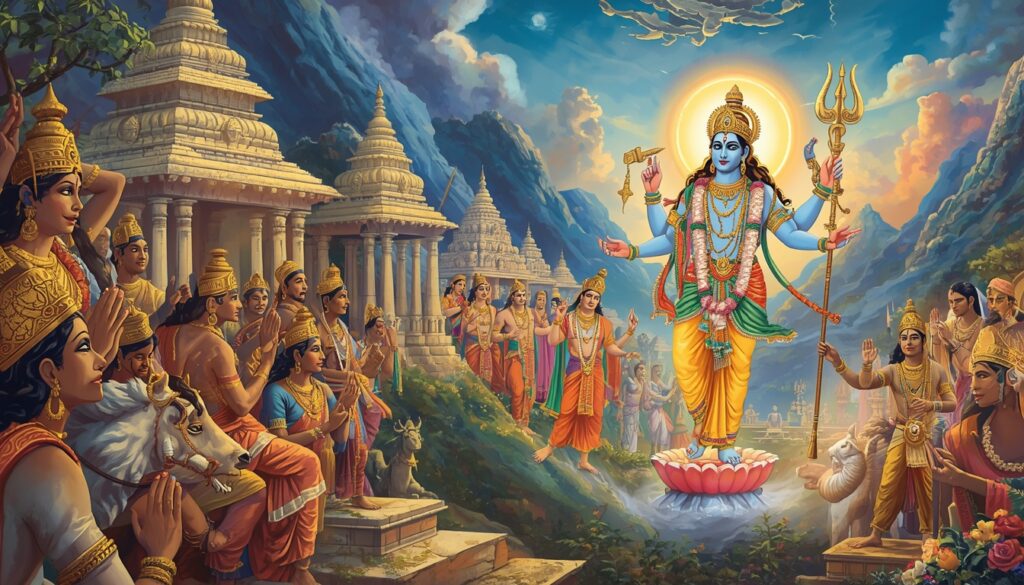
At the heart of Onam stands the unforgettable figure of King Mahabali, also called Maveli. His story is one of those legends where the most powerful person in the room is not remembered because he conquered everyone, but because people loved the way he ruled.
According to the traditional story, Mahabali was a generous and powerful ruler whose kingdom became known for prosperity, fairness and social harmony. His popularity was so great that his reign came to represent an almost ideal age a kind of golden age where people lived with dignity and abundance.
Then comes Lord Vishnu in the form of Vamana Avatar. Vamana, appearing as a young dwarf Brahmin, approached Mahabali and asked for as much land as he could cover in three steps.
Mahabali agreed.
The little visitor then became cosmic in scale. With two enormous steps, Vamana covered the worlds. For the third step, Mahabali offered his own head, accepting the consequence of his promise.
The story is remembered not merely as a tale about divine power. It also speaks about dharma, humility, generosity and the complicated relationship between earthly greatness and spiritual surrender.
According to Onam tradition, Mahabali is allowed to return once each year to see his people. That imagined homecoming is one reason the festival feels so personal. A flower carpet is not just decoration, a feast is not merely lunch they become a symbolic welcome.
People often search why is Onam celebrated expecting one short answer, but Onam carries several layers of meaning.
It is connected with the legendary return of King Mahabali, but it is also a harvest festival, a celebration of abundance and a major expression of Kerala’s cultural identity.
Agricultural life has always shaped the festival. Harvest festivals naturally create a feeling of thanksgiving: the fields have produced, the difficult season has passed, and families have something to share.
The deeper message is even more beautiful. Onam repeatedly brings forward ideas of equality, unity, community harmony, gratitude, prosperity, contentment and human brotherhood.
That is perhaps why Onam can be celebrated in a home, a temple, a school, an office or a Malayali community abroad. The setting changes, but the central idea survives.
One of the most recognizable symbols of Onam 2026 will be the Pookalam, a traditional floral rangoli created from fresh flowers.
At first, it may look like a simple circle of petals. Look closer, though, and you find patience, planning and a surprising amount of artistic thinking.
In many traditional celebrations, the floral design develops over the festival period. Families collect Pookalam flowers, arrange them in patterns and gradually create a more elaborate Onam flower carpet.
Modern celebrations have added competitions, geometric designs and enormous public installations, while many families still prefer the quiet version: children sitting on the floor, someone arguing about which flower belongs where, and one grandmother silently fixing the design after everyone leaves.
That little domestic scene may not appear in tourism brochures, but it is exactly where cultural continuity lives.
If Pookalam gives Onam its visual identity, Onam Sadhya gives it an edible one.
A traditional Onam Sadhya is a grand vegetarian feast served on banana leaves, with numerous dishes arranged according to established culinary customs. Kerala Tourism describes the Onam celebration as featuring a lavish vegetarian feast and family gatherings around traditional food.
A Sadhya may include dishes such as:
The remarkable thing about the feast is not simply the number of dishes. It is the idea of sitting together and sharing one meal.
A banana leaf can look surprisingly humble, but put a complete Kerala Sadhya on it and suddenly lunch has become an event. Someone will inevitably say they are full and then somehow find room for another spoonful of payasam. That part of the tradition seems almost universal.
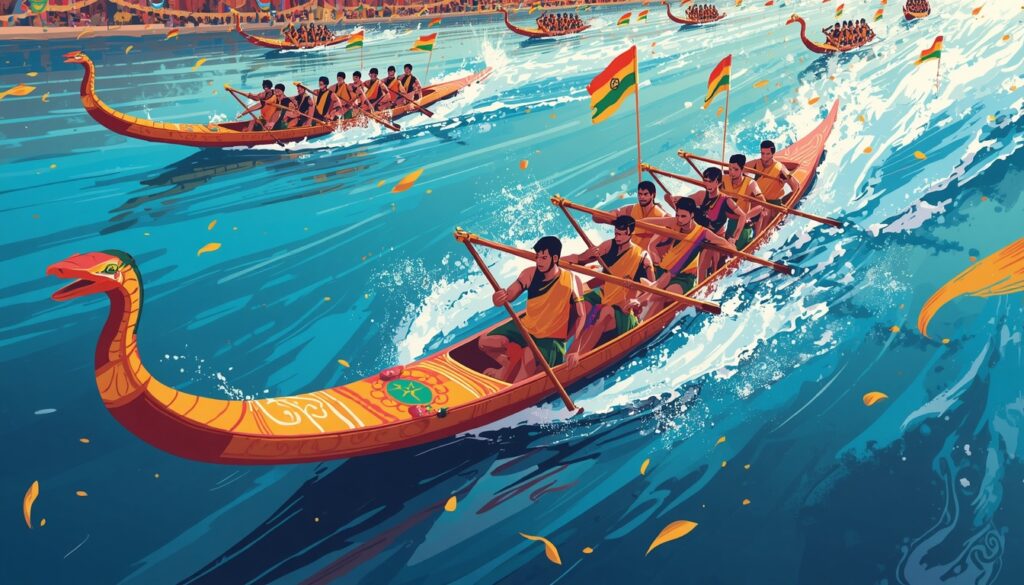
There is another side of Onam that is far more energetic: Vallam Kali, the traditional snake boat race.
Long boats filled with rowers move together in powerful rhythm, often accompanied by songs and the enormous enthusiasm of spectators. The famous Nehru Trophy Boat Race at Punnamada Lake in Alappuzha is closely associated with Kerala’s vibrant boat-racing culture.
The connection between Onam and water is especially natural in a state where backwaters, rivers and waterways have shaped everyday life for centuries.
Watching a snake boat race is not quite like watching an ordinary sporting competition. The synchronization is part athletic discipline, part cultural performance. One person rowing badly would be a problem; many people rowing badly together would be an entirely different disaster.
Onam is also a giant stage for Kerala’s artistic traditions.
Pulikali, often translated as tiger dance, is one of the most visually striking celebrations. Performers paint their bodies in tiger-like patterns and dance to rhythms while crowds gather around.
Then there are forms such as Thiruvathirakali, Kathakali, Mohiniattam, Kummattikali and musical traditions supported by instruments such as Panchavadyam.
These performances show that Onam is not only religious or agricultural. It is also an expression of artistic heritage.
Kerala Tourism’s festival calendar highlights Onam-season events across the state, including Thiruvonam, Pulikali in Thrissur and boat-racing events, showing how the celebration expands into a broader cultural season.
The public celebrations are spectacular, but some of the most meaningful Onam traditions happen quietly at home.
Families may begin with Onam cleaning, arrange flowers, prepare special food, buy Onakkodi or new clothes, light a Nilavilakku, visit temples and exchange gifts.
For some families, Onam puja, Vishnu worship, temple prayers or recitation of Vishnu Sahasranama may form part of the spiritual side of the celebration.
Other families may emphasize the cultural rather than devotional side. That diversity is important because there is no single way every Malayali family experiences Onam.
A household in Alappuzha may have a different rhythm from one in Kozhikode. A family in Thrissur may experience Pulikali differently from a family in Palakkad. And a Malayali family living outside India may recreate the festival in a community hall because there is no Kerala courtyard nearby.
The setting changes; the feeling doesn’t disappear.
Onam in Kerala is naturally diverse because the state itself is culturally varied.
In Alappuzha, backwaters and boat races can become central to the festive atmosphere. In Thrissur, Pulikali provides a spectacular public expression of the season. Ernakulam combines urban celebrations with traditional temple and community events.
In Kottayam, village and family traditions remain important, while Kozhikode, Malappuram and other parts of Malabar bring their own regional food and cultural styles.
Onam traditions can also be found beyond Kerala, including communities in Karnataka, Tulunadu and elsewhere in India.
Then there is the Kerala diaspora. For Malayalis living in the Gulf, Europe, North America or other parts of the world, Onam can become a community reunion.
A rented hall, a homemade Pookalam and a Sadhya prepared far from Kerala can suddenly make a foreign city feel a little bit like home.
Read more: https://templetimingsdaily.com/hanuman-chalisa/
New clothes are an important part of the festive experience, often referred to as Onakkodi.
There is something charming about receiving new clothes for a festival. It isn’t really about fashion. It is the symbolism of renewal — beginning again, looking forward, and welcoming the new season with dignity.
For children especially, the new outfit can become the unofficial highlight of the entire day. The Pookalam may be beautiful, the Sadhya may be legendary, but the child is thinking about showing everyone the new dress.
And honestly, that is part of the charm.
For families observing the spiritual side of Onam, prayers may be included in the day’s rituals. Some may focus on Vishnu, Vamana, or the symbolic presence of Mahabali.
Traditional devotional practices can include Vishnu Sahasranama, temple visits, offerings, lighting a lamp and prayers for prosperity and family wellbeing.
Some traditions also refer to devotional verses and mantras such as the Vamana Gayatri Mantra or Vishnu Mangalashtakam. However, practices differ by family and community, so these should be understood as examples of devotional traditions rather than compulsory rituals for every person celebrating Onam.
The spiritual significance of Onam ultimately comes back to simple ideas: gratitude, humility, generosity, righteousness and peace.
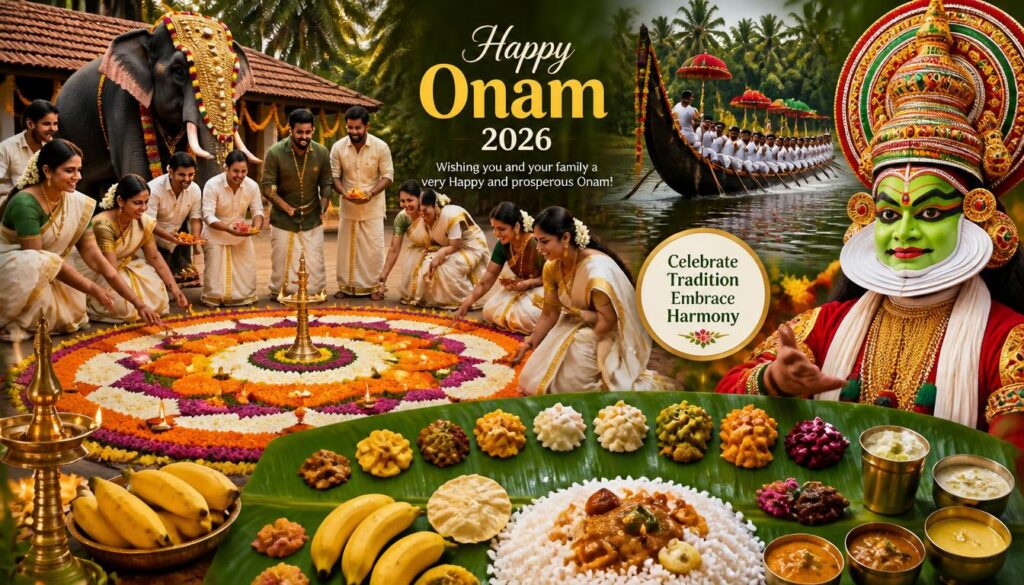
The cultural importance of Onam festival 2026 goes well beyond the celebration itself.
A festival survives when people keep doing something together. Children learn how to arrange flowers because parents and grandparents show them.
Recipes survive because someone refuses to write down exact measurements and says, “Just add enough.” Songs remain alive because people sing them even when the old pronunciation has become slightly mixed with modern speech.
That is cultural continuity in its most ordinary form.
Onam therefore becomes a bridge between generations. It connects modern Kerala with older agricultural traditions, mythology with contemporary life, and local customs with the worldwide Malayali community.
You do not need a huge event to celebrate meaningfully.
Start with a small Pookalam. Even a simple flower arrangement can create the right atmosphere.
Prepare a few Sadhya dishes instead of trying to cook everything in one heroic afternoon. Wear something new, call family members, share an Onam greeting and spend a little time talking without everyone looking at a phone.
If you have children around, tell them the Mahabali story. Don’t make it sound like a school lesson. Tell it like a story your grandmother might have told you.
And if you live outside Kerala, don’t worry if your celebration is imperfect. A festival carried across countries will naturally change shape. That does not mean the tradition has been lost.
A good Onam message doesn’t have to sound like it came from a greeting-card factory. A few sincere words can be enough.
The easiest way to write a meaningful Onam greeting is to mention something real.
For a parent, mention family and gratitude. For a friend, mention food, laughter or an old Onam memory. For someone living abroad, mention the feeling of celebrating Kerala far from home.
Instead of writing only “Happy Onam,” try connecting the festival with the person receiving your message.
For example, you could mention the first Sadhya you shared together, a childhood Pookalam competition, a family gathering, or even the hilarious memory of somebody eating far too much payasam.
Personal details make a message feel alive. A perfect sentence is not nearly as valuable as a true one.
You can make the festival memorable without spending a fortune.
Create a small family Pookalam competition, cook one traditional dish together, organize a video call with relatives, wear traditional clothes for family photographs, or teach children a traditional game such as Uriyadi or Talappanthukali where appropriate.
You could also create a small digital Onam album with photographs from previous years. Ask grandparents to explain old customs and record their stories. Those recordings may become unexpectedly precious years later.
For workplaces and communities, an Onam Sadhya, cultural programme, traditional dress day or flower-decoration activity can create a shared celebration without requiring everyone to follow identical religious practices.
That last part matters. Onam has a strong religious and mythological history, but it also functions as a broad cultural celebration of Kerala, community and togetherness.
Perhaps it is the unusual combination.
There is mythology, but also food. There is spirituality, but also sport. There are flowers, dances, boats, new clothes, family gatherings and public celebrations.
Onam traditions can feel ancient and modern at exactly the same time.
A person may visit a temple in the morning, eat Sadhya at noon, watch a boat race later, send a WhatsApp greeting in the evening and then video-call relatives living on another continent.
That mixture doesn’t weaken the festival. In some ways, it proves how adaptable the tradition has become.
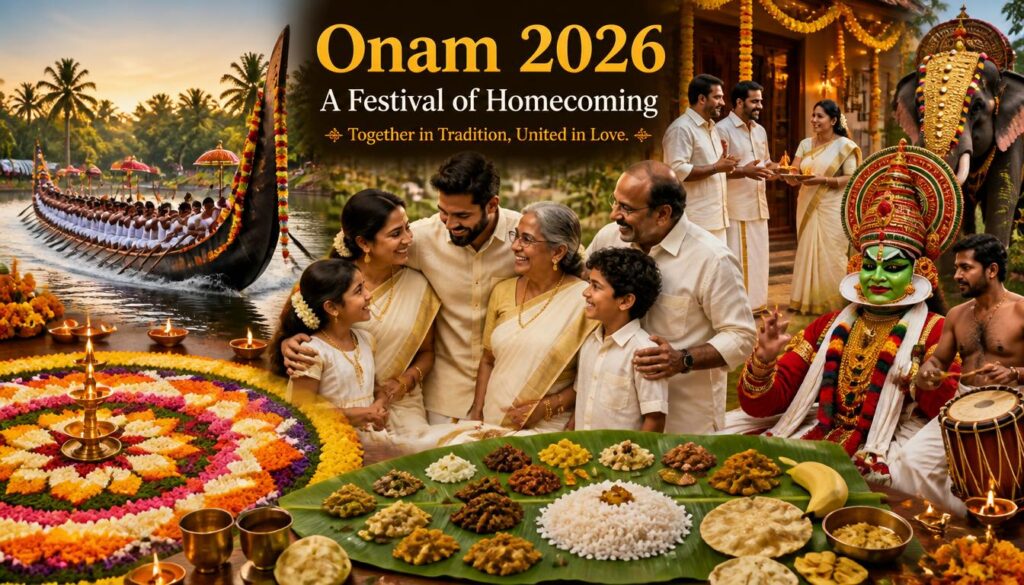
The most touching idea behind Onam 2026 may be the idea of homecoming itself.
Mahabali is remembered as returning to his people. Families return to their homes. People living abroad return to Kerala when they can. Those who cannot travel return emotionally through food, flowers, songs and stories.
That is why a Pookalam can feel bigger than flowers.
Why a banana leaf meal can feel bigger than lunch.
Why an old festival story can suddenly feel relevant in a modern apartment.
The celebration says, in its own quiet way, that prosperity is not only about having more. It is also about having someone to share it with.
Onam 2026 brings together the many faces of Kerala: the agricultural heritage of the harvest, the mythology of King Mahabali and Lord Vishnu, the beauty of Pookalam, the abundance of Onam Sadhya, the excitement of Vallam Kali, the color of Pulikali, and the intimacy of a family sitting together at home.
The main day, Thiruvonam, falls on Wednesday, August 26, 2026, and Kerala’s official tourism calendar recognizes it as a major traditional festival.
But dates are only the skeleton of a festival. The real Onam is built from people.
It lives in the hands arranging flowers, the kitchen preparing Sadhya, the children wearing Onakkodi, the songs that somehow everyone remembers, and the relatives who arrive saying they will stay only for an hour and somehow remain until dinner.
So celebrate Onam in whatever way is meaningful to you. Make the Pookalam, share the feast, remember Mahabali, visit family, learn a tradition, teach one to a child, or simply call someone you haven’t spoken to in too long.
May the spirit of prosperity, equality, gratitude, unity and hope remain long after the flowers have faded.
And perhaps that is the nicest wish for Onam 2026: may every home have enough to share, every family have someone to return to, and every celebration leave behind a little more kindness than it found.