Physical Address
304 North Cardinal St.
Dorchester Center, MA 02124
Physical Address
304 North Cardinal St.
Dorchester Center, MA 02124

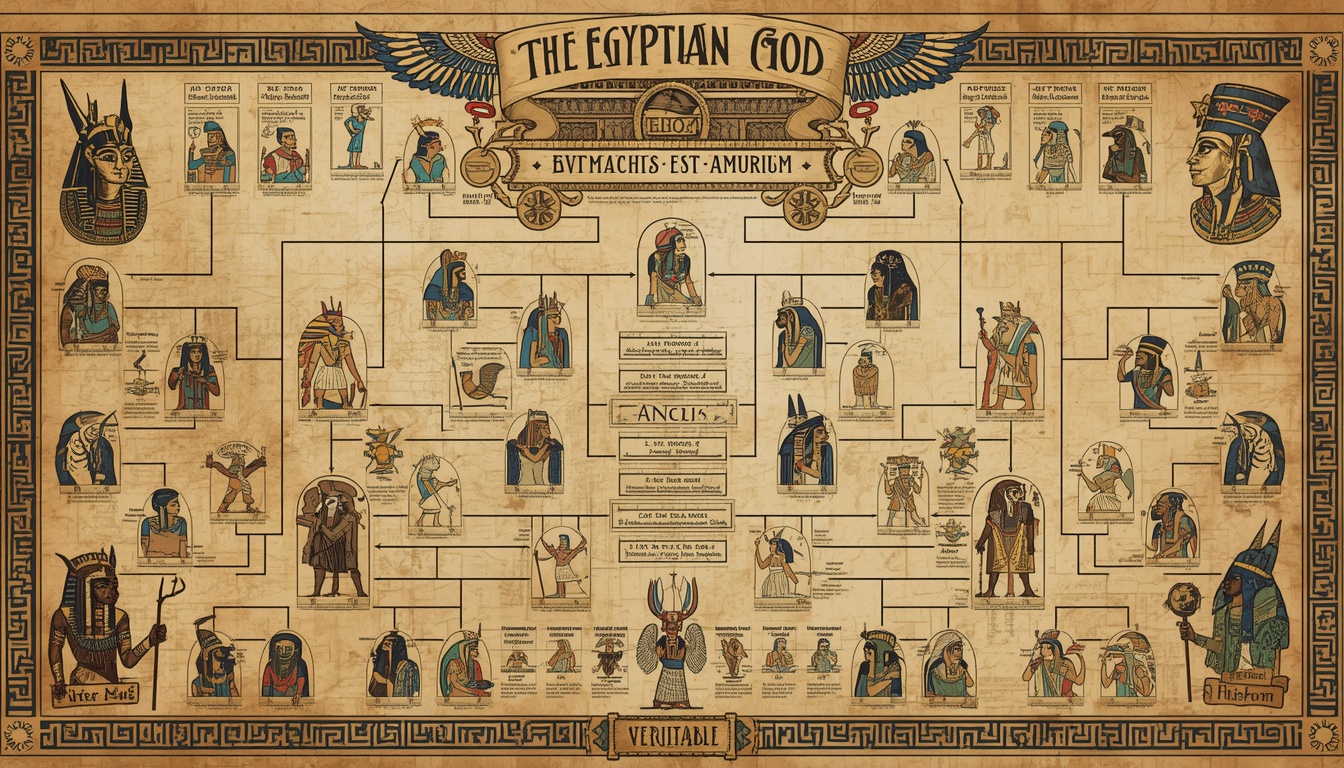
Trying to draw the Egyptian God Family Tree is a bit like trying to untangle a very old necklace that has been sitting in a temple for three thousand years. You pull one thread called Ra, and somehow Atum, Amun, Horus, Osiris and half the divine neighborhood come tumbling out. It looks confusing at first, but there is a reason for this strange mess.
Ancient Egyptian religion did not have one fixed family tree accepted everywhere, forever. Different cities had their own gods, creation stories, priesthoods and religious traditions. Heliopolis, Thebes, Memphis, and Hermopolis each developed important theological systems, and those traditions sometimes merged or changed over time.
So when someone searches for an Egyptian gods family tree, the answer is not simply one neat diagram with a beginning at the top and everybody obediently standing underneath. Egyptian mythology was more fluid than that, which is precisely what makes it so fascinating.
The biggest problem with an Egyptian mythology family tree is that ancient Egyptians did not always separate family relationships, religious roles, and political ideas in the way modern readers expect.
A deity could have different identities, relationships or functions depending on the city and historical period. Gods could also be merged together. Ra and Amun, for example, became associated as Amun-Ra, a combined deity that joined important traditions together.
Then there are creation myths. One tradition could describe Atum as the creator, while another emphasized Ptah, Khnum, Ra, Amun or primordial forces such as Nun. This does not mean ancient Egyptians were simply arguing about who was “really” first. Their religious world allowed several theological explanations to exist side by side.
That is why the phrase Egyptian divine genealogy should be treated as a useful map, rather than an absolutely fixed biological family chart.
If there is one lineage that gives readers a strong starting point, it is the family associated with Heliopolis.
The basic sequence begins with Atum, who is described in the source as a self-created creator god. Atum produces Shu and Tefnut, who then become the parents of Geb and Nut. Geb and Nut produce four especially important deities: Osiris, Isis, Set, and Nephthys.
In simple form, the lineage looks like this:
This is the backbone many readers have in mind when they search for an ancient Egyptian god family tree.
But even here, things get wonderfully untidy. The Egyptian pantheon was not created as a single family drama by one ancient author. These relationships emerged from religious traditions that developed and changed over long periods.
Atum occupies an important place in the Heliopolitan creation tradition. He represents the self-created creator and stands near the beginning of the divine genealogy.
From Atum come Shu, associated with air, and Tefnut, associated with moisture. Their pairing leads the mythology toward the next generation, Geb and Nut.
Geb is the earth god, while Nut is the sky goddess. Their imagery is almost wonderfully literal: earth below, sky above, and between them the divine world keeps producing complications.
Geb and Nut become the parents of Osiris, Isis, Set and Nephthys, creating the generation that dominates much of the most familiar Egyptian mythology.
So if you are trying to remember the family tree, this little chain is more useful than memorizing dozens of disconnected names.
The relationship between Osiris and Isis sits right in the middle of the Egyptian mythological family drama.
Osiris is presented as the husband of Isis and the ruler of the afterlife. Isis is his wife and the mother of Horus. Their story connects family, kingship, death, resurrection, magic and succession in one enormous mythological knot.
Their son Horus becomes especially important because his conflict with Set is not merely a personal sibling quarrel. It becomes a struggle connected with legitimate rule and divine kingship.
That is why an Egyptian god genealogy is also a story about political authority. The gods are not just floating around in heaven doing mysterious god-things; their family relationships explain ideas about rightful succession and the nature of kingship.
Set, also written as Seth, is the brother of Osiris and the husband of Nephthys. He becomes one of the most complicated figures in the Egyptian pantheon.
Set is associated with storms, violence, chaos and other dangerous forces. Yet reducing him to a simple “evil god” misses the complexity of Egyptian mythology. The source connects him with violence, storms, drought, plague and foreign lands, but his importance goes beyond a modern good-versus-evil label.
His rivalry with Horus is central to the question of divine succession.
Horus is presented as the son of Isis and Osiris and as the rightful successor. His conflict with Set therefore becomes a struggle over legitimate kingship.
It is family politics on a cosmic scale, basically.
Horus is one of the most important names to understand when exploring the Egyptian gods and goddesses family tree.
He is not simply another son in the family. Horus becomes connected with the idea of the rightful king and divine succession. The source also connects Horus, Ra, Osiris and Set with Egyptian ideas of kingship, while Horus serves as the divine model for human pharaohs.
This creates an important bridge between mythology and ancient Egyptian political culture.
The human pharaoh could be understood through divine ancestry and kingship symbolism. The family struggles among Osiris, Set and Horus therefore had meaning beyond entertainment or storytelling.
They expressed ideas about order, succession, legitimacy and the restoration of cosmic balance.
No discussion of Egyptian mythology can comfortably avoid Ra.
Ra is a creator deity and an important solar god, while Atum is also connected with creation and the sun. Other solar forms include Aten, Amun-Ra, and Khepri, the latter being associated with the rising sun.
This is another reason the Egyptian mythology family tree refuses to behave like a modern genealogy.
A deity could be understood through several aspects or combined with another deity. Ra could be associated with different divine figures, and Amun eventually merged with Ra to form Amun-Ra.
The Egyptian religious imagination was comfortable with these combinations. One god did not necessarily have to cancel another god out.
The city of Thebes provides another important family grouping.
Amun became one of the great gods of the Theban religious tradition. He is associated with Mut, who is described as the mother of gods, and their divine circle includes Khonsu.
The Theban tradition demonstrates why it is risky to create one rigid chart and announce that it contains the entire Egyptian pantheon.
The relationships that mattered in Thebes were shaped by local worship and theology. Elsewhere, another god could occupy the central position.
Over time, major traditions interacted, and Amun became associated with Ra as Amun-Ra. Suddenly the family tree has grown another branch without anyone asking permission first.
Memphis had its own major theological tradition centered on Ptah.
Ptah is associated with Memphis and appears among the Egyptian creator gods. The source also connects Apis with Ptah, describing Apis as the son or messenger of Ptah.
This tradition is important because it gives us another example of creation theology that does not simply copy the Heliopolitan family.
In other words, when studying the Egyptian pantheon family tree, Memphis cannot just be squeezed into the Heliopolitan structure and called finished. Ancient Egyptian religion was regional, layered and changing.
That is one of the reasons the title “family tree” can sometimes be a little misleading.
Hermopolis contributes another creation tradition involving the Ogdoad, a group of primordial deities connected with the earliest state of existence.
The source associates this tradition with Nun, Naunet, the primordial waters, the watery abyss and the cosmic egg.
Nun represents primordial waters rather than simply behaving like another character in a family drama.
This matters because Egyptian creation mythology did not always begin with a married divine couple. Some traditions began with primordial forces, cosmic elements or a state of existence before the ordered world emerged.
So the beginning of the family tree depends rather heavily on which Egyptian city and theological tradition you are looking at.
Isis is one of the central female deities in the Egyptian divine family.
Her importance comes through several connected roles. She is the wife of Osiris, mother of Horus, and is associated with magic and wisdom. The source also places her within themes of fertility, motherhood and the afterlife.
Her relationship with Horus is particularly important because it connects motherhood to succession.
She is not merely somebody’s wife or somebody’s mother on a chart. Her identity is part of the larger story involving Osiris, Set, Horus, kingship and the struggle to restore order.
That makes Isis one of the strongest anchor points for anyone learning the Egyptian god relationships.
Nephthys is the sister of Osiris, Isis and Set, and she is associated with Set as his wife. Her place in the divine family helps complete the four-child generation of Geb and Nut.
Nephthys can sometimes disappear from simplified versions of the family tree, which is a shame because leaving her out makes the genealogy look cleaner than it really was.
Egyptian mythology rarely stays clean for long.
The Osirian family includes marriage, sibling relationships, rivalry, death, motherhood and succession. Nephthys belongs inside that complicated network rather than sitting outside it as a minor footnote.
Anubis is strongly associated with embalming and mummification, making him one of the most recognizable gods connected with the Egyptian underworld and afterlife.
His animal-headed imagery is equally famous, and the source associates Anubis with an animal-headed deity tradition.
Anubis does not fit neatly into the central Heliopolitan genealogy in the same way Osiris or Horus does. Yet he is deeply connected to the Osirian world through funerary religion.
This shows another important point: being part of the Egyptian god family tree is not only about direct parent-and-child relationships. Religious associations, functions and traditions also matter.
The Egyptian divine world also includes deities connected with knowledge rather than warfare, kingship or death.
Thoth is associated with writing, wisdom and knowledge, while Seshat is connected with writing, mathematics, calendars and record-keeping. The source specifically places scribes and scholars within this semantic group.
These figures remind us that the ancient Egyptian gods represented many areas of life.
A family-tree article that only talks about Osiris, Isis, Set and Horus would therefore give a very narrow picture of the Egyptian pantheon.
There was room for gods of writing, fertility, protection, agriculture, the Nile, war, magic and cosmic order too.
Sekhmet is associated with a lion-headed form and with war, violence and destructive forces. Hathor, meanwhile, belongs to the wider sphere of fertility and motherhood.
The source also identifies Bastet, Taweret, Wadjet, Nekhbet, Serket, Mut and others as important protective or maternal figures.
Their roles demonstrate the enormous range of the Egyptian pantheon.
Taweret, for example, is associated with childbirth and protection and has hippopotamus imagery. Serket is linked with scorpion symbolism and protection from poison.
These goddesses cannot all be forced into one simple sibling chart. Their significance often comes from their functions, regional traditions and religious imagery.
One of the most striking features of Egyptian mythology is its animal symbolism.
Egyptian deities could appear with animal heads, human bodies, or through sacred animals and symbols. The source associates Apep with a giant serpent, Sekhmet with a lion, Bastet with a cat, Taweret with a hippopotamus, Khnum with a ram, Apis with a bull, Khepri with a scarab beetle and Serket with a scorpion.
These images were not random decoration.
Animals carried religious meanings and helped communicate divine powers in visual form. A scarab, lion, cat, ram or serpent could immediately evoke particular qualities in Egyptian religious art.
So when looking at a family tree, it is worth looking sideways too, toward the symbols that helped ancient Egyptians recognize their gods.
The Egyptian divine family is also tied to the concept of Maat, representing ideas connected with truth, justice, harmony and cosmic order.
Against this stands the broader concept of chaos and destructive forces.
This is one reason Egyptian mythology should not be read only as a collection of family gossip among supernatural beings. The relationships are connected with a much bigger idea of how the universe should function.
The conflict between Horus and Set, for example, can be understood through the themes of succession and order, rather than simply as two relatives who could not stand being in the same room.
The gods also had relationships with the practical world of ancient Egypt.
Hapy is connected with the flooding of the Nile, while Satet and Anuket are associated with the Nile and its fertility. The annual flood was closely connected with agriculture, plants and food.
Protection was another major religious concern.
Bastet, Bes, Wadjet, Nekhbet, Serket and Taweret all appear within the source’s protection-related grouping. Some were connected with households, regions, childbirth or protection from poison.
This gives the Egyptian gods genealogy a much more human dimension. The divine world was not somewhere completely detached from ordinary concerns.
For readers who want the whole thing without getting lost in the hieroglyphic fog, the main structure can be remembered like this:
That is not a complete list of every Egyptian deity. It is better thought of as a working map of the most important relationships and traditions.
The phrase Egyptian mythology family tree sounds wonderfully definite, but ancient Egyptian religion itself was not definite in that modern sense.
The source specifically stresses that religious traditions varied between Thebes, Heliopolis, Memphis and Hermopolis, and that the pantheon changed over more than 3,000 years.
Gods were merged. Local gods became nationally important. Foreign deities entered Egyptian religious life. Religious reforms changed emphasis, and political developments influenced worship.
The period associated with Akhenaten, also known as Amenhotep IV, is one famous example of religious change through Atenism. Later periods brought additional cultural influences, including Greek rule and foreign deities.
So a rigid chart claiming “this is the one true Egyptian family tree” is, frankly, a bit of veritable hokum.
The best approach is to separate three things: genealogy, religious function and local tradition.
First, look at direct relationships such as Geb and Nut producing Osiris, Isis, Set and Nephthys, followed by the relationship of Isis and Osiris to Horus.
Second, look at functions. Ra belongs to solar traditions, Osiris to the afterlife, Thoth to knowledge, Sekhmet to war and destructive power, and Hapy to the Nile.
Third, look at location and historical period. A god’s importance could change depending on whether you are studying Thebes, Heliopolis, Memphis, or Hermopolis.
Once you understand those three layers, the supposedly impossible family tree becomes much easier to follow.
Perhaps the most interesting thing about the Egyptian divine family is not that it can be reduced to a perfect chart.
It cannot.
Its beauty comes from the fact that it reflects a living religious tradition that changed, absorbed local ideas and connected gods in different ways. The family relationships tell stories, while the different pantheons reveal how communities understood creation and the universe.
Ra, Osiris, Isis, Horus, Set, Geb, Nut, Shu, Tefnut and Atum form the most recognizable central lineage, but around them sits an enormous religious universe involving Amun, Mut, Khonsu, Ptah, Thoth, Anubis, Sekhmet, Hathor, Bastet and many others.
The result is less like a tidy family photograph and more like an ancient city itself: several neighborhoods, old roads crossing newer ones, temples added beside older temples, and stories that refuse to stay in one straight line.
Egyptian gods were the divine beings worshipped in ancient Egypt, with different gods representing creation, the sun, death, protection, wisdom, fertility, and other aspects of life.
Egyptian minor gods were lesser-known deities connected with specific places, occupations, natural forces, protection, or particular religious traditions.
The Egyptian deities family tree commonly begins with Atum, followed by Shu and Tefnut, then Geb and Nut, whose children include Osiris, Isis, Set, and Nephthys.
The hierarchy of Egyptian gods was not fixed, because different cities and periods gave greater importance to different deities such as Ra, Amun, Ptah, and Osiris.
Egyptian gods cannot be placed in one universally accepted order, but major creation traditions commonly begin with primordial beings such as Nun or Atum before later generations of gods.
Read aRticul: https://templetimingsdaily.com/the-norse-god-family-tree/
The Egyptian God Family Tree is fascinating precisely because it is not a perfectly behaved family tree.
At its center are the great relationships of Atum, Shu, Tefnut, Geb, Nut, Osiris, Isis, Set, Nephthys and Horus. Around them are the solar traditions of Ra, the Theban theology of Amun and Mut, the Memphite tradition of Ptah, the Hermopolitan creation story, and countless gods associated with protection, knowledge, fertility, war, the Nile and the afterlife.
The most important lesson is simple: there was never just one frozen Egyptian pantheon.
There were multiple local traditions, overlapping creation stories, changing religious priorities and divine combinations. That is why every neat diagram should come with a tiny warning label saying, “Please don’t take me too literally.”
If you remember the major family of Geb and Nut, the role of Osiris and Isis, the rivalry between Horus and Set, and the different traditions of Ra, Atum, Amun, Ptah and Nun, you already have a strong foundation for understanding Egyptian mythology genealogy.
And perhaps that is the best way to approach ancient Egyptian religion—not as a puzzle that must be forced into one perfect shape, but as a vast and wonderfully strange collection of stories that kept growing, changing and intertwining across the long history of ancient Egypt.
If you want, I can also make this into a more SEO-aggressive 2,000–2,500 word version with a stronger keyword distribution, FAQ section, and a clean text-based Egyptian god family tree.