Physical Address
304 North Cardinal St.
Dorchester Center, MA 02124
Physical Address
304 North Cardinal St.
Dorchester Center, MA 02124

Trying to draw The Hindu God Family Tree is a little like trying to sketch a river while standing inside it. You can see where some streams meet, where others split, and where one current seems to disappear only to surface somewhere else entirely.
But the moment you think the picture is finished, another tradition, scripture, regional story, or philosophical interpretation gently says, “Well, not quite.”
That is part of what makes Hindu mythology so fascinating. The Hindu gods and goddesses are connected through marriages, births, manifestations, reincarnations, avatars, cosmic functions, and stories that developed across an enormous span of time. They don’t always behave like members of a tidy human genealogy, because, frankly, they aren’t one.
A Hindu gods family tree, therefore, should be read as a guide rather than an absolute biological chart. Different traditions may tell the same divine relationship differently, and some deities who appear separate in a story may be understood philosophically as expressions of the same divine essence.
So, rather than forcing thousands of years of religion and storytelling into neat little boxes, let’s explore the major relationships, families, avatars, and divine roles that make the Hindu pantheon such a wonderfully complicated universe.
The first thing to understand about a Hindu deity family tree is that the word “family” can be misleading. Human family trees usually move in one direction: parents produce children, those children have children, and eventually somebody discovers a cousin they haven’t spoken to since 2008.
Divine genealogy works rather differently.
In various Hindu creation stories, gods may emerge from cosmic principles, appear from other deities, manifest themselves in new forms, or take an incarnation for a particular purpose. A goddess can be described as the consort of a god while also representing the cosmic power through which that god acts.
This is especially important with Shakti, the concept of divine feminine energy. In traditions such as Shaktism, the Goddess isn’t merely a supporting character in somebody else’s divine household.
Devi may be understood as the supreme reality herself, with goddesses such as Parvati, Durga, and Kali representing forms or manifestations of that power.
Likewise, followers of Vaishnavism place Vishnu or one of his forms at the center of religious life, while Shaivism centers upon Shiva.
Hindu traditions aren’t simply competing versions of one enormous mythology spreadsheet. Their theological ideas can be beautifully different, sometimes in ways a single diagram just can’t catch.
One familiar framework for understanding three major Hindu deities is the Trimurti: Brahma, Vishnu and Shiva.
They are traditionally associated with three great cosmic functions: creation, preservation, and transformation or destruction.
Brahma is commonly associated with creation. Vishnu is associated with preservation and maintaining cosmic order, while Shiva is linked with destruction, transformation, asceticism, and renewal.
That last word matters. Destruction in Hindu thought shouldn’t automatically be imagined as senseless smashing. Something ending can make another beginning possible. A forest sheds old leaves; a day collapses into night; even stars don’t get permanent contracts.
This connects naturally with ideas of cyclical time, reincarnation, karma, death, and rebirth found throughout Hindu traditions.
The Trimurti is useful when learning about the three main Hindu gods, but it shouldn’t be mistaken for a universally accepted ranking system. Hindu religious traditions are much richer than a simple “top three gods” arrangement.
Alongside discussions of the Trimurti, readers often encounter the Tridevi, commonly represented by Saraswati, Lakshmi, and Parvati.
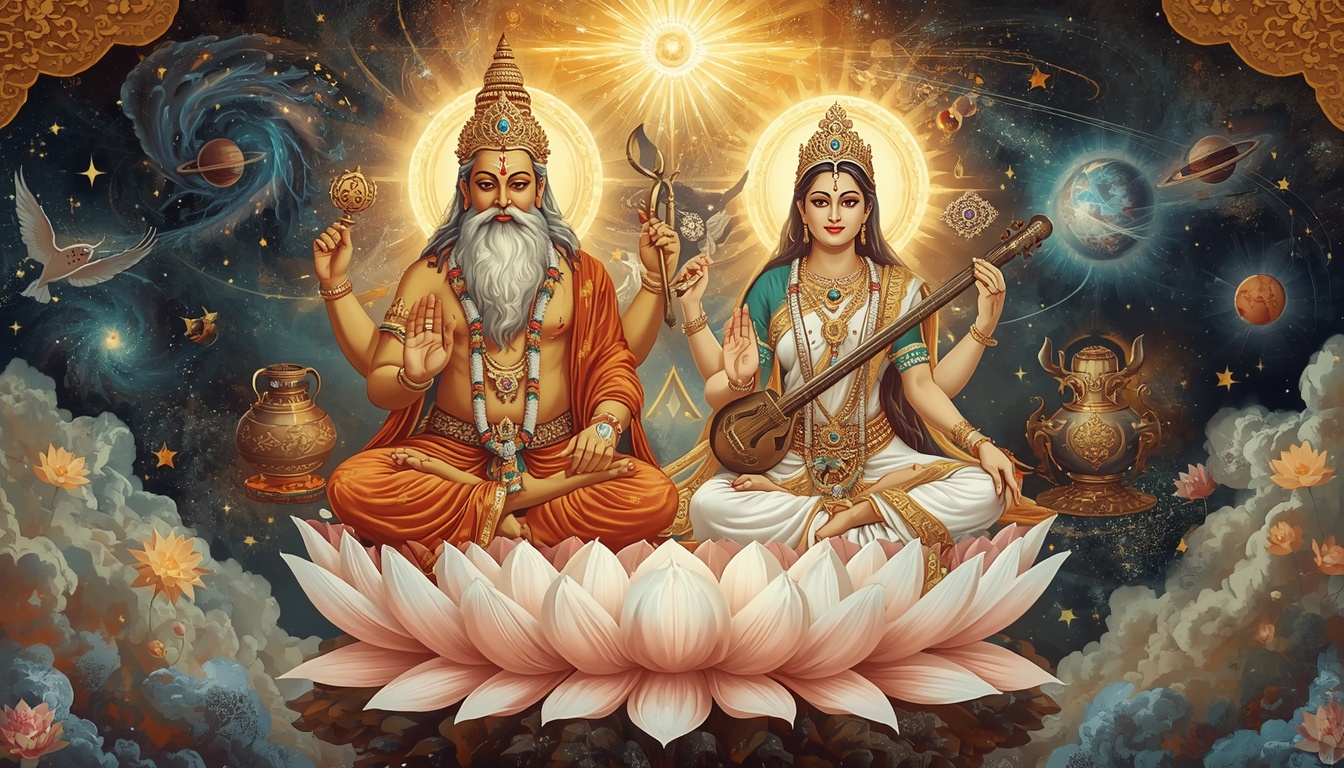
Saraswati is associated with knowledge, wisdom, learning, music, and the arts. She is traditionally connected with Brahma.
Lakshmi, the goddess of wealth, prosperity, fortune, and auspiciousness, is the consort of Vishnu. Their relationship becomes especially interesting when Vishnu’s earthly manifestations enter the story, because Lakshmi is also associated in traditions with corresponding manifestations.
Then there is Parvati, wife of Shiva and one of the central figures in the Shiva family. She is connected with love, devotion, motherhood, fertility, strength, and Shakti.
Yet these three goddesses aren’t merely feminine equivalents added beside three male gods. The theological landscape is deeper than that. In many traditions, divine feminine power is fundamental to existence itself.
That makes any Hindu goddess family tree partly genealogical and partly philosophical, which is where things start becoming deliciously complicated.
Brahma occupies an unusual position within the Hindu God Family Tree. He is widely recognized as the creator god, yet his worship today is far less widespread than the worship of Vishnu, Shiva, or major forms of Devi.
Different texts also provide different accounts of Brahma’s origin.
One famous cosmological image describes Brahma emerging from a lotus associated with Vishnu, who rests upon the primordial cosmic waters. The picture is almost dreamlike: endless water, sleeping divinity, a lotus stretching outward, then creation waking up.
Saraswati is commonly described as Brahma’s consort. As the goddess of learning, speech, music, wisdom, and arts, she represents qualities intimately connected with knowledge and creative order.
Already, the supposedly simple Hindu creation mythology has shown why ordinary genealogy rules won’t work terribly well here. Creation isn’t always presented as one literal historical event, and multiple scriptural traditions preserve different cosmological accounts.
If Brahma represents creation within the Trimurti framework, Vishnu represents preservation.
Vishnu is one of the most important figures in the Hindu pantheon, particularly within Vaishnavism. His consort Lakshmi represents prosperity, fortune, beauty, and abundance.
Their place in the family tree of Hindu gods becomes especially intriguing because Vishnu repeatedly enters the world through avatars.
An avatar isn’t quite the same thing as a child or descendant. It is better understood here as a divine descent or manifestation. So placing Rama or Krishna beneath Vishnu on a chart may visually resemble genealogy, but the relationship is theological rather than ordinary biological parentage.
And this is where the tree starts growing sideways, upside-down, and possibly through the ceiling.
The Dashavatara, or ten principal avatars of Vishnu, is among the best-known concepts associated with Vishnu. Lists can differ between traditions, particularly regarding certain positions, so one shouldn’t pretend there is only one uncontested version.
Among commonly discussed Vishnu avatars are Matsya, Kurma, Varaha, Narasimha or Nrisingha, Vamana, Parashurama or Parasurama, Rama, Krishna, and the future avatar Kalki.
Some traditions or lists include Balarama in the Dashavatara, while others identify a different figure in that position.
Matsya, the fish avatar, is associated with the Hindu flood myth and Manu.
Kurma, the tortoise avatar, is famously connected with the Churning of the Ocean of Milk, when gods and asuras seek Amrita, the nectar of immortality.
Varaha, the boar avatar, battles Hiranyaksha and rescues the earth.
Narasimha, the extraordinary man-lion manifestation, appears in the story of the defeat of a powerful demon king.
Vamana, appearing as a dwarf Brahmin, is associated with Mahabali, whose story also has a celebrated relationship with the Onam festival tradition.
Then comes Parashurama, the warrior-sage figure; Rama, hero of the Ramayana; and Krishna, whose stories extend across an enormous religious and literary landscape.
Finally, Kalki is traditionally understood as a future avatar yet to appear.
These divine incarnations show why a Hindu mythology chart needs more than parent-and-child arrows. One deity can participate in earthly history through many forms without those forms simply becoming his sons.
Among the most beloved divine relationships in Hindu tradition is Rama and Sita.
Rama is widely regarded as an avatar of Vishnu, particularly the seventh in familiar Dashavatara lists. Sita is his wife and is associated with Lakshmi in Vaishnava tradition.
Their story stands at the heart of the Ramayana, one of the great Hindu epics.
Rama’s exile, Sita’s abduction by Ravana, the struggle to locate her, and the eventual war against Ravana form some of the epic’s most recognizable episodes.
Hanuman becomes essential to this story. Famous for his extraordinary strength, loyalty, courage, and devotion to Rama, Hanuman occupies a special place in Hindu devotional life far beyond being merely another character on a mythology chart.
The Rama and Sita story also demonstrates something a family tree can’t quite express: relationships in Hindu epic literature aren’t important merely because of who married whom. Duty, devotion, sacrifice, loyalty, kingship, and dharma give those relationships their spiritual and cultural weight.
Krishna is another enormously important manifestation of Vishnu in many Hindu traditions, though Krishna-centered traditions may understand his divinity in even more central terms.
Krishna is closely associated with Balarama, commonly described as his elder brother. Their stories stretch far beyond one little branch on a Hindu mythology family tree.
Krishna becomes a pivotal figure in the Mahabharata, particularly through his relationship with the Pandava prince Arjuna.
Within the Mahabharata appears the Bhagavad Gita, the celebrated dialogue in which Krishna teaches Arjuna amid the moral and spiritual crisis preceding battle.
The Gita addresses profound ideas surrounding duty, action, devotion, knowledge, the self, and ultimate reality. So Krishna isn’t merely “Vishnu’s eighth avatar” on a chart and then we’re done. That label can help beginners organize information, but his theological significance goes miles beyond it.
The Shiva family is perhaps one of the most recognizable divine households in popular representations of Hindu gods and goddesses.
Shiva is associated with destruction and transformation, but also with meditation, yogic discipline, asceticism, cosmic power, and profound paradoxes. He may appear terrifying in one story and deeply compassionate in another.
Sati is traditionally described as Shiva’s first wife and the daughter of Daksha, a Prajapati associated with creation and progeny.
Their story reaches a tragic turning point when Daksha performs a great sacrifice but insults or excludes Shiva. Sati, deeply distressed by the dishonor, dies in connection with the event. Shiva’s grief and fury become central to what follows.
Parvati is later born and becomes Shiva’s consort, and she is traditionally associated with Sati’s rebirth or return.
The relationship of Shiva and Parvati becomes one of Hindu mythology’s great divine partnerships: asceticism beside household life, stillness beside energy, detachment beside affection.
It’s a marriage of opposites that somehow makes the opposites look like they were never really separate.
Two of the best-known children of Shiva and Parvati are Ganesha and Kartikeya, also widely known as Skanda and by other regional names.
Ganesha is instantly recognizable by his elephant head and is widely revered as a deity associated with beginnings, wisdom, intelligence, prosperity, and the removal of obstacles.
Different texts and traditions preserve variations of the famous birth of Ganesha and the story explaining his elephant head. In a familiar version, Parvati creates Ganesha and instructs him to guard her privacy. Shiva returns, doesn’t recognize the boy, and conflict follows with rather more decapitation than the average family reunion should contain.
Ganesha eventually receives an elephant’s head and becomes one of Hinduism’s most beloved deities.
Some traditions associate Ganesha with consorts such as Riddhi, Siddhi, and sometimes Buddhi, though representations and theological traditions vary.
Kartikeya, meanwhile, is a powerful god of war, martial strength, and divine leadership. His worship has particular prominence in South Indian traditions, where Murugan is among his most familiar names.
Thus Ganesha and Kartikeya form two major branches of the divine household of Shiva and Parvati.
Trying to put Devi, Durga, Kali, and Parvati into ordinary family-tree boxes can become confusing quickly.
That’s because Hindu goddess traditions frequently concern forms and manifestations rather than separate biological individuals.
Devi simply means Goddess, but in Shaktism, Devi can represent supreme divine reality. Shakti is the active divine power through which the cosmos lives, moves, creates, and transforms.
Durga is a formidable warrior form of the Goddess, famously associated with the defeat of the buffalo demon Mahishasura. She represents divine strength that rises when ordinary solutions are no longer enough.
Kali presents another fierce manifestation of divine feminine power. Her imagery can initially seem frightening—darkness, death, destruction, severed heads—but reducing Kali to a simple “goddess of destruction” misses layers of theology surrounding time, ego, liberation, and transformative divine power.
Parvati, Durga, and Kali may therefore appear distinct in particular narratives while also being understood as manifestations of divine feminine energy.
A normal family tree scratches its head at this point. Theology smiles and keeps walking.
Beyond the best-known Trimurti-centered families lies a huge network of Vedic gods and later Hindu deities.
Surya, the sun god, occupies an important position in this wider divine landscape. One important tradition connects him with Saranyu.
Their family relationships lead toward figures such as Yama and Yami.
Yama becomes strongly associated with death and the world of the departed. He is often described as the god of death, connected with judgment and the destiny of souls in the afterlife.
Yami is associated with Yama as his twin sister and has connections in later traditions with Yamuna, the sacred river goddess.
The Ashvins, divine twins associated in Vedic tradition with healing and rescue, are also connected to traditions surrounding Surya’s family.
These relationships reveal another layer of the Hindu gods family tree—one rooted deeply in Vedic mythology, before many later Puranic relationships developed into their familiar forms.
Aditi is an important Vedic goddess associated with boundlessness and motherhood and is famously connected with the Adityas, a group of deities whose identities and number vary in different texts.
Names associated with the Adityas include figures such as Mitra, Varuna, Aryaman, Bhaga, Daksha, Savitar, Pushan, Amsa, and others depending upon the source and period.
This variation is worth emphasizing because lists of ancient Hindu gods didn’t remain frozen for thousands of years. Religious language, emphasis, mythology, and theological interpretation developed across generations.
Varuna, for example, is an enormously significant Vedic deity associated with cosmic and moral order and waters. Mitra is linked with contracts, friendship, and order, while Savitar has strong solar associations.
Pushan is connected with journeys, roads, guidance, and livestock. Tvastar, meanwhile, is known as a divine craftsman or artisan of the gods.
The ancient divine world was crowded, lively, and far more nuanced than a modern “god of X” label sometimes suggests.
Before focusing entirely on Vishnu, Shiva, and Devi, anyone exploring Hindu mythology gods should meet several major Vedic figures.
Indra occupies a commanding place in the Rigvedic religious world. He is associated with storms, rain, warfare, and kingship among the gods. One of his great mythic opponents is Vritra, a serpent or dragon-like being associated with the obstruction of waters.
Agni, the fire god, is central to Vedic sacrifice. Fire carries offerings, symbolically bridging human ritual and divine realms, which makes Agni much more than simply a deity attached to flames.
Vayu is the god of wind, while Soma is both a deity and associated with the sacred ritual substance celebrated in Vedic hymns.
Chandra is associated with the moon, though relationships between lunar figures and Soma can differ across textual contexts.
Ushas, the goddess of dawn, is among the beautifully praised divine figures of Vedic poetry. Dawn becomes not merely sunrise but a goddess arriving, awakening life and pushing darkness away. That’s quite a job before breakfast.
Other ancient divine relationships widen the picture even further.
Prithvi represents the earth and appears in Vedic contexts in relationship with Dyaus, the sky father. Their pairing reflects an ancient cosmic pattern: earth below, sky above, existence unfolding between them.
Kama is associated with desire and love, while Rati is his consort and a goddess connected with love, passion, and pleasure.
A famous mythology involving Kama concerns Shiva. When efforts are made to awaken Shiva’s interest in Parvati, Kama attempts to disturb Shiva’s meditation with desire.
It doesn’t go smoothly.
Shiva opens his famous third eye, and Kama is burned. Different versions continue the story in different ways, but the episode beautifully captures the tension between desire and ascetic discipline.
The Shiva third eye itself becomes a powerful symbol of insight, destruction, and spiritual perception beyond ordinary sight.
Kubera is commonly associated with wealth and treasures and occupies a fascinating position within the broader Hindu pantheon.
Calling both Kubera and Lakshmi figures associated with wealth doesn’t make them duplicates. Hindu deities can share domains while expressing quite different religious meanings.
Lakshmi embodies prosperity, auspiciousness, fortune, abundance, and well-being. Kubera is often portrayed more specifically as a lord or guardian of wealth and treasures.
This overlap is another reminder that a list of Hindu gods and their powers shouldn’t be treated like job descriptions in an office where only one person is allowed per department.
Mythology is rarely that tidy, thank goodness.
A complete picture of Hindu religious mythology also involves beings beyond the principal gods.
Stories contain devas, asuras, sages, kings, demons, celestial beings, animals, and extraordinary creatures whose relationships with the gods can shift between cooperation, rivalry, devotion, and war.
The Churning of the Ocean of Milk is a perfect example.
Devas and asuras cooperate to churn the cosmic ocean in pursuit of Amrita, the nectar of immortality. Mount Mandara serves in the churning process, and Vishnu’s Kurma avatar supports the mountain.
The episode produces various treasures and divine beings and is connected in important traditions with Lakshmi’s emergence.
Here, rivals cooperate because the cosmic task is too large for either side alone. Of course, harmony doesn’t exactly survive the whole affair. Mythology knows people—or divine beings, anyway—rather well.
It is tempting to search for one definitive Hindu gods chart and assume every relationship should fit it perfectly.
But Hindu deity relationships emerge from texts composed and transmitted across long periods, including Vedic literature, epics, Puranic traditions, regional stories, temple traditions, devotional movements, and philosophical schools.
Consequently, the parentage, consort relationships, manifestations, or importance of a deity may differ depending on the source.
One tradition may emphasize Vishnu worship, another Shiva worship, and another Devi worship. Some traditions interpret deities as distinct personalities while simultaneously understanding them through a deeper metaphysical unity.
So questions such as “Who is the highest Hindu god?” or “Who came first?” can’t always be answered with one universal genealogy.
Context matters a lot.
The Hindu universe isn’t usually framed as a simple straight timeline beginning once and ending forever.
Many Hindu cosmological traditions describe vast repeating cycles of creation, preservation, dissolution, and recreation. This cosmic rhythm helps explain why the functions represented by Brahma, Vishnu, and Shiva carry such meaning.
The same broader worldview connects with karma, reincarnation, souls, and rebirth, though precise philosophical interpretations differ among Hindu schools.
Ideas about death also include traditions concerning Yama, various heavenly and lower realms, and Naraka, sometimes loosely translated as hell but better understood within its own Hindu cosmological contexts rather than simply equated with concepts from other religions.
The divine family therefore exists inside a universe that itself moves in cycles.
Maybe that’s why a straight family-tree line always feels slightly inadequate.
Much of what people call Hindu mythology comes from an enormous and diverse body of religious literature rather than one single book.
The Vedas preserve some of the earliest layers of Vedic religion and contain hymns to figures such as Indra, Agni, Soma, Varuna, Ushas, and others.
The Ramayana gives us the great epic narrative centered on Rama, Sita, Lakshmana, Hanuman, Ravana, and their interconnected destinies.
The Mahabharata contains an immense world of dynasties, conflict, morality, politics, devotion, and philosophy. Within it, the Bhagavad Gita presents Krishna’s celebrated teaching to Arjuna.
The Puranas and many other Hindu scriptures develop countless narratives concerning Vishnu, Shiva, Devi, avatars, creation, divine families, sages, kings, and cosmic events.
Regional traditions add still more texture.
This is why two people can tell a myth slightly differently and both may be drawing from authentic traditions.
When looking at a Hindu mythology chart, start by identifying what kind of relationship each connecting line actually represents.
A line between Shiva and Parvati can indicate marriage or divine partnership. Lines toward Ganesha and Kartikeya can represent parent-child relationships.
A connection from Vishnu to Rama or Krishna, however, usually represents incarnations of Hindu gods, specifically avatars, rather than biological sons.
Connections between Parvati, Durga, Kali, and Devi can represent forms of Devi or theological manifestations instead of sisters or descendants.
Similarly, relationships may shift across different texts.
A useful family tree should therefore distinguish among:
Without those distinctions, an attractive diagram can accidentally become misleading.
The complexity of the Hindu divine family isn’t simply a case of mythology getting messy over time.
It reflects Hinduism’s long history and extraordinary diversity.
Ancient Vedic deities remain significant while later devotional traditions give tremendous prominence to Shiva, Vishnu, Krishna, Rama, Devi, Ganesha, and other gods. Local traditions merge with pan-Indian narratives. Philosophical schools interpret divine personality in different ways.
Meanwhile, mythology keeps telling stories.
Gods marry. Gods manifest. Gods meditate for impossible lengths of time. Goddesses battle demons. Vishnu becomes a fish, tortoise, boar, man-lion, prince, and much more. Shiva dances destruction into renewal. Ganesha receives an elephant head. Hanuman crosses extraordinary distances through devotion and strength.
A rigid genealogy could never comfortably hold all that.
And perhaps it shouldn’t try.
For beginners, the broadest Hindu God Family Tree can still be remembered through several major relationships.
Within the familiar Trimurti-Tridevi framework, Brahma and Saraswati are associated together, Vishnu and Lakshmi form another divine pair, and Shiva and Parvati form another.
Shiva and Parvati’s family prominently includes Ganesha and Kartikeya.
Vishnu manifests through numerous avatars, with Rama and Krishna among the most famous. Rama’s consort is Sita, while Krishna’s mythology includes a much wider network of familial and devotional relationships.
Beyond these familiar families lie ancient Vedic figures such as Aditi and the Adityas, Surya and his family, Indra, Agni, Vayu, Soma, Varuna, Ushas, and many more.
Then come manifestations of the Goddess, including powerful forms such as Durga and Kali.
That’s the simplified map. The territory itself is much bigger.
Hindu gods are divine beings in Hinduism who represent different aspects of life, nature, and the universe. Major deities include Brahma, Vishnu, Shiva, Ganesha, and Krishna.
Hinduism includes many gods and goddesses, ranging from major deities like Vishnu and Shiva to ancient Vedic gods such as Indra, Agni, Surya, and Vayu.
A Hindu god may represent a particular divine power or cosmic role, such as creation, preservation, destruction, wisdom, wealth, love, or protection.
Indian gods are closely connected with Hindu traditions and mythology. Well-known examples include Shiva, Vishnu, Brahma, Krishna, Ganesha, Hanuman, and Indra.
All Hindu gods together form a diverse pantheon of deities with different roles, forms, avatars, and relationships across Hindu traditions and mythology.
Read ARticuL: https://templetimingsdaily.com/veritable-hokum/
The Hindu God Family Tree – Veritable Hokum isn’t really a tree in the ordinary sense. It is closer to an ancient forest: roots cross beneath the ground, branches touch overhead, old trunks stand beside younger growth, and sometimes what looked like two separate trees turns out to share something deeper underneath.
The Hindu gods relationships connect Brahma, Vishnu, Shiva, Saraswati, Lakshmi, Parvati, Ganesha, Kartikeya, Rama, Sita, Krishna, Hanuman, Durga, Kali, Surya, Yama, Indra, Agni, and countless other figures through stories that have lived for centuries.
But understanding those relationships requires more than memorizing Hindu gods names. The important distinction is knowing whether a connection represents marriage, birth, an avatar, reincarnation, manifestation, theological identity, or simply one particular textual tradition.
That is what makes the Hindu mythology family tree so endlessly interesting. It isn’t merely a diagram showing Hindu gods and their wives or Hindu gods and their children. It is a window into ideas about creation, preservation, destruction, love, devotion, duty, death, rebirth, cosmic order, and divine power.
Follow one branch and you’ll find a family. Follow another and you’ll find an epic. Follow another far enough and you may discover a philosophical question about the nature of reality itself.
And somehow, wonderfully, they’re all growing in the same forest.
I kept the deity relationships qualified where Hindu traditions and texts can differ, rather than presenting one mythology chart as universally definitive.